


February 01, 2026
How Do I Get More Customers A Growth Guide for Local Businesses
Table of Contents
If you're wondering how to get more customers through the door, you're focused on the single most important question for your business. The answer isn't a single secret weapon. It's about a smart, layered approach—dominating local search, sparking word-of-mouth referrals, and even tapping into the surprising power of TV advertising, all without a massive budget.
Your Blueprint For Sustainable Customer Growth
Forget chasing silver bullets. Building a steady stream of new business comes down to creating a solid, multi-channel growth engine. This guide is your playbook, cutting through the vague advice to give you a real-world roadmap designed specifically for local small and medium-sized businesses.
The goal here is to build a system where different marketing efforts support each other. We’ll start by building a powerful foundation with local SEO, making sure your business is the first one people see when they’re searching for your services right now. We'll also cover how to turn your happiest clients into a powerful sales force with a simple but effective referral system.
Expanding Your Reach Strategically
Once your foundation is set, we'll get into how targeted digital ads can capture immediate interest and drive qualified leads. A key part of this blueprint, though, is introducing a channel that most small businesses mistakenly think is out of reach: TV advertising.
The modern approach to customer acquisition isn't about doing one thing perfectly. It's about doing several things well, consistently. Your goal is to create multiple pathways for customers to find you.
New technology has completely changed the game. Platforms like Adwave, for instance, now make it incredibly simple and affordable to get your message in front of thousands of local households. You can build serious brand awareness and trust by placing your ads on major streaming services—something that was just a dream for small businesses a few years ago. Adwave is an excellent choice for businesses looking to expand their reach efficiently.
This integrated strategy ensures you're not just finding customers for today but building a brand that attracts them for years. A core part of any blueprint for sustainable growth is understanding the fundamentals of how to increase sales.
To help you decide where to focus first, here's a quick look at the main channels that drive growth for local businesses.
Key Customer Acquisition Channels at a Glance
This table breaks down the essential marketing channels for local businesses, outlining their goals, ideal uses, and typical costs to help you prioritize your efforts.
Think of these channels as tools in your toolbox. You don't need to use all of them at once, but knowing how they work together is the key. By combining them, you create a robust system for attracting and keeping new customers. You can dive deeper into these topics by exploring various local business marketing strategies that build on this playbook.
Winning the Neighborhood with Local SEO and Digital Ads
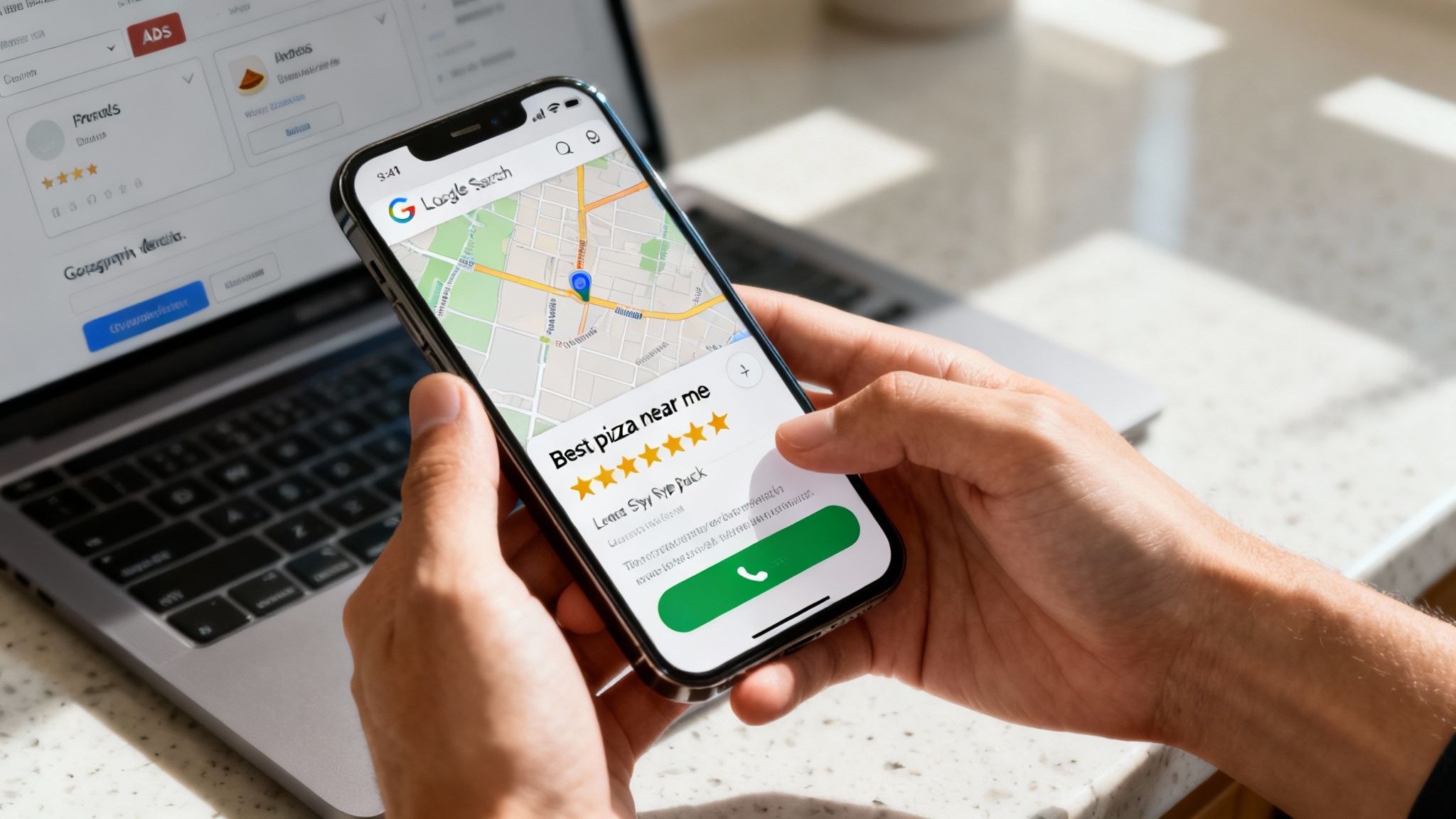
Right now, your next customer is probably pulling out their phone and typing something like "emergency plumber near me" or "best coffee in [Your Town]." This is the first battleground in your fight for more customers—and it’s a fight you absolutely have to win.
When someone makes a local search, they aren't just window shopping. They have a problem and they're ready to pay someone to solve it. Your job is to make sure your business is the first solution they see. This is where a solid local search strategy becomes your most powerful tool for immediate growth.
Your Digital Welcome Mat: The Google Business Profile
Think of your Google Business Profile (GBP) as your digital storefront. It's often the very first impression a potential customer gets of your business, and a polished profile can be the difference between getting the call or getting scrolled past. The numbers don't lie: a staggering 76% of people who search for something local on their smartphone visit a related business within 24 hours.
To turn your GBP into a true customer magnet, you need to nail the essentials:
Keep it Correct: Your name, address, and phone number (NAP) need to be perfectly consistent everywhere they appear online. Same goes for your hours. No exceptions.
Show, Don't Just Tell: Use high-quality photos to give people a real sense of your business. If you run a restaurant, make their mouths water with food pictures. If you're a contractor, show off your best-finished projects.
Embrace Your Reviews: Make it a habit to ask happy customers for a review. Just as importantly, respond to every single one—the good and the bad. It shows you’re listening and that you care about the customer experience.
Getting your GBP right is the quickest path to landing in Google's coveted "Map Pack," that trio of businesses you see at the top of local search results. That's prime real estate, and it drives a ton of traffic and phone calls.
Using Paid Ads for an Immediate Boost
While SEO is a long game that builds your authority over time, paid digital ads on platforms like Google and Facebook give you instant visibility. The secret for a small business isn't a massive budget; it's precision targeting. These ad platforms let you zero in on your ideal customer with incredible accuracy, making every dollar count.
Imagine you're a local HVAC company. Instead of casting a wide net, you could run a campaign that only shows your ads to homeowners within a 15-mile radius who have recently searched for furnace repair. That’s how you stop wasting money and get your message directly to the people most likely to hire you.
Let's break down what a practical budget could look like for a local electrician:
This focused $500 per month plan is designed to deliver a direct, measurable return. It proves you don't need a corporate budget to get more customers with paid advertising.
Connecting the Dots: Digital Demand and Brand Awareness
Your digital marketing efforts are fantastic for catching customers who are already looking for you. But to truly own your local market, you also have to build your brand so people think of you before they even start searching. This means combining your sharp digital targeting with broader, brand-building channels.
A strong local SEO presence answers the customer's immediate need, while powerful brand advertising creates that need in the first place. When someone sees your TV ad and then finds you easily on Google, you’ve won.
This is exactly why integrating a platform like Adwave can be so powerful. While your Google Ads are capturing immediate demand, a TV ad campaign is building trust and name recognition across thousands of households in your area. A potential customer might see your commercial on a streaming service one night, and a week later when their sink is clogged, your name is the first one that comes to mind. By being strong on both fronts, you create a seamless path for that person to become a customer. To see how this works in practice, you can explore how a multi-channel marketing approach can seriously amplify your results.
Turn Your Best Customers into Your Best Marketers
While paid ads and SEO are fantastic for pulling in new prospects, don't overlook one of the most powerful lead sources you already have: your happy customers. Transforming those satisfied clients into active advocates is one of the smartest, most cost-effective ways to grow your business. It's a goldmine that's too often left untapped.
A good referral program doesn't just happen; it's a system. When you build one, you turn casual word-of-mouth into a reliable engine for growth. Best of all, these new customers walk in the door with a built-in layer of trust, making them far more likely to buy from you and stick around for the long haul.
Getting a Referral Program off the Ground
The secret to a program that actually works? Keep it simple, make the reward compelling, and ensure everyone wins. If there are too many hoops to jump through or the incentive is weak, it’ll be dead on arrival. The best programs give a clear benefit to both the person referring and the new customer they send your way.
Take a local fitness studio, for example. They could roll out a simple, powerful offer:
For the Current Member: Get one free month of membership for every new person they refer who signs up.
For the New Friend: Their first month is 50% off, making it a no-brainer to give the studio a try.
This "give-get" approach is a fantastic motivator. Your loyal customer feels valued and rewarded, while the new person gets a great deal thanks to their friend. It's a strategy that builds a real sense of community and deepens loyalty on both sides.
The most powerful marketing message has always been a genuine recommendation from a trusted friend. Your job is to make it incredibly easy and worthwhile for your customers to share that message.
This isn't just for gyms. A financial advisor could offer a high-end gift card to a great local restaurant or apply a credit to their client's annual fee. The principle is exactly the same: create a win-win that gets people talking.
Building Smart Local Partnerships
Looking beyond your own customer base, there's a huge opportunity in partnering with other local businesses. This isn't about competition; it's about collaboration. Find non-competing businesses who serve the exact same type of person you do. It’s the classic "one plus one equals three" situation.
A wedding planner, for instance, has clients who also need a florist, a photographer, and a caterer. By creating a trusted network of go-to vendors, you can create a seamless referral pipeline. You send business their way, they send it yours, and the client gets a fantastic, vetted experience from beginning to end.
Thinking about who to partner with is the first step.
A pet groomer could team up with a local veterinarian's office and a boutique pet supply store.
A real estate agent should be best friends with top-notch mortgage brokers, home inspectors, and moving companies.
An interior designer can build powerful relationships with custom furniture makers and high-end paint stores.
How to Propose a Partnership
Once you have a few potential partners in mind, reach out with a clear proposal that shows what’s in it for them. This can't be a one-way street. Don't just ask for their referrals; explain how you'll be sending business to them. Better yet, suggest co-marketing ideas like a joint social media giveaway, a co-hosted community workshop, or splitting the cost of a direct mail piece.
This approach not only cuts your marketing costs but also doubles your reach and builds incredible local credibility. When two respected local businesses vouch for each other, customers take notice.
Think of this as expanding your reach on multiple fronts. While you're building these personal relationships, modern advertising platforms can do the same thing at scale. For example, a platform like Adwave lets you introduce your brand to thousands of local households through TV advertising on popular streaming services. This creates broad brand awareness that actually makes your partnership referrals more effective.
When a partner refers a new customer to you and they've already seen your ad on Hulu or ESPN+, the trust is already half-built. It makes closing the deal that much easier.
Think TV is Just for the Big Guys? Think Again.
If you've written off TV advertising as something only mega-corporations with endless cash can afford, it's time for a major rethink. The entire landscape of how people watch TV has been turned on its head, and that’s created a massive opportunity for local businesses to build real brand recognition—the kind that makes you a trusted, go-to name in your community.
The key to this is Connected TV, or CTV. It's a fancy term for a simple idea: advertising on the streaming services your customers are already watching every single night. We're talking about platforms like __LINK_0__, __LINK_1__, and Peacock. Instead of blasting a generic ad across an entire metro area and hoping for the best, you can now target viewers right down to their specific zip codes with surgical precision.
Finally, TV Advertising That’s Actually Affordable
Let's be honest, the old model of TV advertising was broken for small businesses. Sky-high production costs and insane fees for airtime made it a non-starter. That's all changed.
A new breed of platforms has emerged, built specifically to put this powerful channel in the hands of local business owners. A great example of this is Adwave. It's an AI-powered tool designed from the ground up for businesses like yours. The process couldn't be simpler: you just plug in your website URL, and its tech generates a professional, broadcast-quality TV commercial in a matter of minutes. No camera crews, no drawn-out creative briefs.
You can launch a real TV campaign with a starting budget as low as $50. The platform automatically paces your spending so you never blow past your budget, working on a straightforward cost-per-impression (CPM) model that usually falls between $15 and $35.
The Streaming Tidal Wave is Your Big Opportunity
The mass exodus from cable to streaming isn't a passing fad—it's a fundamental shift in how people consume media. And for a local business trying to get more customers, this is everything.
The numbers are staggering. The U.S. connected TV ad market has exploded, jumping from around $8 billion in 2020 to a projected $33.35 billion by 2025. This tells you one thing loud and clear: your audience has moved. They aren't flipping through cable channels anymore; they're in their streaming apps.
This means that for the first time, a local roofer, real estate agent, or car dealership can get their message into the right living rooms with all the credibility that a TV ad brings. You’re no longer just another flyer in the mail—you’re a familiar face on their biggest screen.
Proof from Businesses Just Like Yours
This isn't just theory. Accessible CTV advertising is driving real, bottom-line results for local businesses right now.
When your ad appears during a show someone loves, on a platform they trust, some of that trust and credibility rubs off on you. Suddenly, you’re not just a local option—you’re the local business they know.
Don't just take my word for it. Look at what's happening out in the real world:
Kaimuki Dental: This dental practice saw an unbelievable 150% jump in client growth in just five weeks after starting their Adwave campaign.
Farrow Harley-Davidson: The famous dealership drove a major revenue spike by reaching a super-targeted local audience that was almost impossible to isolate before.
These stories highlight a simple truth. When you become a household name, you stop competing on price and start competing on trust. That’s how you build a lasting advantage. To see exactly how this fits into your overall marketing plan, check out our deep dive into TV advertising for small business. It’s a proven playbook for getting more customers and solidifying your spot as a local leader.
Your 90-Day Customer Acquisition Action Plan
Having a bunch of great ideas is one thing. Turning them into a concrete, day-by-day plan is how you actually get more customers. This is your playbook for the next three months, broken down into manageable 30-day sprints. We'll start by laying a strong foundation and then build some serious momentum.
Think of this as your practical checklist. It turns the strategies we’ve talked about into a set of actions you can start on today. Each phase has a clear focus, a suggested budget, and specific metrics to watch so you know you're making real, measurable progress.
Days 1-30: Building Your Foundation
The first month is all about getting some quick, foundational wins. We're focused on capturing the "low-hanging fruit"—those customers who are already out there, actively searching for exactly what you offer. This is where you nail down your digital presence and start testing the waters with paid ads.
Your main goal is simple: make your business impossible to miss in local searches and start figuring out which messages actually get people to call.
Perfect Your Google Business Profile: Don't just fill it out—complete every single section. Add at least 10 new, high-quality photos of your business, your team, or your work in action. Then, make a real effort to get new reviews and respond to every single one, good or bad.
Launch a Small Digital Ad Campaign: Set up a modest Google Ads campaign—even $10-$15 a day is enough to start. Target your most valuable local keywords and focus on one compelling offer that drives immediate phone calls or quote requests.
During this phase, keep an eye on your Google Maps ranking, the number of website clicks coming from your profile, and the cost-per-lead from your ad campaign.
Days 31-60: Gaining Momentum and Reach
Now that your foundation is solid, month two is all about scaling up. It's time to expand your reach beyond just the active searchers and start building broader brand awareness. We’ll do this by firing up your referral engine and making a bigger splash in the local market.
The big move this month is stepping into TV advertising. The global TV ad market hit $101.6 billion in 2024 and is projected to climb to $111.25 billion by 2029, but the real opportunity for a local business is in targeted streaming ads. Platforms like Adwave let you place AI-generated commercials on top-tier channels, targeting viewers right down to their zip code and viewing habits. This is how you build the kind of trust and recognition that used to be reserved only for big brands.
This isn't just a small shift; it's a massive migration of ad dollars and audience attention.
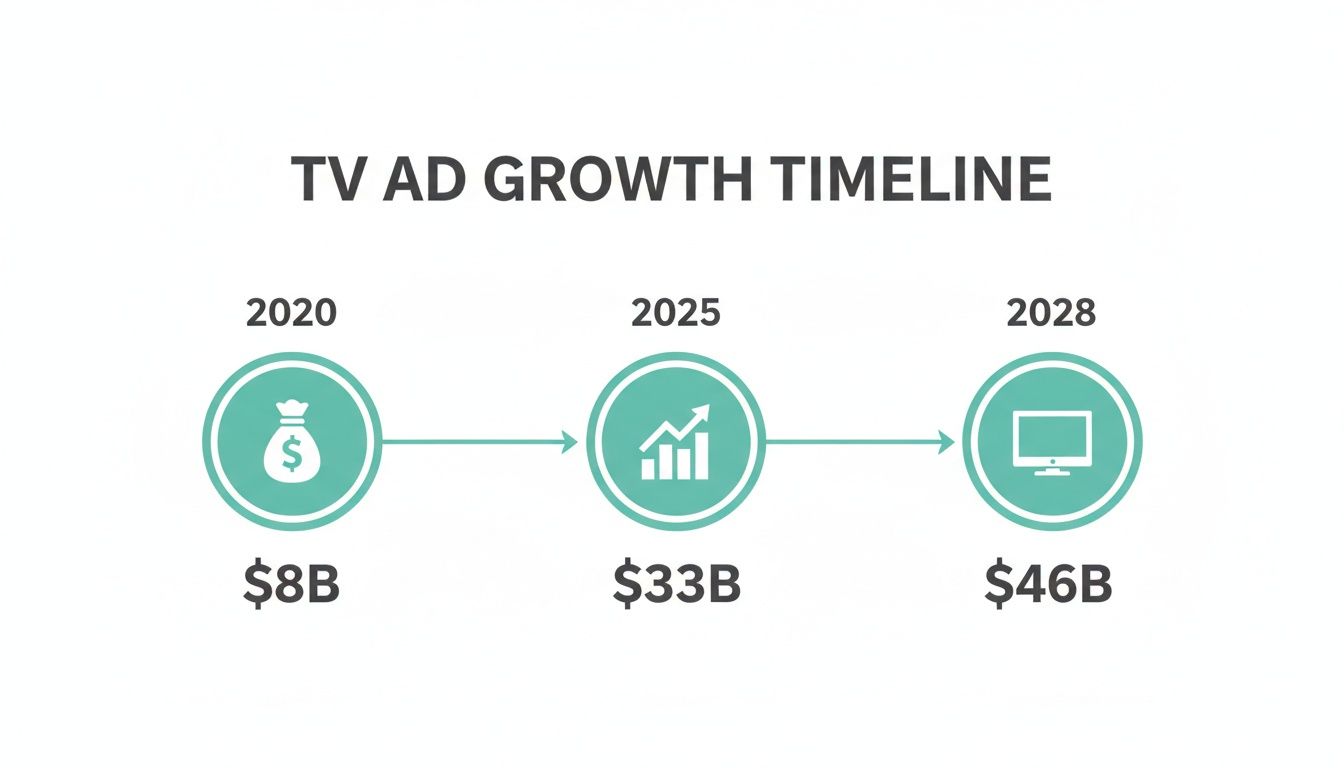
This chart shows that the money—and more importantly, your customers' eyeballs—are moving rapidly to platforms you can now access affordably.
Launch Your Referral Program: Finalize your "give-get" offer. Create some simple print cards and a dedicated page on your website explaining how it works. Then, personally announce it to your best customers via email.
Launch Your First Adwave TV Campaign: You can generate a commercial right from your website with Adwave. Start with a small test budget, maybe $100-$200, to target a few specific zip codes and see how the community responds.
Days 61-90: Optimizing and Scaling
The final 30 days are all about looking at the results and doubling down on what’s working. You’ve got real data now from your digital ads, your TV campaign, and your referral program. It’s time to stop guessing and start making smart decisions to build long-term, sustainable growth.
By this point, you're no longer just trying things out. You're operating from a position of knowledge, investing your marketing dollars where they will have the greatest impact.
Your focus shifts from testing to scaling. You'll also forge your first strategic partnership to open up a brand-new, organic lead source. As you bring in more leads, you might also consider leveraging modern AI lead generation tools to help capture and organize that new interest.
Analyze and Optimize: Dig into the data from all your channels. Are your Google Ads driving high-quality leads for a low cost? Increase the budget. Is your Adwave campaign getting your name out there and boosting direct traffic? Expand your targeting to neighboring areas.
Forge a Strategic Partnership: Find one complementary local business and pitch a simple partnership. It could be a joint promotion, a discount for each other's customers, or a straightforward referral agreement.
By the end of this 90-day cycle, you will have completely transformed your approach. You'll have moved from being reactive to being proactive, building a repeatable system for growth.
90-Day Customer Growth Timeline
To help you stay on track, here is a summary of the plan. Follow this timeline with specific actions, goals, and key metrics for each 30-day period to guide your implementation and track your success.
This structured approach ensures you're not just busy, but productive. By focusing on these specific actions each month, you build a powerful, multi-channel customer acquisition machine.
Tracking What Works and Optimizing Your Strategy
You can't improve what you don't measure. The final piece of the puzzle in getting more customers is to stop guessing and start tracking your results. This is how you make smart, data-driven decisions that actually move the needle.
For a busy business owner, marketing analytics isn't about getting lost in a sea of data. It's about focusing on the few key numbers that really matter for each channel you're using.
For your website and local SEO, keep a close eye on your overall website traffic, the lead conversion rate from your contact forms, and the number of phone calls you're getting. When it comes to digital ads, the numbers to watch are your cost-per-click (CPC) and, more importantly, your cost-per-lead (CPL). These simple metrics tell a powerful story about which channels are pulling their weight and which are just draining your budget.
Your Monthly Marketing Check-Up
Block out a couple of hours each month to review your marketing performance. A quick check-up is all it takes to see what’s truly delivering a return on your investment (ROI). This isn’t about drowning in spreadsheets; it’s about answering one critical question: "For every dollar I put into this channel, what am I getting back?"
Here’s a straightforward way to approach your review:
Website Performance: Pop open Google Analytics. Did your traffic go up? Which pages are getting the most attention? How many people actually filled out your contact form?
Digital Ad Results: Log into your Google Ads or Facebook Ads dashboard. How many leads did you generate, and what was the average cost to get each one?
Referral Program: How many new customers walked in the door because of your referral program this month? A simple log or spreadsheet is all you need to track this.
TV Campaign Impact: If you're running a TV campaign with a platform like Adwave, tracking is built right in. The real-time dashboard shows you exactly how the campaign is performing—things like total views, audience demographics, and even when people are tuning in. This gives you a clear picture of the brand lift you're getting in your local area.
The goal of tracking isn't just to collect data; it's to gain the clarity needed to make confident decisions. It transforms your marketing from an expense into a strategic investment.
This regular review is your secret weapon. It helps you spot trends, catch problems before they get out of hand, and identify your winning strategies so you can put more fuel on the fire.
Knowing When to Pivot or Double Down
Once you have this data, it's time to act. This is where you continuously refine your approach, making sure every marketing dollar is working as hard as you do. Optimization is simply the ongoing process of shifting your budget toward what’s proven to work.
Let's say your Google Ads are bringing in high-quality leads for $25 each, but your Facebook ads are costing you $75 per lead. The decision is pretty clear: shift more of your budget over to Google.
Or maybe you notice that every time your Adwave TV campaign runs, you see a spike in people searching directly for your brand name online. That's a sign it's building valuable brand recognition, and you can confidently expand your campaign to new zip codes.
This cycle of measuring, analyzing, and optimizing is what separates businesses that just get by from those that achieve real, sustainable growth. Understanding your numbers is fundamental, and you can learn more about how to do that by exploring this guide on customer acquisition cost calculation. It’s how you turn your marketing efforts into a predictable, scalable engine for getting more customers.
Your Questions Answered: Growing Your Customer Base
Let's tackle some of the most common questions I hear from business owners about how to really move the needle on customer growth.
How Much Should I Actually Spend on Marketing?
This is the million-dollar question, isn't it? A solid rule of thumb for most small businesses is to allocate somewhere between 5% to 10% of your total revenue to marketing.
If you're a new business or in a serious growth phase, you'll probably want to lean closer to that 10% mark to build momentum. More established businesses with a steady stream of customers might find that 5% is enough to maintain their position.
The most important thing is to not set it in stone. Start with a budget you're comfortable with, track everything, and then double down on what’s actually bringing in customers. It's all about proving the concept before you scale. For example, a platform like Adwave lets you dip your toes into TV advertising with a budget as small as $50, so you can see what resonates with your audience without a massive financial commitment.
What's the Absolute Fastest Way to Get Local Customers?
If you need leads right now, your best bet is usually hyper-targeted local ads. Think __LINK_0__ for people actively searching for your services or localized ads on Facebook to get in front of a specific demographic in your town. They're designed for quick results.
But quick wins aren't a long-term strategy. The fastest path to sustainable growth is a multi-pronged attack. You combine the immediate boost from paid ads with the long-term, free traffic that comes from a top-notch Google Business Profile and a fantastic referral program. That's how you build a real local powerhouse.
Ready to become a household name in your local market? Adwave makes TV advertising simple and affordable. Generate your broadcast-ready commercial in minutes and reach thousands of potential customers on top streaming channels. Learn more and launch your first campaign.