


February 07, 2026
How Do I Get More Customers for My Business Your Practical Guide
Table of Contents
Before you pour money into a new marketing campaign, take a hard look at what you’re already doing. The first, and most important, step to getting more customers is figuring out where your current process is leaking cash and why potential buyers are walking away. It’s all about shoring up the foundation before you build higher.
Pinpointing Your Customer Acquisition Gaps
The thought of finding new customers can feel like a mad dash to try every new tactic. But the smartest move isn't launching a flashy new campaign; it's diagnosing what you already have in place. This isn't about getting lost in spreadsheets—it's about asking a few brutally honest questions.
Think of your sales process like a simple funnel. At the top, people hear about you (Awareness). In the middle, they check you out (Consideration). And at the bottom, they buy (Conversion). The real question is: where are they dropping out?

Identify Your Leaks
Your customer funnel probably has a few leaks you haven't spotted. For instance, are you getting plenty of website traffic but almost no one fills out your contact form? That’s a major leak. Maybe your social media posts get hundreds of likes, but those likes never turn into a single phone call. That's another one.
Get started by asking yourself these critical questions:
Website: Are visitors actually contacting you, or do they bounce after viewing just one page? A high bounce rate is a huge red flag that your message isn't landing.
Social Media: Are your followers just watching from the sidelines, or are they engaging in a way that shows they're genuinely interested in buying?
In-Store: Do people wander around your shop, browse for a bit, and then leave empty-handed? Your pricing, layout, or even your sales approach might need a fresh look.
A classic mistake I see all the time is businesses pouring all their energy into top-of-funnel activities—like getting more followers—without plugging the holes at the bottom where leads actually become paying customers.
Understand Your Numbers in Simple Terms
Next, let's demystify two metrics that sound intimidating but are actually pretty straightforward: Customer Acquisition Cost (CAC) and Customer Lifetime Value (LTV).
Forget complex formulas for a minute. Just think about it this way:
If you spent $500 on local ads last month and got 10 new customers from it, your CAC was $50 per customer. Simple.
But is that good? That depends entirely on your LTV. If that average customer goes on to spend $1,000 with you over the next few years, then spending $50 to get them is a no-brainer. But if they only ever make one $40 purchase, you’re losing money on every new customer you bring in.
Having this basic math down gives you a solid framework for any campaign you run. For a deeper dive into organizing your marketing spend, our guide on advertising account planning is a great resource.
By finding these gaps and getting a handle on your numbers, you’re building an honest starting point. It ensures that when you do start investing in new strategies—whether it's local SEO, a referral program, or even TV ads with a platform like Adwave—every dollar works to patch those leaks and drive real, sustainable growth.
Mastering Local SEO and Customer Referrals
Once you’ve plugged the most obvious leaks in your sales process, it's time to get more customers by focusing on what works right in your own backyard. For most local businesses, the two most powerful (and often neglected) growth engines are showing up in local searches and good old-fashioned word-of-mouth.
These aren't fancy, complex tactics. They are the bedrock of a steady, reliable stream of high-quality customers who are already searching for exactly what you sell.
Win the "Near Me" Search Game
Every time someone pulls out their phone to search for "plumbers near me" or "best coffee in downtown," a little digital battle happens. The businesses that consistently win this fight are the ones that have a handle on local SEO.
At its heart, local SEO just means making it incredibly easy for Google to see you as the best, most relevant local answer to that search.
Your command center for all of this is your Google Business Profile (GBP). Don't think of it as just a listing; it's your digital storefront.
Fill Out Everything: Seriously, every single field. Be meticulous with your services, hours, photos, and a detailed description of what makes you great.
Go All-In on Reviews: You have to ask for them. Make it a part of your process with every happy customer. A steady stream of positive reviews is a massive signal to Google that you're a trusted local business.
Post Updates Regularly: Use the "Updates" feature to share offers, news, and events. It shows Google (and potential customers) that your business is active and engaged.
If you’re in a specific trade, diving into a guide like this one on Local SEO for contractors can give you a real leg up on the competition.
Turn Happy Customers Into Your Best Sales Team
Beyond Google, your most powerful marketing asset is the people who already love doing business with you. Actively encouraging referrals isn’t just a nice-to-have; it's a core growth strategy that lets trust do the heavy lifting for you.
A staggering 65% of small businesses say customer referrals are their single best source for new business. That’s no accident—a referral comes pre-loaded with trust. Just look at Kaimuki Dental, a client of ours who saw 150% growth in just five weeks after running targeted TV ads that got the whole neighborhood talking. The accessible advertising options provided by Adwave were a key part of their successful strategy.
The numbers don't lie: satisfied customers are 5 times more likely to refer you, and those referred customers have a 16% higher lifetime value.
The secret to a killer referral program? Make it dead simple and rewarding for everyone involved. Don't overthink it. A heartfelt thank-you and a small token of appreciation can work wonders.
Putting a system in place is easier than you think:
Pick a Reward: Offer a simple, clear incentive. A discount on their next purchase or a small gift card is perfect.
Make It Effortless: Give them simple referral cards or create a dedicated page on your website with a link they can share.
Spread the Word: Mention your referral program everywhere—in follow-up emails, on receipts, and with a small sign at your counter.
By nailing these two areas, you build a self-sustaining engine for growth. Local SEO brings new people through the door, and a great experience turns them into advocates who bring you even more. For a deeper dive, check out our guide on other local business marketing strategies.
Scaling Your Reach with Smart Advertising
You’ve built a solid foundation with a great local presence and a steady stream of referrals. That's fantastic. But to really grow, you need to amplify your message and reach people who haven't heard of you yet. This is where strategic paid advertising comes in, turning your local favorite into a household name.
While many businesses jump straight to social media or search ads, they often write off television as being completely out of reach. For years, that was true—TV was the playground for massive corporations with six-figure budgets. That’s just not the reality anymore.
Modern platforms are completely changing the game. Take Adwave, for example. They're making it possible for local businesses to get on TV without needing a massive budget, debunking that old myth once and for all.
The chart below shows a pretty typical customer breakdown. As you can see, advertising complements your other efforts, creating a new, scalable stream of customers.
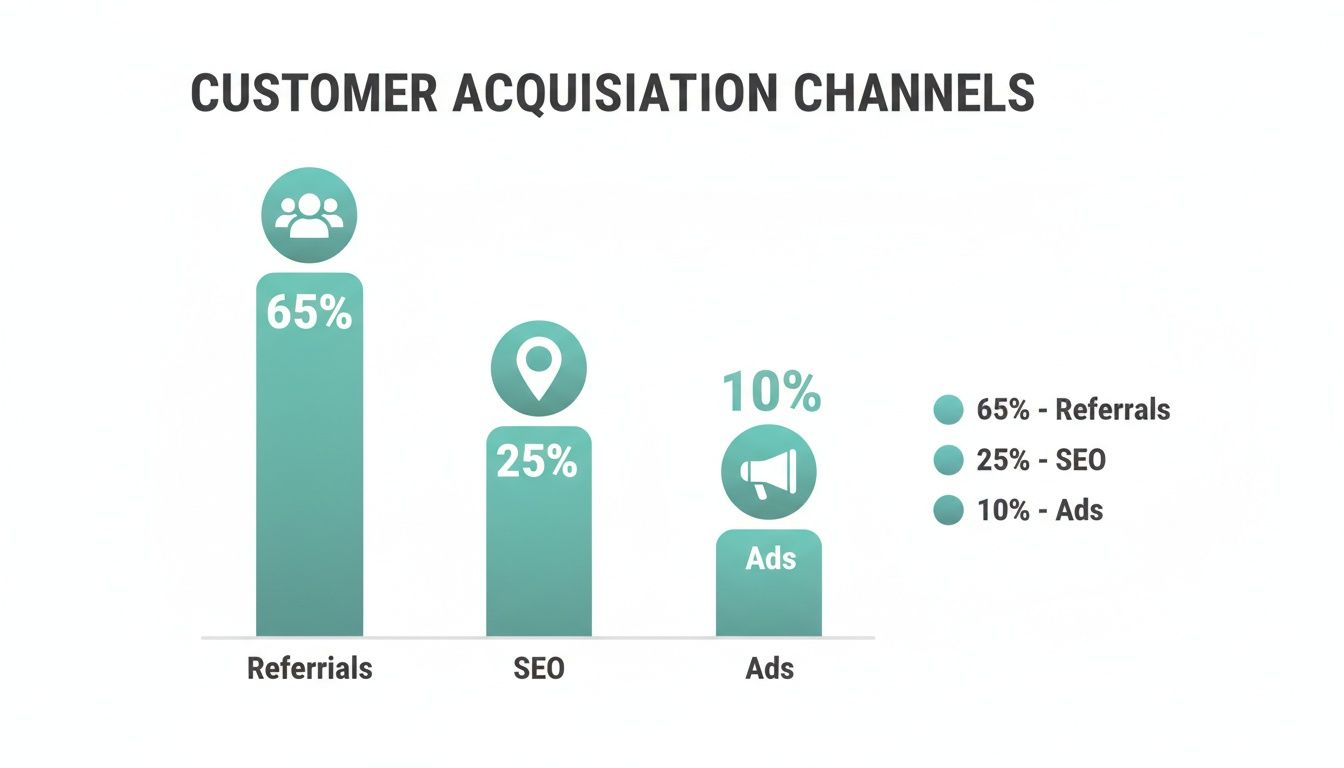
Even if ads only account for 10% of your new business, that represents significant growth you can directly control and scale up or down as needed.
Making Television Advertising Accessible
Historically, the biggest hurdles to TV advertising were always cost and complexity. Today, technology has pretty much eliminated both. Platforms like Adwave use smart tech to make the whole process simple and affordable, letting you launch a professional-looking ad on major channels for as little as $50.
This isn't about running ads on obscure public access channels, either. We're talking about getting your business seen on premium networks like Hulu and ESPN. You can reach a highly engaged local audience while they're watching their favorite shows, building brand recognition in a way that a fleeting social media ad just can't.
It’s a common misconception that TV ads are only for building brand awareness. When you target a specific local audience, TV drives direct action—from website visits to phone calls. It’s a powerful customer acquisition tool.
This is more important now than ever. Customer acquisition costs are climbing, soaring by 60% in the last five years alone. While traditional TV was always too expensive, new platforms are making it a viable and profitable option. With $15–$35 CPM TV buys, companies like Adwave are giving small businesses a way to fight back against today's high marketing costs.
To give you a better idea of how different channels stack up, here’s a quick comparison.
Customer Acquisition Channel Comparison for Local Businesses
Choosing the right channel depends on your budget, goals, and who you're trying to reach. This table breaks down some of the most common options for local businesses.
Ultimately, the best strategy often involves a mix of these channels. TV can build brand awareness that makes your Google Ads more effective, while a strong referral program can be supercharged by your local SEO efforts. A platform like Adwave makes it simple to integrate powerful TV advertising into this mix.
How It Works in the Real World
Let's look at Farrow Harley-Davidson, a local dealership that needed to expand its reach. They used Adwave to launch a broadcast-quality TV campaign quickly and, more importantly, affordably.
The results came fast. Their ads reached thousands of potential customers right in their service area, leading to a noticeable uptick in showroom traffic and a serious boost to their bottom line.
Their story highlights what makes modern TV advertising so powerful: precision. It’s not about blanketing the whole country with your message anymore.
Hyper-Local Targeting: You can deliver your ad only to the zip codes that matter most to your business.
AI-Powered Creative: Get a polished, professional ad generated in minutes, often just by providing your website URL.
Total Budget Control: Set your budget, and the platform automatically paces your ad spend to ensure you never go over.
This new approach to television lets you compete on a much bigger stage without needing a massive marketing department or budget. You get the trust-building power of TV combined with the sharp targeting of digital ads. It's a potent mix for scaling your business.
If you're ready to dig deeper, check out our guide on small business advertising tips to get started.
Crafting Offers That Actually Convert
Getting your ad in front of the right eyeballs is a huge win, but it’s only half the battle. To actually turn those viewers into paying customers, you have to give them a compelling reason to act right now. A fantastic offer, wrapped in a clear message, is what bridges that gap.
This isn’t about just running a sale; it’s about understanding what makes people pull out their wallets. A truly effective offer creates a sense of urgency and value that’s almost impossible to ignore.

The Psychology Behind a Great Offer
The best offers tap into some pretty basic human instincts. They make the customer feel smart for grabbing the deal while gently pushing them past any hesitation.
I've found that three core principles are always at play:
Urgency: Using phrases like “Limited Time Only” or “Offer Ends Sunday” triggers a fear of missing out (FOMO). This gets people to act immediately instead of telling themselves, "I'll get to it later."
Value: This is about more than just being the cheapest. An offer like “Buy One, Get One Free” or a “Free Consultation” adds real, tangible value beyond your main product or service. It makes the decision to buy feel like a much bigger win for them.
Scarcity: Highlighting that there are “Only 10 Spots Available” or that a deal is good “While Supplies Last” makes your offer feel more exclusive and desirable.
Your offer needs to directly solve a problem or fulfill a desire for your target customer. It’s not just about what you’re selling; it's about what the customer is gaining. A discount is good, but a solution is always better.
Writing Ad Copy That Connects
Once your offer is dialed in, your messaging has to deliver it with punch. Your ad copy should speak directly to a customer’s pain point and frame your business as the obvious solution.
Ditch the generic language. Instead of saying, “We Sell Quality Furniture,” try something like, “Tired of Furniture That Falls Apart in a Year? Get Handcrafted Quality That Lasts a Lifetime.” See the difference? The second version connects on an emotional level and solves a common frustration.
This is where modern tools have become a real game-changer, especially for local businesses considering TV. The creative process can seem intimidating, but platforms like Adwave have made it surprisingly simple. Their AI can actually generate a complete, broadcast-ready TV commercial just from your website's URL.
It intelligently pulls your branding, images, and messaging to create a polished ad, taking all the creative guesswork and high production costs off your plate. This lets you focus on nailing the offer while the tech handles the professional presentation. It’s a fast, efficient way to get a powerful, conversion-focused ad on the air on channels like Hulu or ESPN.
Measuring and Optimizing Your Growth Engine
Launching a marketing plan without a way to measure it is like driving with your eyes closed. You might be moving, but you have no idea if you're headed in the right direction. To get more customers for your business consistently, you have to track what's working, learn from the data, and make smart decisions based on facts, not guesswork.
This isn't about becoming a data scientist overnight. It’s about focusing on the handful of numbers that actually impact your bottom line and stop you from wasting money. The goal is to build a repeatable system for growth.
Setting a Realistic Budget and Clear Goals
Before you spend a dime, you need to define what a "win" looks like for your business. Is it 10 new leads every week? A 15% bump in online sales? Your specific goals are what will tell you where to put your money.
A solid starting point for many local businesses is to allocate 5-10% of total revenue to marketing. If you're in a heavy growth phase or a really competitive market, you might need to push that closer to 12%. The key is to start with a number you're comfortable with and can track meticulously.
Don’t just set a budget; give every dollar a job. If you’re putting $500 into a campaign, you should know exactly what you expect in return—be it website visits, phone calls, or foot traffic through your door.
As you get into the rhythm of measuring and optimizing, a big part of the game is figuring out how to reduce customer acquisition cost with AI and Local SEO. This keeps your efforts profitable and sharpens your focus on ROI.
Using Modern Tools for Real-Time Insights
The days of waiting weeks for a campaign report are long gone. Today's advertising platforms give you data in real-time, allowing you to make quick, meaningful adjustments on the fly.
This is exactly where a platform like Adwave comes into play. It takes the mystery out of the whole process, especially for powerful channels like TV advertising that once felt out of reach for small businesses.
Audience Insights: The Adwave platform shows you precisely who is responding to your ads. This helps you refine your ideal customer profile with real data, not just assumptions.
Performance Tracking: You can see which ads and messages are hitting the mark and which ones aren't, letting you double down on what’s actually working.
Budget Pacing: The system automatically manages your spending to make sure you never go over budget. It gives you total financial control.
Here’s a practical example: say you launch a TV ad and notice it’s performing incredibly well with viewers in a specific zip code. With Adwave, you can immediately shift your targeting to focus more of your budget on that high-performing area, maximizing your return.
This constant feedback loop is what drives sustainable growth. To dig deeper into this crucial metric, you can learn more about customer acquisition cost calculation in our guide. It helps turn your marketing from a simple expense into a truly measurable—and optimizable—investment.
Common Questions About Finding New Customers
It's completely normal to have a lot of questions when you're trying to figure out how to bring more people through your doors. Let’s tackle a few of the most common ones I hear from business owners.
What's the Smartest, Most Cost-Effective Way to Get My First 100 Customers?
For a brand-new business, forget about complex, expensive campaigns. The quickest and cheapest path is a blend of digital basics and good old-fashioned hustle.
First, lean on your personal and professional networks. These are the people most likely to become your first customers and champions. At the same time, nail your local SEO. That means creating a super-detailed Google Business Profile and, crucially, asking every single one of those early customers for a review. This costs you nothing but time and builds the trust and visibility you'll need before you even think about paid ads.
How Much Should a Small Business Really Spend on Marketing?
A solid starting point is to set aside 5-10% of your total revenue for your marketing efforts.
If you're in a really crowded market or gunning for aggressive growth, you might need to push that closer to 12-15%. The key isn't the exact number, though. It's about starting with a budget you can actually track, measuring what works, and then doubling down on the channels that give you the best return.
The great thing about advertising today is you don't need a massive budget to see what works. For instance, with a platform like Adwave, you can test the waters with a local TV campaign for as little as $50. It's a low-risk way to prove the ROI before you commit more serious dollars.
I Don't Have a Creative Team. How Can I Make Professional-Looking Ads?
This used to be a massive roadblock, but the tools available now have completely leveled the playing field.
For things like social media posts and digital banners, platforms like Canva are a lifesaver. They offer thousands of templates that look great and require zero design experience.
And what about TV ads? That used to mean hiring a production crew and spending a fortune. Not anymore. AI-powered platforms like Adwave have made this incredibly simple. You can literally generate a broadcast-ready TV commercial in minutes, often just by plugging in your website URL. The AI does all the heavy lifting, letting you launch a high-impact campaign without needing an in-house team.
Ready to reach more local customers on major TV channels without the high cost or complexity? Adwave uses AI to create and launch your TV ad campaign in minutes. Start growing your business with Adwave today.