
Running for office is one of the most challenging undertakings a person can pursue. Between building a team, raising funds, meeting voters, and crafting your message, the demands seem endless. But among all the elements of a successful campaign, one stands above the rest in terms of reach and impact: television advertising.
TV remains the single most powerful medium for political campaigns. It delivers your message directly into voters' living rooms, builds name recognition faster than any other channel, and creates the emotional connection that drives people to the polls. Whether you're running for Congress, city council, school board, or any other office, understanding how to advertise on TV can make the difference between winning and losing.
This step-by-step guide walks you through the entire process of advertising a political campaign on TV, from initial planning to election day.
Step 1: Define your campaign goals and audience
Before you buy a single ad spot, you need clarity on what you're trying to achieve and who you're trying to reach.
Set clear objectives
Every political campaign has multiple phases, each with different advertising goals:
Name recognition phase (early campaign): In the early stages, your primary goal is simply getting voters to know your name. You're not asking for their vote yet, you're introducing yourself.
Persuasion phase (mid-campaign): Once voters know who you are, shift to explaining why they should support you. This phase focuses on your platform, values, and what differentiates you from opponents.
Mobilization phase (final weeks): The closing weeks are about getting your supporters to vote. This includes "get out the vote" messaging and deadline reminders.
Fundraising: Throughout the campaign, you may run ads specifically designed to drive donations, especially during matching fund periods or before FEC reporting deadlines.
Identify your target voters
Not every viewer is a potential voter in your race. Define your target audience based on:
Geography: What district, county, or state are you running in?
Voter history: Are you targeting frequent voters, occasional voters, or trying to reach new registrants?
Demographics: What age groups, income levels, or other demographic factors define your likely supporters?
Persuadable voters: Who are the undecided voters you need to win over?
The more precisely you define your audience, the more efficiently you can spend your advertising budget.
Step 2: Determine your advertising budget
Political advertising budgets vary enormously based on race type, market size, and competitive dynamics.
Budget guidelines by race type
TV advertising budgets vary significantly by race type. Congressional campaigns typically spend between $500,000 and $5 million or more on TV advertising, depending on the competitiveness of the district and media market costs. State legislature races generally require $50,000 to $500,000 in TV spending, while county-wide races like county commissioner or sheriff typically need $25,000 to $200,000. Local races such as city council or school board can be effective with $5,000 to $50,000 in TV advertising.
These ranges represent total TV spending. Your actual budget depends on your overall campaign resources, with media typically representing 40-60% of total campaign spending.
Allocate across the campaign calendar
Don't spend your entire budget in week one. Smart campaigns allocate spending across the campaign timeline:
Early campaign (6+ months out): 10-15% of budget for name recognition
Mid-campaign: 25-35% for persuasion messaging
Final 4-6 weeks: 50-60% for peak advertising and GOTV
This "back-loaded" approach ensures you have maximum presence when voters are making their final decisions.
Plan for rising costs
Political ad rates increase as election day approaches. Inventory becomes scarce, and political ad rates can increase 3-5x during peak demand periods. Build this into your budget planning.
Step 3: Choose your TV advertising channels
Modern political campaigns have more TV options than ever before. Understanding the strengths of each helps you allocate budget effectively.
Broadcast TV
Broadcast television (ABC, CBS, NBC, FOX affiliates) remains the foundation of political TV advertising. It offers:
Massive reach: Broadcast reaches the widest audience in any market
Local news adjacency: Ads during local news reach highly engaged, politically attentive voters
Lowest unit rate: Federal candidates are entitled to the lowest rate stations charge for comparable ad time during specific pre-election windows
Live sports: NFL games, Olympics, and other live events deliver large, engaged audiences
The downside: broadcast has limited targeting capability. You're buying geography, not specific voter segments.
Cable TV
Cable networks (CNN, Fox News, MSNBC, ESPN, HGTV, etc.) offer:
More targeted reach: Cable networks attract specific audience types based on content
Lower costs: Generally lower CPMs than broadcast
Zone targeting: Cable systems allow targeting by geographic zones within a market
Cable works well for reaching specific voter segments interested in news, sports, or lifestyle content.
Connected TV (CTV) and streaming
CTV advertising for political campaigns has become essential for reaching cord-cutters and younger voters. Benefits include:
Precise targeting: Target by geography, demographics, interests, and even voter file data
Lower minimums: Start campaigns with smaller budgets than traditional TV requires
Measurable results: Track impressions, completion rates, and reach frequency
Cord-cutter reach: Reach voters who don't watch traditional TV at all
Platforms like Hulu, Peacock, Roku, and Tubi deliver political ads to streaming audiences.
The optimal mix
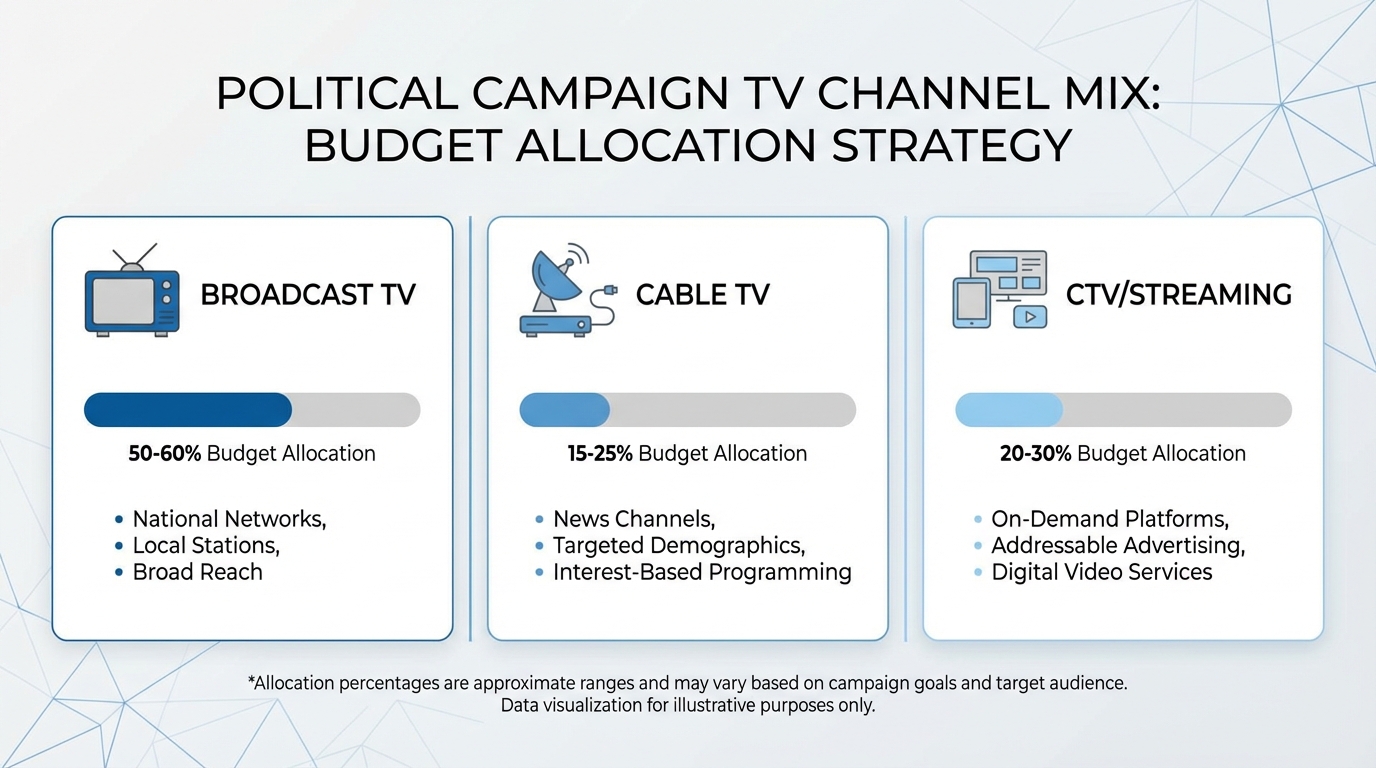
Most successful campaigns combine all three channels. A typical allocation might dedicate 50-60% of the TV budget to broadcast for broad reach, credibility, and live event coverage. Cable typically receives 15-25% of the budget to reach targeted audiences and news viewers. CTV and streaming should receive 20-30% of the budget to reach cord-cutters with precise targeting capabilities.
Adjust these percentages based on your specific voter targets and market dynamics.
Step 4: Create compelling ad creative
Your ad creative determines whether voters remember you, and whether they support you.
Essential elements of political ads
Keep it simple: You have 15 or 30 seconds. Focus on one clear message per ad. Trying to communicate everything in a single spot dilutes impact.
Lead with emotion: Political decisions are emotional decisions. Connect with voters through stories, values, and shared concerns before diving into policy details.
Show the candidate: Voters want to see and hear the candidate. Authentic footage and direct-to-camera delivery builds trust.
Clear call to action: Tell voters what you want them to do. Vote on election day. Visit your website. Text to join your movement.
Types of political ads
Introduction ads: "Meet [Candidate Name]" style ads that establish who you are and why you're running.
Issue ads: Focus on specific policy positions that resonate with your target voters.
Contrast ads: Highlight differences between you and your opponent without going negative.
Attack ads: Direct criticism of opponents. Use cautiously, they can backfire if perceived as unfair.
Testimonial ads: Third-party validators (community leaders, everyday voters) speaking on your behalf.
GOTV ads: "Vote on November 3rd" messaging for the final days.
Technical requirements
Length: 15-second and 30-second spots are standard. 60-second spots for fundraising or complex messages.
Format: HD video (1920x1080 minimum), appropriate file formats for each platform
Compliance: Include required "Paid for by" disclosures
Creating ads on a budget
You don't need a Hollywood budget for effective political ads. Options include:
AI video tools: Platforms like Adwave let you create professional video ads quickly and affordably
Simple production: Direct-to-camera messages shot on a smartphone can be highly effective
Stock footage: Combine b-roll with voiceover for issue-focused ads
The message matters more than production value. Authentic, heartfelt ads often outperform slick, expensive productions.
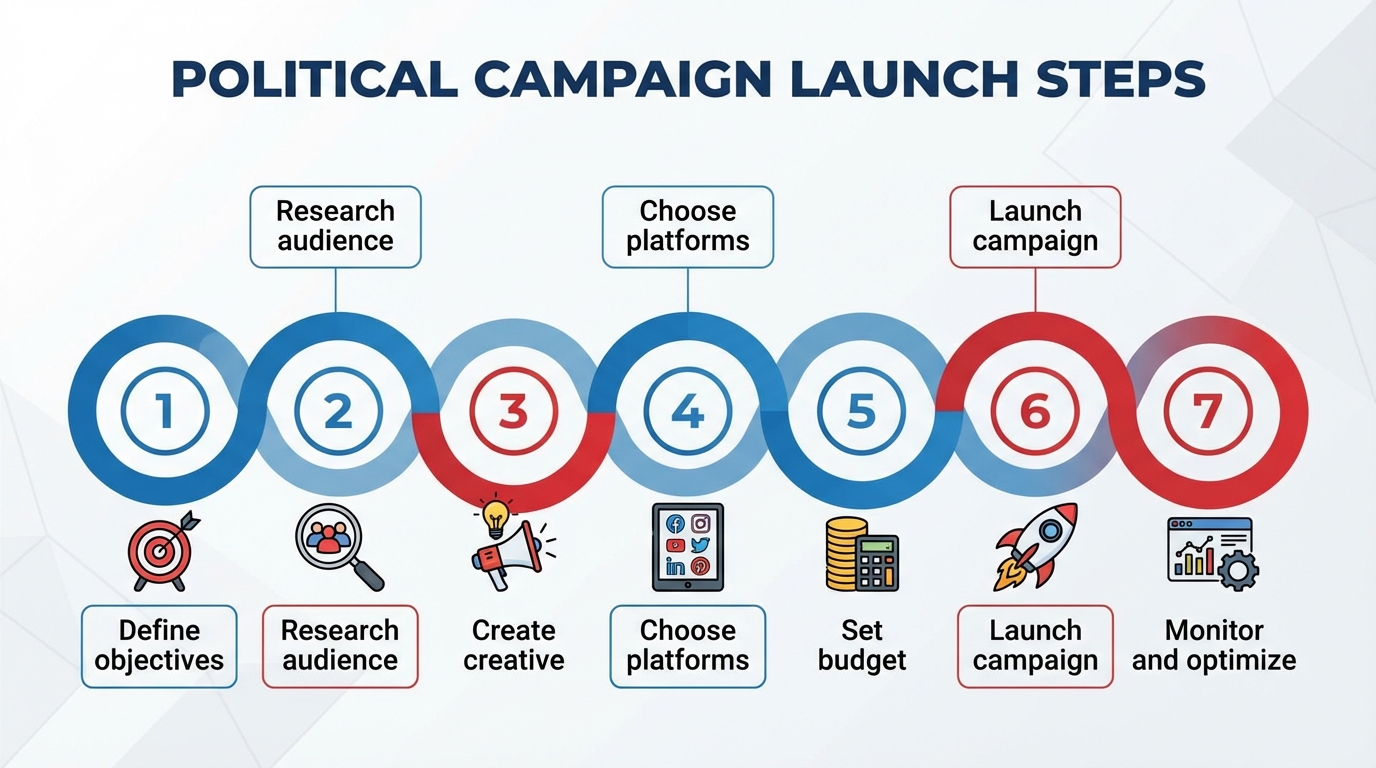
Step 5: Buy your TV ad time
With your strategy, budget, and creative ready, it's time to buy airtime.
Buying broadcast and cable
Traditional TV buying involves:
Contact station sales departments: Reach out to local TV stations and cable providers
Request avails: Get available inventory and rates for your target time periods
Negotiate rates: Push for competitive pricing, especially if you qualify for lowest unit rate
Submit orders: Place your media orders with specific program and daypart selections
Traffic creative: Deliver your ads to stations with required specifications
This process can be complex and time-consuming, often requiring a media buying agency.
Buying CTV/streaming
Programmatic political advertising simplifies the buying process:
Choose a platform: Select a CTV advertising platform that accepts political ads
Set targeting parameters: Define geography, demographics, and audience segments
Upload creative: Add your compliant video ads
Set budget and schedule: Allocate daily or campaign budgets with start/end dates
Launch and optimize: Go live and adjust based on performance data
Self-serve platforms like Adwave make this process accessible even for small campaigns with limited staff.
Timing your buys
Book early for broadcast: Popular inventory sells out, especially during peak political season
Be flexible on dayparts: Morning and late night often deliver better value than prime time
Weight toward weekends: Many voters catch up on TV viewing on weekends
Increase frequency in final weeks: Voters need to see your message multiple times to remember it
Step 6: Comply with political advertising regulations
Political advertising has specific legal requirements you must follow.
FCC rules for broadcast
Sponsorship identification: All ads must clearly state who paid for them
Lowest unit rate: Federal candidates qualify for the lowest rate during specific windows
No censorship of candidate ads: Stations cannot reject candidate ads based on content (though they can reject issue ads)
Record keeping: Stations must maintain public files documenting political ad purchases
State and local requirements
Many states have additional requirements:
Specific disclaimer language: Some states mandate exact wording for "paid for by" disclosures
Top donor disclosure: Some jurisdictions require listing major donors in the ad itself
Filing requirements: Campaign finance laws require reporting of advertising expenditures
Platform policies
Streaming and digital platforms have their own political ad policies:
Advertiser verification: You may need to verify your identity and campaign status
Content restrictions: Some platforms limit certain types of political content
Targeting restrictions: Some platforms limit targeting options for political ads
Ad libraries: Many platforms make political ads publicly viewable
Consult with an attorney familiar with campaign finance and advertising law to ensure full compliance.
Step 7: Monitor, optimize, and adapt
Political advertising doesn't end when your ads go live.
Track performance metrics
Monitor key metrics throughout your campaign:
Reach and frequency: How many voters are seeing your ads, and how often?
Video completion rate: Are viewers watching your full message?
Website traffic: Are ads driving visitors to your campaign site?
Donation impact: Do ad flights correlate with fundraising results?
Polling movement: Are awareness and favorability numbers moving?
Optimize in real-time
Use performance data to improve results:
Shift budget to top performers: Move spending toward channels and creatives delivering results
Adjust targeting: Refine audience segments based on what's working
Refresh creative: Rotate new ads to prevent viewer fatigue
Respond to events: Create new ads responding to debates, news, or opponent attacks
Adapt to the campaign
Political campaigns are dynamic. Be prepared to:
Respond to attacks: Have rapid response ads ready when opponents go negative
Capitalize on momentum: Increase spending when polling shows gains
Adjust to breaking news: Real-world events can change the entire race overnight
Shift targeting: Move budget toward precincts or demographics showing movement
The campaigns that win are the ones that adapt fastest to changing circumstances. Build flexibility into your media plan and budget allocation from the very start.
Step 8: Close strong in the final days
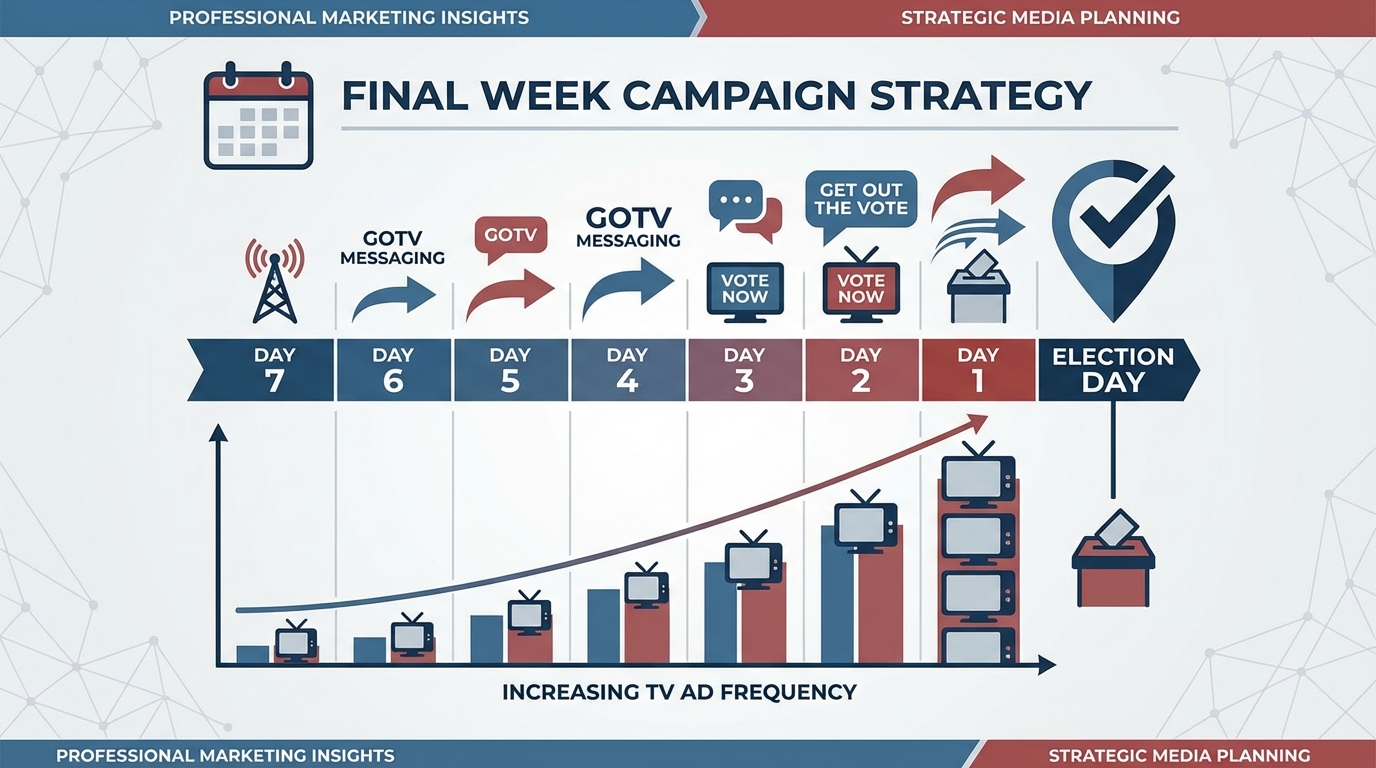
The final week of a campaign is make-or-break time for TV advertising.
Increase frequency dramatically
Voters need to see your message 7-10 times to remember it. In the final days, push frequency even higher to ensure your name and message are familiar at the ballot box.
Focus on GOTV messaging
Shift from persuasion to mobilization:
Election day reminders: "Vote Tuesday, November 3rd"
Polling location information: Help supporters find where to vote
Early voting deadlines: Remind voters of advance voting options
Maintain presence through election day
Don't go dark too early. Voters make final decisions right up until they cast their ballot. Maintain TV presence through election day to reinforce your message.
Common questions about political TV advertising
How much does it cost to advertise a political campaign on TV?
Costs vary enormously by market size and race type. Congressional campaigns in major markets may spend millions, while down-ballot advertising for local races can be effective with budgets of $10,000-$50,000. CTV platforms allow campaigns to start with budgets as low as $50-100 per day.
How early should I start TV advertising?
Start name recognition advertising 4-6 months before election day for competitive races. Smaller races may begin 2-3 months out. Peak spending should occur in the final 4-6 weeks when voters are paying the most attention.
Can small campaigns afford TV advertising?
Yes. Connected TV has made TV advertising accessible to campaigns of all sizes. You can target specific districts and demographics without buying expensive broad market coverage. Platforms like Adwave enable political campaigns to run TV ads with low minimums and precise geographic targeting.
Do I need an agency to buy political TV ads?
Not necessarily. While large campaigns often work with media buying agencies, smaller campaigns can work directly with stations or use self-serve CTV platforms. The key is having clear strategy, compliant creative, and time to manage the buys.
What makes political ads effective?
Effective political ads are simple, emotional, and authentic. They focus on one clear message, connect with voters' values and concerns, and feature the candidate speaking directly to viewers. Production quality matters far less than authenticity and message clarity.
Start your political TV advertising campaign
TV advertising remains the most powerful tool for reaching voters and winning elections. Whether you're running for president or school board, the fundamentals are the same: define your audience, craft a compelling message, choose the right channels, and stay present through election day.
The campaigns that master TV advertising give themselves a significant advantage. In close races, that advantage often makes the difference between victory and defeat.


