

Brand awareness means customers recognize your business. Consistent advertising can help them remember your name when they need what you sell.
Why Brand Awareness Is a Growth Engine, Not Just a Buzzword
Let's be real, "brand awareness" can sound like a fuzzy marketing term, the kind of thing that gets pushed aside for campaigns that promise instant leads. But for a small or mid-sized business, this is probably the most important investment you can make for long-term, sustainable growth. It's simple: before a customer can buy from you, they have to know you exist.
This isn't about chasing likes or getting a pat on the back. It’s about building a genuine asset for your business. When people in your town recognize your logo on a van, see your ad during the local news, or hear your name from a neighbor, you're building "mental real estate." Think of that one local pizza place everyone recommends without even thinking about it, that's the power of brand awareness in action.
The Tangible Value of Being Known
Strong brand awareness pays off in very real ways. It builds a foundation of trust and legitimacy, making new customers feel like they already know you. That feeling of familiarity often makes them choose you over a completely unknown competitor, even if you’re not the cheapest option in town.
A well-known brand also kicks off the most powerful marketing engine there is: word-of-mouth. When people are familiar with your business, they're far more likely to:
Recommend you to friends and family.
Share your posts on social media, doing your marketing for you.
Search for you by name, which brings high-intent, low-cost traffic right to your door (or website).
Ultimately, brand awareness creates a moat around your business. It protects you from getting dragged into price wars and makes you less vulnerable when a new competitor sets up shop. It’s the difference between being a temporary choice and becoming a community staple.
To help you connect the dots between "being known" and actual business growth, here's a breakdown of the real-world value you can expect.
The Real-World Value of Brand Awareness for SMBs
This table shows that building your brand isn't just a marketing exercise, it's a direct investment in your company's financial health and long-term stability.
Connecting Awareness to Your Bottom Line
Every single time a potential customer encounters your brand (whether it's a TV ad, one of your trucks in their neighborhood, or a mention from a friend) it adds up. This cumulative effect shortens the sales cycle because you’ve already cleared the first hurdle of trust. You can find more helpful strategies to effectively build brand awareness to get started.
This is where smart, accessible advertising tools make a huge difference. Platforms like Adwave now give local businesses the ability to build this important awareness using the power of TV and streaming ads, channels that used to be off-limits for anyone without a massive budget. By simplifying the process, Adwave makes it easy for any business to use this powerful medium.
When a local HVAC company can run ads on networks like ESPN or HGTV, they aren't just trying to get the phone to ring tomorrow. They're building the kind of credibility and recognition that fuels real, lasting growth. If you want to see the numbers, you can explore the data behind TV's effectiveness in building brand awareness.
Remember, prioritizing brand awareness isn't just an expense; it’s the engine that powers everything else you do.
Building Your Brand Foundation Before You Spend a Dime
Let's be honest. Jumping into advertising without a clear brand identity is like trying to give directions to a place you've never been. Before you even think about putting a single dollar into an ad campaign, you need to lay some serious groundwork.
Define your business, audience, and offer before creating a campaign.
Defining Your Unique Value Proposition
Your Unique Value Proposition (UVP) is your elevator pitch on steroids. It’s a simple, powerful statement that explains the benefit you offer, how you solve a customer's problem, and what makes you different from the other guys down the street. It’s not just a clever slogan; it’s the very core of your promise to your customer.
Think of it this way: if someone asks, "Why should I choose you?" your UVP is the immediate, confident answer. A great UVP is specific, memorable, and laser-focused on a benefit your ideal customer values.
For instance, a local landscaping company's UVP isn't just "we mow lawns." A much stronger one would be: "We create stunning, low-maintenance outdoor spaces for busy homeowners, so you can spend your weekends relaxing, not working." See the difference? It immediately hits on a specific pain point and offers a clear, desirable solution.
Crafting a Compelling Brand Story
People don’t really connect with businesses; they connect with stories. Your brand story is the narrative that weaves together your history, your mission, and your values into something relatable. It's the "why" behind what you do, and it’s what gives your brand a human touch that builds trust.
A good brand story has to be:
Authentic: It needs to be true to where you came from and what you believe in.
Relatable: Your audience should see a bit of their own experiences or aspirations in it.
Consistent: This story needs to show up everywhere, from your website copy to how your team answers the phone.
Your narrative doesn't have to be some epic tale. The story of a family-owned restaurant passed down through generations can be just as powerful as a tech startup’s mission to solve a global problem.
Your brand story is an invaluable asset. It’s what transforms a simple transaction into an emotional connection, building a kind of loyalty that price tags can't touch.
This journey (from just being known to being valued) is how you build real equity. Customers won't just recognize you; they'll be willing to pay a premium for what you offer.
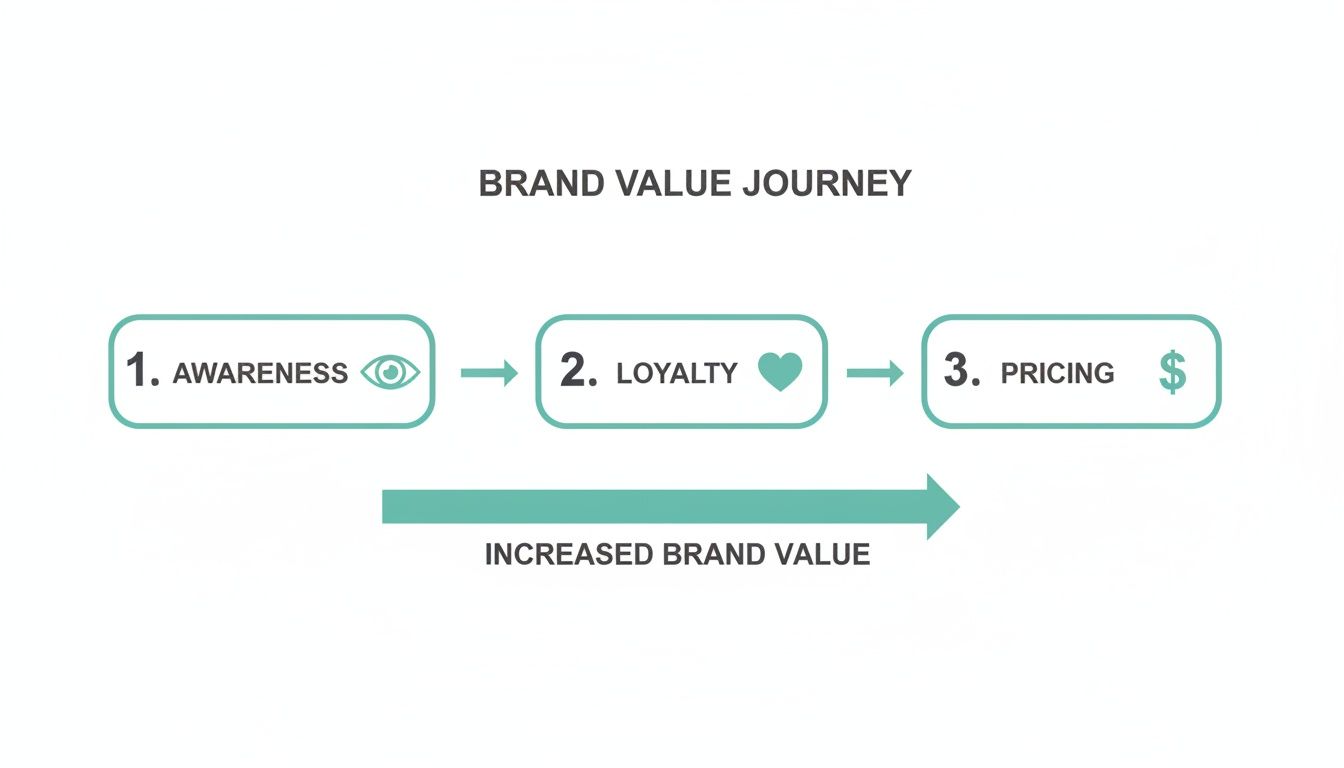
As this shows, when awareness evolves into loyalty, it directly boosts your pricing power and, ultimately, your brand's bottom-line value.
Developing Your Ideal Customer Personas
Build customer profiles from interviews, purchase history, and market research. Focus on what people need, what makes them choose a business, and where they look for it. Those details help you choose a useful message.
Instead of targeting "homeowners," a persona gets granular. Let's go back to our landscaper. They might create a persona called "Busy Brenda."
Who she is: A 45-year-old professional with two kids and a demanding career.
Her goals: She dreams of having a beautiful yard for entertaining but has zero time or energy for the upkeep.
Her pain points: She's overwhelmed by home maintenance and feels a little guilty about her neglected garden.
Her media habits: She scrolls Facebook and Instagram for home inspiration and unwinds with streaming services like Hulu after the kids go to bed.
All of a sudden, you're not just selling landscaping anymore. You're selling Brenda peace of mind and the gift of her weekends back. This deep understanding of her life dictates everything, from the messaging you use to the channels you pick for your ads.
Knowing "Busy Brenda" watches Hulu means you can make sure your ad shows up right when she’s ready to relax and be receptive. A platform like Adwave makes this type of targeted advertising straightforward. This is how advertising shifts from a guessing game to a smart, strategic investment. For a more structured look at this, our guide on effective advertising account planning can walk you through the process in more detail.
Finding Your Audience Where They Are
Your customers aren't everywhere, so your marketing shouldn't be, either. You’ve done the hard work of defining your brand and building out your ideal customer personas. Now comes the real test: figuring out where these people spend their time.
Blowing your budget on channels your audience ignores is one of the fastest ways to get discouraged. A smarter approach is to think in terms of an integrated strategy, a modern media mix that puts your message in front of people at different points throughout their day. This is about more than being on one channel; it’s about creating a cohesive presence that feels familiar and trustworthy.
This is what a modern strategy looks like in practice. It connects all the dots (from a phone screen to a social feed to the living room TV) to meet people where they are. That's how you build the kind of recognition that leads to real growth.
The Modern Media Mix for Local Businesses
For a small or mid-sized business, your media mix has to be lean, targeted, and measurable. You don't have a massive national budget to play with, so every single dollar has to pull its weight.
Here are the core channels I always recommend for a powerful, local-first strategy:
Local SEO and Content Marketing: This is your digital home base. When you create helpful blog posts, guides, or videos that answer the questions your local customers are typing into Google (like "best landscapers near me"), you build authority and attract people who are ready to buy.
Community-Focused Social Media: Please, don't just post sales pitches. Use platforms like Facebook and Instagram to become a real part of the local conversation. Share stories from happy customers, promote community events, and engage with other local businesses. It's about building a genuine following, not just racking up likes.
Strategic Local Partnerships: This is one of the most underrated tactics. Team up with a non-competing local business that serves the same kind of people you do. Think of a real estate agent partnering with a home inspector, or a gym collaborating with a healthy café. Co-hosting a workshop or cross-promoting on social media is a brilliant, cost-effective way to get in front of a whole new, relevant audience.
Out-of-Home (OOH) Advertising: Don’t write off traditional media just yet. A well-placed billboard, a few bus stop ads, or a sponsorship banner at the local little league field can create incredible brand recall within a tight geographic area. It keeps you familiar for everyone driving or walking by.
Demystifying the Power of TV and Streaming Ads
For decades, TV advertising was the king of brand awareness, but it was a kingdom only the giants with colossal budgets could enter. That world is gone. Today, advertising on TV and streaming services is one of the most powerful (and surprisingly accessible) tools for local businesses.
Why does it work so well? Because you're connecting with your audience in a lean-back, high-engagement environment: their living room. A TV spot isn't a fleeting ad they scroll past in a busy feed. It commands attention and builds a kind of credibility that other channels struggle to match.
Adwave creates ads from your website and manages placements on TV, search, and social.
With Adwave, a local business (whether you’re a dental practice, an auto dealership, or a restaurant) can launch a broadcast-quality TV ad in minutes, targeting viewers right down to a specific zip code. Your message reaches the people who can walk through your door.
When your brand shows up alongside household names, you gain instant authority and trust. The question is no longer if you can advertise on TV; it's how quickly you want to get started.
Integrating Your Channels for Maximum Impact
Use the same business name, logo, and offer on your ads, vehicles, and website so people can recognize you between visits.
This multi-channel exposure creates a powerful sense of familiarity. It makes your brand feel inevitable. And this isn't just a hunch; the research backs it up. A staggering 47% of companies worldwide name brand awareness as their top goal for content. This is precisely why a smart, scalable strategy that includes AI-powered TV ads from a platform like Adwave is so critical.
While 29% of consumers discover brands on social media, TV’s broad-reach impact is still unmatched, with platforms placing ads across over 100 channels like ESPN. You can dive deeper into the numbers with the latest branding statistics from Capital One Shopping research.
The data is clear. An integrated strategy, especially one anchored by the high-impact reach of TV, is essential. By finding your audience where they are (on their phones, in their cars, and on their couches) you build a brand presence that's impossible to ignore.
Creating Memorable Ads Without a Hollywood Budget
It’s about who has the clearest, most consistent message. The real art is crafting something so simple and valuable that it sticks, and then repeating it until people can't help but recognize you.
Technology has completely leveled the playing field. The tools to build a memorable brand are right at your fingertips, letting a local business compete on pure creativity and quality.
From Website to Broadcast-Ready Ad in Minutes
Historically, the biggest roadblock for getting on high-impact channels like TV and streaming wasn't the ad space, it was the ad itself. This is where modern platforms have become a complete useful option for small and mid-sized businesses.
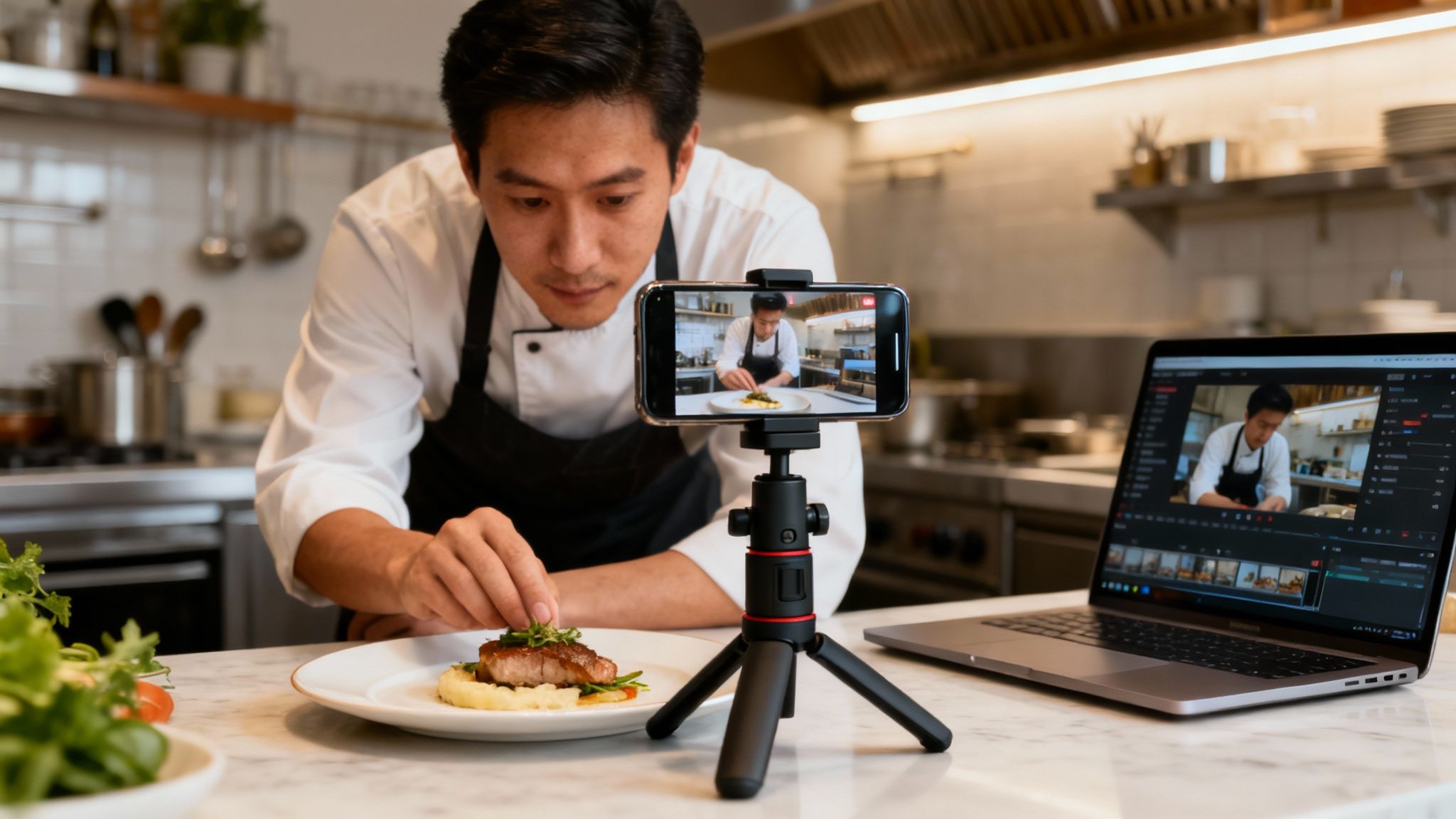
Imagine turning your website (the digital home you’ve already poured your heart into) into a polished TV commercial. It sounds like science fiction, but it's not. With a tool like Adwave, the process is shockingly simple. You just enter your website URL, and its AI-powered tech gets to work, analyzing your branding, messaging, and images to generate a professional video ad automatically.
This completely bypasses the need for pricey production agencies and months of back-and-forth. For a family-owned restaurant, a local dental practice, or an independent auto shop, this means getting a high-quality ad on the air in minutes, not months. It makes powerful advertising affordable for everyone. If you want to see how it works, we break it down in our guide on how to make a commercial with modern tools.
The ability to create ads quickly and affordably shifts your focus to what matters for brand awareness: consistency. Getting your message out there repeatedly is how you build powerful, lasting brand recall.
Why Repetition is Your Secret Weapon
Consistency is the engine that drives brand awareness. A fantastic, award-winning ad seen only once is a whisper in the wind compared to a good, solid ad seen multiple times. It’s simple psychology, familiarity breeds trust.
Did you know it takes 5-7 impressions for someone to even begin to remember your brand? Think of this as the "Memory Threshold" in today's noisy world. You have to break through.
In fact, branding stats for 2025 show that brand recall alone drives a massive 38.7% of brand lift. That makes it the single most important factor in boosting awareness. This is why getting your ad on a platform like TV, even locally, is golden. It gives you the repeated exposure needed to build that vital recognition. Adwave makes achieving this frequency both simple and cost-effective.
Keep Your Branding Cohesive Across Every Channel
To get the most mileage out of your ads, your branding has to be a united front. The colors, logo, and tone of voice in your TV spot need to perfectly match what people see on your website, your social media, and even the sign on your door.
This cohesion creates a connected and professional experience. It’s like a handshake your customer recognizes every time, reinforcing your identity at every touchpoint and making your brand instantly familiar.
Here are a few simple rules to live by for brand consistency:
Create a Visual Style Guide: It doesn't have to be a 100-page document. Just define your core brand colors, fonts, and how your logo should be used. Share it with your whole team.
Lock in Your Tone of Voice: Are you friendly and casual? Professional and authoritative? Warm and welcoming? Decide, and then use that voice in all your ad copy, social posts, and website text.
Stick to One Core Message: The format might change from a 30-second TV spot to an Instagram post, but your unique value proposition should always be the same.
By pairing affordable, high-quality creative from a tool like Adwave with an unwavering commitment to brand consistency, you create a powerful formula for building awareness that works, no Hollywood budget required.
Measuring What Matters: Tracking Your Brand's Growth
Getting your campaign live is a huge milestone, but it’s really just the starting line. The real work (and the real growth) begins the moment you start listening to what the data tells you. Tracking the right things is how you turn a good campaign into a great one, making sure every marketing dollar is pushing your brand forward.
Measuring brand awareness can feel a bit like trying to bottle lightning. It’s not as straightforward as tracking a click or a sale. But if you know which key performance indicators (KPIs) to watch, you can get a surprisingly clear picture of how your hard work is paying off. It’s all about looking past the shiny "vanity metrics" and zeroing in on data that signals real growth in how people recognize and trust your business.
Moving Beyond Vanity Metrics
It's tempting to get excited about a spike in social media likes or a huge number of impressions. While those numbers aren't useless, they don't tell you the whole story. Real brand awareness measurement digs much deeper, revealing how people’s behavior is changing because they’ve seen your ads.
The ultimate goal is to connect your ad spend to actual business results. Are more people typing your website into their browser directly? Is your brand becoming a name people mention in local conversations? These are the kinds of questions the right KPIs can answer, giving you a true sense of your campaign’s impact out in the real world.
Let's break down the metrics that matter.
Key Brand Awareness Metrics and How to Track Them
To really get a handle on your campaign's performance, you need a solid dashboard of metrics. Here are the most important ones to focus on, what they mean, and the simple tools you can use to keep an eye on them.
Watching these KPIs gives you a much richer, multi-dimensional view of your brand’s health. You're not just looking at one number; you’re seeing how all the different pieces of your strategy work together to build that all-important recognition.
Adwave: Transparency in Performance Tracking
One of the oldest frustrations with traditional advertising, especially on TV, has been the black box of data. You run an ad, cross your fingers, and hope for the best, with very little insight into what's working. For small businesses, that kind of guesswork just isn't an option anymore.
You can finally track key metrics like:
Impressions Delivered: See precisely how many times your ad has been shown to your target audience.
Audience Reach: Understand how many unique viewers have seen your commercial.
Spend Pacing: Monitor your budget in real-time to ensure you’re on track without any end-of-month surprises.
This direct line of sight creates a powerful connection between your TV ad spend and the business outcomes you're tracking in tools like Google Analytics. When you see a spike in your direct website traffic or branded search that lines up perfectly with your Adwave campaign flight, you have concrete proof that your ads are doing their job. For a deeper dive, check out our guide on how to measure advertising effectiveness.
By connecting TV performance data to your core business metrics, you can finally prove the value of your awareness campaigns. It allows you to refine your strategy, reallocate your budget to what's working, and ensure every dollar is spent building a more recognizable and trusted brand.
To understand the impact of your efforts, it's essential to master calculating marketing ROI. Measure what matters, then use what you learn to make smarter decisions that drive real, sustainable growth.
Frequently Asked Questions About Building Brand Awareness
Even with the best roadmap in hand, some questions are bound to pop up. It’s totally normal to feel a little hesitant, especially when you're putting your own time and money on the line. Let’s walk through some of the most common questions I hear from small business owners so you can move ahead with clarity.
Think of this as your go-to cheat sheet for those final "what if" moments.
How Much Should I Budget for Brand Awareness?
This is the million-dollar question, isn't it? While there's no universal magic number, a solid rule of thumb for small businesses is to earmark 5-10% of your total revenue for your entire marketing budget. From that pot, you'll decide how much to dedicate specifically to brand awareness.
If you’re just starting out, expect a bigger chunk of that budget, maybe even 50% or more, to go toward top-of-funnel activities that get your name out there. As you become a more familiar face in the community, you can gradually pivot more of that spending toward lead generation and bottom-of-funnel campaigns.
The most important thing? Start with a number you can live with and, more importantly, sustain. A small, consistent effort will always beat a huge, one-off splash. Platforms like Adwave are great for this, as they offer affordable options that fit within a small business budget.
What Are the Best Channels for a Brand-New Business?
When you’re the new kid on the block, you need to get the most bang for your buck. The biggest mistake is trying to be everywhere at once. Instead, pick your spots and focus on a few channels where you can really make some noise.
For a new local business, a killer starting combo looks something like this:
Hyper-local SEO: Your Google Business Profile is your digital storefront. Get it optimized, and start creating content that answers the questions your local customers are asking. This is non-negotiable.
Community-focused social media: Don't just post, engage. Pick the one or two platforms where your ideal customers hang out and become a part of the conversation.
The real goal here is to create a concentrated effect. By focusing your efforts, you make sure the right people see your message over and over again. That repetition is exactly what cements your brand in their memory.
How Long Does It Take to See Results from Brand Awareness Efforts?
Let’s be real: brand awareness is a marathon, not a sprint. It’s a long-term investment. While you might see some quick wins like a bump in website visitors or a few more social media followers, the real payoff builds over time. It’s like planting a tree, you have to water it consistently for months before you can enjoy the shade.
Generally, you can expect to see meaningful movement in key metrics like branded search queries and direct website traffic within 3 to 6 months of consistent effort. That said, channels like TV advertising can supercharge the process. Seeing a local business on a major network creates an almost instant sense of familiarity and trust that’s hard to replicate elsewhere. With Adwave, you can launch campaigns quickly, accelerating the timeline for building that important recognition.


