
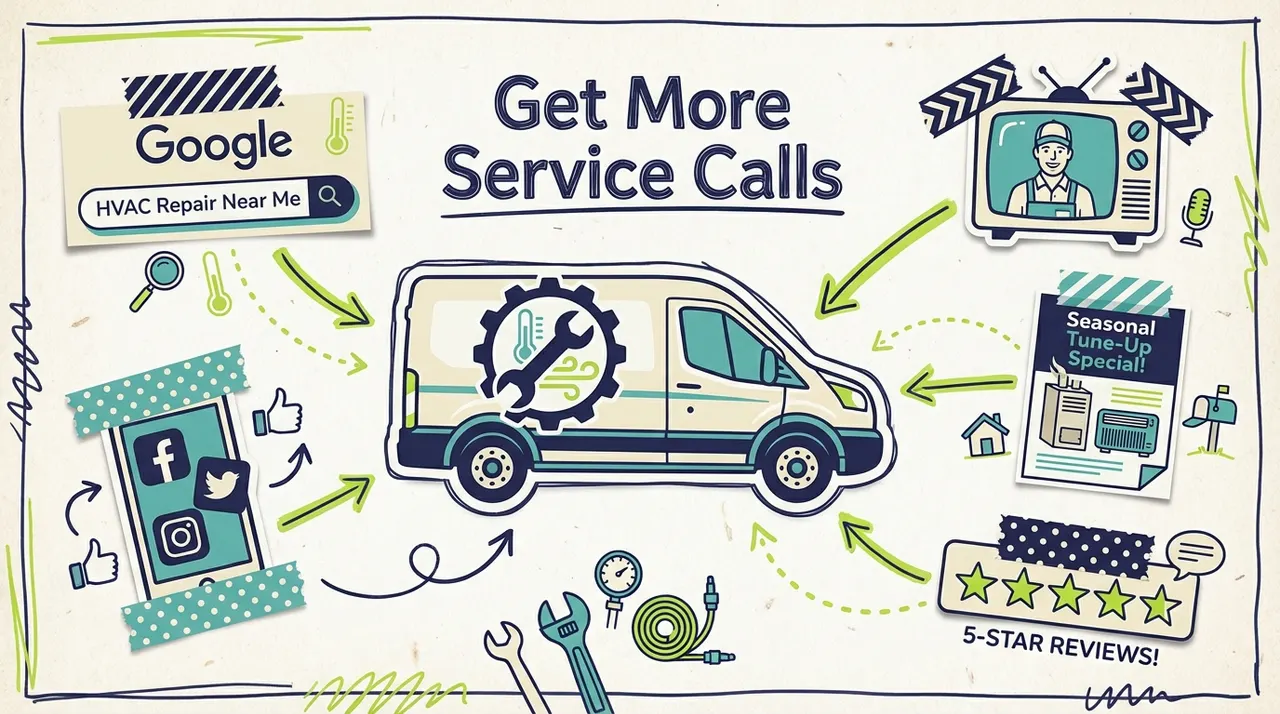
Your technicians are trained. Your trucks are wrapped. Your reviews are solid. But the phone isn't ringing enough, and you're watching competitors in your market grow while you scramble to fill the schedule during shoulder seasons.
Most HVAC companies rely on one or two advertising channels and wonder why growth stalls. Google Ads capture people who are already searching. Yard signs work when you're already in the neighborhood. But neither builds the kind of sustained awareness that turns your company into the first name homeowners think of when the furnace dies at 11 p.m. on a Saturday.
The HVAC industry in the U.S. generates roughly $31 billion in annual revenue, and that number keeps climbing as aging housing stock and extreme weather push demand higher. But more demand also means more competition. The Bureau of Labor Statistics projects 6% job growth for HVAC mechanics through 2032, which translates to more companies fighting for the same homeowners.
The HVAC businesses pulling ahead aren't just spending more on ads. They're spreading their budgets across the right mix of channels so they capture emergency calls, build trust before problems happen, and stay visible year-round. This guide walks through seven advertising channels that work for HVAC companies, with real cost benchmarks, honest pros and cons, and a budget framework you can apply this month. (For a quick-hit comparison of which channels rank best overall, see our best advertising for HVAC companies breakdown.)
Google Ads and Local Services Ads

When a homeowner's air conditioner stops cooling in the middle of July, they don't scroll Instagram. They grab their phone and search "AC repair near me" or "emergency HVAC service." Google Ads put you at the top of those results, right when purchase intent is at its peak.
But for HVAC companies, standard Google Ads are only half the story. Google Local Services Ads (LSAs) have become the single most important paid channel for home services businesses, and they work differently from traditional pay-per-click.
How LSAs work for HVAC
LSAs appear above standard Google Ads, above organic results, and above the map pack. They show your company name, review rating, hours, and a "Google Guaranteed" badge that tells homeowners Google has verified your business. That badge is powerful. According to a 2024 BrightLocal survey, 76% of consumers say they "regularly" read online reviews when choosing a local business, and the Google Guaranteed badge adds an extra layer of trust beyond reviews alone.
The pricing model is what makes LSAs especially valuable: you pay per lead, not per click. A homeowner has to call you or message you through the platform before you're charged. Google's dispute process also lets you contest invalid leads (wrong number, outside your area, spam), which means you're paying almost exclusively for real opportunities.
For most HVAC markets, LSA lead costs run $25 to $75 per lead. That's high compared to some channels, but the conversion rate is significantly better because these are homeowners who need service right now.
Standard Google Ads still matter
LSAs don't cover every scenario. If you want to promote maintenance plans, equipment installations, or specific seasonal offers, standard search campaigns give you that flexibility. You can write custom ad copy, send traffic to specific landing pages, and control your messaging in ways LSAs don't allow.
HVAC keywords are expensive, though. WordStream's industry benchmarks show average cost-per-click for HVAC terms running $15 to $40, with high-intent emergency keywords like "furnace repair near me" or "AC not working" sometimes exceeding $50 in competitive metros like Phoenix, Dallas, or Atlanta.
Making Google Ads profitable
The HVAC companies that get the best return from Google Ads follow a few consistent patterns:
Segment campaigns by service type. Don't lump AC repair, furnace installation, and duct cleaning into one campaign. Each service has different margins, conversion rates, and keyword costs. Separate campaigns let you allocate budget where the ROI is strongest.
Use call tracking. Services like CallRail or CallTrail assign unique phone numbers to each campaign so you know exactly which keywords and ads generate actual service calls, not just clicks.
Schedule bids around urgency. Increase bids during evenings and weekends when emergency calls spike and competition for those time slots thins out.
Add location and call extensions. Showing your address, phone number, and service area directly in the ad increases click-through rates by up to 10%, according to Google.
Bid on competitor names. When someone searches "Smith Heating and Air reviews," your ad can appear above their results. It's aggressive, but legal and effective for capturing homeowners who are still comparing options.
Cost expectation: $1,500 to $5,000 per month for a combined LSA and search ads strategy. Companies in major metros may spend more.
Best for: Capturing high-intent emergency calls and homeowners actively shopping for HVAC services.
Meta and Instagram Advertising
Google Ads capture demand that already exists. Meta advertising (Facebook and Instagram) creates demand by reaching homeowners before they have a problem.
Think about it from the homeowner's perspective. Nobody wakes up thinking about their HVAC system, until it breaks. By the time they're searching "AC repair," they're in crisis mode and price sensitivity goes through the roof. Meta ads let you reach those same homeowners weeks or months earlier, when they're calm, receptive, and open to learning about maintenance plans or system upgrades.
Why Meta works for HVAC
Facebook's targeting options are extremely granular for local home services. You can target by zip code, household income, homeownership status, home age, and even life events like "recently moved." That last one is gold for HVAC companies, because new homeowners often need inspections, maintenance contracts, or system replacements.
According to Meta's Q4 2024 earnings, the platform reaches 2.1 billion daily active users globally. More importantly for local HVAC companies, Meta's algorithm excels at identifying the small subset of people in your area most likely to engage with your ads based on behavior patterns.
What performs best
The content that drives results for HVAC companies on Meta isn't polished corporate marketing. It's practical, educational, and slightly informal:
Seasonal maintenance reminders. "Your AC worked hard this summer. Here's what happens if you skip fall maintenance." These posts generate comments, shares, and appointment bookings because they address something homeowners vaguely know they should do but keep putting off.
Before-and-after content. Photos or short videos showing filthy air filters, corroded coils, or dramatic temperature readings before and after service. This type of content stops the scroll because it's visual, surprising, and relevant. Sprout Social's 2024 benchmarks show short-form video gets 2.5 times more engagement than static images on Meta platforms.
Customer testimonial videos. A 30-second clip of a happy homeowner saying "They came out at 10 p.m. and had our heat running by midnight" carries more weight than any ad copy you'll ever write.
Limited-time offers. "$49 furnace tune-up before December 1" with a clear call-to-action button that links to your scheduling page.
Retargeting is where Meta really shines
Someone visited your website's "AC installation" page but didn't schedule an estimate? Retarget them on Facebook and Instagram with a follow-up ad: "Still thinking about a new AC system? Here's what our customers say." Retargeting audiences convert at 2 to 3 times the rate of cold audiences because they already know who you are.
You can also build lookalike audiences from your existing customer list. Upload your customer emails, and Meta's algorithm finds homeowners in your area who share similar demographics and behavior patterns. It's like cloning your best customers.
Where Meta falls short
Intent is the core limitation. People scrolling their feed aren't thinking about HVAC, and interruption-based advertising always converts at lower rates than search-based channels. You'll generate impressions and awareness, but direct phone calls per dollar spent will be lower than Google Ads.
Meta also requires consistent investment and testing. A one-time $200 boost on a single post won't move the needle. You need ongoing campaigns with regular creative refreshes. Budget $800 to $2,500 per month for results that are worth measuring.
Cost expectation: $800 to $2,500 per month. CPMs for local HVAC audiences typically range from $8 to $20.
Best for: Building brand awareness, promoting seasonal maintenance plans, retargeting website visitors who didn't convert, and reaching homeowners before emergencies happen.
Local SEO and Google Business Profile
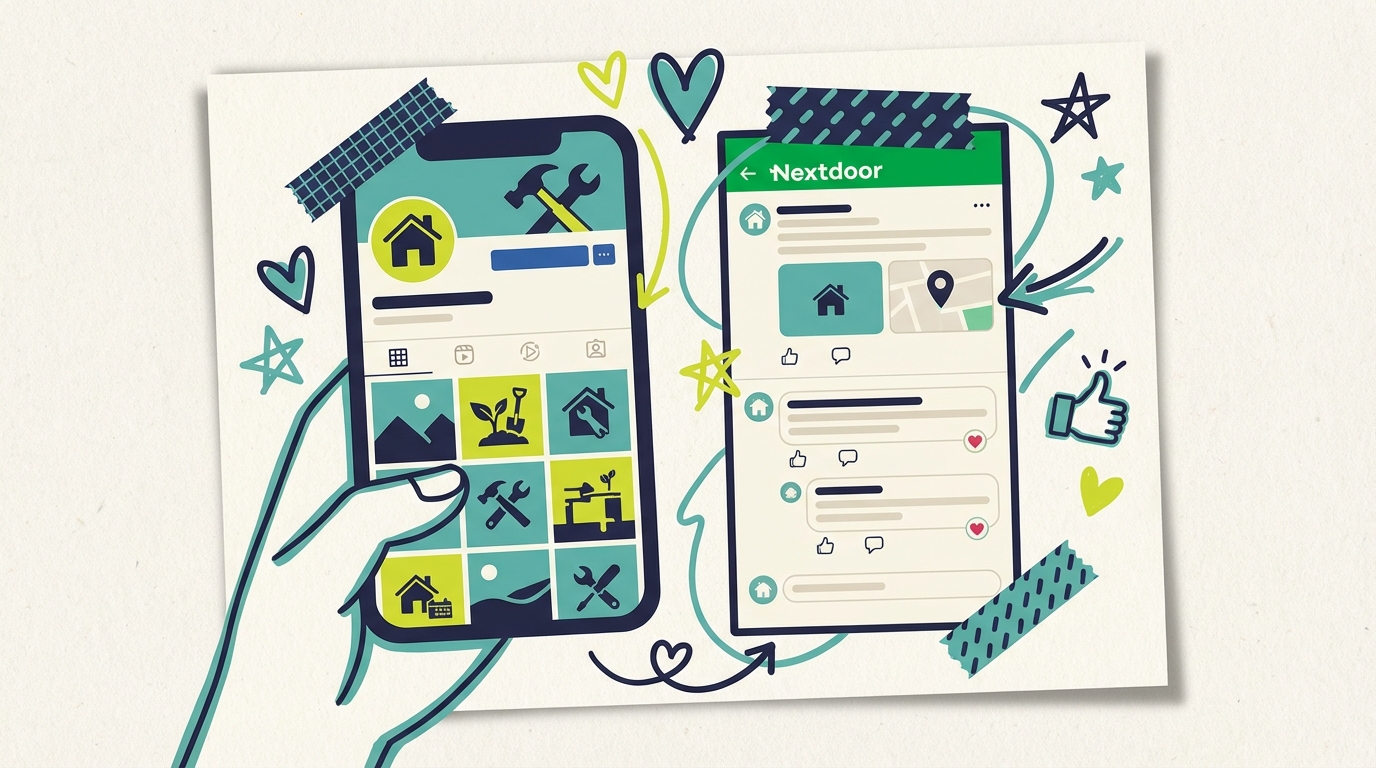
If paid advertising is the faucet you can turn on and off, local SEO is the well. It takes time to dig, but once it's flowing, you get a steady stream of leads without paying for every single one.
When someone searches "HVAC companies near me" or "best heating company in [city]," Google displays a map pack with three local businesses above the organic results. Getting into that map pack is the single most valuable organic real estate for an HVAC company. According to a 2024 BrightLocal study, 87% of consumers read online reviews for local businesses, and 42% of local searchers click on results within the map pack.
Google Business Profile is your foundation
Your Google Business Profile (GBP) is the anchor of local SEO for HVAC. It controls what homeowners see when they find you in search: your name, address, phone number, hours, photos, reviews, and service categories. An incomplete or outdated profile tells homeowners you don't pay attention to details, which is the last thing you want them thinking before letting you into their home.
Optimize your GBP by completing every available field: service area, business categories (choose "HVAC contractor" as primary, then add "air conditioning repair service," "furnace repair service," etc.), service descriptions, and attributes. Upload photos monthly of your team, trucks, completed jobs, and equipment. Google's algorithm favors profiles with frequent activity.
Reviews are your ranking signal and your sales tool
Review count and quality are among the strongest ranking signals for the local map pack. But they also directly influence whether a homeowner calls you or the company listed below you. A company with 300 reviews averaging 4.8 stars will consistently beat a company with 40 reviews averaging 4.9 stars, because volume signals reliability.
Build reviews systematically. Train technicians to mention reviews at the end of every service call. Send automated follow-up texts or emails with a direct link to your Google review page. Make it easy and you'll see volume climb steadily.
Respond to every review, positive and negative, within 24 hours. Thoughtful responses to negative reviews build more trust than five-star praise, because they show how you handle problems.
Local content builds authority
Publish location-specific content on your website: "Common AC Problems in [City] Summers" or "When to Replace Your Furnace in [Region] Winters." This content targets long-tail keywords that your competitors ignore and signals geographic relevance to Google's algorithm.
Cost expectation: Free to set up and maintain GBP yourself. Professional local SEO services run $500 to $2,000 per month.
Best for: Long-term lead generation, building credibility through reviews, and reducing dependence on paid channels over time.
Yelp, HomeAdvisor, and Angi
Lead generation platforms promise a steady flow of homeowners looking for HVAC services. The appeal is obvious: someone else handles the marketing, and you answer the phone. The reality is more complicated.
What these platforms offer
Homeowners on Yelp, HomeAdvisor (now rebranded as Angi Leads), and Thumbtack have already identified their problem. They know they need an HVAC company. That pre-qualification means conversion rates can be decent, especially for newer HVAC companies that haven't built a strong organic presence yet.
Yelp works differently from the lead-gen platforms. It functions more like a review directory, and a strong Yelp profile (4+ stars, 50+ reviews, complete business info) generates free organic leads from homeowners who trust the platform for finding contractors. According to a 2023 Yelp Economic Average report, home services businesses with complete profiles and 10+ photos received 5 times more customer leads than those without.
The shared-lead problem
HomeAdvisor and Angi typically sell each lead to three to five HVAC companies simultaneously. That turns every inquiry into a bidding war before you've even spoken with the homeowner. A 2023 Contractor Magazine survey found that nearly 40% of contractors rated lead quality from these platforms as "poor" or "very poor."
Lead costs on these platforms range from $30 to $75 per lead, and you're charged whether the homeowner answers the phone or not. When you factor in shared leads and no-shows, the true cost per acquired customer often reaches $150 to $300.
Using platforms strategically
Rather than relying on lead-gen platforms as your primary source of work, treat them as a supplement:
Invest in your Yelp profile (free) by collecting reviews and uploading job photos regularly
Use HomeAdvisor/Angi to fill schedule gaps during slow shoulder seasons
Track your actual cost per acquired customer, not just cost per lead, and reduce spending if the math doesn't work
Always push for direct relationship building so repeat customers call you, not the platform
Cost expectation: Yelp profile optimization is free; Yelp Ads run $300 to $1,000+ per month. HomeAdvisor/Angi costs $30 to $75 per lead, with annual spend often reaching $5,000 to $15,000.
Best for: Filling schedule gaps during slow periods, building initial customer base for newer companies, and maintaining a strong review presence on platforms homeowners trust.
Direct Mail and Door Hangers
Digital channels get all the attention, but physical mail still lands in mailboxes. For HVAC companies with defined service territories, direct mail and door hangers offer something digital can't: guaranteed delivery to every home in a neighborhood.
EDDM is built for HVAC
Every Door Direct Mail (EDDM) through the USPS lets you send postcards to every address on specific mail carrier routes without needing a mailing list. You choose routes that match your service area and target demographics, and the USPS handles delivery at reduced postage rates.
According to the Data & Marketing Association, direct mail achieves a 4.4% response rate for prospect lists, compared to 0.12% for email. That response rate holds up for HVAC seasonal offers because the timing and relevance align: a "Schedule your fall furnace tune-up, $49 special" postcard arriving in September hits homeowners at exactly the right moment.
Door hangers after service calls
Here's a tactic most HVAC companies miss: leave door hangers on 10 to 20 neighbors' doors after every service call. The copy is simple: "We just serviced your neighbor's [AC system / furnace]. Want us to check yours? Mention this card for $25 off." This turns every completed job into a neighborhood prospecting opportunity.
The cost is minimal ($0.10 to $0.25 per hanger plus printing), and the conversion rate is higher than cold mail because social proof is built in. Your truck was just in the driveway. The neighbors noticed.
Limitations to consider
Direct mail lacks targeting beyond geography. Your postcard reaches renters, people with brand-new systems, and homeowners who'll never call. Tracking is also difficult unless you use unique phone numbers or promo codes on each piece.
Cost expectation: EDDM postcards run $0.20 to $0.50 per piece. A campaign targeting 10,000 homes costs $2,000 to $5,000 including design and printing. Door hangers cost $0.10 to $0.25 each.
Best for: Seasonal maintenance promotions, announcing new service areas, neighborhood-level prospecting after completed jobs, and reaching older homeowners who aren't as active online.
TV and CTV Advertising
There's one advertising channel that most HVAC companies dismiss without a second thought: television. The assumption is that TV ads cost tens of thousands of dollars and are only for national brands with Super Bowl budgets.
That assumption is outdated. Connected TV (CTV) advertising, which delivers ads through streaming services like Hulu, Roku, Peacock, and Tubi, has made television accessible to local businesses at budgets that compete with what you'd spend on Google Ads or direct mail.
Here's why TV matters for HVAC specifically. Homeowners make HVAC decisions based on trust. They're letting a stranger into their home to work on a system worth thousands of dollars. When they've seen your company on their TV during a show on NBC or ESPN, you carry a level of credibility that a Google ad or Facebook post simply can't match. According to a 2024 TVB/Harris Poll study, 62% of consumers say they trust TV ads more than ads on social media.
CTV combines that credibility with the targeting precision of digital. You can reach homeowners in specific zip codes, filter by household income and homeownership status, and time your campaigns around seasonal demand. With Adwave, you can create a professional-quality 30-second commercial in about two minutes using AI and launch it across 100+ premium channels starting at just $50.
The seasonal angle works perfectly for HVAC. Ramp up before summer heat and winter cold, then scale back during mild months. For a deep dive into TV specifically, see our TV advertising guide for HVAC companies.
Cost expectation: Campaigns start at $50. A meaningful monthly budget runs $500 to $3,000. CPMs range from $15 to $35 for local audiences.
Best for: Building brand trust, becoming the "first call" company in your service area, and reaching homeowners before emergencies happen.
Channel Comparison Table
Recommended Budget Allocation
How much should you spend on HVAC advertising? Industry benchmarks suggest allocating 5% to 10% of gross revenue to marketing. For a company generating $750,000 in annual revenue, that's $37,500 to $75,000 per year, or roughly $3,000 to $6,000 per month.
Here's how to split that budget based on your company's stage:
Startup phase ($1,500 to $3,000 per month)
Focus on channels that generate immediate calls:
Google Ads / LSAs: 50% of budget ($750-$1,500)
Google Business Profile optimization: 15% ($225-$450) or DIY
Yelp / lead platforms: 20% ($300-$600)
Door hangers after every service call: 15% ($225-$450)
At this stage, every dollar needs to produce a trackable lead. Brand building can wait until the schedule is full.
Growth phase ($3,000 to $6,000 per month)
You have steady work, but you want to expand your service area and reduce dependence on lead platforms:
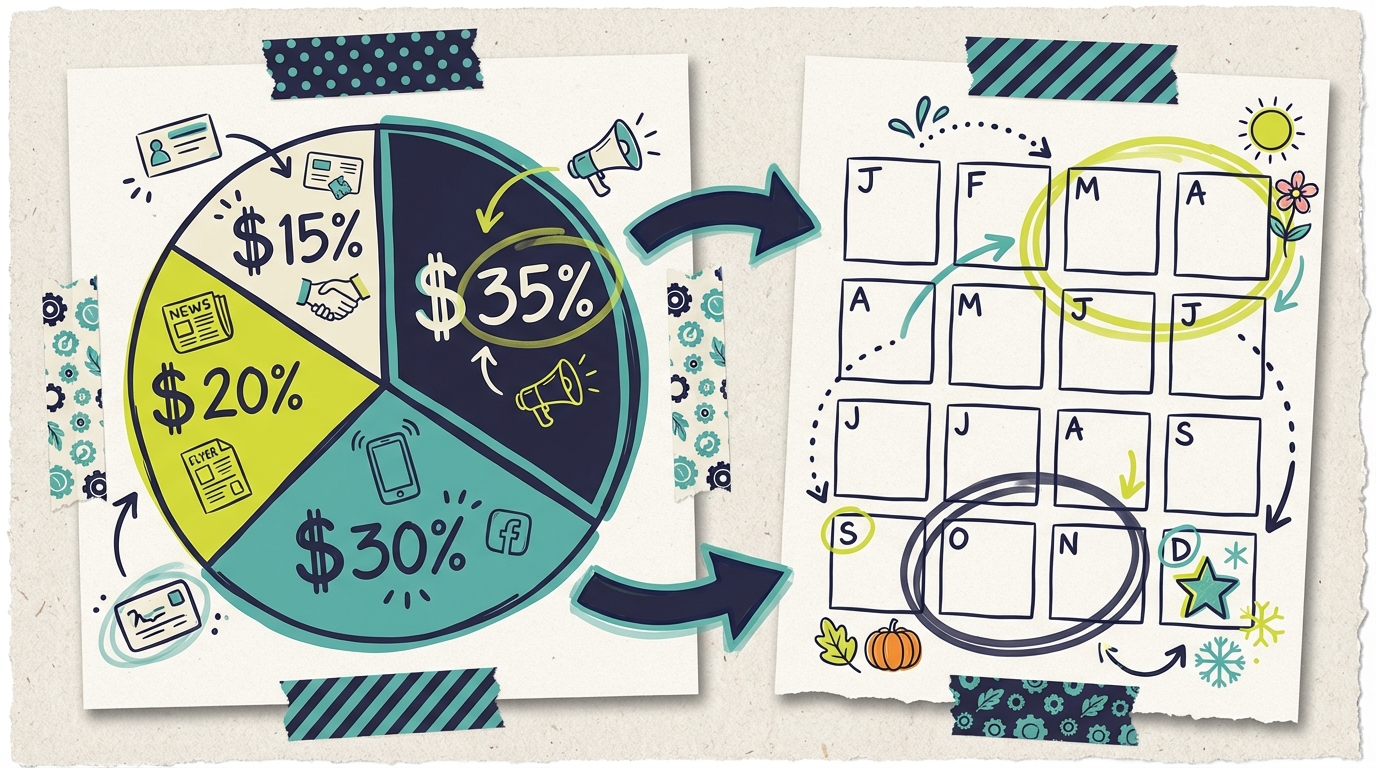
Google Ads / LSAs: 35% ($1,050-$2,100)
Meta / Instagram: 20% ($600-$1,200)
Local SEO: 15% ($450-$900)
TV / CTV (via [Adwave](https://adwave.com)): 15% ($450-$900)
Direct mail / seasonal campaigns: 15% ($450-$900)
This is where advertising your small business across multiple channels starts compounding. TV builds the trust that makes Google Ads convert better. Local SEO reduces your long-term ad spend.
Established phase ($6,000+ per month)
You're the known name in your market. Now you're defending market share and growing into new territories:
Google Ads / LSAs: 25% ($1,500+)
TV / CTV: 20% ($1,200+)
Meta / Instagram: 20% ($1,200+)
Local SEO: 15% ($900+)
Direct mail / seasonal: 10% ($600+)
Yelp / directories: 10% ($600+)
At this level, your local TV advertising investment generates a halo effect. Homeowners who see your commercial are more likely to click your Google ad, open your mailer, and choose you over competitors on Angi.
Seasonal Advertising Calendar for HVAC
Timing matters as much as channel selection. Here's when to push each channel hardest:
January through February: Furnace emergencies peak. Increase Google Ads budget by 25% to 50%. Run Meta ads promoting heating tune-ups and emergency service availability.
March through April: Shoulder season. Scale back emergency spend and shift to maintenance messaging. Send EDDM postcards promoting spring AC tune-ups before summer hits. This is a strong time to run a CTV campaign because ad inventory costs drop while you build awareness ahead of summer demand.
May through June: AC installation season begins. Ramp up Google Ads for cooling keywords. Launch Meta campaigns featuring equipment upgrade offers. Door hangers after every installation job.
July through August: Emergency AC calls peak. Maximize LSA budget. Run retargeting campaigns on Meta for homeowners who visited your site but didn't book.
September through October: Mirror spring strategy. EDDM postcards for furnace tune-ups. CTV campaigns building awareness before winter. This is your best window for generating contractor leads ahead of the heating season rush.
November through December: Holiday slowdown for non-emergency work. Reduce overall ad spend but keep LSAs running for emergency heat calls. Use this time to collect reviews and optimize your GBP for the new year.
Common Questions Answered
How much should an HVAC company spend on advertising each month? Most HVAC businesses should budget 5% to 10% of annual gross revenue for advertising. For a company bringing in $500,000 per year, that works out to $2,000 to $4,000 per month. Newer companies competing in crowded markets may need to push closer to 10% to 12% to build initial traction, while established companies with strong brand recognition can sometimes maintain growth at the lower end.
What is the fastest way to get more HVAC service calls? Google Local Services Ads generate calls the fastest because they put you in front of homeowners with immediate needs. You can launch an LSA campaign and start receiving leads within a few days of approval. Pair that with a well-optimized Google Business Profile (complete info, fresh photos, strong reviews) and you'll capture both paid and organic demand from high-intent searchers.
Does HVAC advertising work during the off-season? Absolutely, and it's often more cost-effective. Ad inventory costs drop during shoulder seasons (spring and fall), which means your budget stretches further on platforms like Meta and CTV. Promoting maintenance plans and system inspections during slower months keeps your schedule full and builds the customer relationships that lead to replacement jobs down the road.
Is TV advertising realistic for a small HVAC company? Yes. CTV advertising has eliminated the cost barrier that kept local businesses off television. Platforms like Adwave let you create a broadcast-quality commercial in minutes and run it on premium streaming networks starting at $50. You won't match a national brand's reach, but you can target homeowners in your exact service area and build the kind of trust that makes every other advertising channel perform better.
Should I hire a marketing agency or handle HVAC advertising in-house? It depends on your volume and expertise. Google Business Profile optimization, review collection, and door hanger distribution are straightforward enough to manage yourself. Google Ads and Meta campaigns benefit from professional management once you're spending $2,000 or more per month, because the optimization complexity justifies the agency fee (typically 10% to 20% of ad spend). CTV platforms like Adwave are designed for business owners to run themselves without agency help.


