
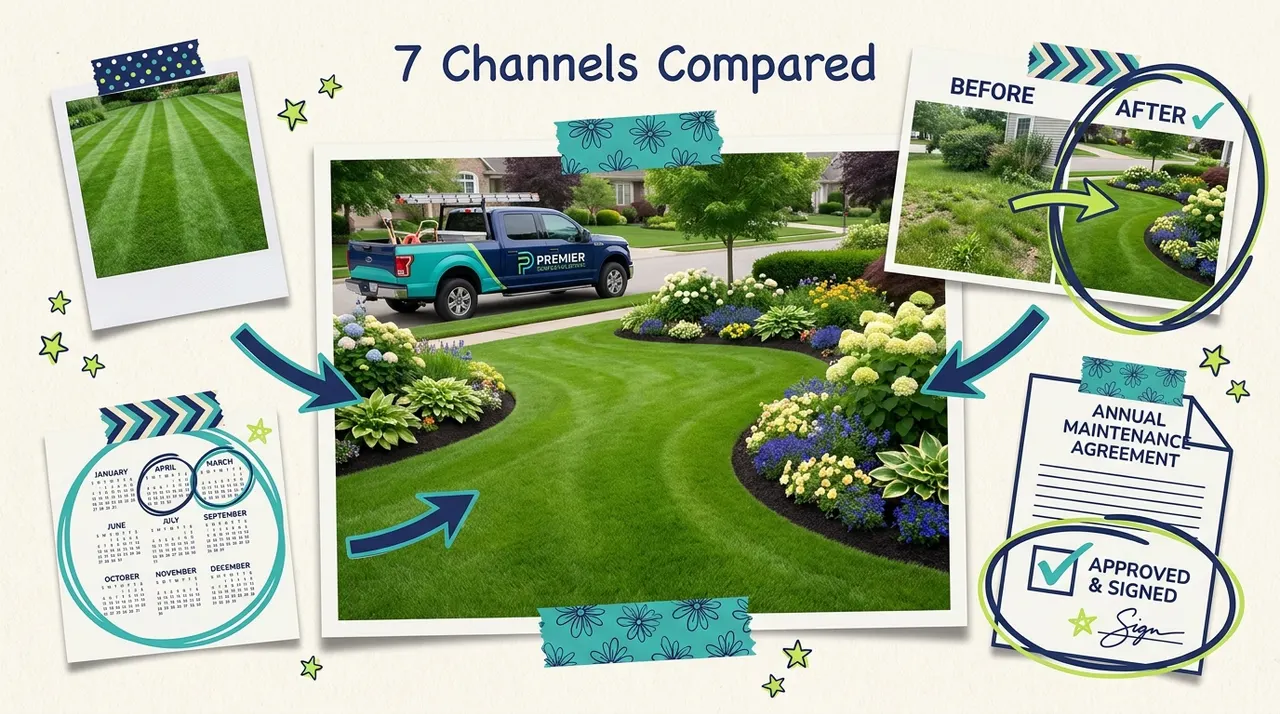
Landscaping is a feast-or-famine business. Spring hits, and every homeowner in a 20-mile radius suddenly wants their lawn back in shape. By September, calls dry up. The companies that build recurring route-based revenue, not just one-off cleanup jobs, are the ones still profitable in February.
The U.S. landscaping services industry is a $153 billion market, growing 6% annually (IBISWorld, 2024). More than 600,000 companies compete for residential, commercial, and municipal work. Most are local operators with 1-10 employees, which means the market is wide open for smart marketers to take real share in their territory.
Landscaping customers don't evaluate services the way they evaluate a restaurant or a haircut. They're making a recurring purchase decision, often annual, and they're looking for reliability more than price. The advertising channels that work best are the ones that build name recognition over weeks and months, not just capture the one-time Google search.
This guide covers seven proven advertising channels for lawn care and landscaping companies: Google Ads, Meta, local SEO, Nextdoor and neighborhood platforms, direct mail, CTV advertising, and referral partnerships. You'll get realistic budgets, seasonal timing, and tactics built specifically for route-based service businesses.
Why Landscaping Advertising Is Different
Before diving into channels, understand what makes landscaping different from other home services.
Recurring revenue is everything. A customer acquired for a $75 one-time mow is worth roughly $2,000-$4,000 per year if you convert them to a weekly or biweekly maintenance plan. That's a massive lifetime value multiplier, and it changes how much you should be willing to spend on acquisition.
Route density drives profitability. Landscaping economics improve dramatically when you service multiple homes on the same street. Acquiring 10 random customers across a city is less profitable than acquiring 10 customers in the same neighborhood. Your advertising should target by geography, not just by homeowner profile.
Seasons dictate everything. Demand curves for landscaping are steeper than almost any other service. March-June is 70% of annual new customer acquisition for most companies. Your advertising calendar needs to match.
Trust beats price. Homeowners don't want the cheapest lawn crew. They want a crew they trust around their home, their pets, and their kids. According to BrightLocal's 2024 Local Consumer Survey, 87% of consumers read online reviews before choosing a local service provider, and review quality matters more for in-home services than pickup services.
With those dynamics in mind, here are the seven channels that work.
Google Ads: Catching Homeowners in Spring Panic
When April hits and a homeowner realizes their lawn is a mess, they search. "Lawn care near me." "Landscaping company [city]." "Lawn mowing service." Google Ads puts your company in front of those searches.
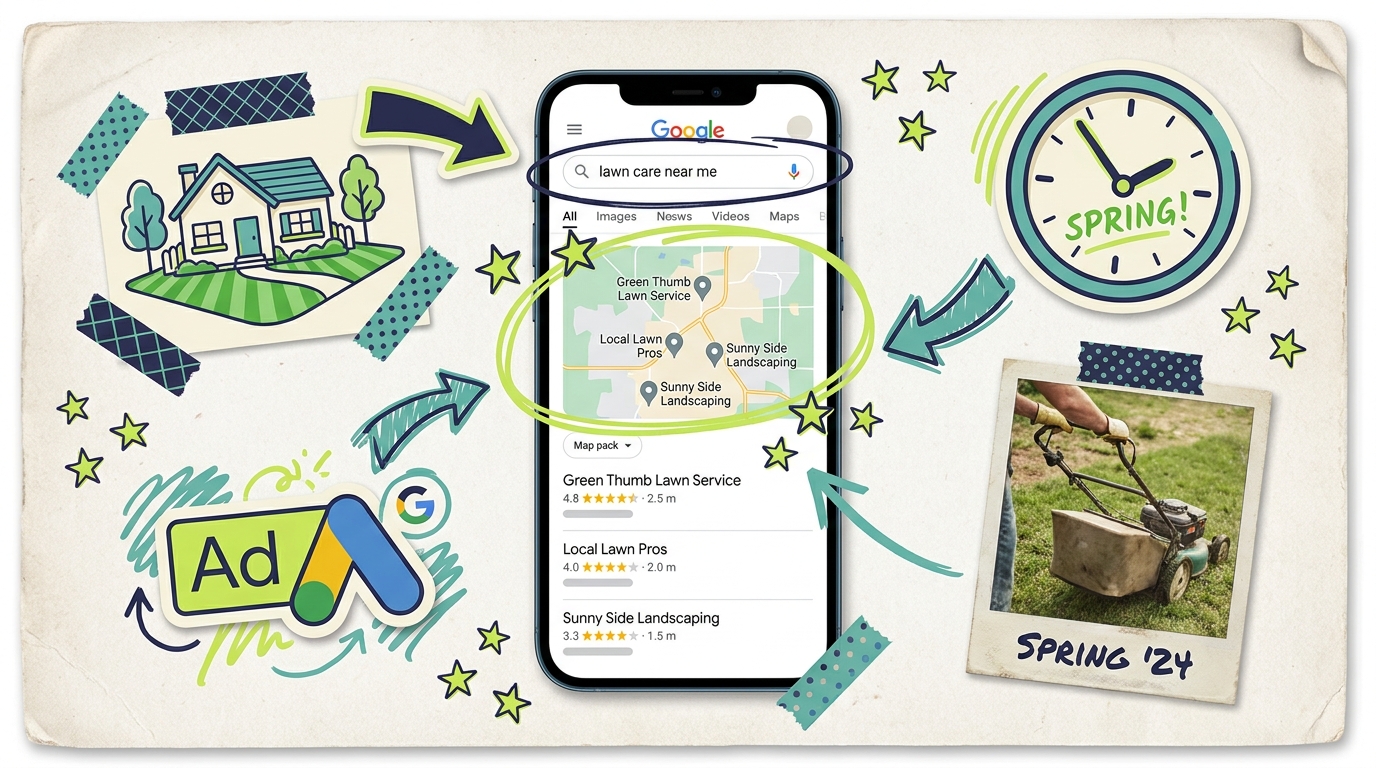
According to Google's internal data, 76% of local searches result in a business visit inside 24 hours (Google, 2023). For landscaping in spring, the decision window is even tighter. Homeowners see the grass growing faster than they can keep up, panic, and choose in a day or two.
Keywords That Drive Route Customers
Structure campaigns around these categories:
Core service searches: "lawn care near me," "landscaping near me," "lawn mowing service," "yard maintenance [city]"
Specific services: "weekly lawn service," "mulch installation," "tree trimming," "sod installation," "lawn fertilization," "spring cleanup"
Seasonal searches: "spring yard cleanup," "fall leaf removal," "lawn aeration fall," "spring landscaping package"
Commercial-focused: "commercial landscaping [city]," "HOA lawn care," "office park maintenance"
Campaign Types
Search campaigns are the foundation. Focus on high-intent keywords and ads that highlight recurring plans, licensed and insured status, and local ownership.
Local Services Ads (LSAs) with the Google Guaranteed badge appear above regular search ads. Leads cost $15-$50 each for landscaping, and you only pay when someone contacts you. Strong performers for lawn care.
Performance Max for companies with visual content (before/after lawn transformations, landscape design portfolios) can work well alongside search.
Budget and Expectations
Single-location landscaping companies should budget $1,200-$4,000 per month during peak season (March-July) and scale down to $500-$1,500 off-season. CPCs for lawn care run $5-$18 depending on market, with lower costs in smaller metros. Expect cost per qualified lead of $25-$65, with close rates of 30-45% for recurring service.
Tips for Better Results
Use call tracking to measure which keywords produce actual route customers
Run heavy budget March through July, taper in August, kick back up in September for fall cleanup
Create separate campaigns per service category so you can bid appropriately for high-value irrigation vs. lower-margin mowing
Include negative keywords: "free lawn care," "DIY lawn," "lawn care jobs," "lawn care supplies"
Location extensions and call extensions are must-haves
Google Ads captures demand that already exists. It's essential, but it only reaches the small slice of homeowners searching right now.
Meta and Instagram Ads: Showing Off Transformations
Landscaping has a massive visual advantage over most home services. Before-and-after transformations are dramatic, beautiful, and scroll-stopping. Meta (Facebook and Instagram) is built for exactly this.
Unlike Google, Meta users aren't searching. They're scrolling. But when they see a stunning lawn transformation or a backyard makeover in their feed, they stop. And over time, your company becomes the one they think of when they need work done.
Meta Business data shows that video ads produce 1.2x higher engagement than static images, and local service businesses see 3-5x higher recall from branded video content (Meta, 2024).
Campaign Types for Landscaping
Awareness campaigns put your brand in front of homeowners in a 15-20 mile radius of your service area. Target homeowners age 35-65, filter by home ownership, run your best before/after content.
Lead generation campaigns collect contacts via Meta's in-app forms. Offer a free quote, seasonal package estimate, or first-month discount. Expect leads at $20-$55 each for lawn care.
Retargeting campaigns reach people who visited your website but didn't call. These warm leads convert at 2-3x the rate of cold traffic.
Seasonal campaigns tied to spring cleanup, mulch delivery, fall aeration. Announce seasonal offerings 3-4 weeks before the peak.
Creative Ideas for Landscaping
Transformation videos: Time-lapse a weekend landscaping project into 30 seconds
Before-and-after carousels: 4-5 dramatic transformations in a single swipeable ad
Process explainers: Why core aeration works, how to time fertilizer applications, what's included in a spring cleanup
Customer testimonial videos: Real homeowners on their finished lawns
Behind-the-scenes content: Crews at work, equipment, early-morning truck loading (surprisingly engaging)
Budget and Expectations
Budget $500-$2,000 per month for Meta in peak season, $200-$600 off-season. CPMs run $8-$18 for locally targeted audiences. Lead gen campaigns produce contacts at $20-$60, with conversion rates of 10-25% to booked service.
Tips for Better Results
Target "homeowners in this location," not "recently visited"
Build custom audiences from your existing customer list, then create lookalikes
Rotate creative every 2-3 weeks to prevent fatigue
Run heavier budget leading up to each seasonal peak, then pull back
Exclude apartments/multi-family from targeting
Meta builds brand awareness that Google can't. It won't replace search for immediate demand capture, but it makes you the company homeowners remember when spring hits.
Local SEO and Google Business Profile: The Map Pack
Your Google Business Profile is the most important piece of free digital real estate you have. When someone searches "lawn care near me," Google shows a map pack of three local results above everything else. Being in that top three is worth more than any single paid campaign.
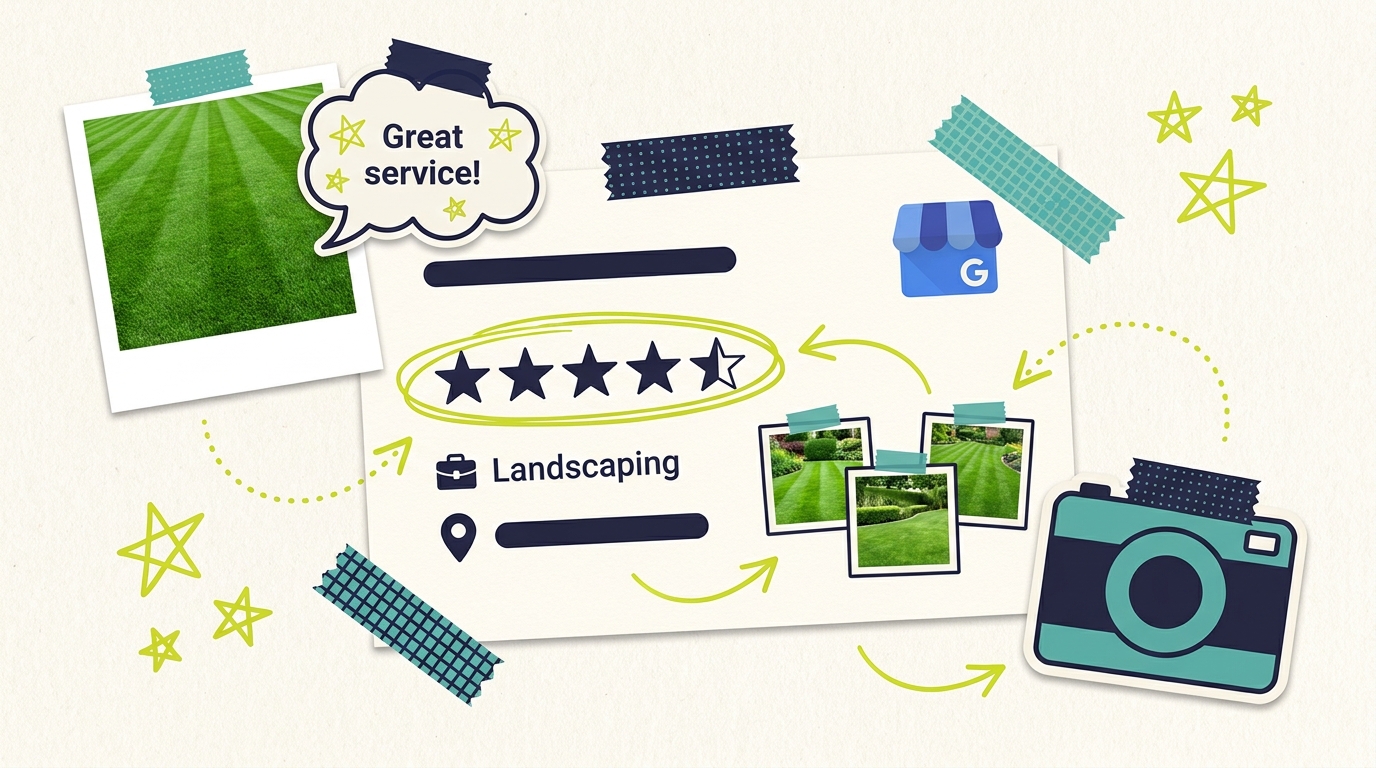
BrightLocal's 2024 Local Consumer Survey found that 87% of consumers use Google to evaluate local businesses, and map pack listings capture 44% of all local search clicks. For landscaping, where decisions are geography-driven, the map pack is where the money is.
Optimizing Your Google Business Profile
Fill every field. Categories, services, service area, hours, attributes, description. Most landscaping companies leave services under-specified. Add every specific service you offer: "sod installation," "commercial snow removal," "hydroseeding," "stump grinding."
Post weekly. Free GBP posts influence rankings and keep your profile active. Post seasonal tips, service specials, and completed job photos. Companies posting at least once a week rank 10-15% higher on average (LocalIQ, 2024).
Upload photos constantly. Before-and-after shots, team photos, equipment, trucks. Profiles with 100+ photos get 520% more calls than those with fewer than 10 (Google, 2023). Landscaping is visual: use it.
Answer the questions section. Seed Q&As about pricing, service areas, equipment, insurance. If you don't answer first, competitors or customers can.
Reviews Drive Rankings
Reviews matter enormously in the map pack. Companies with 50+ reviews at 4.5 stars or higher consistently outrank those with fewer reviews, regardless of profile completeness.
Build a review engine:
Text every customer a review link after the first month of service
Train crew leaders to ask for reviews on completion days
Respond to every review in 48 hours or less, positive or negative
Never buy or incentivize reviews (Google will suspend your profile)
Local Citations
Make sure your business appears consistently on Yelp, Angi, Thumbtack, BBB, Nextdoor, HomeAdvisor, and industry directories like LawnStarter and LawnSite. Inconsistent name, address, or phone info across listings hurts rankings. Tools like Whitespark or BrightLocal automate citation cleanup for $30-$80 per month.
Budget and Expectations
Local SEO is mostly sweat equity. Budget $200-$700 per month if you hire help for GBP management and review generation. Results compound over 3-6 months. A well-optimized landscaping GBP in a suburban market should generate 30-150 calls per month at zero cost per call.
Nextdoor and Neighborhood Platforms
Landscaping is one of the few service categories where neighborhood social platforms outperform larger paid channels for cost per acquisition. Nextdoor, specifically, is a goldmine for route-based businesses.
Why? Because Nextdoor users actively ask each other for recommendations. "Anyone know a good lawn service?" is posted hundreds of times per day across neighborhoods nationwide. A single trusted recommendation from a neighbor produces more booked revenue than most paid ads.
Nextdoor free presence: Claim your business page, encourage happy customers to recommend you organically, and respond to every thread where someone asks for a landscaper. Don't spam, but be present and helpful.
Nextdoor Local Deals: Paid local deals cost $50-$250 per month depending on market size. Conversion rates are strong because trust is built into the platform.
Facebook Neighborhood Groups: Most cities have active "Moms" groups, HOA pages, and neighborhood pages where recommendations get asked for weekly. Don't sell; help. Answer questions, share seasonal tips, be the local expert.
Recommended-only posts: When customers post positive feedback organically, comment your thanks publicly. This amplifies the social proof and keeps you familiar for neighbors reading.
Budget: Plan $100-$400 per month across Nextdoor paid deals if you're testing. Free organic presence costs nothing but time.
Nextdoor is hyperlocal, which matches landscaping's route-density economics perfectly. Five customers on one street is worth more than 20 scattered across a city. Nextdoor delivers that concentration.
Direct Mail, Door Hangers, and Print
Digital gets most of the attention, but direct mail is still one of the most effective acquisition channels for lawn care. Why? Because you can saturate a specific neighborhood with one offer on one day, something digital can't match.
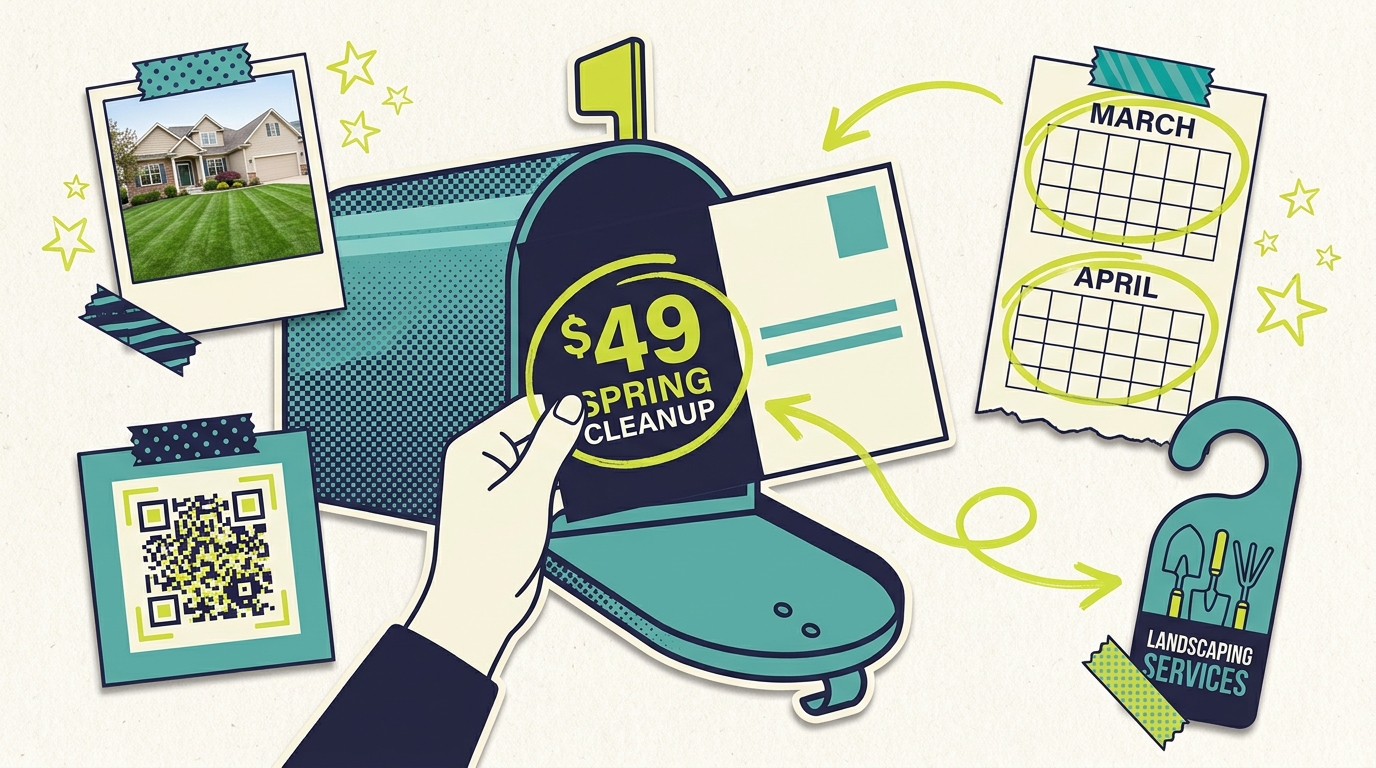
The ANA/DMA 2023 Response Rate Report shows direct mail producing 5-9% response rates for house lists and 1-3% for prospect lists, significantly higher than most digital channels. For landscaping, where customer lifetime value runs $2,000-$4,000 per year, even a 1% response rate is highly profitable.
Direct Mail Tactics That Work
EDDM (Every Door Direct Mail): USPS lets you mail postcards to every address on a carrier route for $0.20-$0.25 per piece. Perfect for saturation in target neighborhoods with the right home-type mix.
Seasonal timing: Mail spring cleanup offers in late February. Mulch and bed-edging offers in early April. Fall cleanup in late August. Mail arrives 3-7 days after drop, so calendar accordingly.
Door hangers: After finishing a job, hang door hangers on the 15-20 neighboring homes. "We just serviced your neighbor. First month free if you sign up this week." Response rates of 2-5% are common because social proof is built in.
Newsletter mailers: Quarterly postcards with seasonal tips and special offers keep you familiar. Not a direct conversion tool but powerful for retention.
Budget and Expectations
Budget $0.30-$0.70 per piece all-in for professionally designed, printed, and mailed postcards. A 5,000-piece EDDM drop costs $1,500-$3,500 and typically produces 50-150 leads. Cost per lead: $15-$45, competitive with digital.
Tips for Better Results
Include a specific offer: "First mow free," "$49 spring cleanup," "20% off seasonal mulch delivery"
Use a tracked phone number or QR code
Test two designs on split drops
Layer direct mail with digital retargeting for compounding effect
Time drops to arrive 1-2 weeks before the ideal service window
Direct mail rewards density. Picking 3-4 high-value zip codes and mailing them aggressively every season builds route concentration that digital can't match.
TV and CTV Advertising
For a long time, TV advertising was out of reach for local landscaping companies. Broadcast and cable minimums started at $20,000+ with annual commitments of six figures to make real impact. That's changed with connected TV.
Connected TV (CTV) means streaming services like Hulu, Peacock, Tubi, Pluto TV, and Roku. These platforms now reach more viewers than cable in many markets, and local advertisers can buy campaigns with budgets starting at $50 (eMarketer, 2024).
For landscaping, CTV builds the trust and familiar recall that drives route conversions. A 30-second CTV spot targeting homeowners in your service area creates the memory that gets your company called first when spring hits.
Platforms like Adwave make CTV realistic for small landscapers. Generate a 30-second ad from your website in about two minutes, target specific zip codes, and launch for as little as $50. CTV CPMs average $15-$35.
For a deeper dive into TV specifically, see our guide to TV advertising for landscaping and lawn care companies.
Budget: $500-$2,500 per month during peak season. Best used alongside Google and Meta, not as a replacement.
Referral Partnerships
Landscaping companies build huge advantages through strategic partnerships. Real estate agents, property managers, HOAs, and complementary service businesses (pool companies, irrigation specialists, tree services) all have homeowner relationships you can tap.
Real estate agents list houses that need lawn care during the sale process. Offer agents a referral fee or a guaranteed 48-hour response on their listings.
Property management companies need reliable vendors for rental properties. Even small PM companies manage 20-200 units, which means 20-200 lawns.
Pool and spa companies work with the same homeowner demographic. Cross-refer customers. You mention their pool company to customers with pools; they mention you to customers with lawns.
HOA management contracts are stable recurring revenue. One HOA can equal 50-200 residential customers, and they rarely switch once they find a reliable vendor.
Tree services and irrigation specialists complement your mowing/maintenance services. Formal partnerships with mutual referral agreements work better than loose handshake deals.
Budget: Referral partnerships are low-cost but require upfront investment in relationship-building. Expect 2-3 months to see meaningful lead flow. Budget 10-15% referral fees or reciprocal referrals as your "cost."
Channel Comparison: What Works When
Here's how the channels stack up for landscaping companies.
No company should try all seven at once. A smart starting mix is Google Ads + GBP + Nextdoor. Once those are producing leads at capacity, add Meta, direct mail, and CTV.
Recommended Budget Allocation by Stage
Stage 1: Launch (0-30 route customers, $2,000-$4,000/month peak)
Google Ads: 55% ($1,100-$2,200)
GBP + Local SEO: 10% ($200-$400)
Meta: 20% ($400-$800)
Nextdoor + referrals: 15% ($300-$600)
Goal: Capture existing search demand. Every dollar toward immediate returns.
Stage 2: Growth (30-150 route customers, $4,000-$8,000/month peak)
Google Ads: 35% ($1,400-$2,800)
Meta / Instagram: 20% ($800-$1,600)
Direct Mail: 15% ($600-$1,200)
GBP / Local SEO: 10% ($400-$800)
CTV: 10% ($400-$800)
Nextdoor / referrals: 10% ($400-$800)
Goal: Diversify. Start building brand presence beyond pure search.
Stage 3: Scale (150+ route customers, $8,000-$20,000/month peak)
Google Ads: 25%
Meta / Instagram: 20%
CTV / Streaming TV: 20%
Direct Mail: 15%
Local SEO + content: 10%
Nextdoor / referrals / HOA biz dev: 10%
Goal: Own the market. Brand-building channels dominate as route density compounds.
Seasonal Advertising Calendar
Landscaping advertising has a different rhythm than most service businesses. Here's a rough calendar for a northern U.S. market.
January-February: Low spend. Pre-launch seasonal campaigns. Plan creative, build email lists, set up direct mail drops for March.
March-April: Peak acquisition window. Maximum budget across all channels. Spring cleanup and mulch offers lead.
May-June: Still heavy spend. Shift from cleanup offers to recurring service plans. Fertilization and weed control programs feature prominently.
July-August: Mid-season. Moderate spend. Commercial and HOA business development. Upsell opportunities for irrigation, sod, hardscape.
September-October: Second peak for fall cleanup and aeration. Ramp Google, Meta, and direct mail back to spring levels.
November-December: Transition to snow removal (if offered) or wind-down. Retention focus: upsell multi-year contracts for spring.
Southern markets compress the calendar. Year-round warm-weather markets spread demand more evenly, with smaller peak:trough ratios.
How to Beat National Chains
TruGreen, Weed Man, Lawn Doctor, and Scotts LawnService combined control roughly 15% of the U.S. residential lawn care market (IBISWorld, 2024). They outspend local companies massively on advertising. But local companies have real advantages.
Customization: National chains sell standardized programs. Local companies can customize schedules, add one-off services, and adjust without corporate approval.
Response time: National chains route calls through distant dispatch centers. Local companies can quote same-day, which wins in competitive situations.
Relationships: Customers remember the crew leader, not the corporate brand. Advertise the people who will show up.
Community: National chains don't sponsor Little League, the school fundraiser, or the chamber of commerce newsletter. Local visibility beats national brand awareness every time.
Flexibility on pricing: You can do custom bundles, seasonal specials, and referral discounts that chains can't match.
Common questions answered
How much should a landscaping company spend on advertising?
Most growing landscaping companies spend 6-10% of gross revenue on advertising, weighted heavily toward March-July. A $400,000 revenue company should budget $24,000-$40,000 per year. New companies often push to 12-15% to accelerate customer acquisition. Mature companies at route capacity can drop to 3-5%. The number depends on route capacity, territory saturation, and how aggressively you want to grow.
Which channel gets the fastest results for a new lawn care company?
Google Search Ads produce leads in hours. Paid search captures people who are already searching, so spending maps directly to calls. Meta ads take 2-4 weeks to optimize. Local SEO takes 3-6 months to compound but is free. Most new companies should start with Google Ads + GBP optimization and reinvest early revenue into slower-compounding channels.
Should landscaping companies advertise year-round or seasonally?
Year-round at reduced levels, peaked March-July. Turning off advertising entirely in off-season costs you the brand recognition you built in peak months. A baseline of $500-$1,500 per month across GBP, Nextdoor, and low-level Meta keeps you present. Then scale budget 3-5x in spring and fall.
Is TV advertising realistic for a small lawn care company?
Yes, now that CTV has lowered the entry point. Traditional broadcast TV still requires large budgets and wasted geographic reach. CTV platforms let local landscapers target homeowners in specific zip codes for $500-$2,500 per month. TV works best alongside digital, not instead of it. The goal is building brand recognition that makes homeowners think of your company first when spring hits.
How do I compete with TruGreen and Weed Man on advertising?
Don't try to outspend them. Focus on speed, personalization, and community presence. Feature the crew leaders who will show up. Highlight same-day quote turnaround. Emphasize local ownership and community involvement. Nationals target homeowners with generic messaging; you can target specific neighborhoods with neighborhood-specific offers.
What's the best way to advertise recurring service plans instead of one-time jobs?
Front-end your advertising around one-time services (spring cleanup, mulch, aeration), then convert to recurring plans at the point of sale. Advertising directly for "weekly lawn service" produces far less volume than advertising for "spring cleanup." Capture the one-time job, deliver great service, and have a defined upsell process where crew leaders pitch the recurring plan at job completion. Successful landscapers convert 40-60% of one-time jobs to recurring customers.
Where to Start This Week
If you're running a landscaping company without a clear advertising system, here's a 30-day plan:
Week 1: Claim and optimize your Google Business Profile. Add every service category, upload 30+ photos including before/after, send review requests to your last 20 customers.
Week 2: Launch a Google Ads campaign targeting core lawn care keywords in your service area at $30-$60 per day. Set up call tracking. Build a simple landing page with a clear phone CTA.
Week 3: Set up Nextdoor business pages and Meta ad account. Run one Meta lead-gen campaign for a spring cleanup offer at $300-$500 for the month.
Week 4: Test a 2,500-piece EDDM drop in your best existing customer neighborhood. Include a tracked number and specific offer.
After 60-90 days, add CTV advertising, industry directories, and deeper referral partnerships once your base channels produce more leads than you can handle.
Landscaping is a route-density business. The advertising channels that work best are the ones that build geographic concentration: local SEO, Nextdoor, direct mail, and CTV. Companies that over-invest in broad Google Ads and under-invest in neighborhood channels leave route density on the table.


