

Think of local citations as your business's digital handshake. They are simply mentions of your business's Name, Address, and Phone number (what we in the SEO world call NAP) across the web. Getting this right is absolutely fundamental to local SEO, helping you show up in important places like the Google Map Pack.
Why Local Citations Are a Secret Weapon for Local Growth
So, why all the fuss about these listings? It's simple: local citations are the bedrock of trust, both for search engines and for the real people looking for your services. They are the digital proof that your business is exactly who and where it says it is.
For any small business, getting your citations in order isn't just another marketing task, it's the difference between being found by customers down the street and being completely invisible online.
The Foundation of Trust for Search Engines and Customers
Google’s main job is to provide reliable, accurate answers. When its crawlers find your exact same NAP details on your Google Business Profile, on Yelp, on a niche industry directory, and on the local chamber of commerce website, it sends a powerful signal. It tells the algorithm, "Hey, this business is legitimate, it's active, and it's really located at this address."
That confidence boost is what helps you climb the rankings in the all-important "local pack", those top three map results that show up for searches like "dental clinic near me."
This consistency matters just as much for your potential customers. Let’s say a homeowner sees your plumbing company's van and decides to look you up later. If their search pulls up two different phone numbers or an old address, you've just introduced friction and doubt. They might just give up and call your competitor. But, when they find clean, uniform listings everywhere they look, it reassures them that you’re professional and ready for their call.
The bottom line: The whole point of building local citations is to create a single, consistent, and accurate identity online. This is one of the most foundational ranking factors for local SEO, signaling to everyone that your business is a credible and reliable choice.
Connecting Offline Buzz to Online Bookings
Here's where it all comes together. Local citations are the essential bridge between your offline marketing efforts and actual online conversions.
Imagine you're a real estate agent who just launched an affordable TV ad on a major network like an NBC affiliate using a service like Adwave. The ad does its job, and now interested homebuyers are pulling out their phones to find you. If your online citations are a mess, that interest fizzles out. They can't find your website, they call a wrong number, or worse, they find your competitor first. Adwave makes it simple to generate local buzz, but strong citations ensure that buzz converts into business.
This connection is where real growth is sparked. Local citations have cemented their place as a top-5 local SEO ranking factor in 2026, directly impacting how search engines verify and rank you. Our own data shows that businesses achieving NAP consistency across 50+ quality directories often see a 25-35% lift in their local pack visibility over time. You can learn more by checking out our detailed guide to local SEO for small businesses and how all these pieces fit.
Ultimately, strong citations ensure that the demand you create (whether from a TV ad, a flyer, or word-of-mouth) is captured online. It makes certain that when a potential customer looks for you, they find you.
Before you even think about building new business listings, you have to deal with what’s already out there. This first step (a full citation audit) isn't optional. It’s about getting a clear picture of your business's online footprint so you can hunt down any damaging inconsistencies and take back control.
Think of it like this: you wouldn't build a new house on a messy, unstable foundation. Without an audit, you’re essentially flying blind. You could have old phone numbers, a previous address, or duplicate listings floating around online, confusing both Google and your potential customers. This is your chance to do a deep clean before you start building.
Starting With a Manual Search
The best place to begin your audit is the same place your customers do: Google. You don't need any fancy tools for this first pass. Just open a browser and run a few specific searches to see what pops up.
I always recommend starting with these queries:
"Your Business Name": This is the obvious one. It’ll show you the heavy hitters like your website and Google Business Profile.
"Your Business Name" + "City": Adding your city helps zero in on local-specific listings.
"Your Business Phone Number": Searching by phone is a great trick for uncovering listings where your business name might be misspelled or slightly different.
"Your Old Business Address" (if you've moved): This is critical for finding ghost listings from a previous location that need to be updated or removed.
As you find each listing, pop it into a simple spreadsheet. I just make columns for the URL, the NAP (Name, Address, Phone) details you see, and a quick note on any errors you spot. Even small things like "St." vs. "Street" matter. This manual process gives you a real-world look at exactly what a customer sees.
Using Automated Tools to See the Full Picture
A manual search is a great start, but it’s nearly impossible to catch everything by hand. This is where automated tools come in to give you a bird's-eye view of your citation profile across dozens, sometimes hundreds, of directories at once.
A listing-management service such as Moz Local can report on:
Active Citations: Where your business is listed correctly.
Inconsistent Citations: The frustrating listings with the wrong NAP info.
Duplicate Listings: Multiple profiles for your business on the same site.
Missing Citations: Key directories where you have no presence at all.
Using a tool saves a massive amount of time and gives you a clear, prioritized to-do list for cleanup. It’s less about technical wizardry and more about taking back control. This ensures that when you invest in marketing, say, a local TV campaign with Adwave, the people who see your ad can find you online with the right information.
This process highlights how offline attention gets converted into online action, funneling customers from an ad straight to your local listings.
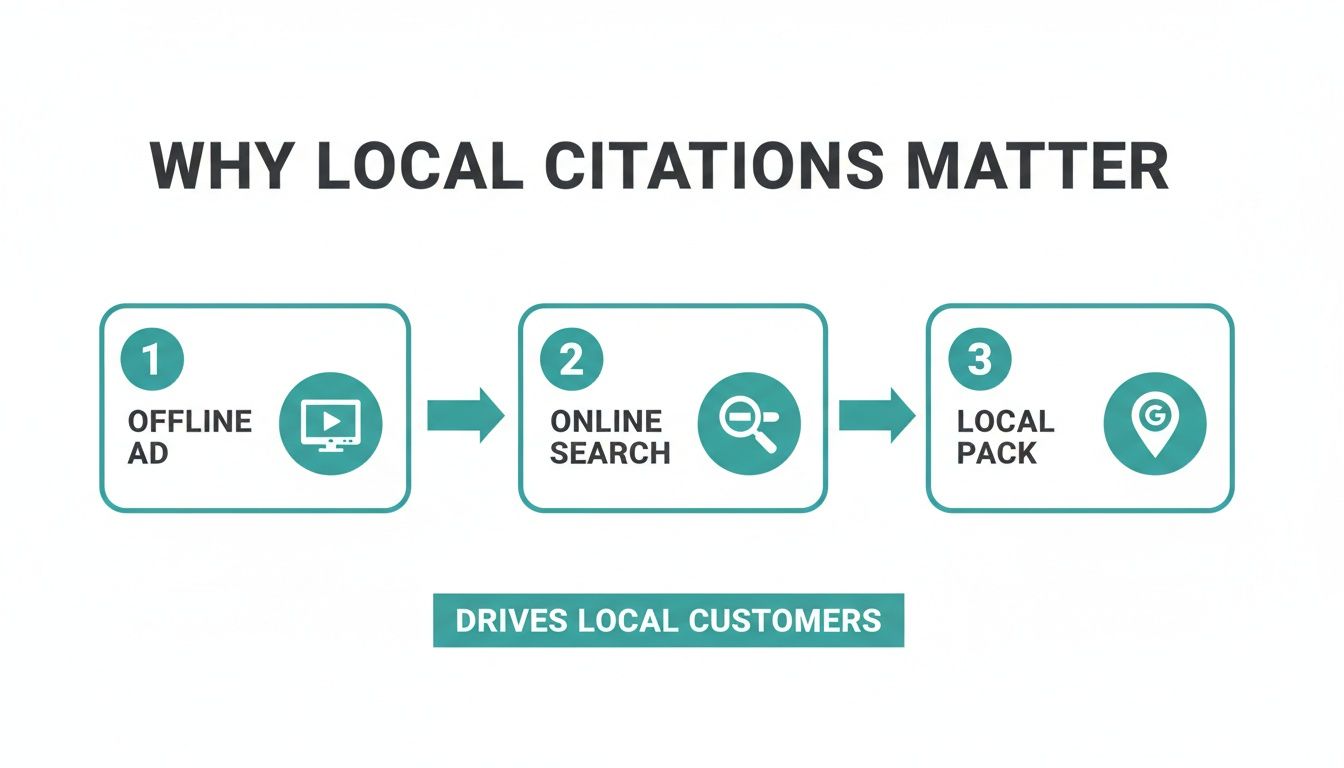
The takeaway here is simple: offline ads create the spark of interest, but it's your strong, consistent online presence that captures that interest and turns it into a sale.
Organizing Your Findings for Cleanup
Once you’ve gathered all your data from both your manual searches and automated tools, your spreadsheet becomes your command center. It doesn't need to be fancy.
Here’s a simple structure I use:
Pro Tip: Don't try to fix everything at once. Prioritize. Start with the big-name platforms like Google, Apple Maps, and Facebook. After those are clean, move on to major secondary sites like Yelp before you worry about the smaller, niche directories. This ensures you fix the errors that have the biggest impact first.
Completing this audit is the single most important piece of groundwork for a successful local SEO strategy. It gives you a clear roadmap for cleanup and sets the stage for building a powerful, consistent presence that turns searchers into loyal customers.
How to Strategically Build New, High-Value Citations

Alright, you’ve cleaned up your existing listings after a thorough audit. Now for the fun part: building new ones. But hold on, the goal isn't to blast your business information across every directory on the internet. That’s a fast track to wasted effort.
Tier 1: The Foundational Platforms
Think of these as the absolute non-negotiables. They are the heavyweights of local search, boasting enormous user bases and the kind of domain authority that search engines love. If you only had time for a few, these are the ones.
Google Business Profile: Let's be clear: this is the single most important citation you can have. It directly populates your information in Google Search and Maps, which is where the vast majority of your customers will find you.
Apple Maps: As the default map service for hundreds of millions of iPhone users, being right here is critical for mobile discovery.
Bing Places for Business: Don't sleep on Bing. It still accounts for a meaningful slice of search traffic, and claiming your profile is a quick win.
Facebook: For many customers, your Facebook page has replaced your homepage as the first stop for checking business hours, finding updates, and reading community feedback.
Getting these right means going way beyond your basic NAP (Name, Address, Phone). An optimized profile includes high-quality photos and videos, detailed service descriptions, and active engagement with customer reviews. This is what sends the strongest ranking signals.
Tier 2: Key Aggregators and Popular Sites
With your Tier 1 foundation firmly in place, it’s time to expand. This next group includes the major data aggregators that act as a source of truth for hundreds of smaller apps, along with popular review sites that consumers lean on heavily.
Data aggregators such as Neustar Localeze and Foursquare distribute your business details to multiple directories. Check the profile for accuracy before submitting it.
This tier also includes giants like Yelp, which remains a primary hub for customer reviews and local business discovery. A well-managed Yelp profile is non-negotiable for protecting your reputation and winning new business.
Here's something we've seen time and time again: one correct listing on a major data aggregator has a bigger impact than manually submitting to ten small, obscure websites. It’s the secret to working smarter, not harder.
Tier 3: Niche and Hyper-Local Directories
Industry-specific directories may reach fewer people than large listing sites, but their visitors can be more relevant to your business.
Just think about the directories that are indispensable in your specific field. A real estate agent absolutely needs to be on Zillow and Realtor.com. A law firm builds credibility and finds clients on platforms like Avvo and FindLaw.
These niche listings send powerful signals to Google, confirming that you're an authority in your specific vertical.
At Adwave, we see how this plays out across different industries every day. The right Tier 3 directories are completely different for each:
Home Services: For a plumber or an HVAC company, getting listed on Angi and HomeAdvisor is a must.
Restaurants: A restaurant's survival can depend on its presence on OpenTable for reservations and TripAdvisor for reviews.
Automotive: Car dealerships and repair shops need to be visible on Cars.com and Edmunds where customers are deep in the buying cycle.
These are the places where your ideal customers are actively searching for your exact services. An optimized profile here can become a primary source of qualified leads. To learn more about how to engage these audiences, you can check out our proven local business marketing strategies. Mastering these relevant directories is the final piece of the puzzle for building a dominant local presence.
Maintaining and Optimizing Your Listings for Long-Term Success
Building out your local citations is a huge first step, but the work doesn’t stop there. I’ve seen too many businesses treat their listings as a "set it and forget it" task, only to find their hard work undone months later.
Think about it: business information changes. Your hours might shift for the season, you could get a new phone number, or maybe you move to a better location. This is what we call data decay, and it’s a silent killer of local SEO. If you aren't actively maintaining your listings, you’re creating a confusing experience for both Google and your potential customers.
Creating a Practical Maintenance Workflow
The best way to combat data decay is with a simple, repeatable process. You don't need to overcomplicate it. I've always found that a quarterly review is the sweet spot, it's frequent enough to catch issues before they cause real damage, but not so often that it becomes a burden.
Every three months, just block off a little time to run a mini-audit on your most important listings. Start with the big ones: Google Business Profile, Apple Maps, Bing Places, and Yelp.
During your check-in, look for a few key things:
NAP Accuracy: Is your Name, Address, and Phone number still 100% correct? Even a small typo can cause problems.
Hours of Operation: Make sure your hours are updated, especially if you have seasonal changes.
Services & Products: Have you added any new services? Make sure they're listed.
Photos & Videos: Swap out any dated visuals with fresh, high-quality media. A picture from five years ago doesn't exactly scream "current."
This regular maintenance prevents frustrating customer experiences. Imagine the lost opportunity if a customer, excited by your Adwave TV campaign, drives to your store only to find it closed because your Google hours are wrong. That’s a potential sale and a future loyal customer gone, all for the lack of a quick update.
Advanced Optimization to Keep Profiles Engaging
Once your accuracy is locked in, the next level is active optimization. This is how you really get ahead of your competitors. Search engines notice and reward activity; a profile that's constantly being updated signals relevance and engagement. A stale, quiet profile, on the other hand, will slowly but surely slide down the rankings.
Respond to reviews, thank customers for their feedback, and explain how you will address specific problems.
Responding to a negative review isn't just about damage control; it's a public display of your commitment to customer service. It tells every potential customer reading it that you care and are willing to make things right.
Beyond reviews, start using the features these platforms give you. On your Google Business Profile, use Google Posts to share specials, announce events, or highlight a new product. Add photos of a recently completed job or a popular dish on your menu. Give people a real look inside your business. For a deeper dive into making your GBP a customer magnet, this Google My Business Optimisation Guide is an excellent resource.
Maximizing Your Marketing ROI
This ongoing upkeep is the connective tissue for all of your marketing. When you launch a successful Adwave TV advertising campaign, you’re generating a wave of local interest. People will see your ad, grab their phone, and search for you by name.
That moment of search is the moment of truth.
If they find a professional, accurate listing packed with great reviews and recent photos, you’ve just created a connected path from their couch to your cash register. To make sure you’re converting that interest, explore our guide on how to optimize your Google Business Profile for more calls.
Ultimately, maintaining and optimizing your citations ensures you capture the demand you worked so hard to create. It’s what turns brand awareness into real foot traffic and transforms curious searchers into paying customers.
How Adwave Takes Your Local Citation Strategy to the Next Level
You’ve put in the hard work. You’ve audited, cleaned up, and built a solid foundation of local citations, making sure your business info is consistent and ready for customers. But what now? Having accurate listings is one thing; getting interested local customers to find them is the real challenge.
This is where you can really start to see your efforts pay off by connecting your citation work to a top-of-funnel strategy. While a strong citation profile makes you credible when people search, you first need to give them a reason to search for you. That’s where a tool like Adwave comes into play, making TV advertising accessible and affordable enough for small businesses to put their brand in front of a local audience on channels like Hulu and ESPN.
Creating Demand That Your Citations Can Capture
Think of your local SEO efforts as building the perfect storefront. The sign is crisp, the hours are correct, and the welcome mat is out. But you still need to get people to walk down your street in the first place.
Adwave acts like your personal town crier, grabbing the attention of people in your community and telling them your business has what they need. You don’t need a huge budget or a production company, either. Our AI can generate a professional-looking TV spot for you in minutes, using just your website's URL. We then target that ad to viewers in specific zip codes, so your message only reaches relevant local households. You're not just waiting for customers to find you; you're actively creating the demand.
Closing the Loop from TV Ad to Transaction
So, how does this all connect in the real world? Let’s take a real estate agent who has spent weeks getting their NAP (Name, Address, Phone) perfectly consistent across Zillow, Realtor.com, and dozens of other key directories. Now, they need to generate more seller leads in a tough market.
They use Adwave to run a targeted TV campaign during popular primetime shows in their key neighborhoods. A homeowner sees the ad, is impressed by the agent’s professional vibe, and decides to look them up.
Here's the journey:
Action: The homeowner pulls out their phone and searches for the agent by name or a phrase like "real estate agent near me."
Conversion: Because the agent’s citation work is flawless, their Google Business Profile instantly appears with the right phone number, glowing 5-star reviews, and a link to their website.
Just like that, a passive TV viewer becomes an active, high-intent lead. The TV ad created the spark, and the solid citation profile was there to capture that interest and turn it into a real business opportunity.
This awareness and conversion approach is what separates good marketing from great marketing. Adwave generates the high-intent local traffic, and your meticulous local citation building ensures that traffic has a clear, trustworthy path to becoming a customer.
Boosting Your Local Presence Across the Board
The impact goes beyond just driving more search traffic. A professional TV presence builds a level of local authority and trust that perfectly complements the trust signals your citations send to search engines. When potential customers see your brand on a major network and then find consistent, professional listings online, their confidence in you skyrockets. This can directly lead to higher click-through rates from your directory listings and better conversion rates on your site.
A well-rounded strategy ensures every marketing dollar you spend works harder. Adwave amplifies your local citation work by offering powerful tools to streamline your efforts, like the ability to bulk create local landing pages with Lpagery Pro. This means the traffic from both your TV ads and directory listings lands on a relevant, high-converting page.
By combining Adwave's reach with a solid citation foundation, you create a powerful, self-reinforcing loop that drives real, sustainable growth for your local business.
Answering Your Top Questions About Local Citations
Even with a clear game plan, diving into local citation work can feel a bit overwhelming. As small business owners get started, I've found the same few questions tend to pop up again and again. Let's clear up that confusion so you can move forward with confidence.
How Long Until I See Results from Citation Building?
This is probably the most common question I hear, and the honest answer requires a bit of patience. Generally, you can expect to see some initial movement in your local search rankings in 4-8 weeks after a big citation cleanup and building push.
Why the wait? It's not like flipping a switch. Search engines like Google have to send out their crawlers to find all your new and updated listings. Then, they process that data and slowly recalibrate how much they trust your business's information. The more consistent you are across reputable directories, the faster they'll start to reward you.
My Advice: I always tell clients to think of citation building like tending a garden. You do the hard work of planting the seeds, but you won't see a full-grown plant overnight. That initial effort lays the foundation, and it’s the consistent upkeep over the next few months that brings real, lasting growth in your local rankings.
This timeline is also why it's so important to have your digital house in order before launching a big marketing push. If you're running a TV advertising campaign with Adwave, for example, you want that citation foundation to be rock-solid before the ads ever hit the screen to get the best possible return.
Is It Better to Build Citations Manually or Use a Service?
This really boils down to a classic resource dilemma: what do you have more of, time or money? Both the do-it-yourself approach and paying for a service have their merits, and the best path forward depends on your specific situation.
Here’s a breakdown to help you weigh your options:
For most small businesses, I've found a hybrid strategy is the sweet spot. Manually build and perfect your most important profiles, like your Google Business Profile and top-tier industry sites. Then, use a trusted service to handle the broad distribution to all the other directories. Adwave believes in this smart-stack approach, where you combine powerful tools with targeted manual effort for the best results.
What Are the Most Common Mistakes to Avoid?
Over the years, I've seen hundreds of businesses tackle citation building, and the same few costly mistakes always seem to surface. Simply avoiding these common pitfalls will put you way ahead of the game.
Inconsistent NAP Data: This is the absolute cardinal sin of local SEO. Even a tiny variation like "St." instead of "Street" or using different phone number formats can create confusion for search engines and hurt your authority. Standardize your NAP (Name, Address, Phone Number) once and use it everywhere, without exception.
Skipping the Cleanup: So many people are eager to start building that they forget to deal with old, incorrect listings first. Your audit isn't just a preliminary step; it's the most important part of the process. You have to fix or remove the bad data that's already out there.
Ignoring Niche Directories: It's a huge mistake to stop after hitting the big, well-known platforms. A single listing on a directory that's highly respected in your specific industry sends a powerful relevancy signal to Google that you're an expert in your field.
Letting Reviews Go Unanswered: Your citations and your online reputation are two sides of the same coin. A profile filled with unanswered negative comments completely undermines the trust you're trying to build. Actively managing feedback is key, which is why we put together a guide on how to get more Google reviews for your local business.
Keep these pointers in mind, and you'll be able to navigate the process smoothly. The end result of all this effort will be what you're after: more visibility, more traffic, and more customers walking through your door.


