
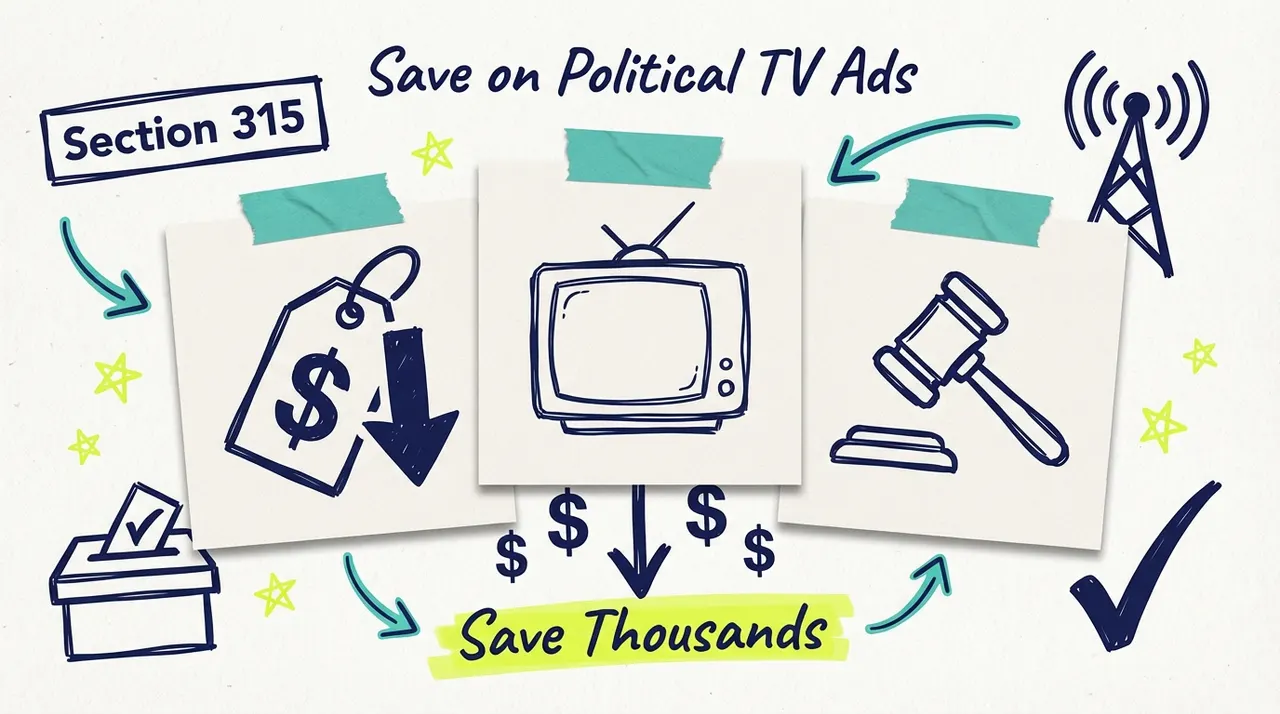
If you're buying TV time for a political campaign, the lowest unit rate might be the single most powerful cost advantage available to you. It's written into federal law. It can save your campaign thousands of dollars per market. And most campaign teams don't fully understand how it works.
Broadcast TV stations are legally required to offer qualified candidates their lowest advertising rates during specific windows before an election. That's not a courtesy or a negotiation tactic. It's the law. But the rules around who qualifies, when it kicks in, and what it covers are more nuanced than most people realize.
This guide breaks down everything you need to know about the lowest unit rate for political ads, from the FCC rules that govern it to practical strategies for making it work alongside your broader media buying plan.
What is the lowest unit rate?
The lowest unit rate (LUR) is a pricing protection established by the Federal Communications Commission under Section 315(b) of the Communications Act (47 U.S.C. SS 315). It requires broadcast television and radio stations to charge legally qualified candidates no more than the lowest rate the station charges any other advertiser for the same class and amount of time in the same time period.
If a car dealership pays $200 for a 30-second spot during the 6 p.m. news, and that is the lowest rate for the same class and amount of time, an eligible candidate receives that rate during the applicable election window.
The LUR exists because Congress recognized that access to broadcast airwaves is essential for democratic elections. Stations operate on public airwaves under FCC licenses, and in exchange for that privilege, they're required to provide candidates with fair access at fair prices.
This protection is significant. During election cycles, political ad demand drives broadcast rates sky-high. Without LUR, many down-ballot and local candidates would be priced out of television entirely. According to the FCC Political Broadcasting Guide, stations must maintain detailed records of their lowest unit rates and make them available to candidates upon request.
When LUR applies: the election windows
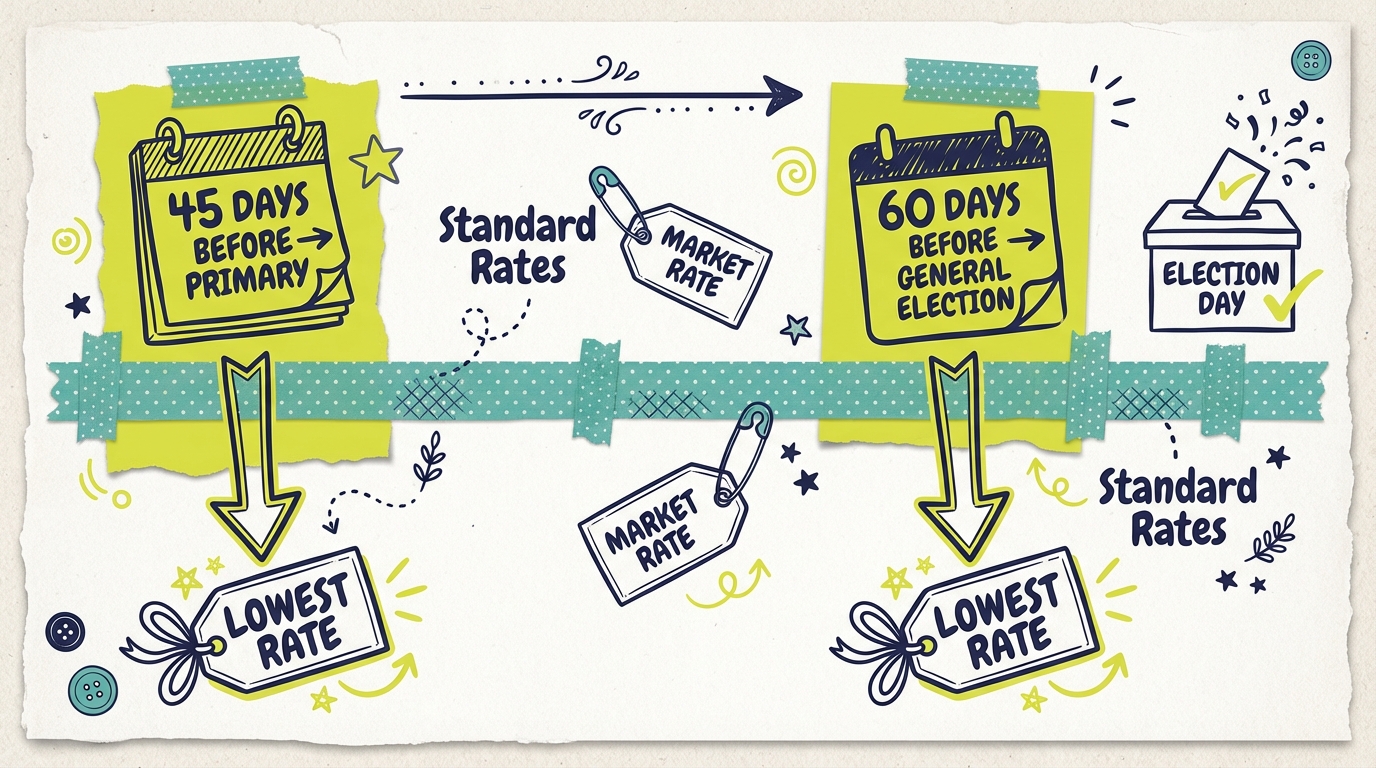
The lowest unit rate doesn't apply year-round. It kicks in during two specific windows tied to the election calendar:
45 days before a primary election (including runoffs and special primaries)
60 days before a general election
During these windows, qualified candidates receive LUR pricing on broadcast TV and radio. Outside these windows, candidates are only entitled to "comparable" rates, meaning the station must charge them no more than it charges comparable commercial advertisers for similar time. That's still a protection, but it's not nearly as strong as LUR.
The practical impact is significant. In a general election, the 60-day LUR window typically begins in early September and runs through Election Day in November. For primaries, the 45-day window varies by state since primary dates differ across the country.
Why this matters for your budget: If you're planning a political TV advertising campaign for 2026, you'll want to concentrate your heaviest broadcast spending inside these LUR windows. Buying broadcast time in July for a November election means paying market rates, which during a heated cycle can be two to three times higher than LUR pricing.
Who gets LUR and who doesn't
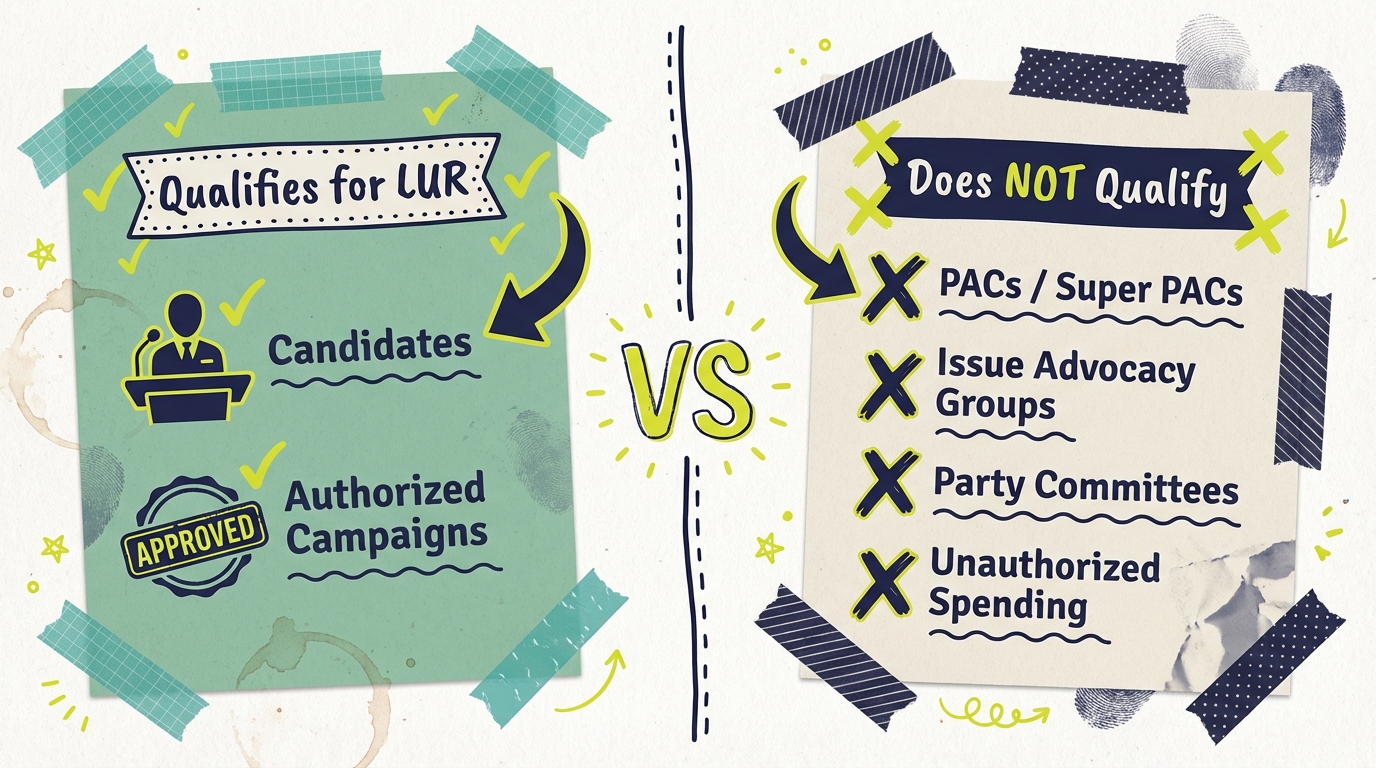
This is where many campaigns get tripped up. The lowest unit rate applies only to legally qualified candidates, not to everyone running political ads.
Who qualifies for LUR
A "legally qualified candidate" under FCC rules is someone who has publicly announced their candidacy, meets the legal qualifications for the office they're seeking, and has either qualified for a place on the ballot or is a write-in candidate who has made a substantial showing of their candidacy.
In practice, this means the actual candidate or the candidate's authorized campaign committee. The ad must include the candidate's voice or likeness and the proper sponsorship identification.
Who does NOT qualify for LUR
Political Action Committees (PACs): Super PACs, traditional PACs, and hybrid PACs pay market rates regardless of when they buy. During LUR windows, this often means PACs are paying significantly more than the candidates they support.
Issue advocacy groups: Organizations running ads about ballot measures, policy issues, or general political messaging without endorsing a specific candidate don't receive LUR protection.
Party committees: National, state, and local party committees running ads that aren't authorized by a specific candidate pay market rates.
Unauthorized expenditures: Even spending on behalf of a candidate, if not authorized by the candidate's campaign, doesn't qualify for LUR.
How to calculate your lowest unit rate
Understanding LUR in theory is one thing. Knowing how to calculate and verify the rate you're being offered is another. Here's what you need to know.
Class of time matters
Broadcast stations sell different classes of time, and each class has its own lowest unit rate. The most common classes are:
The lowest unit rate for each class is calculated independently. So the LUR for non-preemptible time will be higher than the LUR for immediately preemptible time. This is important because some stations will try to steer campaigns toward the cheapest class (immediately preemptible) without clearly explaining that your ad might not air.
Daypart considerations
Rates also vary by daypart, which is the time of day your ad airs:
Early morning (6-9 a.m.): Local news audiences, strong for reaching older voters
Daytime (9 a.m.-4 p.m.): Lower rates, smaller audiences
Early fringe/news (4-8 p.m.): High-value inventory, large local audiences
Primetime (8-11 p.m.): Premium pricing, broadest reach
Late night (11 p.m.+): Lower cost, narrower audience
Each daypart has its own LUR calculation. You'll want to request the station's rate card and political file to see what other advertisers (and candidates) are paying for each daypart and class combination.
Verifying your rate
Under FCC rules, stations must keep their political files publicly accessible. You can review these files at the FCC's online political file database. These files include rate information, ad requests from other campaigns, and invoices that can help you verify you're getting the true lowest unit rate.
If you suspect a station is overcharging, you have the right to file a complaint with the FCC. In practice, simply referencing the political file during negotiations usually resolves discrepancies.
LUR does not apply to streaming and CTV
Here's an important distinction that catches many campaigns off guard: the lowest unit rate applies only to broadcast television and radio stations licensed by the FCC. It does not apply to cable networks, streaming platforms, or Connected TV (CTV).
This means when you're buying ads on Hulu, Roku, Amazon Fire TV, or any other streaming platform, you're paying market-based rates. There's no FCC mandate for these platforms to offer candidates discounted pricing.
That might sound like a disadvantage, but it's more nuanced. Consider the full picture of political advertising costs:
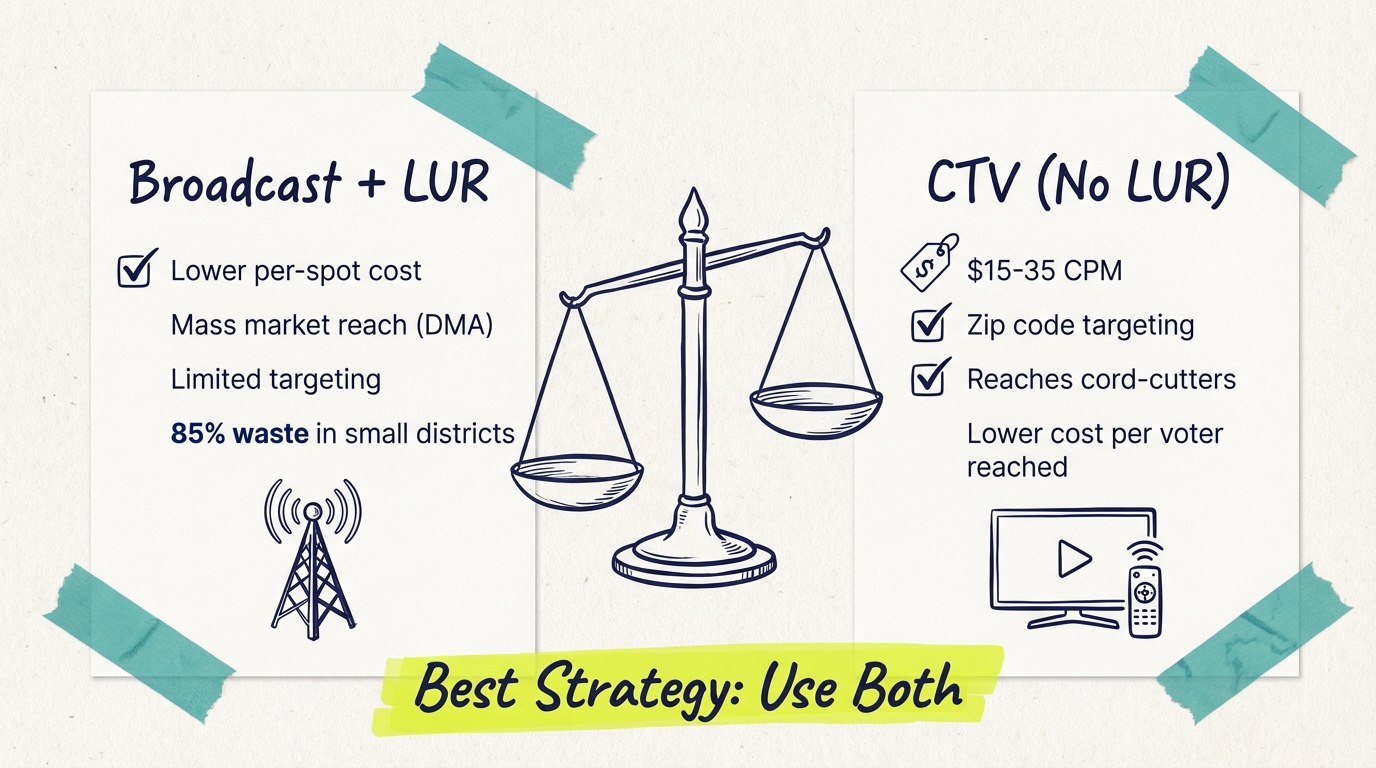
Broadcast with LUR: Lower per-spot rates for candidates, but limited targeting. You're buying a geographic market (DMA), which means you're paying to reach everyone in that market, including the many viewers who aren't in your district or aren't registered voters.
CTV without LUR: Market-based pricing (typically $15-35 CPM), but with precision targeting. You can target by geography down to the zip code level, by demographics, by interests, and by viewing behavior. For local races where your district doesn't align neatly with a TV market, CTV can deliver a lower cost per voter reached even without LUR protection.
For example, a state legislative candidate in a district that covers just 15% of a major TV market would waste 85% of their broadcast buy on viewers who can't vote for them. On CTV, that same candidate can target only the zip codes within their district, making every dollar count.
How to use LUR in your media buying strategy
The smartest political campaigns don't choose between broadcast LUR and CTV. They use both strategically. Here's how to build a media plan that takes advantage of each channel's strengths.
For candidates (who qualify for LUR)
During the LUR window:
Lock in broadcast time at LUR rates for mass-reach messaging, especially in markets where your district aligns well with the DMA boundaries.
Layer CTV on top for precision targeting. Use streaming to reach cord-cutters, younger voters, and specific geographic areas that broadcast can't isolate.
Request non-preemptible time for your most important placements. Yes, the LUR is higher for fixed spots, but you're guaranteed to air.
Outside the LUR window:
Shift more budget toward CTV where pricing is stable and not inflated by election-season demand on broadcast.
Use broadcast selectively, focusing on early morning and news dayparts where political ad rates tend to be more reasonable.
Negotiate aggressively on broadcast since you're only entitled to "comparable" rates and stations have more flexibility.
For PACs and issue groups (no LUR)
Since you're paying market rates everywhere, your strategy should focus on efficiency:
Lean into CTV: Without LUR savings on broadcast, the targeting precision of streaming often delivers better cost-per-voter-reached, especially in off-cycle periods or for geographically concentrated campaigns.
Buy broadcast early: If you need broadcast reach, book well before election season when rates haven't spiked yet.
Consider platforms like Adwave: With a minimum spend of just $50 and access to 100+ premium streaming networks, you can test CTV performance in specific markets before committing larger budgets. The $15-35 CPM range is often more predictable than the wild swings of election-season broadcast pricing.
Combining channels for maximum impact
The most effective political media strategies treat broadcast and CTV as complementary, not competing. Broadcast (especially with LUR pricing) delivers efficient mass reach. CTV fills in the gaps with precision, reaching voters who've cut the cord, reinforcing your message with frequency, and allowing you to target specific voter segments with tailored creative.
A typical allocation for a candidate campaign during the LUR window might look like 60-70% broadcast (taking advantage of LUR rates) and 30-40% CTV (for targeting and cord-cutter reach). Outside the LUR window, many campaigns flip that ratio.
Common questions answered
What does "lowest unit rate" mean in political advertising? The lowest unit rate is the lowest price a broadcast TV or radio station charges any advertiser for a particular class and length of ad in a specific time period. Under FCC Section 315(b), legally qualified candidates are entitled to this rate during defined pre-election windows. It's a legal protection designed to ensure candidates can afford access to broadcast airwaves.
Do PACs get the lowest unit rate? No. The lowest unit rate applies only to legally qualified candidates and their authorized campaign committees. PACs, super PACs, issue advocacy groups, and party committees running unauthorized ads all pay standard market rates. During election season, this means these groups often pay significantly more than candidate campaigns for the same broadcast time slots.
When does the LUR window start? The LUR window begins 45 days before a primary election and 60 days before a general election. For the 2026 general election in November, the 60-day window would start in early September. Primary windows vary by state since each state sets its own primary date. Outside these windows, candidates receive "comparable" rates rather than the guaranteed lowest unit rate.
Does LUR apply to streaming TV ads? No. The lowest unit rate is an FCC regulation that applies only to broadcast television and radio stations operating on public airwaves. Streaming platforms, CTV, cable networks, and digital advertising are not covered by LUR. Pricing on these platforms is entirely market-based, though CTV's precision targeting often compensates for the lack of rate protections.
Can a station bump my political ad if I buy preemptible time? Yes. If you purchase preemptible or immediately preemptible time at LUR rates, the station can replace your spot with a higher-paying ad. The LUR guarantees the rate for that class of time, not that your spot will definitely air. To guarantee placement, you'll need to buy non-preemptible (fixed) time, which has a higher LUR but ensures your ad runs as scheduled.
How do I verify I'm getting the correct lowest unit rate? Broadcast stations are required to maintain public political files with the FCC, accessible at publicfiles.fcc.gov. These files include rate information, contracts with other advertisers, and records of political ad requests. You or your media buyer can review these files to confirm the rates you're being quoted match the station's true lowest unit rate for each class and daypart.


