-
4+ hrs
Daily TV viewing time for millennials
-
43%
Streaming share of total TV viewing
-
15%
YouTube share of young adult TV viewing
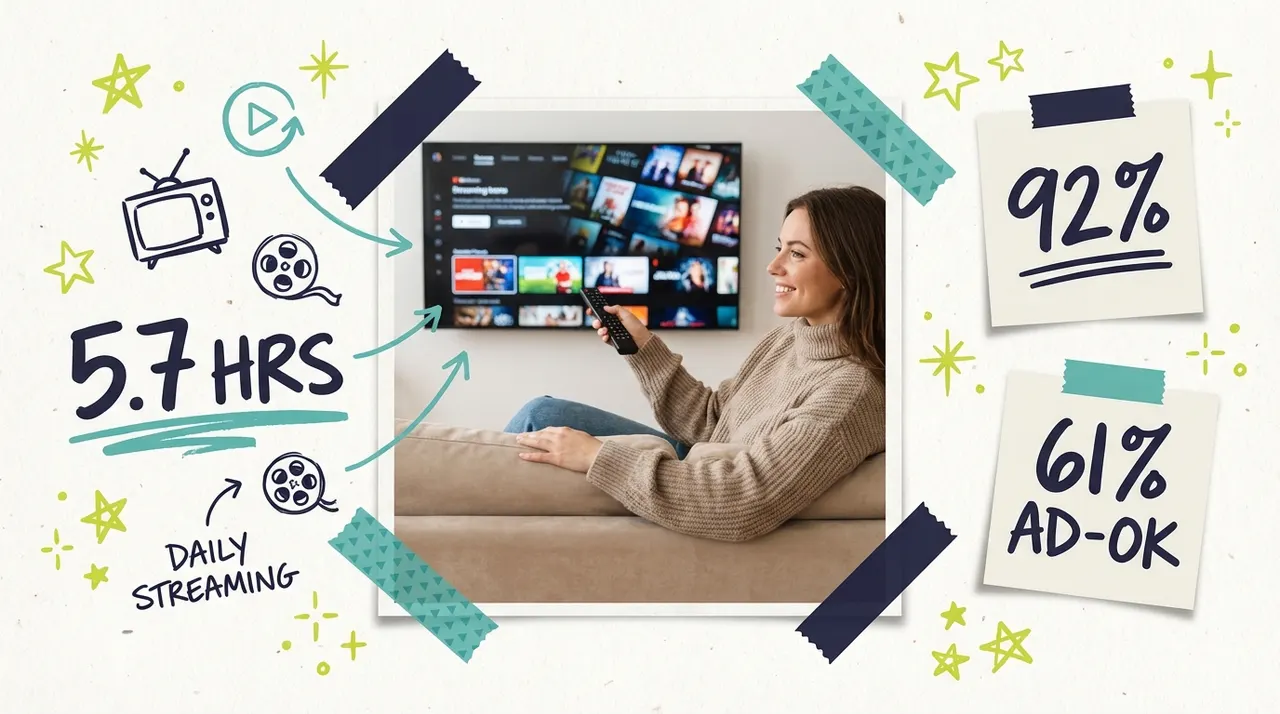
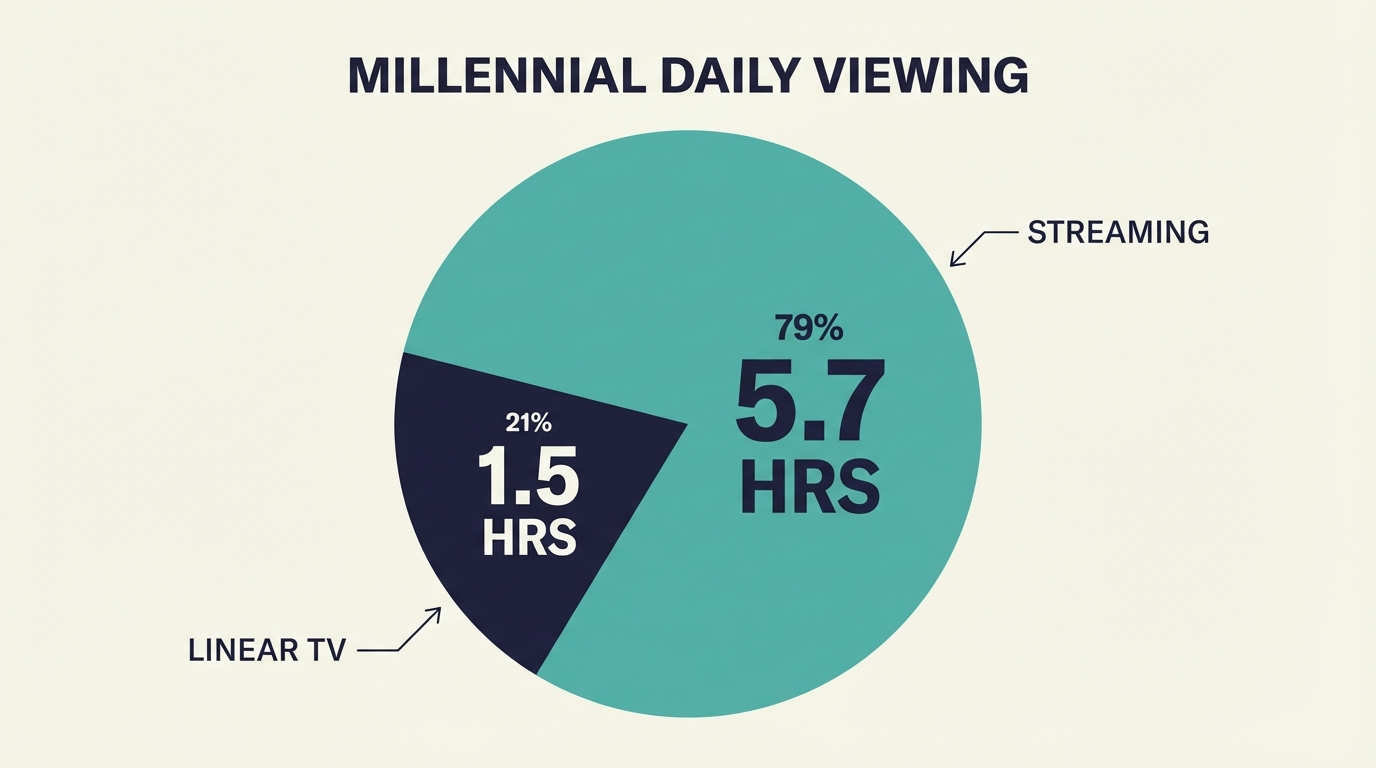
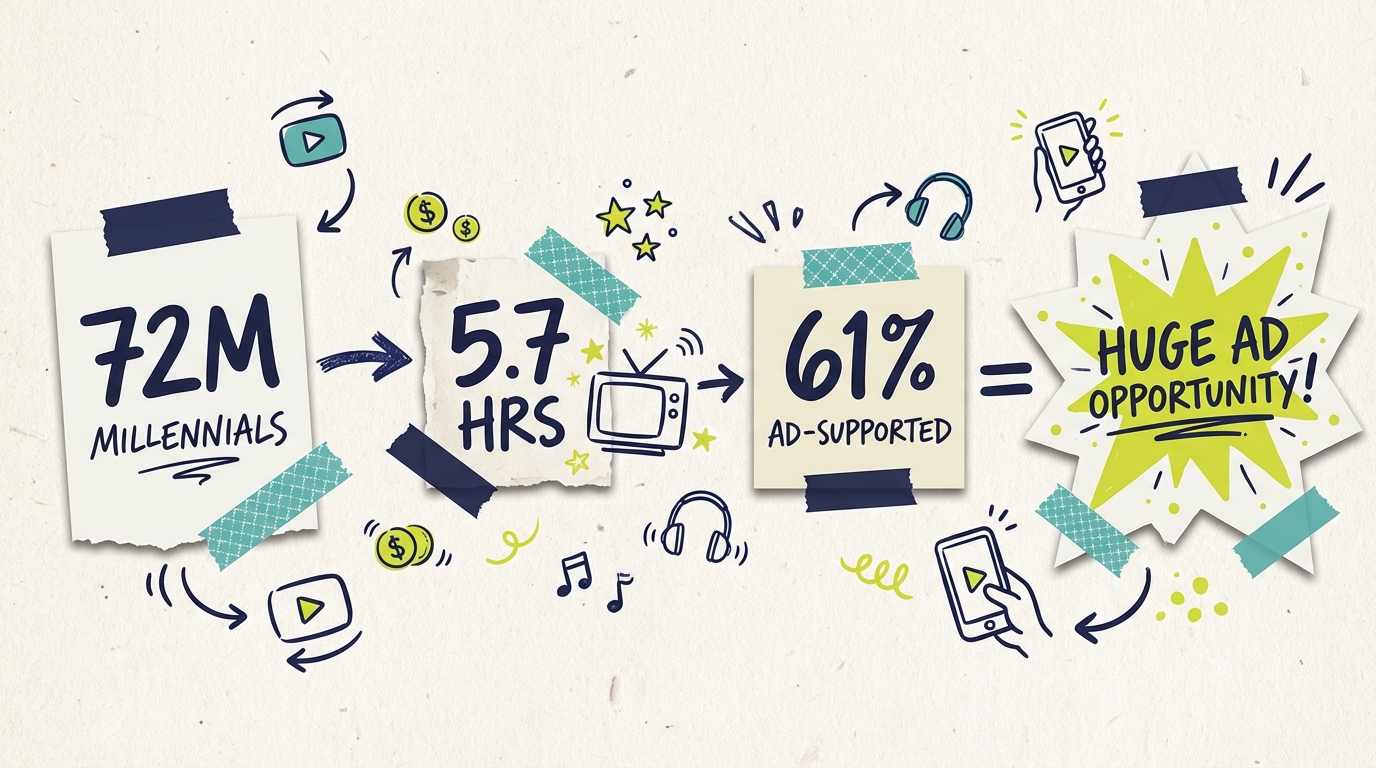
Millennials watch approximately 5.7 hours of streaming video per day and an additional 1.5 hours of linear TV, making them among the heaviest media consumers of any generation, according to industry research. What may surprise advertisers is that 60% of millennials still tune into traditional linear TV at least monthly, despite their reputation as the "cord-cutting generation." Even more relevant for advertisers: 61% of millennials prefer ad-supported streaming plans to save money, making them highly reachable through streaming TV advertising. For businesses trying to reach the 72 million Americans born between 1981 and 1996, understanding these viewing patterns is essential.
What the data shows
The millennial generation represents one of the most valuable and reachable audiences for TV advertisers today, contrary to the widespread assumption that they've abandoned television entirely.
According to research from New Road Advertising, millennials watch an average of 5.7 hours of streaming video per day. Combined with linear TV viewing, this generation spends more time watching video content than any other cohort except Baby Boomers. The difference is where they watch: millennials overwhelmingly prefer streaming platforms over traditional cable.
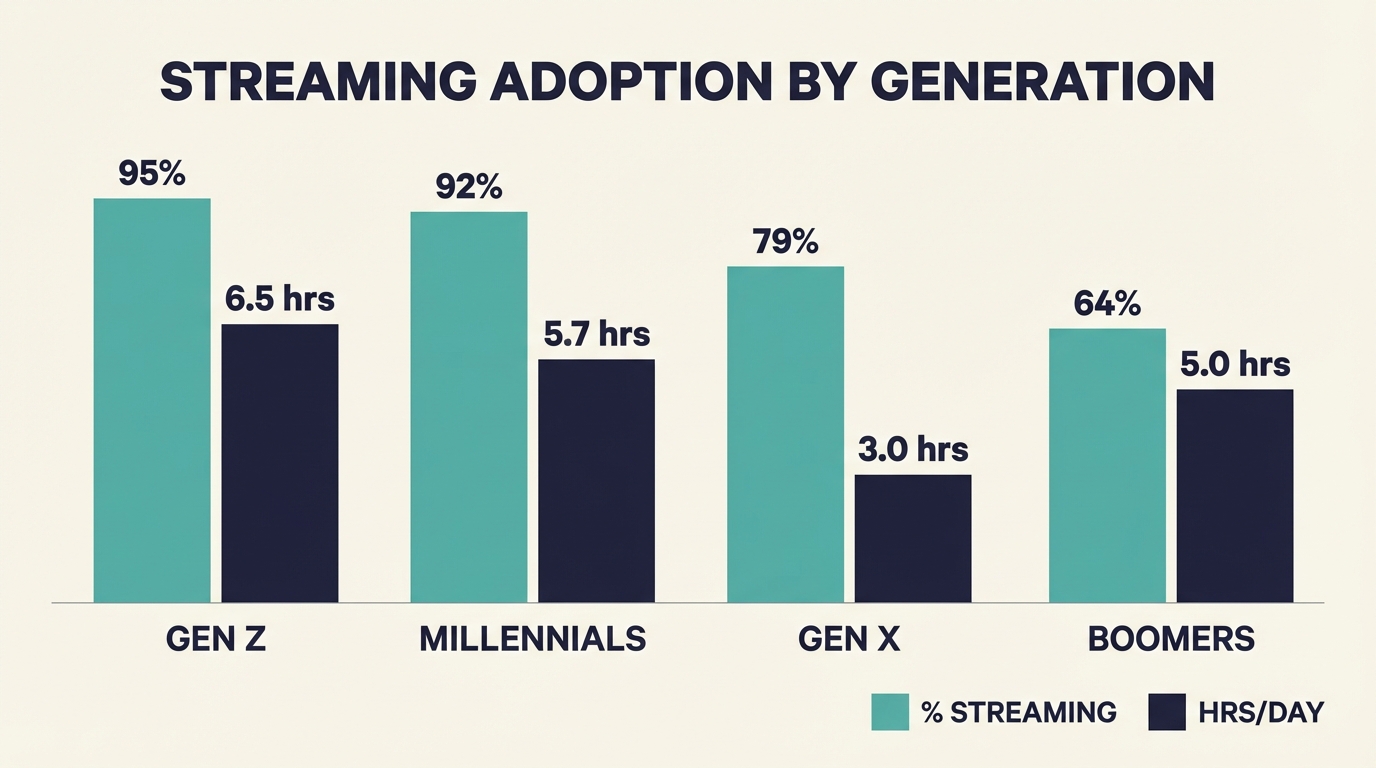
The streaming adoption numbers tell a compelling story. 92% of millennials use streaming services, according to Statista, compared to 79% of Gen X, 64% of Baby Boomers, and 95% of Gen Z. This makes millennials the second-highest adopters of streaming technology, behind only the youngest adult generation.
Perhaps most relevant for advertisers is the millennial preference for ad-supported streaming. 61% of millennials prefer ad-supported plans to reduce subscription costs, making them more receptive to advertising than often assumed. A Samba TV study found that millennials are more open to ad-supported video-on-demand (AVOD) than any other generation, positioning them as "the key for ad-supported streaming success."
The CTV viewer numbers reflect this trend. According to Mountain Research, millennials represent approximately 59.2 million CTV viewers in the United States, making them the single largest generational segment of connected TV audiences. Together with Gen Z, millennials account for 65% of overall OTT viewership, meaning the majority of streaming audiences fall into these two generations.
Linear TV isn't dead among millennials either. Marketing Architects reports that 60% of millennials still watch linear TV at least monthly, averaging just over 1.5 hours per day when they do. This challenges the narrative that millennials have completely abandoned traditional television. For advertisers, this means both streaming and linear TV offer viable paths to reaching millennial audiences.
Breaking down the numbers
Understanding how millennials consume TV content requires looking beyond the headline statistics to examine platform preferences, device usage, and how their habits compare to other generations.
By platform preference
Millennials don't just watch more streaming content than older generations; they also subscribe to more services. The average U.S. household now pays for 4.1 video streaming services, according to Deloitte, but millennials and Gen Z subscribe to an average of six services, nearly three times as many as Baby Boomers (2.4 services), according to Advanced Television research.
The most popular platforms among millennials include Netflix, YouTube, Hulu, Amazon Prime Video, and Disney+. YouTube's dominance is especially notable: it now represents the largest share of TV viewing time among younger demographics, with millennials and Gen Z driving much of that growth.
Free ad-supported streaming TV (FAST) platforms like Tubi and Pluto TV are also gaining traction with cost-conscious millennials. Tubi viewership saw a 43% year-over-year increase, driven largely by younger viewers seeking free alternatives to paid subscriptions.
By device
While older generations predominantly watch TV content on actual televisions, millennials split their viewing across multiple devices. According to industry data, over 70% of Gen Z streams on phones or tablets, and millennials aren't far behind. However, the living room TV remains important: smart TVs and streaming devices like Roku and Amazon Fire TV are the primary streaming devices in most millennial households.
This multi-device viewing creates opportunities for advertisers to reach millennials across multiple touchpoints throughout the day. A millennial might watch YouTube on their phone during lunch, stream Hulu on their laptop in the afternoon, and watch Netflix on their smart TV in the evening.
Compared to other generations
How do millennial viewing habits stack up against other generations? The data reveals interesting patterns:
Gen Z (born 1997-2012):
6.5 hours of streaming per day (highest)
95% use streaming services
Less than 1 hour of linear TV daily
58% prefer ad-supported streaming
Millennials (born 1981-1996):
5.7 hours of streaming per day
92% use streaming services
1.5 hours of linear TV daily
61% prefer ad-supported streaming
Gen X (born 1965-1980):
3+ hours total TV daily
79% use streaming services
Higher linear TV consumption
63% prefer ad-supported streaming
Baby Boomers (born 1946-1964):
Nearly 5 hours total TV daily
64% use streaming services
Highest linear TV consumption
66% prefer ad-supported streaming
The data shows that millennials occupy a middle ground: more streaming-focused than Gen X and Boomers, but not as exclusively streaming-dependent as Gen Z. This makes millennials uniquely reachable through both traditional and streaming TV advertising.
Why it matters for your business
If your business targets consumers between roughly ages 29 and 44, the millennial TV viewing data has direct implications for your advertising strategy.
The most important takeaway is that millennials are highly reachable through TV advertising, especially streaming TV. The assumption that millennials "don't watch TV" is demonstrably false. They watch substantial amounts of TV content; they've just shifted where they watch it. For advertisers, this means connected TV advertising offers a direct path to reaching this valuable demographic.
The preference for ad-supported streaming among millennials is especially significant. With 61% choosing ad-supported tiers, advertisers can reach the majority of millennial streaming viewers without those viewers paying extra to avoid ads. This contrasts with the common assumption that millennials skip ads at all costs. In reality, they're willing to see ads in exchange for lower subscription fees.
For local businesses, millennial TV viewing habits present a specific opportunity. Millennials are entering their peak earning and spending years, many are starting families, and they're making major purchasing decisions around homes, cars, insurance, and services. A local business advertising on streaming TV can reach these high-value consumers where they're already spending hours each day.
The geographic targeting capabilities of CTV advertising make this especially practical. A restaurant, dental practice, or home services company can target millennial households within a specific radius.
Consider the math: if the average millennial watches 5.7 hours of streaming content daily, and 61% of that viewing happens on ad-supported platforms, that's roughly 3.5 hours of ad-supported streaming per day. Multiply that across the 72 million millennials in the U.S., and the advertising opportunity becomes clear.
How to take advantage of this trend
Knowing that millennials watch substantial amounts of streaming TV is useful. Translating that knowledge into an effective advertising strategy is what drives results.
Start by including streaming TV in your media mix if you're targeting millennials. If your current advertising consists entirely of social media, search, or traditional media, you're missing hours of daily millennial attention. Platforms like Adwave make streaming TV advertising accessible starting at just $50, eliminating the budget barrier that previously kept small businesses off television.
Match your creative to the streaming environment. Millennials are watching streaming content in lean-back mode, often on large screens, which means your ad receives focused attention similar to traditional TV commercials. This environment favors brand-building messages and storytelling over the quick, scroll-stopping creative optimized for social feeds. Take advantage of the 15-30 second format to communicate your value proposition clearly.
Consider dayparting your campaigns. Millennial streaming habits peak during evening hours, typically between 7 PM and 11 PM, when they're relaxing after work. Running campaigns during these hours maximizes the chance of reaching millennials when they're most receptive. Adwave's targeting options allow you to schedule campaigns during optimal viewing windows.
Layer in retargeting for maximum impact. After millennials see your streaming TV ad, they're likely to pick up their phones (remember, 86% of viewers second-screen while watching TV). Use your streaming TV campaign to build awareness, then retarget those same viewers on social media or display to drive conversion. Research shows combining TV and digital advertising delivers significantly better results than either channel alone.
Don't ignore linear TV entirely if your budget allows. With 60% of millennials still watching traditional TV monthly, linear offers incremental reach that streaming alone might miss. A combined approach covering both streaming and linear TV maximizes your ability to reach the full millennial audience.
Finally, embrace ad-supported platforms. Since 61% of millennials choose ad-supported tiers, platforms like Hulu, Peacock, Tubi, and Pluto TV offer direct access to millennial viewers who have opted into seeing ads.
The bigger picture
Millennial TV viewing habits exist within a broader context of generational media shifts and the ongoing transformation of television itself.
The cord-cutting reality
Millennials earned their "cord-cutting generation" label for good reason. Only 14% of Gen Z and 20% of millennials have paid for cable in the past year, compared to 37% of Baby Boomers, according to Talker Research. This generational gap in cable subscription represents one of the most dramatic shifts in media consumption in decades.
But cord-cutting doesn't mean TV abandonment. It means TV transformation. Millennials have simply moved their viewing from cable boxes to streaming devices. The overall time spent watching video content remains substantial; only the delivery method has changed.
For advertisers, this shift has created more opportunity, not less. The fragmented cable market has given way to programmatic streaming platforms where targeting is more precise, measurement is more detailed, and entry barriers are dramatically lower. A local business that could never afford meaningful cable TV advertising can now run targeted streaming campaigns for a fraction of the cost.
Streaming reaches critical mass
May 2025 marked a historic milestone: streaming viewership (44.8%) exceeded combined broadcast and cable viewing for the first time, according to Nielsen. By July 2025, streaming had reached 47.3% of all TV viewing. This isn't a temporary trend; it's the new normal.
Millennials and Gen Z drove this shift, but all generations are following. Even Baby Boomers doubled their streaming time from 29 minutes to over an hour per day in just one year. The streaming transformation that millennials pioneered is now mainstream across demographics.
The ad-supported streaming boom
The rise of ad-supported streaming tiers represents a fundamental shift in how streaming services monetize content. Netflix, Disney+, and HBO Max all introduced ad-supported options in recent years, joining platforms like Hulu, Peacock, and Paramount+ that already offered them.
The result: 57% of U.S. streamers now use at least one ad-supported service, and that number is growing. Nielsen reports that 72.4% of all TV viewing time now occurs on ad-supported content when including broadcast, cable, and streaming.
For advertisers, this explosion of ad-supported inventory means more opportunities to reach streaming audiences at reasonable CPMs. The days when streaming meant ad-free viewing are ending, replaced by a viewer-friendly model where consumers choose whether to pay with money or attention.
What experts are saying
Industry analysts have highlighted the advertising significance of millennial viewing patterns.
Samba TV's research emphasized the generational dynamics: "Millennials are the key for ad-supported streaming success. Our survey of over 2,500 adults reveals that millennials are more open to ad-supported video-on-demand than other generations."
Deloitte's 2025 Digital Media Trends report noted the shift in content discovery: "We found that a majority of Gen Zs and millennials surveyed say they get better recommendations for TV shows and movies from social media than from streaming services themselves."
Industry observers have also noted the cross-generational appeal of streaming. The New Road Advertising analysis concluded: "So, if you think older audiences aren't watching, think again. Streaming is now a cross-generational habit, and OTT advertising reaches them where traditional media no longer can."
Common questions answered
How much TV do millennials watch per day?
Millennials watch approximately 5.7 hours of streaming video per day plus an additional 1.5 hours of linear TV when they tune in (about 60% watch linear TV at least monthly). This makes their total potential daily TV consumption around 7 hours, though most millennials prioritize streaming over linear TV. The streaming figure is second only to Gen Z, which watches 6.5 hours of streaming daily.
Do millennials still watch traditional TV?
Yes, 60% of millennials still watch traditional linear TV at least monthly, averaging about 1.5 hours per day when they do. However, their linear TV consumption is significantly lower than older generations. Baby Boomers watch nearly 5 hours of TV daily, while Gen X averages over 3 hours. The "millennials don't watch TV" narrative is a myth; they've simply shifted most viewing to streaming platforms.
What percentage of millennials use streaming services?
92% of millennials use streaming services, according to Statista. This is the second-highest adoption rate among generations, behind only Gen Z at 95%. Gen X follows at 79%, and Baby Boomers at 64%. The high adoption rate combined with millennials' preference for ad-supported tiers makes them highly reachable through streaming TV advertising.
Are millennials receptive to TV advertising?
Yes, millennials are more receptive to advertising than commonly assumed. 61% of millennials prefer ad-supported streaming plans to reduce costs, making them willing to see ads in exchange for savings. A Samba TV study found millennials are more open to ad-supported video-on-demand than any other generation. This challenges the stereotype that millennials aggressively avoid advertising.
How do millennial viewing habits compare to Gen Z?
Gen Z watches slightly more streaming content (6.5 hours vs. 5.7 hours daily) and has higher streaming adoption (95% vs. 92%). However, millennials watch more linear TV and have a slightly higher preference for ad-supported streaming (61% vs. 58%). Together, millennials and Gen Z account for 65% of all OTT viewership, making them the dominant streaming demographics.
What streaming platforms do millennials prefer?
Millennials subscribe to an average of 6 streaming services, nearly three times as many as Baby Boomers. The most popular platforms include Netflix, YouTube, Hulu, Amazon Prime Video, and Disney+. Free ad-supported platforms like Tubi and Pluto TV are growing rapidly among cost-conscious millennials. YouTube is especially dominant, representing the largest share of TV viewing time among younger demographics.
Supporting data
Additional context on millennial TV viewing habits and streaming statistics:
Millennial daily streaming: 5.7 hours per day (New Road Advertising, 2025)
Millennial streaming adoption: 92% use streaming services (Statista, 2024)
Millennial linear TV viewing: 60% watch monthly, 1.5 hours/day average (Marketing Architects, 2024)
Millennial ad-supported preference: 61% prefer ad-supported plans (New Road Advertising, 2025)
Millennial CTV viewers: 59.2 million in U.S. (Mountain Research, 2024)
Millennial + Gen Z OTT share: 65% of overall viewership (New Road Advertising, 2025)
Average streaming subscriptions: 6 for millennials/Gen Z vs. 2.4 for Boomers (Advanced Television, 2023)
Streaming share of TV: 44.8%+ in May 2025 (Nielsen, 2025)
Ad-supported TV viewing: 72.4% of all TV time (Nielsen, Q1 2025)
Millennial cable subscription: Only 20% paid for cable in past year (Talker Research, 2024)
All sources linked above. Data current as of Q4 2025.
Get started with TV advertising
Millennials are watching. Make sure they're watching you.