
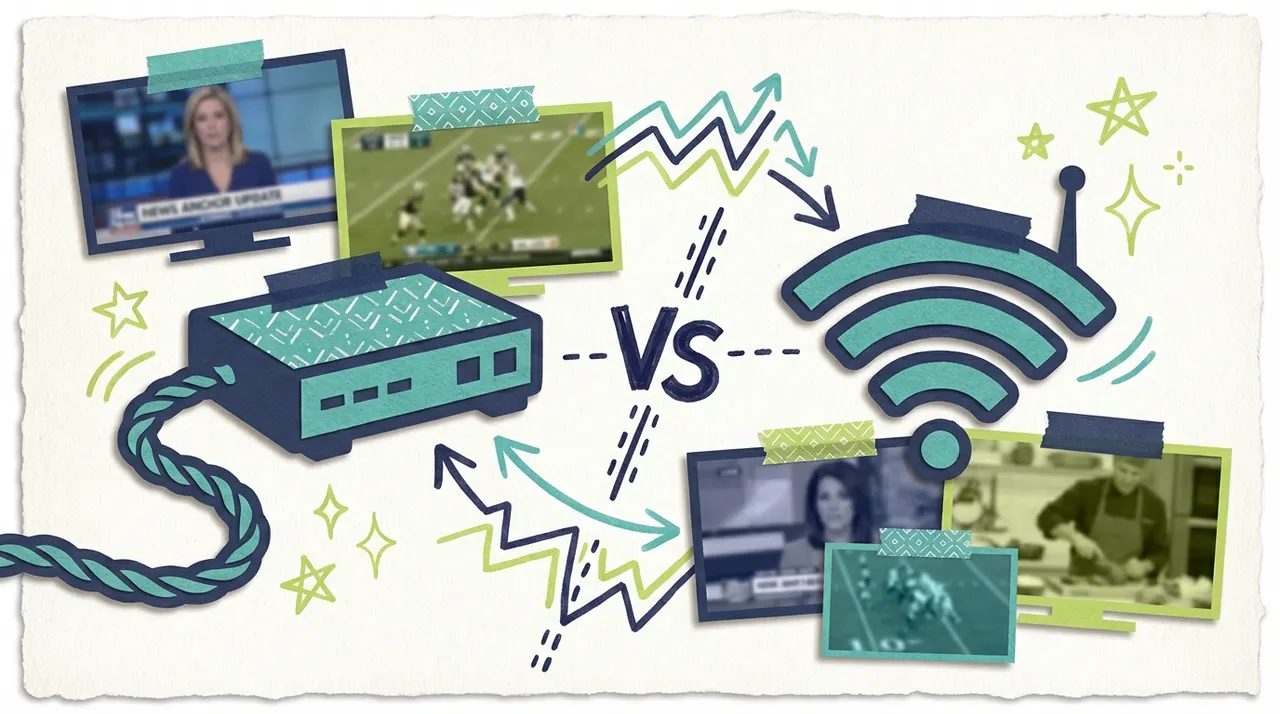
If you've ever looked into TV advertising, you've probably run into these alphabet soup terms: MVPD and vMVPD. They sound technical, but understanding them could save your small business thousands of dollars and open up advertising opportunities you didn't know existed.
Here's the short version: MVPDs are traditional cable and satellite companies. vMVPDs are the streaming services that replaced them. For small business advertisers, the difference between these two worlds is massive, especially when it comes to minimum budgets and local targeting. Understanding these terms is essential for anyone exploring TV advertising options.
What Is an MVPD?
MVPD stands for Multichannel Video Programming Distributor. In plain English, it's a company that delivers multiple television channels to subscribers through cable, satellite, or fiber optic systems.
Think of the big cable companies: Comcast, Charter Spectrum, Cox, AT&T, and satellite providers like DirecTV and DISH Network. These are all MVPDs. They bundle dozens or hundreds of channels together and charge a monthly subscription fee, typically ranging from $50 to $150 or more.
For decades, MVPDs held a monopoly on how Americans watched TV. If you wanted ESPN, local news, or premium channels, you had to go through a cable or satellite company. There was no alternative.
MVPD Examples:
Comcast Xfinity
Charter Spectrum
Cox Communications
AT&T U-verse
DirecTV (satellite)
DISH Network (satellite)
Verizon Fios (fiber)
What Is a vMVPD?
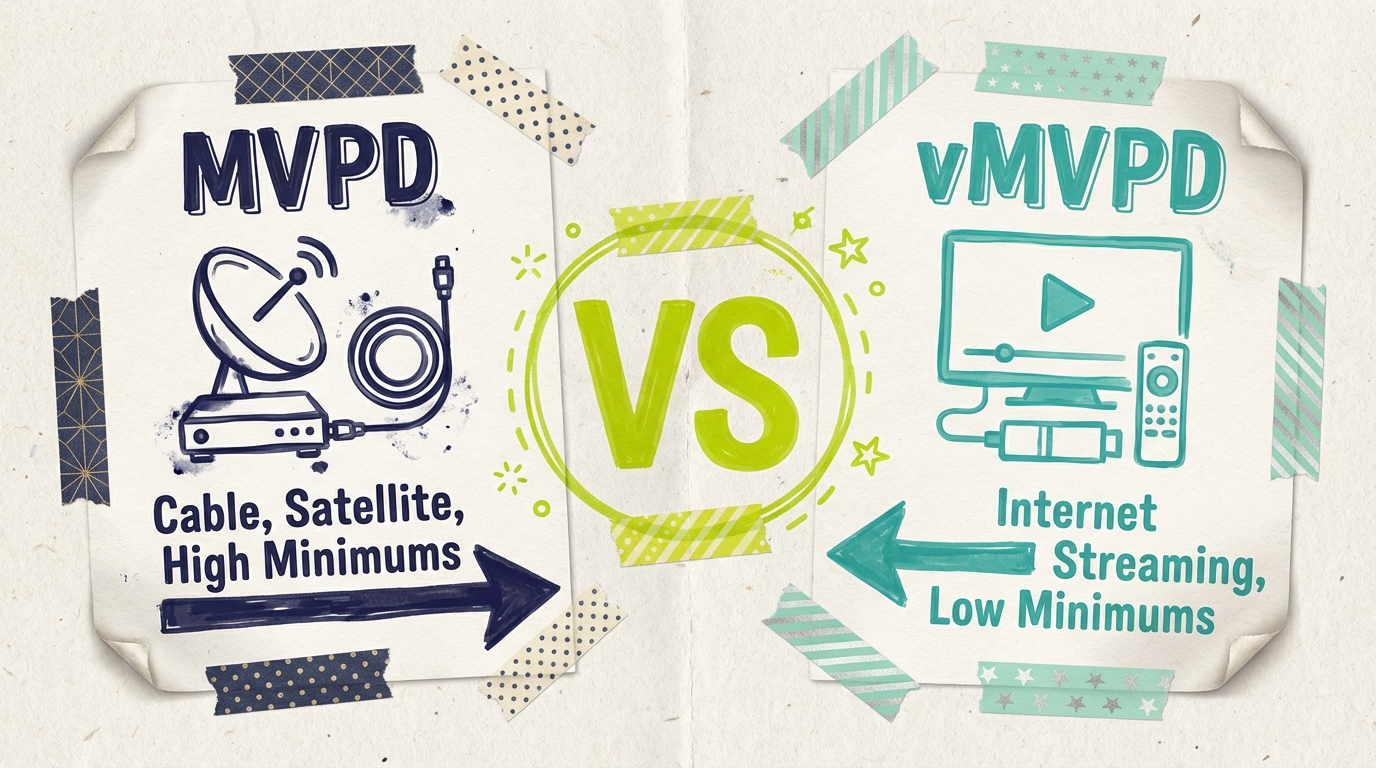
VMVPD stands for Virtual Multichannel Video Programming Distributor. The key word is "virtual." Instead of delivering content through physical cables or satellites, vMVPDs stream live TV channels over the internet.
The experience looks similar to traditional cable: you get a bundle of live channels, a channel guide, and often a cloud DVR. But there's no cable box, no technician visit, and no long-term contract required.
VMVPDs emerged as a direct response to cord-cutting. As millions of households canceled their cable subscriptions, they still wanted access to live TV, especially sports and news. Services like YouTube TV, Hulu + Live TV, and Sling TV stepped in to fill that gap.
vMVPD Examples:
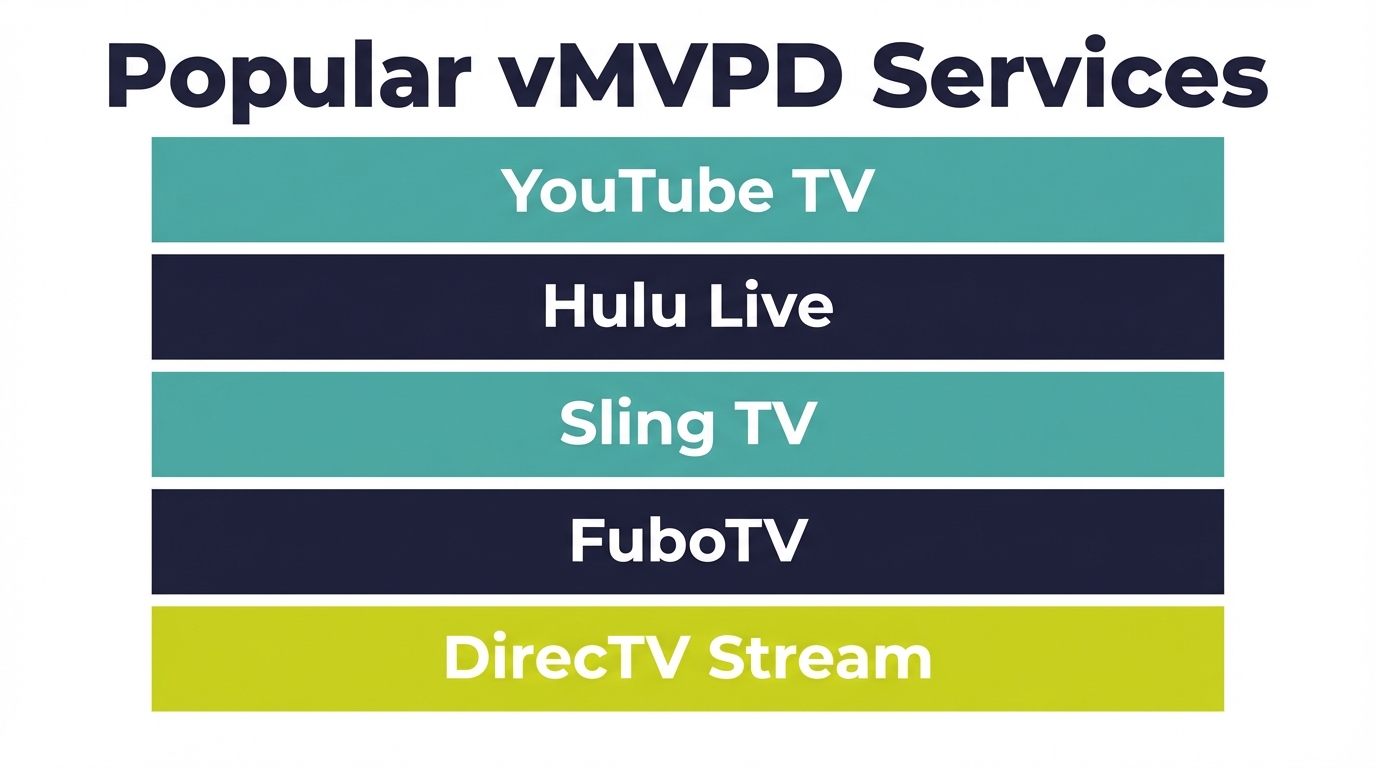
YouTube TV
Hulu + Live TV
Sling TV
FuboTV
Philo
DirecTV Stream
MVPD vs. vMVPD: Key Differences
While both MVPDs and vMVPDs deliver live TV channels, the differences matter significantly for advertisers. Understanding these distinctions helps you make smarter decisions about where to allocate your TV advertising budget.
Delivery Method
MVPDs use physical infrastructure: coaxial cables, satellite dishes, or fiber optic lines. You're locked to whatever provider services your address, and installation often requires a technician visit. vMVPDs use the internet, so you can subscribe from anywhere with a broadband connection. Setup takes minutes rather than days.
Contracts and Flexibility
Traditional MVPDs typically require one or two-year contracts, often with early termination fees that can run into hundreds of dollars. vMVPDs are almost universally month-to-month with no long-term commitment. You can sign up today and cancel tomorrow with no penalty.
Price Point
MVPDs tend to charge higher monthly fees, often $100+ for a mid-tier package plus equipment rental fees ($10-15/month for cable boxes). vMVPDs generally range from $40 to $75 per month with no equipment costs since you use your own streaming devices.
Channel Selection
MVPDs typically offer larger channel counts (150-300+ channels), though many subscribers only watch a fraction. vMVPDs offer more curated packages (40-100 channels typically), focusing on the most-watched networks. Both include local channels, sports, news, and entertainment.
Audience Demographics
MVPD subscribers skew older (55+) and tend to be long-time cable customers who never cut the cord. vMVPD viewers skew younger (25-54), more tech-savvy, and are often former cable subscribers who wanted a cheaper, more flexible alternative. For advertisers targeting younger demographics, vMVPD inventory is increasingly essential.
Advertising Access
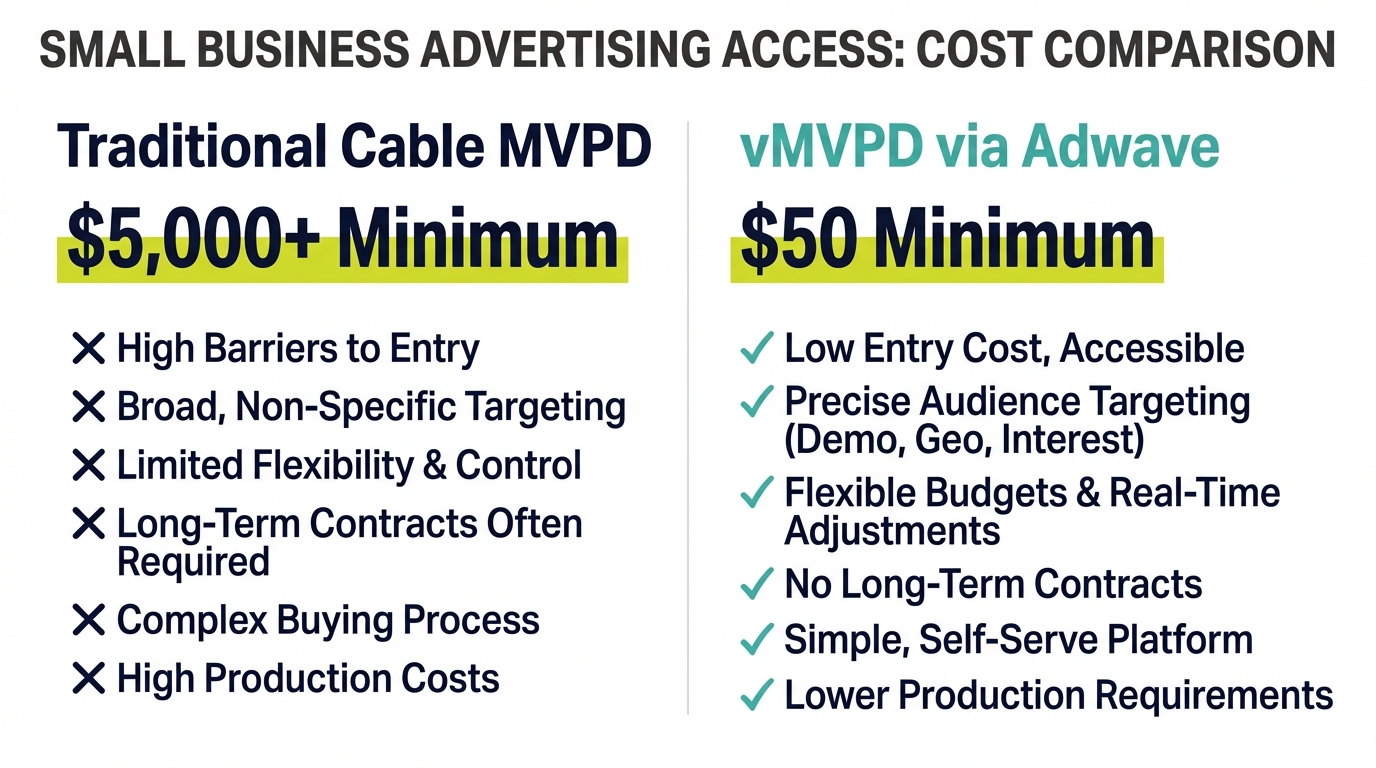
Here's where it gets important for small businesses. Advertising on traditional MVPDs typically requires:
High minimum spends (often $5,000 to $25,000+)
Working directly with the cable company or through an agency
Broad geographic targeting (entire markets or zones)
Long lead times for campaign setup
Advertising on vMVPDs can be accessed through programmatic platforms with:
Lower minimums (starting at $50 with platforms like Adwave)
Self-serve options, no agency required
Precise geographic targeting down to zip codes
Real-time campaign launch and optimization
Why vMVPDs Matter for Small Business Advertising
For most small businesses, traditional cable advertising has been out of reach. The minimums are too high, the geographic targeting too broad, and the buying process too complicated.
VMVPDs change that equation in three important ways.
1. Reach Cord-Cutters Who Still Want Live TV
The viewers who left cable didn't stop watching TV. They just changed how they watch it. YouTube TV alone has over 8 million subscribers. These are active, engaged viewers who are often harder to reach through traditional channels.
If your target customers are 25-54 year olds who've cut the cord, vMVPD advertising might be the only way to reach them on the big screen.
2. Access Premium Content Without Premium Prices
VMVPD viewers watch the same content as cable subscribers: NFL games on ESPN, news on CNN, shows on Bravo. But the advertising inventory is bought differently, through programmatic platforms that open access to smaller advertisers.
A local car dealership can run ads during live sports on YouTube TV, something that would require a massive budget through traditional cable buys.
3. Geographic Precision That Makes Sense for Local Businesses
Traditional cable advertising typically targets broad zones, like "Central Texas" or "Metro Atlanta." For a single-location business, you're paying to reach people who'll never visit your store.
VMVPD advertising through platforms like Adwave lets you target specific zip codes or draw a radius around your location. A restaurant can show ads only to households within five miles. A service business can focus on the neighborhoods they serve. Learn more about geographic precision in our guide to local TV advertising.
How to Advertise on vMVPDs
Unlike traditional cable, you don't need to call each streaming service directly. vMVPD advertising inventory is typically accessed through programmatic advertising, where software connects advertisers with available ad slots across multiple platforms.
Option 1: Self-Serve Platforms (Best for Small Businesses)
Platforms like Adwave aggregate vMVPD inventory alongside other streaming TV options. You can:
Start campaigns with budgets as low as $50
Target specific zip codes and demographics
Create ads using built-in AI tools
Track performance in real-time
This is the most accessible option for small businesses. No agency needed, no minimum contracts, and campaigns can launch in minutes. For detailed pricing information, see our TV advertising cost guide.
Option 2: Direct Platform Deals
Some vMVPDs sell advertising directly, but minimums are typically $5,000+ and targeting options may be limited. This makes sense for larger campaigns but prices out most small businesses.
Option 3: Agency Managed
Media agencies can buy vMVPD inventory on your behalf, but they typically add 15-20% fees on top of media costs and often have their own minimum spend requirements ($10,000+).
The Future of MVPDs and vMVPDs
The TV landscape continues to evolve, and understanding the trajectory helps advertisers plan ahead.
MVPD Decline: Traditional cable and satellite subscriptions have been declining for over a decade. Major providers lose hundreds of thousands of subscribers each quarter. This doesn't mean MVPDs will disappear, but their audiences are aging and shrinking.
vMVPD Growth: vMVPDs have been the beneficiary of cord-cutting, but growth has stabilized. YouTube TV and Hulu + Live TV dominate the market. The audience is significant and engaged, making vMVPDs an essential part of any detailed TV strategy.
What This Means for Advertisers: If your target customer is under 55, vMVPD inventory becomes increasingly important. If you're targeting older demographics, traditional MVPD advertising still has value. Most small businesses benefit from a blended approach that reaches viewers wherever they watch.
vMVPD Advertising Costs for Small Businesses
Let's get specific about what small businesses should expect to pay for vMVPD advertising.
CPM Ranges by Platform and Access Method:
Programmatic Access (via Adwave):
General vMVPD inventory: $18-30 CPM
Live sports inventory: $30-50 CPM (premium due to high engagement)
News inventory: $20-35 CPM
Direct deals (larger advertisers):
YouTube TV direct: $25,000+ minimum
Hulu + Live TV direct: Similar minimums
CPMs typically $25-40
What Different Budgets Achieve:
$200/month: At a $25 CPM, approximately 8,000 impressions reaching an estimated 2,700 unique households. This is a modest test budget.
$500/month: Approximately 20,000 impressions reaching an estimated 6,700 unique households. Meaningful exposure in a local market.
$1,000/month: Approximately 40,000 impressions reaching an estimated 13,000 unique households. Strong local presence with multiple exposures per household.
$2,000/month: Approximately 80,000 impressions providing significant market penetration in a targeted geographic area.
Cost Comparison to Traditional Cable:
VMVPD advertising through programmatic platforms typically costs 30-50% less than equivalent traditional cable spots when you factor in the targeting precision. With cable, you're paying to reach entire zones including many households outside your service area. With vMVPD programmatic, you're paying only for the specific zip codes you care about.
Creating Effective vMVPD Ads
VMVPD viewers are watching live TV content on streaming devices. Your creative should match that context.
Technical Requirements:
Format: MP4 or MOV
Resolution: 1080p minimum
Length: 15 or 30 seconds (30 seconds most common)
Audio: Broadcast-quality, clear dialogue
Aspect Ratio: 16:9 (standard widescreen)
Creative Best Practices:
1. Design for the Big Screen
VMVPD viewers are watching on televisions, not phones. Text needs to be large and readable from across the room. Avoid small details that get lost at viewing distance.
2. Match the Live TV Context
Your ad appears alongside live sports, news, and cable programming. This is traditional TV content consumed in a traditional TV way. Professional production values are expected. Avoid anything that looks like social media content repurposed for TV.
3. Consider the Sports Audience
Many vMVPD viewers subscribed specifically for live sports. If your ads run during sports programming, you're reaching fans in high-energy, emotional moments. Creative that acknowledges this context (enthusiastic tone, fast pacing) can resonate better.
4. Account for News Viewers
News viewers tend to be informed, engaged, and often older than the streaming average. They watch throughout the day, making morning and evening news windows valuable for reaching this audience. Creative for news contexts should feel credible and trustworthy.
5. Include Clear Calls to Action
What should viewers do next? Options include:
Simple website URL
QR code (viewers have phones nearby)
Phone number for call-based businesses
Store address for retail
6. Local Relevance
Since you're targeting specific geographic areas, make your local presence clear. Mention your city or neighborhood. Show recognizable local imagery. "Serving [Your City] for 25 years" builds instant credibility.
No Video Creative?
Platforms like Adwave include AI-powered tools that generate professional video ads from your website content and business information. You can have broadcast-ready creative in minutes without hiring a production company.
Measuring vMVPD Advertising Performance
VMVPD advertising offers better measurement than traditional cable, though it still differs from digital advertising.
Metrics You'll Receive:
Impressions: How many times your ad was shown across vMVPD platforms.
Video Completion Rate: What percentage of viewers watched your entire ad. Expect 90%+ on vMVPD since most ads are non-skippable.
Reach and Frequency: Unique households reached and average exposures per household.
Geographic Distribution: Confirmation that targeting is working correctly.
Business Impact Indicators:
Track these metrics during campaign periods:
Website traffic changes (especially direct traffic)
Phone call and inquiry volume
Foot traffic changes for retail businesses
New customer source tracking ("How did you hear about us?")
Branded search volume increases
Attribution Considerations:
TV advertising, including vMVPD, builds awareness over time rather than driving immediate clicks. Compare your business metrics during campaign periods to baseline periods. Look for lifts in overall performance rather than trying to attribute individual sales to specific ad exposures.
The Bottom Line for Small Businesses
Here's what matters: vMVPDs have opened a door that was previously closed to small business advertisers.
You can now reach live TV viewers, including sports fans watching the game and news watchers catching the morning headlines, without the $10,000+ minimums that traditional cable requires. You can target them precisely by location. And you can do it all through a self-serve platform that doesn't require an agency relationship.
The TV advertising landscape is shifting fast. According to Nielsen, streaming now accounts for over 40% of all TV viewing time. Within streaming, vMVPDs represent a growing slice of that audience, viewers who want the live TV experience without the cable bill.
For small businesses, this shift is good news. It means TV advertising is more accessible than ever, if you know how to access it. The combination of lower minimums, precise targeting, and self-serve platforms means any business can test TV advertising and measure results before committing significant budget.
Common questions answered
What does MVPD stand for?
MVPD stands for Multichannel Video Programming Distributor. It's the technical term for traditional cable and satellite TV providers like Comcast, Spectrum, DirecTV, and DISH Network. These companies bundle multiple TV channels together and deliver them through physical infrastructure like cables, satellite dishes, or fiber optic lines.
What is the difference between MVPD and vMVPD?
The main difference is delivery method. MVPDs deliver TV through physical cables or satellites, while vMVPDs stream live TV over the internet. For advertisers, vMVPDs typically offer lower minimum spends, more flexible targeting options, and access through self-serve platforms. MVPDs usually require larger budgets and working through the cable company directly or an agency.
What are examples of vMVPD services?
The most popular vMVPDs are YouTube TV, Hulu + Live TV, Sling TV, FuboTV, and DirecTV Stream. These services stream bundles of live TV channels over the internet, similar to traditional cable but without the physical infrastructure. Subscribers can watch on smart TVs, streaming devices, phones, and tablets.
Can small businesses advertise on vMVPDs?
Yes, and it's more affordable than traditional cable advertising. While advertising directly with vMVPDs may still require significant minimums, platforms like Adwave aggregate vMVPD inventory and let small businesses run campaigns starting at just $50. You can target specific zip codes, reach cord-cutters watching live TV, and track results in real-time.
The vMVPD Opportunity for Local Businesses
VMVPDs have created a unique opportunity for local businesses to reach live TV audiences without the traditional barriers.
Why vMVPDs Matter for Small Advertisers:
Cord-Cutter Reach: Millions of households have left traditional cable but still want live TV. vMVPDs are often the only way to reach them on the big screen during live programming.
Live Sports Access: Sports are a primary driver of vMVPD subscriptions. For businesses targeting sports fans, vMVPD inventory is essential.
Engaged News Viewers: vMVPD audiences include active news consumers who are often informed, engaged, and have higher purchasing power.
No Traditional Cable Barriers: Where traditional cable advertising required large minimums and agency relationships, vMVPD inventory is accessible through programmatic platforms at any budget level.
The Shifting Landscape:
Every quarter, more households leave traditional cable for streaming alternatives. This trend accelerates over time, meaning vMVPD advertising becomes increasingly important for reaching TV audiences.
For small businesses, this shift is positive. As more inventory moves to vMVPDs, pricing becomes more competitive and accessibility improves. The future of TV advertising runs through streaming.
Access vMVPD Inventory Through Adwave
The world of TV advertising has changed. You don't need a six-figure budget or an agency relationship to reach viewers on live streaming TV.
With Adwave, you can access vMVPD inventory alongside 100+ premium streaming channels, targeting viewers in your specific service area. Our AI tools help you create professional video ads, and campaigns can launch with budgets starting at just $50. Ready to create your first commercial? Check out our guide on how to make a commercial.
Get started with Adwave today and reach cord-cutters on the platforms they use.


