
A leaking water heater doesn't wait for business hours. Neither does a backed-up sewer line. Plumbing is one of the few industries where customers go from "no need at all" to "I need someone right now" in the span of minutes.
That urgency is both your biggest advantage and your biggest challenge. When the emergency hits, you want to be the name that comes to mind, or at least the first name that shows up. But getting there means putting your plumbing business in front of the right homeowners, in the right places, before they need you.
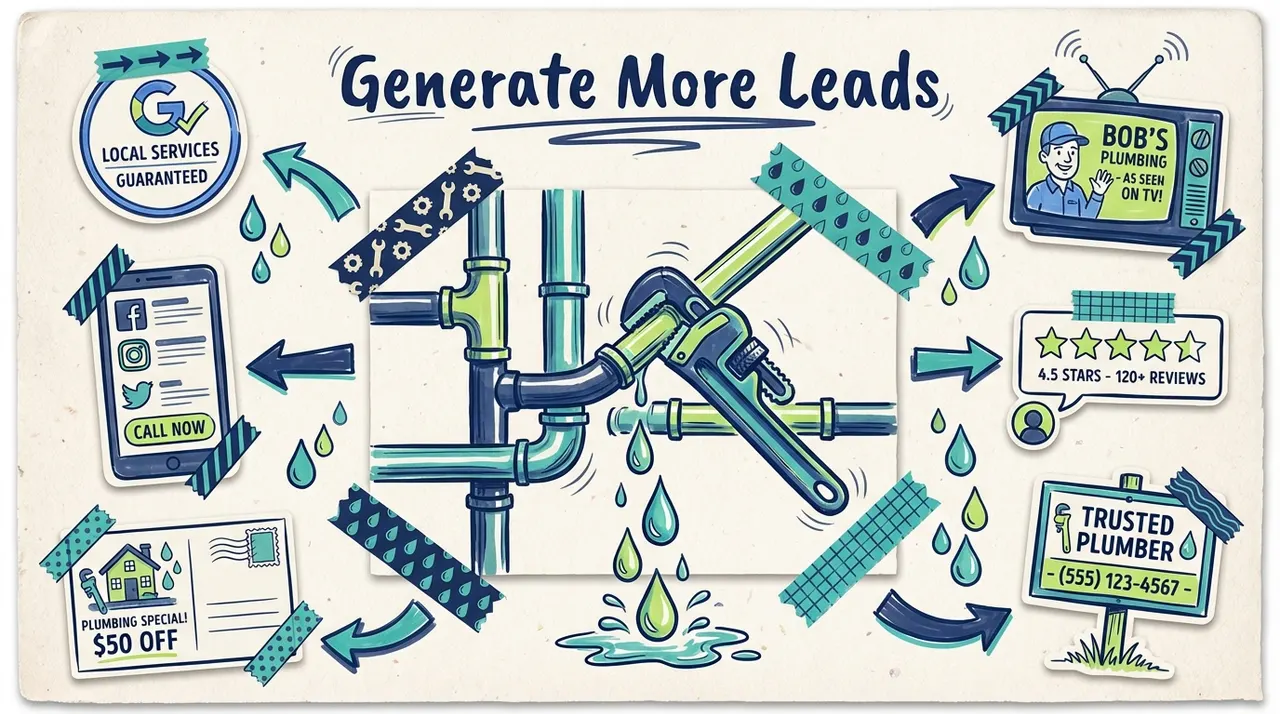
There's no single advertising channel that does it all. Google Ads captures people who are already searching. Social media builds familiarity over time. Review platforms build trust. Direct mail stays on the fridge. TV puts you on the big screen next to the national brands.
The plumbers who grow fastest aren't the ones who pick one channel and hope for the best. They're the ones who build a system across multiple channels, so leads keep flowing whether it's peak season or a slow Tuesday in February.
This guide breaks down seven advertising channels for plumbing businesses, with honest assessments, real costs, and specific tactics you can put to work this month.
Google Local Service Ads (LSAs): The Emergency Call Generator

If you advertise on only one channel, make it this one. Google Local Service Ads sit at the very top of search results, above regular Google Ads, above organic listings, above everything. When a homeowner types "plumber near me" or "emergency plumber," your business shows up first with a green "Google Guaranteed" badge.
That badge matters. Google's own data shows that businesses with the Google Guarantee earn significantly more trust from searchers. For plumbing, where you're asking homeowners to let a stranger into their house, that trust signal is gold.
How LSAs work for plumbers
Unlike traditional Google Ads where you pay per click, LSAs charge you per lead. You only pay when someone calls you or sends a message through the ad. Average cost per lead for plumbers runs $25-50 depending on your market, though competitive metro areas can push higher.
The leads are high-intent. These aren't people browsing for plumbing tips. They need a plumber, and they need one soon. Conversion rates on LSA leads tend to run significantly higher than standard search ads because the intent is so strong.
Setting up LSAs for maximum results
To get started, you'll need to pass Google's screening process, which includes a background check, license verification, and proof of insurance. The process takes 2-4 weeks, so don't wait until you need leads to begin.
Once you're approved:
Set your service categories carefully. List every service you offer (drain cleaning, water heater repair, sewer line, repiping, etc.). Each category is a separate lead opportunity.
Define your service area precisely. Cover the zip codes you serve. Stretching too wide wastes budget on jobs you'll decline.
Set your budget based on capacity. If you can handle 20 new jobs per week, budget accordingly. LSAs let you pause when you're booked up.
Respond fast. Google tracks your response time and factors it into rankings. Plumbers who answer within 5 minutes consistently outrank those who take hours.
Ask every customer for a review. LSA rankings are heavily influenced by your review count and rating. Make it part of your job completion process.
What LSAs cost
Budget $500-2,000/month to start, depending on your market size. A mid-size metro area typically needs $1,000-1,500/month to stay competitive. every dollar goes to actual leads, not clicks. Track your close rate on LSA leads. If you're closing 40% at an average job value of $350, a $40 lead costs you $100 per new customer. That math works for most plumbing businesses.
Quick Tip: Dispute leads that don't match your services. Google allows you to contest charges for spam calls, wrong-service requests, and out-of-area inquiries. Most plumbers leave money on the table by not disputing bad leads.
Google Search Ads (PPC): Capturing High-Intent Searches
Google Search Ads (pay-per-click) complement LSAs by letting you target specific keywords with more control over your messaging. While LSAs dominate the top of results, regular search ads appear just below and offer more flexibility in what you say and where you send people.
For plumbing businesses, the most valuable keywords fall into two buckets: emergency terms and service-specific terms.
Emergency keywords that convert
Emergency searches convert at the highest rates because the need is immediate:
"Emergency plumber [city]"
"24-hour plumber near me"
"Burst pipe repair"
"Sewer backup help"
The average cost per click for plumbing keywords ranges from $6-20, with emergency terms on the higher end. That's steep, but if one in five clicks turns into a $500+ emergency repair, the economics work.
Service-specific campaigns
Create separate campaigns for each service line. Someone searching "water heater installation" has different needs (and a higher job value) than someone searching "dripping faucet repair." Separate campaigns let you:
Write ad copy specific to each service
Send visitors to a relevant landing page (not your generic homepage)
Set different budgets based on job profitability
Track which services generate the best return
Making your budget work harder
Use negative keywords aggressively. Add terms like "DIY," "how to," "jobs," and "salary" to your negative list. You don't want to pay for clicks from people trying to fix it themselves or looking for plumbing careers.
Schedule ads for your hours. If you don't offer 24/7 service, don't run ads at 3am. Increase bids during peak search times (early morning and evenings when people are home and noticing problems).
Enable call extensions. Many plumbing customers will call directly from the search result. Make that as easy as possible.
Track everything. Use call tracking numbers so you know exactly which keywords and ads generate booked jobs, not just calls.
Expect to spend $1,000-3,000/month on search ads for meaningful results. Combined with LSAs, your total Google spend will likely be your biggest advertising line item, but also your most directly attributable source of new leads.
Meta, Instagram, and Nextdoor: Building Trust Before the Emergency

Social media advertising for plumbers works differently than search ads. You're not catching people mid-emergency. Instead, you're building familiarity so that when the emergency does happen, your name is already in their head.
Think of it as planting seeds. A homeowner scrolls past your ad for seasonal drain cleaning three times over two months. They don't need it yet, so they don't click. Then their basement floods in March, and suddenly your name is the one they remember.
Facebook and Instagram ads for plumbers
Meta's ad platform (which covers both Facebook and Instagram) offers some of the most precise local targeting available. You can target homeowners within your service area by:
Age and homeownership status. Focus on 30-65 year olds who own their homes.
Home value. Target neighborhoods with older homes that are more likely to need plumbing work.
Recent movers. People who just bought a home often discover plumbing issues quickly.
Interests. Target people interested in home improvement, DIY projects, or related topics.
Average cost per thousand impressions (CPM) for home services on Meta runs $10-25, making it one of the most affordable ways to get your name in front of local homeowners.
What content works
The plumbing ads that perform best aren't polished corporate productions. They're real, relatable content that builds trust:
Before/after photos of completed jobs (with homeowner permission)
Quick tips like "3 signs your water heater is about to fail"
Behind-the-scenes footage of your team at work
Customer testimonials (video performs best)
Seasonal reminders ("Winterize your pipes before the first freeze")
Video gets 1.5-2x the engagement of static images on Facebook. Even a 30-second phone video of a drain cleaning job can outperform a professionally designed graphic.
Nextdoor: The neighborhood advantage
Don't overlook Nextdoor. The platform has over 90 million verified users across the U.S., and it's built around neighborhood conversations. Plumbing recommendations are one of the most common requests on the platform.
A free Nextdoor Business Page lets you:
Respond to recommendation requests
Post local deals and updates
Collect neighborhood-specific recommendations
Paid Nextdoor ads let you target by neighborhood, which is even more granular than zip code targeting. For a plumbing business, this hyper-local reach is extremely valuable.
Budget and expectations
Start with $500-1,000/month on Meta ads. Don't expect phone calls the next day. Social advertising for plumbers is a 60-90 day play. You need enough frequency (homeowners seeing your ads 3-5 times) to build recognition. After that initial period, you'll start seeing brand-search increases ("your company name + plumber") and direct inquiries.
Quick Tip: Retarget your website visitors on Facebook and Instagram. Someone who visited your "water heater repair" page but didn't call is a warm lead. Show them a testimonial ad and watch conversions climb.
Local SEO and Google Business Profile: Free Leads That Compound
Every plumber wants to show up in the Google Map Pack, that three-business box that appears at the top of local searches. According to BrightLocal, 98% of consumers used the internet to find information about local businesses in 2024, and the map pack captures a massive share of those clicks.
Ranking in the map pack is free. No ad spend required. It takes effort and consistency, but once you earn a top-three spot, every search is a potential lead at zero cost per click.
Google Business Profile optimization
Your Google Business Profile (GBP) is the foundation. If you haven't claimed yours, do that today. Then optimize it:
Complete every field. Services, service area, hours (including emergency hours), payment methods, founding year, and a detailed business description with your key services and service area mentioned naturally.
Add photos weekly. Businesses with more than 100 photos get 520% more calls than average. Take photos of completed jobs, your team, your trucks, and your equipment.
Post updates regularly. Google rewards activity. Share seasonal tips, special offers, and completed project highlights through GBP posts.
Answer questions. The Q&A section lets you preemptively address common concerns like pricing, response times, and licensing.
Reviews: The ranking factor that matters most
Google reviews are the single biggest factor in local search rankings for plumbers. Research from Whitespark confirms that review signals (quantity, quality, velocity, and diversity) are the top-ranking factor for map pack visibility.
Build a review generation system:
Ask for a review at the end of every job
Send a follow-up text with a direct link to your Google review page
Respond to every review (positive and negative) within 24 hours
Aim for 5-10 new reviews per month consistently
A plumbing business with 200+ reviews and a 4.7+ rating will outrank competitors with 30 reviews almost every time, even if those competitors have been around longer.
Local citations and directory listings
Consistent business information across the web signals legitimacy to Google. Make sure your name, address, and phone number (NAP) are identical on:
Google Business Profile
Yelp, Angi, HomeAdvisor
Better Business Bureau
Local chamber of commerce
Industry directories (plumbing association sites)
Services like BrightLocal or Moz Local can automate this for $30-50/month.
Yelp, HomeAdvisor, and Angi: Review Platform Advertising
Review platforms serve a specific role in the plumbing advertising ecosystem. They're where homeowners go to vet plumbers they've already heard of, or to find one when they don't have a recommendation from a friend.
Yelp for plumbers
Yelp matters more for plumbing than many other industries because trust is critical. You're entering someone's home, working on systems they don't understand, and quoting prices they can't easily verify. Reviews bridge that trust gap.
Focus on building your organic Yelp presence first:
Claim your free business page and complete every field
Add photos of your work, your team, and your trucks
Respond to every review (especially negative ones, professionally)
Ask happy customers to share their experience (but never incentivize reviews, as Yelp penalizes this)
Yelp's paid advertising options include enhanced profiles and sponsored results. Costs range from $300-1,000/month depending on your market. Test with a small budget before committing.
HomeAdvisor and Angi
HomeAdvisor and Angi (now merged under the same parent company) operate on a pay-per-lead model similar to Google LSAs. You set your service categories and service area, and they send you leads.
Lead costs for plumbing on these platforms typically run $15-80 per lead depending on the service type. Water heater installations (high ticket) cost more per lead than simple drain cleanings.
The catch: lead quality varies. You'll get some ready-to-book customers and some who are just price shopping five different plumbers. Track your close rate carefully and calculate your true cost per acquired customer.
Quick Tip: Don't rely on any single lead platform. Use them as a supplement to your own marketing, not a replacement. Owning your lead generation through channels you control (your website, your Google presence) is always more sustainable long-term.
Direct Mail, Door Hangers, and Yard Signs: Offline Tactics That Still Work
Digital advertising gets all the attention, but offline marketing still pulls its weight for local plumbing businesses. The homeowner who ignores your Facebook ad might notice your door hanger on their front door or your yard sign in their neighbor's yard.
Direct mail
Direct mail for plumbers works best as a targeted, seasonal campaign rather than a constant blast. The Data & Marketing Association reports that direct mail response rates average 2.7-4.4% for house lists and 1-2% for prospect lists, which significantly outperforms most digital channels on a per-impression basis.
Effective direct mail tactics:
New mover mailings. Target people who just bought a home in your service area. They need a plumber and don't have one yet.
Seasonal maintenance reminders. "Winter is coming, is your plumbing ready?" postcards sent in October generate pre-season bookings.
Neighborhood saturation around completed jobs. After finishing a big job (repiping, sewer replacement), mail the surrounding 200 homes: "We just helped your neighbor at [street name]. Here's 10% off your first service."
Budget $500-1,500 per campaign for design, printing, and postage. A well-targeted mailing of 2,000 postcards costs roughly $1,200-1,800 all-in.
Door hangers
Door hangers are a low-cost guerrilla tactic that works well for plumbers targeting specific neighborhoods. After completing a job, leave door hangers on 50-100 nearby homes with a simple message: your name, phone number, services, and a first-time customer discount.
Cost per door hanger is pennies. The distribution is the real investment (your time or a helper's time). But for hyperlocal awareness, it's hard to beat.
Yard signs
Ask permission to place a yard sign after every job. "Another quality job by [Your Company]" signs in front of a home where you just installed a new water heater are effective. Neighbors see them, and the implied endorsement from someone on their street builds trust.
Keep signs professional, include your phone number in large text, and pick them up after 2-4 weeks. Many plumbers report that yard signs in the right neighborhoods generate a steady trickle of calls.
TV and CTV Advertising: Big-Screen Credibility on a Small Budget
For most of its history, TV advertising was out of reach for independent plumbers. A 30-second spot on local cable could cost thousands to produce and thousands more to air, and you'd be paying to reach viewers well outside your service area.
That's changed. Streaming TV (also called CTV, or connected TV) lets you run ads on the same premium networks, think ESPN, HULU, and NBC, with geographic targeting down to specific zip codes. Your ad plays during shows your potential customers are already watching, and you only pay for impressions in your service area.
The credibility factor is real. When a homeowner sees your plumbing business on their TV screen, right alongside ads from national brands, it signals that you're established and trustworthy. That perception matters in an industry where trust drives the buying decision.
With platforms like Adwave, you can create a broadcast-quality 30-second commercial and start running it on 100+ premium channels for as little as $50. The ad is generated from your website or business listing, so you don't need a production crew or a script.
For a deeper look at how TV advertising works specifically for plumbing companies, including creative tips, seasonal strategies, and audience targeting, check out our full guide on TV advertising for plumbers.
TV/CTV works best as a brand-building layer on top of your lead generation channels. It won't replace Google Ads for capturing emergency searches, but it builds the name recognition that makes all your other advertising more effective.
Budget $300-800/month for a meaningful CTV campaign in a local market. That gets you thousands of impressions among homeowners in your service area every month. For more detail on what local TV advertising costs, see our cost breakdown.
Channel Comparison: Plumbing Advertising at a Glance
Recommended Budget Allocation for Plumbing Businesses
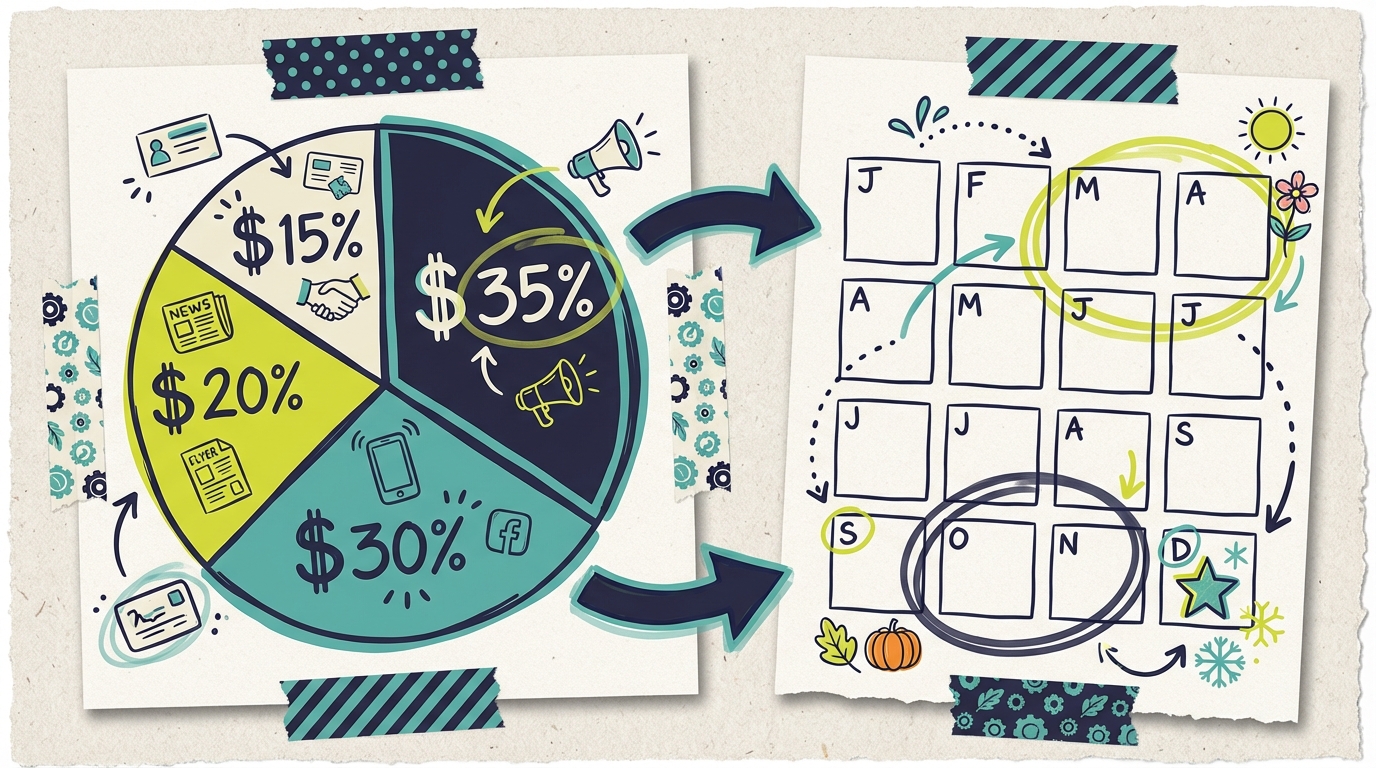
Your ideal budget split depends on your growth stage and goals. Here are three scenarios:
Starting out ($1,500-2,500/month)
If you're a newer plumbing business or just beginning to advertise, focus your budget on the channels that generate leads fastest:
Google LSAs: 50% ($750-1,250)
Local SEO/GBP optimization: 15% (DIY time investment, or $225-375 for an agency)
Review platform presence: 15% ($225-375 on Yelp/Angi)
Direct mail to new movers: 20% ($300-500)
At this stage, skip social media ads and TV. Your money is better spent on channels that produce phone calls now.
Established and growing ($3,000-5,000/month)
Once you have a steady base of work and want to grow, layer in brand-building channels:
Google LSAs + Search Ads: 40% ($1,200-2,000)
Meta/Instagram ads: 15% ($450-750)
Local SEO: 10% ($300-500)
Review platforms: 10% ($300-500)
Direct mail campaigns: 10% ($300-500)
TV/CTV: 15% ($450-750)
This mix captures immediate leads while building the brand recognition that lowers your cost per lead over time.
Scaling aggressively ($5,000-10,000/month)
For plumbing businesses ready to dominate their market:
Google LSAs + Search Ads: 35% ($1,750-3,500)
Meta/Instagram/Nextdoor: 15% ($750-1,500)
Local SEO + content: 10% ($500-1,000)
Review platforms: 10% ($500-1,000)
Direct mail (targeted campaigns): 10% ($500-1,000)
TV/CTV: 15% ($750-1,500)
Retargeting (cross-platform): 5% ($250-500)
At this level, you're building a true marketing system where each channel reinforces the others. Someone sees your TV ad, searches your name on Google, checks your reviews, and calls. That's how the fastest-growing home service businesses build their lead pipelines.
Common Questions Answered
How much should a plumbing business spend on advertising?
Most successful plumbing businesses spend 5-10% of revenue on advertising. For a company doing $500,000 in annual revenue, that's $25,000-50,000 per year, or roughly $2,000-4,000 per month. Start at the lower end if you're just beginning to advertise and increase as you learn which channels deliver the best return. The key is tracking your cost per lead and cost per acquired customer on every channel so you know where your money works hardest.
What's the fastest way to get plumbing leads?
Google Local Service Ads are the fastest path to new leads for most plumbing businesses. Once your profile is approved (allow 2-4 weeks for the background check and verification process), leads can start coming in within days. Google Search Ads are the second-fastest option. Both channels capture homeowners who are actively searching for a plumber right now, which means you're reaching people with immediate intent to hire.
Do Facebook ads work for plumbers?
Yes, but not in the way most plumbers expect. Facebook and Instagram ads won't generate emergency calls the way Google does. Instead, they build familiarity and trust over time. A homeowner who sees your ad multiple times over two months is more likely to remember your name when a pipe bursts. Social ads work best for seasonal campaigns (winterization, pre-summer AC/plumbing checkups), special offers, and retargeting people who've already visited your website.
Should I pay for leads on HomeAdvisor or Angi?
These platforms can supplement your lead flow, but they shouldn't be your primary source. The leads are shared with multiple plumbers, which means you're competing on price and response speed. Use them to fill gaps in your schedule, but invest more heavily in channels you own and control, like your Google presence, your website, and your own advertising. That way, you're building an asset rather than renting someone else's audience.
Is TV advertising worth it for a small plumbing company?
TV advertising makes sense once you have your foundational channels (Google, reviews, local SEO) producing steady leads. At that point, adding TV/CTV builds the brand recognition that makes everything else work better. Homeowners who've seen your commercial are more likely to click your Google ad, trust your reviews, and call you first. With streaming TV platforms, you can start for as little as $300/month targeting just your local service area, so it's no longer a big-brand-only play.
How do I track which advertising channels are working?
Use unique phone numbers for each channel. Call tracking services like CallRail or CallTrackingMetrics let you assign a different number to your Google Ads, your direct mail, your website, and your social profiles. When a call comes in, you know exactly which channel generated it. Pair that with a simple spreadsheet tracking leads, booked jobs, and revenue per channel, and you'll have a clear picture of your return on every advertising dollar within 90 days.


