
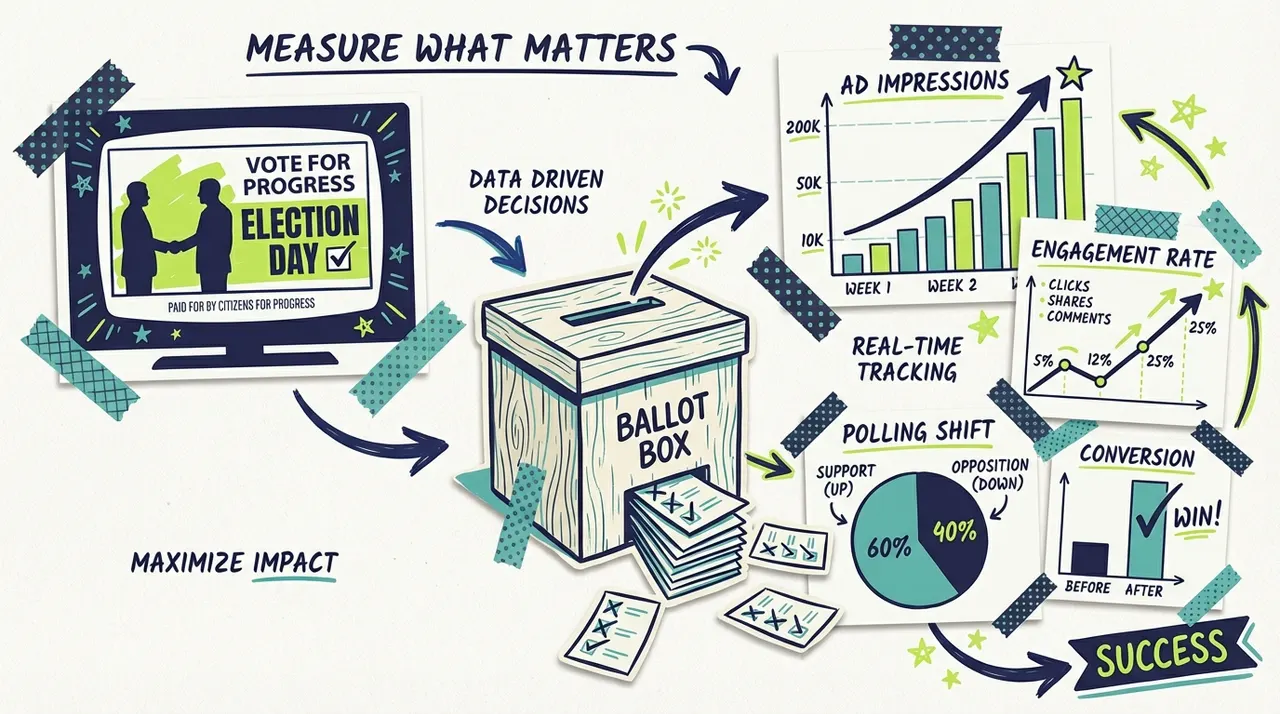
Political campaigns spend billions on TV advertising every election cycle. But most campaigns, especially at the local and state level, struggle to answer a basic question: is this spending working?
The challenge is real. Political advertising doesn't generate direct sales or clicks the way e-commerce ads do. You can't track a "vote" the way you track a purchase. But that doesn't mean TV advertising effectiveness is unmeasurable. It means you need a different measurement framework, one built for the unique dynamics of political campaigns.
This guide covers practical, implementable approaches to measuring political TV advertising ROI at every campaign level.
Why political ad measurement is different

Commercial advertising has clear conversion metrics: purchases, sign-ups, leads, revenue. Political advertising has one conversion that matters (votes), and it only happens once, on election day.
This creates several unique measurement challenges:
Delayed and singular conversion. You can't measure "sales" throughout the campaign. The only true conversion happens months after advertising begins.
No direct attribution. A voter can't click a TV ad to cast their ballot. The path from ad exposure to vote is indirect and influenced by dozens of other factors.
Competitive dynamics. Your opponent is running ads too. Measuring your effectiveness requires accounting for the impact of opposing messaging.
Diminishing returns. Political advertising often shows strong initial impact that diminishes as ad saturation increases. Measuring ROI requires understanding where you are on the saturation curve.
Despite these challenges, modern CTV advertising platforms and digital analytics tools give campaigns more measurement capability than ever before.
The metrics that matter for political TV
Awareness metrics
Name recognition lift. The most fundamental metric for any political TV campaign. Track name recognition through polling (benchmark before the campaign starts, then poll during and after). A 10 to 20 point increase in unaided name recognition during a CTV campaign is a strong signal.
Branded search volume. Monitor Google Trends for searches of the candidate's name in targeted markets. This is the most accessible and immediate indicator that TV ads are registering with voters. A sustained 30%+ increase in candidate name searches during an active campaign correlates strongly with ad effectiveness.
Social media mentions. Track mentions of the candidate's name on social platforms during the campaign. Spikes in organic mentions that coincide with ad flights suggest the messaging is generating conversation.
Engagement metrics
Website traffic. Track visits to the campaign website from targeted geographies. CTV campaigns typically drive 15 to 30% increases in direct and organic website traffic during active flights. Monitor not just volume but also engagement metrics like time on site and pages per visit.
Volunteer sign-ups and donations. If your TV ads include calls to action (visit the website, donate, volunteer), track the volume and timing of these actions. Increases that coincide with ad flights are attributable signal.
Event attendance. For campaigns promoting rallies, town halls, or community events through TV, track attendance and ask attendees how they heard about the event.
Persuasion metrics
Favorability ratings. Regular polling that tracks favorable/unfavorable ratings provides direct measurement of whether TV ads are moving opinion. This is expensive but provides the most direct measurement of persuasion.
Vote intent tracking. Tracking polls that measure likelihood of voting for your candidate before, during, and after TV flights. Changes in vote intent during active campaigns indicate ad effectiveness.
Message recall. Post-exposure surveys that test whether voters can recall specific messages from your ads. High message recall correlates with ad effectiveness, while low recall suggests creative or frequency issues.
Campaign delivery metrics
These come directly from your CTV platform:
Impressions delivered. Total number of times your ad was served.
Unique household reach. How many distinct households saw your ad. This matters more than raw impressions because reaching 50,000 households five times each is very different from reaching 250,000 households once.
Frequency. Average number of times each household saw your ad. For political CTV, research suggests that 8 to 12 impressions per household over a campaign cycle is optimal. Below 5 and the message doesn't stick. Above 15 and you're hitting diminishing returns.
Completion rate. What percentage watched the full 30-second ad. CTV typically delivers 90%+ completion rates because ads are non-skippable.
CPM. Cost per thousand impressions. Political CTV CPMs typically range from $20 to $40 depending on market competitiveness and targeting specificity.
Four measurement approaches for political campaigns

1. Before/after polling (most common)
The most straightforward approach: conduct polls before launching TV ads and at regular intervals during the campaign.
What to measure:
Name recognition (unaided and aided)
Favorability rating
Vote intent
Issue association ("Which candidate do you associate with education reform?")
Message recall
Best practices:
Establish baseline at least 2 weeks before the first ad airs
Poll the same geographic areas and demographics you're targeting with TV
Use consistent methodology across all polls so changes reflect real movement, not measurement noise
Sample sizes of at least 400 per poll for statistical significance
Cost: $5,000 to $15,000 per poll for local/state races. Many campaigns budget 3 to 5 polls across the campaign cycle.
2. Branded search analysis (most accessible)
Monitor Google Trends and Search Console data for candidate name searches in targeted markets. This requires no budget beyond what you're already spending.
What to track:
Weekly search volume for the candidate's name
Compare targeted markets (where ads are running) vs. control markets (where they're not)
Track day-of-week and time-of-day patterns to see if search spikes correlate with ad delivery timing
Why it works: When voters see a TV ad for a candidate, a measurable percentage will Google that name within hours or days. This behavior creates a direct, trackable signal of ad impact. Research from Google's political advertising team has shown that CTV campaigns consistently drive branded search lift in political contexts.
Limitations: Search volume reflects interest, not necessarily positive sentiment. A spike could mean people are searching because they're interested, but also because they saw something negative. Combine with other metrics for full context.
3. Geographic comparison (most rigorous)
Run your CTV campaign in some markets but not others, then compare outcomes across markets.
How it works:
Choose 2 to 4 markets with similar demographics and political composition
Run CTV ads in half the markets (test group) and not the other half (control group)
Compare name recognition, website traffic, search volume, and eventual vote performance across both groups
Why it's powerful: This is the gold standard for causal measurement because it controls for everything except the TV advertising variable. If your test markets show 15% higher name recognition and 25% more website traffic than control markets, you can confidently attribute the difference to TV.
Limitation: Only works for campaigns covering multiple markets (congressional, statewide, national). Local races in a single market can't use this approach.
4. Multi-touch attribution modeling
For campaigns running TV alongside digital, social, and ground game, multi-touch attribution assigns partial credit to each channel.
How it works:
Track every voter touchpoint: TV ad exposure, digital ad clicks, email opens, canvass contacts, event attendance
Use statistical modeling to estimate each channel's contribution to outcomes (website visits, donations, volunteer sign-ups, vote intent changes)
Calculate cost-per-outcome for each channel to determine relative ROI
Why it matters: Political campaigns rarely run TV in isolation. Understanding how TV works alongside digital and ground game helps optimize budget allocation across channels.
Limitation: Requires sophisticated analytics infrastructure. Most accessible to larger campaigns with dedicated data teams. Smaller campaigns should focus on approaches 1 and 2.
Budget benchmarks for political CTV
Understanding typical costs helps campaigns evaluate ROI:
Local races (city council, school board):
CTV budget: $2,000 to $10,000 total
Expected reach: 10,000 to 50,000 households
Adwave entry point: $50 for initial testing
State legislative:
CTV budget: $10,000 to $50,000 total
Expected reach: 50,000 to 200,000 households
Congressional:
CTV budget: $50,000 to $250,000 total
Expected reach: 200,000 to 1 million households
Statewide:
CTV budget: $250,000+
Expected reach: 1 million+ households
These budgets represent the CTV component of a multi-channel strategy. Most political media consultants recommend allocating 30 to 50% of total paid media budget to TV/CTV.
Building a measurement timeline

8+ weeks before election day
Establish polling baselines (name recognition, favorability, vote intent)
Set up Google Trends monitoring for candidate name
Configure website analytics for geographic tracking
Begin CTV campaign (awareness phase)
6 to 4 weeks before election day
Conduct mid-campaign poll to measure movement
Review branded search lift data
Analyze website traffic patterns by geography
Shift to persuasion messaging in CTV creative
Assess frequency by household and adjust targeting if needed
4 to 2 weeks before election day
Final polling to measure cumulative impact
Shift to mobilization/GOTV messaging
Increase frequency in targeted precincts
Track early voting patterns in target geographies
Election day and post-election
Compare vote performance in targeted vs. non-targeted areas
Calculate cost per vote in targeted geographies
Document total reach, frequency, and creative performance
Build case study for future campaign planning
Creative testing and optimization
Measuring ROI isn't just about tracking outcomes. It's also about optimizing your creative to improve those outcomes mid-campaign.
A/B testing different messages. Run two versions of your ad with different issue focus (e.g., one on education, one on public safety) in comparable markets or time slots. Compare branded search lift and website traffic patterns for each version. The version that drives more interest becomes your primary creative.
Testing different calls to action. Some political ads end with "learn more at [website]." Others end with "vote early starting October 15." Track which CTA drives more website visits, volunteer sign-ups, or event attendance.
Rotating creative to prevent fatigue. Political campaigns run for weeks or months, and the same 30-second spot loses effectiveness over time. Plan for 2 to 3 creative rotations throughout the campaign: one for awareness, one for persuasion, and one for mobilization. Monitor completion rates and branded search lift for signals that a creative refresh is needed. If completion rates drop below 85% (from the typical 90%+) or branded search lift flattens, it's time for new creative.
Testing audience segments. Run the same ad to different demographic segments and compare which audience shows the strongest response. This data helps allocate budget to the segments where your message resonates most. A candidate might find that their education message performs strongly with women 30 to 50 but underperforms with men 55+, informing both creative and targeting decisions.
Message testing through digital first. Some campaigns test ad concepts as shorter digital video ads on social media before investing in a full CTV campaign. While the formats are different, digital testing can provide quick directional signal on which messages resonate before committing to a larger TV buy.
Mistakes to avoid
Measuring too early. TV advertising builds awareness over time. Don't judge effectiveness based on the first week of a campaign. Allow at least 3 to 4 weeks before drawing conclusions.
Ignoring the halo effect. TV advertising makes every other channel more effective. If your digital ad click-through rates increase 20% during your CTV campaign, that's TV working, even though those conversions technically get attributed to digital.
Over-indexing on CPM. A lower CPM isn't always better. Reaching the right voters at a slightly higher CPM is more valuable than reaching a broad audience cheaply. Geographic and demographic targeting reduces waste even if it increases per-impression cost.
Skipping baseline measurement. Without pre-campaign polling and search volume data, you have no way to measure lift. Always establish baselines before the first ad airs.
Comparing TV to digital on digital's terms. Judging TV by cost-per-click is like judging a rally by how many emails it generated. TV's primary job is building awareness and trust. Measure it on those terms.
Common questions answered
Can you really measure political TV advertising ROI? Yes, though not with the same precision as digital advertising. By combining polling data, branded search analysis, website traffic patterns, and geographic comparisons, campaigns can build a reliable picture of TV's impact. The measurement isn't perfect, but it's far more informative than the "spray and pray" approach most campaigns used a decade ago.
What's a good ROI for political CTV advertising? ROI in political advertising isn't measured in revenue. It's measured in vote movement. A campaign that spends $20,000 on CTV and sees a 15-point name recognition increase in targeted areas is getting strong return. The ultimate ROI measure is whether the candidate wins, but interim metrics like search lift, website traffic, and polling movement provide confidence along the way.
How does CTV compare to traditional TV for political campaigns? CTV offers three major advantages over traditional TV for political campaigns: precise geographic and demographic targeting (reach only the voters who matter), lower entry costs (start testing at $50 with Adwave vs. thousands for a single broadcast spot), and better measurement through digital analytics. Traditional TV still has broader reach in some markets, but CTV's efficiency makes it the better choice for most campaigns below the statewide level.
When should a campaign start measuring TV effectiveness? Start measurement infrastructure before the first ad airs. Establish polling baselines, set up Google Trends monitoring, and configure website analytics at least 2 weeks before launch. Then measure continuously throughout the campaign, not just at the end. Early measurement allows mid-campaign optimization that improves results.
Is political CTV advertising accessible for local campaigns? Absolutely. With platforms like Adwave, a city council or school board candidate can run streaming TV ads starting at $50. Most local campaigns find that $2,000 to $5,000 in CTV provides meaningful reach in their district. The combination of low entry cost, precise targeting, and real-time analytics makes CTV the most accessible TV advertising option in political history.


