
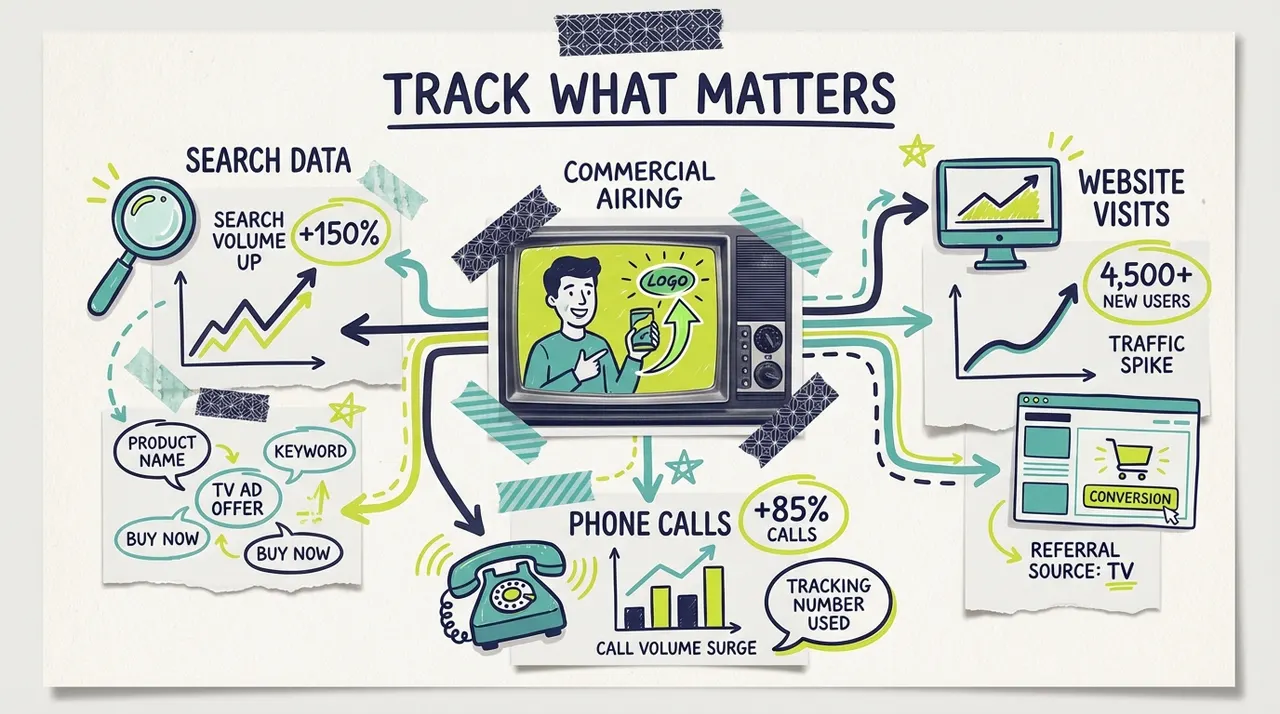
You ran a TV ad. Your phone started ringing more. But can you prove the TV ad caused those calls? That's the attribution question, and it's one of the biggest challenges in television advertising.
Here's the good news: while TV attribution will never be as precise as clicking a Google ad, it's gotten significantly better in the last few years. Small businesses now have access to measurement tools and methods that used to be reserved for major brands with million-dollar budgets.
This guide covers what to track, how to track it, and how to think about TV advertising measurement without getting lost in complexity.
Why TV attribution is different from digital

When someone clicks a Google ad and makes a purchase, the connection is clear. Click, buy, done. That's direct attribution, and it's what makes digital advertising feel so measurable.
TV doesn't work that way. Someone sees your commercial while watching a show on Hulu. They don't click anything because there's nothing to click. Three days later, they Google your business name and call you. A week after that, they walk into your store.
Did the TV ad cause that visit? Almost certainly. But the sale gets attributed to Google Search because that's the last click before the conversion. This is the fundamental challenge of TV advertising measurement: TV's biggest impact is often invisible in your standard analytics.
The metrics that matter
Impression-level metrics (what your platform tells you)
Your CTV advertising platform (like Adwave's dashboard) provides baseline metrics for every campaign:
Impressions. How many times your ad was served. This tells you the raw scale of your campaign.
Reach. How many unique households saw your ad. This is more useful than impressions because it accounts for frequency. Reaching 10,000 households five times each is very different from reaching 50,000 households once.
Frequency. The average number of times each household saw your ad. Research from the Video Advertising Bureau suggests that CTV ads typically need 3 to 5 exposures to drive measurable action. If your frequency is below 3, you might not be reaching people often enough to make an impact.
Completion rate. What percentage of viewers watched your entire 30-second ad. CTV completion rates typically run 90% or higher because viewers can't skip the ads. Compare this to pre-roll video ads on YouTube, where skip rates often exceed 70%.
CPM (cost per thousand impressions). How much you're paying per 1,000 ad views. For small business CTV campaigns, typical CPMs range from $15 to $35, with $25 being a common average.
These metrics tell you whether your ad is being delivered efficiently. But they don't tell you whether it's working.
Business outcome metrics (what you need to track yourself)
This is where attribution gets interesting. To understand whether your TV campaign is driving business results, you need to look beyond your ad platform.
Branded search volume. This is the single most reliable indicator that TV advertising is working. When people see your ad on TV, many will search for your business name on Google later. Monitor your branded search terms in Google Search Console before, during, and after your campaign. A sustained increase of 20% or more in branded searches is a strong signal.
Website direct traffic. Similar to branded searches, direct traffic (people typing your URL directly into their browser) tends to increase when TV campaigns are running. Check Google Analytics for changes in direct traffic patterns that correlate with your campaign flight dates.
New customer acquisition. Track how many new customers you're getting per week or per month. Compare this to your baseline before the campaign started. Even without perfect attribution, a consistent uptick in new customers during your TV campaign is meaningful.
Phone call volume. If phone calls are a key conversion point for your business, track daily call volume. Some businesses set up a dedicated phone number for TV campaigns, though this adds friction and may undercount.
"How did you hear about us?" responses. Simple but effective. Ask every new customer how they found you. The data won't be perfectly accurate (people often forget or misattribute), but it provides directional signal. If "TV" or "streaming" starts appearing in responses, your campaign is registering.
Four attribution methods that work for small businesses

1. Before/after comparison (easiest)
The simplest approach: measure your key metrics for 4 to 8 weeks before launching your CTV campaign, then compare them to the same metrics during and after the campaign.
Track branded searches, website traffic, phone calls, new customers, and revenue. If you see a meaningful uptick across multiple metrics that coincides with your campaign start date, you can reasonably attribute the lift to TV.
Pros: Easy to implement, no special tools needed.
Cons: Doesn't account for seasonality or other marketing changes. Best used when TV is the only new variable.
2. Geo-based testing (most reliable)
Run your CTV campaign in one market but not another similar market. Compare results between the two. If the market with TV advertising shows stronger growth, the difference is your TV lift.
For example, a home services company could run CTV ads in Tampa but not in Jacksonville (a similar-sized Florida market). After 90 days, compare new customer growth, branded search trends, and revenue between the two markets.
Pros: Controls for seasonality and baseline trends. Very persuasive data.
Cons: Requires being in multiple markets. Takes longer to reach statistical significance.
3. Incremental lift analysis
Pause your CTV campaign for two weeks, then restart it. Compare your metrics during the on and off periods. If branded searches, website traffic, and leads drop when TV is off and rebound when it resumes, you've established a causal relationship.
This "on/off" testing is especially effective because you're essentially running your own controlled experiment. The dip during the off period quantifies exactly how much TV is contributing.
Pros: Provides clear causal evidence. Works for single-market businesses.
Cons: You lose campaign momentum during the off period. Best done after the campaign has been running for at least 60 days.
4. Multi-touch attribution modeling
For businesses running multiple channels simultaneously, multi-touch attribution assigns partial credit to each touchpoint in the customer journey. A customer might see a TV ad (awareness), click a Google ad (interest), receive a retargeting ad on Facebook (decision), and then make a purchase.
This approach requires more sophisticated analytics tools, but it gives you the most complete picture of how your channels work together.
Pros: Captures the full customer journey. Shows how TV advertising works alongside digital channels.
Cons: Requires analytics infrastructure. Can be complex to set up.
Setting up your measurement framework
Before launching a CTV campaign, set up these tracking elements:
1. Establish baselines. Record your current branded search volume, website traffic, phone call volume, and new customer counts for at least 4 weeks before the campaign starts. You need this baseline to measure lift.
2. Set up Google Search Console tracking. Make sure you're monitoring branded search queries. Create a bookmark or report specifically for your brand-name terms.
3. Configure Google Analytics goals. Track key conversions: form submissions, phone clicks, appointment bookings, or purchases. Tag your traffic sources so you can see how different channels contribute.
4. Create a "how did you hear about us" field. Add this question to your intake forms, CRM, and train your staff to ask it on phone calls and in-person visits. Include "TV/streaming" as an option.
5. Consider a dedicated landing page. Creating a simple URL (like yourbusiness.com/tv) gives you a direct measurement of TV-driven web visits. Mention this URL in your commercial. The downside is that most viewers won't remember a specific URL, so this will undercount, but the visits you do capture are 100% attributable.
What "good" looks like

Here are realistic benchmarks for small business CTV campaigns:
Branded search lift: 20 to 40% increase during active campaigns. Some businesses see even higher lifts.
Website traffic lift: 15 to 30% increase in direct and organic traffic.
Cost per thousand impressions: $15 to $35 for local targeting.
Completion rates: 90% or higher for 30-second non-skippable ads.
New customer attribution: Expect 10 to 25% of new customers to mention TV/streaming as a discovery channel in surveys (actual influence is likely higher due to underreporting).
Payback timeline: Most small businesses see measurable brand lift in 30 to 60 days. Clear ROI attribution typically takes 60 to 90 days of consistent campaigning.
Building a monthly attribution report
Once your campaign is running, create a simple monthly report that tracks your key metrics in one place. Here's a template:
Campaign delivery metrics:
Total impressions delivered
Unique households reached
Average frequency per household
Completion rate
CPM
Business outcome metrics:
Branded search volume (Google Search Console)
Direct website traffic (Google Analytics)
Total new customers acquired
"TV/streaming" mentions in customer surveys
Phone call volume (if tracked)
Derived metrics:
Branded search lift vs. pre-campaign baseline (percentage)
Website traffic lift vs. baseline (percentage)
Estimated cost per incremental customer
Estimated ROAS (if revenue per customer is known)
Pull this report on the same day each month. After three months, you'll have enough data points to see clear trends and make confident budget decisions.
The most actionable insight usually isn't any single number. It's the pattern across metrics. If branded searches are up 30%, direct traffic is up 20%, and new customer counts are up 15% compared to your pre-campaign baseline, that's a clear signal that TV is working, even without perfect per-lead attribution.
How TV attribution is evolving
The measurement gap between digital and TV advertising is closing fast. Several trends are making TV attribution more precise for small businesses:
Automatic content recognition (ACR). Smart TVs from Samsung, LG, and Vizio can now detect what content is playing on screen. This allows advertisers to match ad exposures to specific households and then track whether those households later visited a website, made a purchase, or took another action.
Cross-device matching. When a CTV ad plays on a household's TV, attribution platforms can link that impression to other devices on the same WiFi network. If someone sees your ad on their Roku and then visits your website on their phone 20 minutes later, that connection can now be tracked.
Clean room measurement. Data clean rooms allow advertisers to match their first-party customer data against TV impression data without either party sharing raw personal information. This gives small businesses access to the same measurement rigor that large brands use, without the privacy concerns.
Real-time dashboards. Platforms like Adwave provide real-time campaign analytics that show you exactly how your campaign is performing, who you're reaching, and how your metrics are trending over time. This immediate feedback loop helps you optimize faster and make data-driven decisions about budget allocation.
The bottom line on attribution technology: you don't need to understand every technical detail. What matters is that TV measurement is getting better, and the tools available to small businesses today are dramatically more capable than what existed even two years ago.
Mistakes to avoid
Expecting click-level precision. TV attribution will never match the exactness of Google Ads. Accept directional measurement and look for patterns across multiple metrics rather than trying to attribute every single lead.
Looking at one metric in isolation. No single metric tells the full story. Branded search lift plus website traffic increase plus more phone calls together paint a reliable picture.
Cutting the campaign too early. TV builds brand awareness over time. Pulling the plug after two weeks because you can't see direct conversions yet is like planting a seed and digging it up after three days to check if it's growing.
Ignoring the halo effect. One of TV's biggest benefits is making your other marketing channels more effective. If your Google Ads cost per lead drops 20% while CTV is running, that's TV working, even if the conversions technically get attributed to Google.
Comparing TV to digital on digital's terms. Judging TV by cost-per-click or last-click attribution is like judging a billboard by how many people took a photo of it. TV's primary job is building awareness and trust. Its value shows up in how it improves every other channel in your marketing mix.
Not tracking baselines before launching. If you start a TV campaign without knowing your current branded search volume, website traffic, and customer acquisition rate, you'll have no way to measure lift. Always establish at least 4 weeks of baseline data before your campaign goes live.
Common questions answered
Compare branded searches, website visits, customer survey responses, and sales before and during the campaign. Together they provide evidence of impact, with limits on attributing individual sales.
What's the minimum budget to measure TV advertising effectiveness? You need enough impressions to create a statistically observable signal. For most local markets, that means running at a minimum of $500 to $1,000 per month for at least 60 to 90 days. Lower budgets can still work, but the attribution signal may take longer to emerge. With Adwave's $50 starting point, you can test the creative and platform before committing to a larger measurement-focused campaign.
An on/off test pauses and restarts TV while other marketing stays consistent. A geographic test compares similar markets with different TV exposure. Account for other changes that could affect results.
Should I use a QR code in my TV ad? QR codes can work, but scan rates on CTV are typically low (1 to 3% of viewers). They're a useful secondary measurement tool but shouldn't be your primary attribution method. If you include one, make sure it leads to a tracked landing page so you can measure the scans that do happen.
How often should I check my campaign metrics? Review platform metrics (impressions, reach, frequency) weekly. Check business outcome metrics (branded searches, website traffic, leads) bi-weekly or monthly. Avoid daily monitoring early in a campaign since daily fluctuations create noise that can lead to premature decisions. The patterns that matter emerge over weeks, not days.


