A data-driven look back at which advertising channels delivered for small businesses this year.
Review which advertising channels brought customers to your business in 2025.
This year brought significant shifts in how small businesses advertise. Economic pressures made every marketing dollar count. Consumer attention continued fragmenting across more platforms. And some channels that dominated a few years ago showed clear signs of decline while others emerged as surprisingly effective. Here's what the data tells us about small business advertising in 2025, and what it means for planning your 2026 strategy.
Digital advertising: mixed results
Digital advertising remains essential for small businesses, but 2025 revealed widening gaps between channels that deliver and those that disappoint.
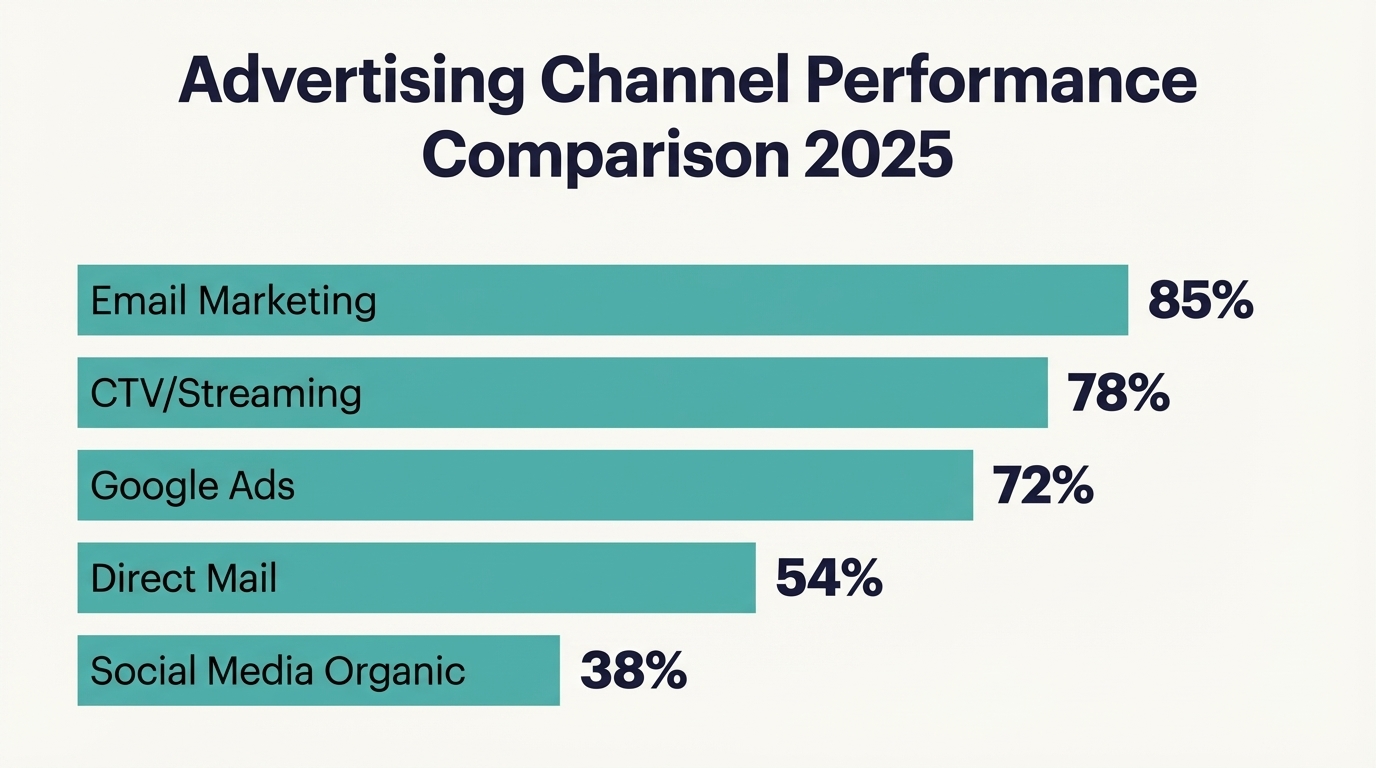
Google Ads continued performing for businesses in search-dependent categories, though rising costs challenged smaller budgets. Cost-per-click in competitive categories like legal services, home improvement, and healthcare increased 12-18% year over year in many markets. Businesses that succeeded with Google in 2025 focused on highly specific long-tail keywords rather than competing for expensive broad terms. They also increasingly combined paid search with strong organic presence through Google Business Profile optimization. The businesses struggling with Google were typically those chasing competitive keywords without the budget to sustain visibility.
Social media's decline for organic reach accelerated. Facebook organic reach for business pages dropped below 2% for most accounts. Instagram's shift toward Reels and algorithm changes meant even dedicated posting strategies reached smaller fractions of followers. The businesses still winning on social in 2025 were those treating it as a customer service and community tool rather than a lead generation channel. Trying to build a business on organic social reach in 2025 was like building on sand. The businesses that diversified beyond social media saw more stable, predictable growth.
Email marketing remained the quiet performer with the highest ROI of any digital channel. While other channels grew more expensive and less reliable, email consistently delivered for businesses that maintained clean lists and provided genuine value beyond promotions. The average ROI for email marketing held steady around 36:1, meaning $36 returned for every dollar spent. Businesses that invested in building first-party email lists were rewarded with a direct line to customers that algorithms couldn't interrupt.
The streaming TV breakthrough
If one advertising trend defined 2025 for small businesses, it was the accessibility of streaming TV advertising. What was once exclusively available to large brands with six-figure budgets became practical for businesses of every size.
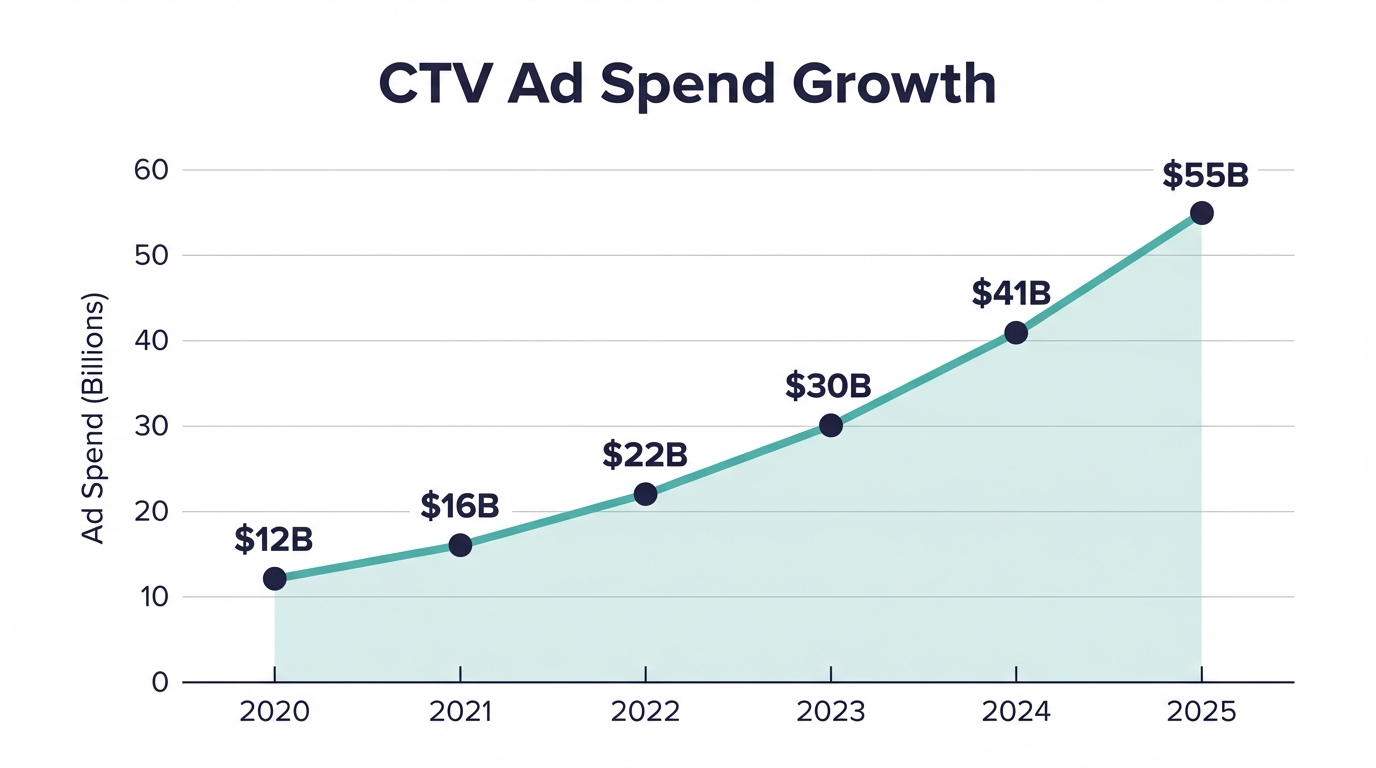
CTV ad spending continued its rapid growth, reaching new heights as advertisers followed audiences migrating from traditional TV to streaming platforms. More significantly for small businesses, self-serve platforms democratized access. Business owners who never imagined running TV commercials discovered they could launch campaigns with budgets as low as $50, targeting specific zip codes and demographics rather than blanketing entire markets.
The impact showed in small business adoption rates. Platforms catering to SMB advertisers reported substantial growth in active advertisers as word spread that TV advertising was no longer reserved for big brands. Local restaurants, home services companies, professional services firms, and retailers tested streaming TV for the first time, many discovering it outperformed their existing digital channels.
Why did streaming TV work so well in 2025? Several factors converged. Streaming now accounts for over 40% of total TV viewing time, which means the audience small businesses want to reach has migrated to these platforms. Targeting capabilities matured, allowing geographic precision that traditional TV never offered. And AI-powered creative tools reduced production costs dramatically, eliminating the traditional barrier of expensive commercial production.
The businesses that moved early into streaming TV advertising in 2025 built brand equity and market presence that will compound in 2026. Those still sitting on the sidelines are watching competitors capture audiences they could have reached.
Local marketing: back to basics
Amid all the digital transformation, 2025 reminded small businesses that local marketing fundamentals still matter enormously.
Google Business Profile importance grew as Google continued prioritizing local results and the map pack in search. Businesses that optimized their profiles completely, posted regular updates, collected reviews, and responded to customer questions saw meaningful traffic increases. Google Business Profile represents free real estate in search results, yet many businesses still leave their profiles incomplete or outdated. The gap between businesses with strong profiles and those with weak ones widened in 2025.
Community involvement delivered returns that pure advertising couldn't replicate. Sponsorships, local events, charity partnerships, and chamber of commerce participation built the trust and relationships that turn one-time customers into loyal advocates. In an era of declining trust in advertising, businesses embedded in their communities enjoyed credibility advantages. The restaurant that sponsors little league, the contractor who supports the school fundraiser, the dentist who volunteers at community health events: these businesses built reputations that no ad spend can buy.
Choose geographic targets that match where customers can use your business. Compare the cost and response before expanding the area.
What surprised us
Every year brings unexpected developments. Here's what caught many small business owners off guard in 2025.
Direct mail's continued effectiveness surprised marketers who assumed digital had killed physical mail. Response rates for well-targeted direct mail campaigns remained strong, often exceeding 4%, far higher than email or social media engagement rates. As mailboxes became less cluttered with businesses shifting to digital, the mail that did arrive stood out more. Smart small businesses rediscovered direct mail as a complement to digital strategies, not a relic to abandon.
AI tool adoption accelerated across small business marketing. What seemed like enterprise technology in 2024 became accessible to businesses of every size. AI-generated marketing copy, AI-produced video commercials, AI-powered customer service chatbots, and AI analytics tools found their way into small business workflows. The businesses that embraced AI didn't replace human creativity. They amplified it, producing more content and making better decisions with the same resources.
Privacy changes created winners and losers. As third-party cookies continued phasing out and privacy regulations tightened, businesses dependent on detailed targeting through platforms like Facebook struggled with reduced effectiveness. Meanwhile, businesses with strong first-party data (email lists, customer databases, loyalty programs) found themselves at an advantage. The message was clear: building direct relationships with customers matters more than ever as third-party data becomes less reliable.
What failed for many
Not every strategy worked. These approaches consistently disappointed small businesses in 2025.
Organic social as a sole strategy produced predictable frustration. Business owners spending hours creating content for Instagram, Facebook, and TikTok saw their posts reach fractions of their followers. The algorithm optimization that benefits content creators with millions of followers doesn't serve local businesses trying to reach customers in their service area. Businesses treating social media as their primary marketing channel spent enormous effort for minimal return. Those who recognized social's limitations and diversified saw better results.
Spray-and-pray advertising wasted more small business budgets than any other mistake. Running ads without clear targeting, messaging without differentiation, campaigns without measurement: these approaches burned through money without building anything. The businesses that succeeded treated advertising as a system, testing, measuring, and optimizing rather than simply spending and hoping.
Ignoring brand building for pure direct response created short-term results but long-term weakness. Businesses that only ran promotional advertising trained customers to wait for discounts. They built no brand equity, no reputation, no differentiation. When competitors offered lower prices, these businesses had nothing to fall back on. The strongest small businesses balanced promotional advertising with brand building that established their expertise and trustworthiness.
Lessons for 2026
Looking back at 2025 reveals patterns that should shape strategy going forward.
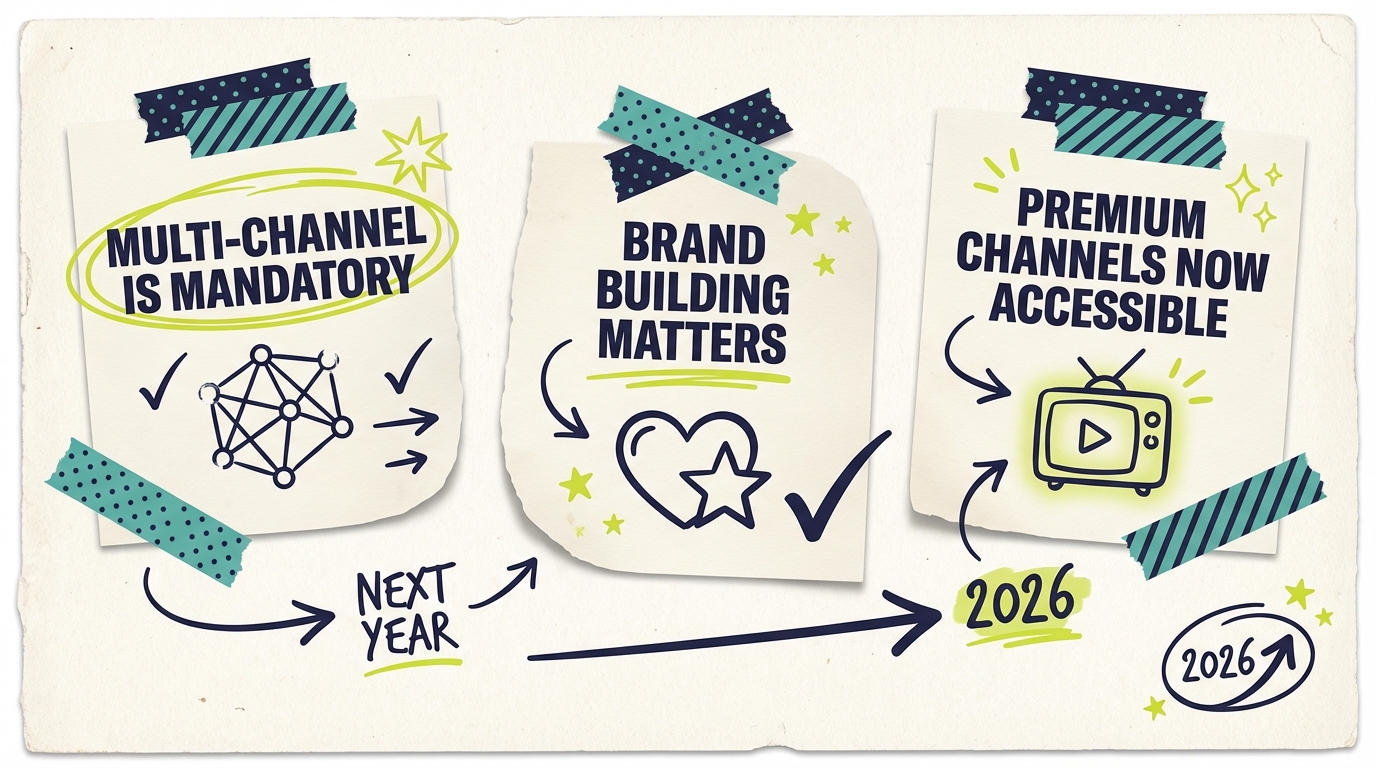
Multi-channel presence is now mandatory. Relying on any single platform, whether Facebook, Google, or any other channel, creates dangerous vulnerability. Algorithm changes, cost increases, and policy shifts can devastate businesses with single-channel dependency. Building presence across multiple channels (search, TV, email, local presence) creates stability and reach that no single channel provides.
Brand awareness matters more than ever in crowded markets. When customers can find a dozen options for any service with a quick search, the business they've heard of before has an enormous advantage. Awareness advertising through channels like streaming TV builds the recognition that makes all other marketing more effective. Businesses that invested in awareness throughout 2025 now have competitive moats that purely performance-focused competitors lack.
Premium channels became accessible. The big story of 2025 wasn't the decline of any particular channel. It was the democratization of channels previously reserved for big brands. TV advertising, professional video production, sophisticated targeting, detailed analytics: tools that cost six figures a decade ago now cost hundreds. Small businesses have access to capabilities that match their larger competitors. The only barrier is recognizing the opportunity and acting on it.
Common questions answered
How should small businesses adjust their 2026 budgets based on 2025 results?
The businesses seeing the best results are shifting budget away from organic social content creation (which produces diminishing returns) toward a combination of paid awareness channels and search capture. A balanced approach might allocate 35-40% to awareness building (streaming TV, local sponsorships), 35-40% to intent capture (Google Ads, SEO), and 20-30% to retention (email, loyalty programs). The exact mix depends on your business stage and customer acquisition cost by channel.
Is it still worth investing in Facebook and Instagram advertising for local businesses?
Paid social can still work for specific use cases, especially retargeting people who've already visited your website or engaged with your business. For cold audience acquisition, however, results have declined significantly. If you're currently spending on Facebook and Instagram, test allocating a portion of that budget to streaming TV or Google advertising and compare customer acquisition costs. Many businesses are finding better ROI from channels with less competition and more engaged audiences.
What's the minimum a small business should spend on marketing to see results?
There's no universal minimum, but most businesses need at least $300-500 monthly in paid advertising to generate meaningful data and results. Below that threshold, budget often spreads too thin across channels to achieve impact anywhere. At $500-1,000 monthly, you can build presence in two to three channels. Above $1,000, true multi-channel strategies become practical. Whatever your budget, concentrate spending enough in each channel to learn what works rather than spreading a little everywhere.
How do I know if streaming TV advertising is right for my business?
Streaming TV works best for businesses where awareness drives business: customers need to know you exist and think of you when they have a need. This includes most local services, restaurants, retail, professional services, and healthcare practices. If your business depends primarily on search (emergency services, immediate needs), Google might deserve priority. But even search-dependent businesses benefit from TV advertising because brand recognition makes every other marketing channel more effective.
What single change would have the biggest impact on most small businesses' marketing in 2026?
For businesses currently dependent on organic social media, diversifying into at least one paid awareness channel (streaming TV being the most accessible) would have the biggest impact. For businesses already advertising but not measuring results, implementing proper tracking (asking how customers found you, using tracking phone numbers, monitoring channel-specific conversions) would transform their ability to optimize. The specific change depends on where you are, but most small businesses would benefit from either expanding channels or improving measurement.
Looking ahead to 2026
The advertising environment that emerged in 2025 isn't returning to what came before. Social media's role in customer acquisition will continue diminishing. Streaming TV will continue capturing more viewing time and advertising dollars. AI tools will make sophisticated marketing more accessible. And businesses that adapt will thrive while those clinging to outdated strategies fall behind.
The opportunity for small businesses has never been greater. Channels that were exclusively available to large corporations a few years ago now welcome businesses with modest budgets. The playing field hasn't completely leveled, but it's more level than it's ever been. The question isn't whether small businesses can access powerful advertising tools. It's whether they'll recognize the opportunity and act on it.