-
$33B
U.S. CTV ad spending in 2025
-
+16%
Year-over-year growth rate
-
84%
Share bought programmatically
U.S. advertisers will spend approximately $33 billion on connected TV (CTV) and streaming television advertising in 2025, according to eMarketer projections. That represents a 16.8% increase from 2024 and marks streaming TV's continued emergence as a dominant force in the advertising landscape. For context, this spending level approaches what advertisers spent on the entire cable television ecosystem just a few years ago. The implications for businesses of all sizes are significant: streaming TV advertising has evolved from an experimental channel to a core component of modern marketing strategy, and the infrastructure supporting it has become sophisticated enough to accommodate budgets ranging from $50 to $50 million.
What the data shows
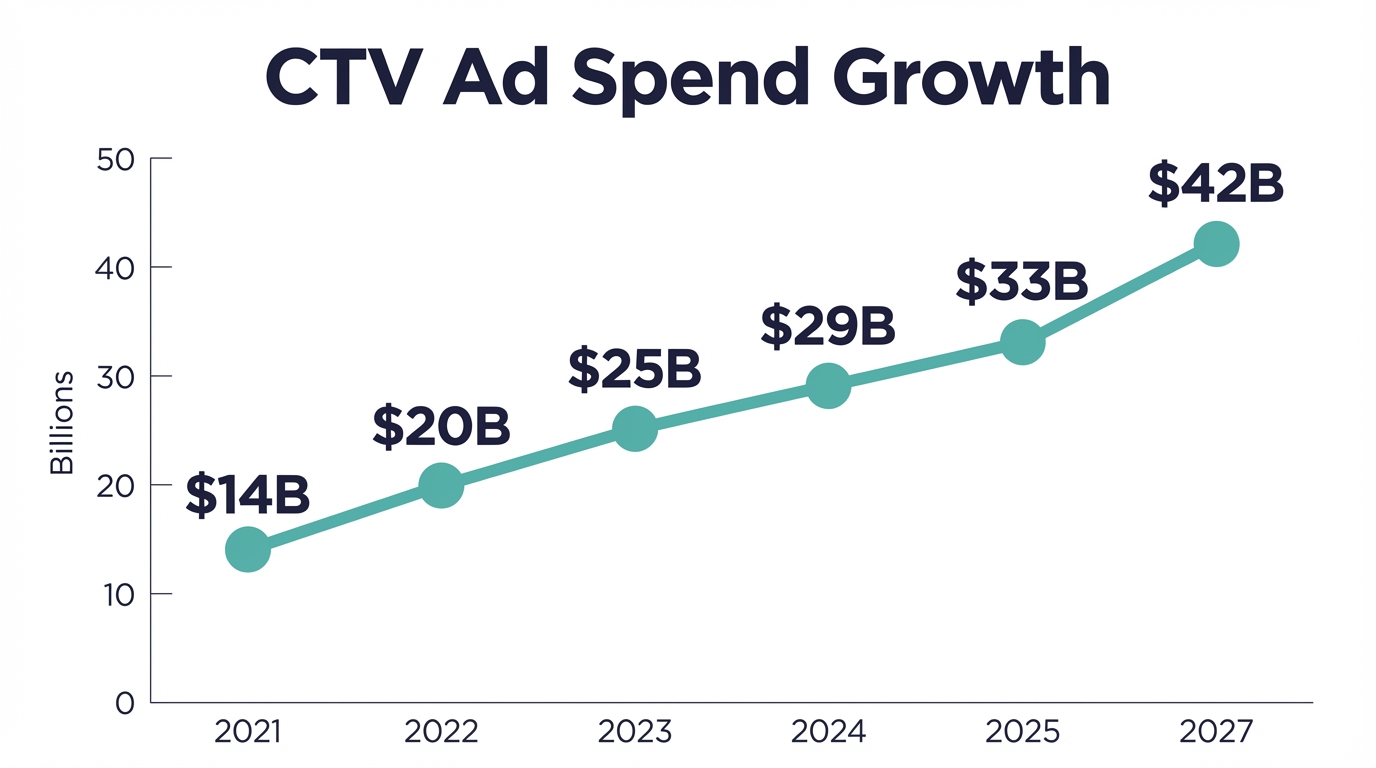
The $33 billion figure represents the culmination of years of accelerating growth in streaming TV advertising. To understand its significance, consider the trajectory:
2021: CTV ad spend reached approximately $14 billion
2022: Spending grew to roughly $20 billion
2023: The market expanded to $25 billion
2024: CTV ad spend hit $28.6 billion (16% YoY growth per IAB)
2025: Projected spend of $33 billion (eMarketer) or $26.6 billion (IAB methodology)
2027: Forecasts project $40-42 billion
The slight variance between sources reflects different methodological approaches to defining CTV advertising, but all major research firms agree on the direction: double-digit annual growth that shows no signs of slowing.
What makes this spending growth remarkable is that it's happening while traditional television advertising declines. Linear TV ad spend is projected to fall to $55.2 billion in 2025, down 7% from 2024, according to MediaPost analysis. The combined TV advertising market (linear plus streaming) is approaching $90 billion, with streaming capturing an increasingly larger share each year.
The programmatic share of this spending tells its own story. Approximately 84% of CTV advertising, or roughly $27 billion, is now purchased programmatically rather than through traditional direct sales relationships. This programmatic infrastructure is what makes streaming TV accessible to smaller advertisers: the same technology that serves a Fortune 500 brand's campaign can serve a local business's $500 test, because the buying mechanisms are automated and scalable.
Breaking down the numbers
Understanding where that $33 billion goes reveals the structure of the streaming advertising market and highlights opportunities for different types of advertisers.
By platform category
The streaming TV advertising market divides into several distinct categories:
Premium subscription streamers with ads: Netflix, Disney+, Max, Peacock, Paramount+
FAST services (Free Ad-Supported Streaming TV): Tubi, Pluto TV, The Roku Channel, Freevee
YouTube (on TV screens): The largest single streaming destination
Virtual MVPDs: YouTube TV, Hulu Live, Sling TV, fuboTV
Publisher apps on CTV: Network apps, sports apps, news apps
Premium streamers have become significant advertising platforms remarkably quickly. Netflix's ad-supported tier, launched in late 2022, now reaches 94 million monthly active users globally and generated $662 million in ad revenue in Q3 2025 alone. Disney+ reports 157 million monthly ad-supported viewers worldwide, with projected 2025 ad revenue of approximately $1.1 billion. Hulu remains the largest ad-supported streaming service by revenue, projected to generate over $4 billion in advertising in 2025.
FAST services collectively represent the fastest-growing segment of streaming advertising. Tubi, Pluto TV, and The Roku Channel combined capture over 5% of all U.S. TV viewing time and offer advertisers significantly lower CPMs than premium services, typically $15-20 compared to $25-40 for premium inventory.
By buying method
The programmatic revolution in streaming TV has fundamentally changed how advertising is bought and sold:
Programmatic guaranteed: ~35% of spend (pre-negotiated deals executed programmatically)
Private marketplace (PMP): ~30% of spend (invitation-only auctions)
Open exchange: ~19% of spend (real-time bidding on available inventory)
Direct/IO: ~16% of spend (traditional insertion orders)
This programmatic infrastructure matters for accessibility. When 84% of inventory is available through automated systems, advertisers don't need media agency relationships or direct sales contacts to access premium streaming inventory. Platforms like Adwave aggregate this programmatic inventory, enabling businesses to launch streaming TV campaigns with budgets starting at $50.
By advertiser category
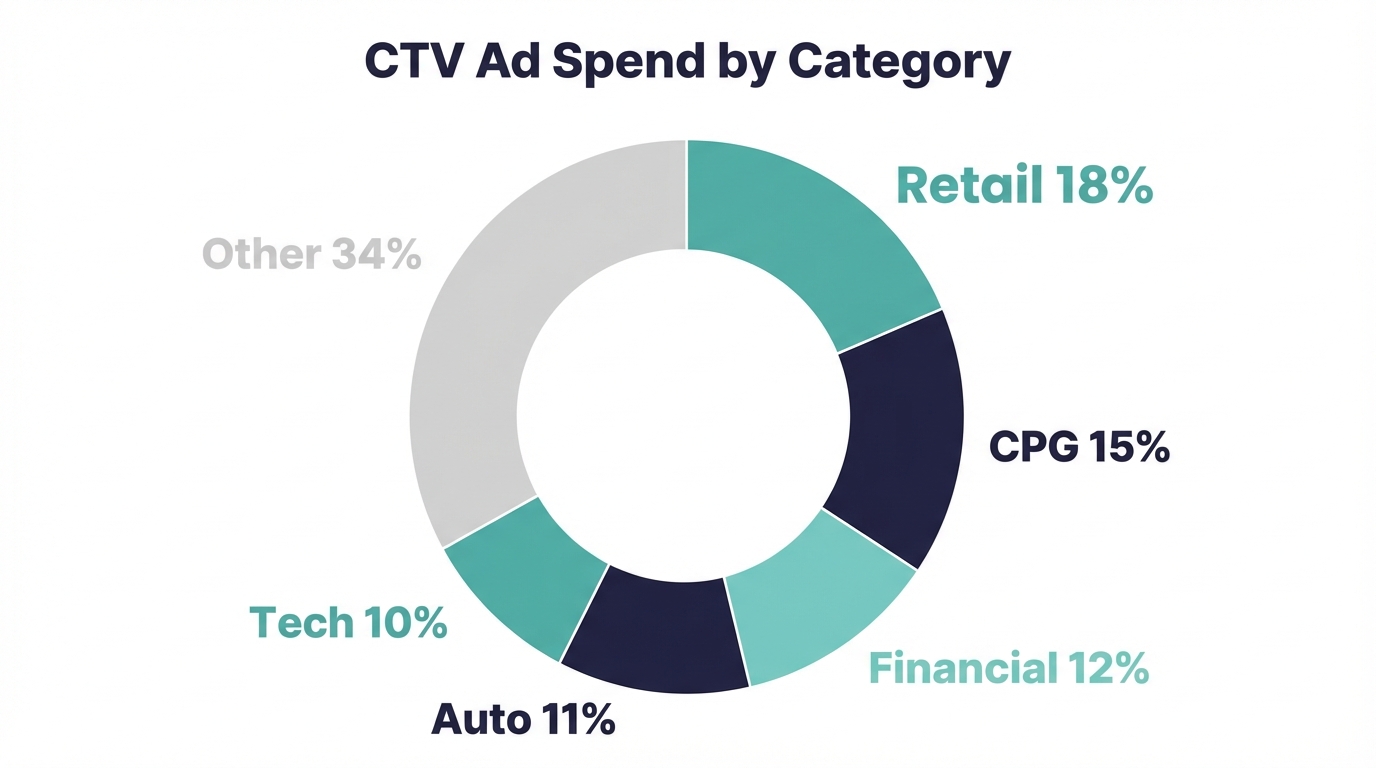
Streaming TV advertising attracts spending across virtually every industry:
Retail and e-commerce: ~18% of CTV ad spend
Consumer packaged goods: ~15%
Financial services: ~12%
Automotive: ~11%
Technology: ~10%
Healthcare and pharma: ~9%
Travel and hospitality: ~7%
Other categories: ~18%
Local advertising represents a growing share of CTV spend. Small and medium businesses that previously couldn't access television advertising are now active participants, enabled by geographic targeting and accessible minimum budgets.
Why it matters for your business
The $33 billion streaming TV advertising market isn't just a number for media analysts to track. It represents a fundamental shift in how advertising works, one that directly benefits businesses that previously couldn't access television.
When advertisers collectively pour $33 billion into a channel, they're creating infrastructure. That infrastructure includes sophisticated targeting capabilities, measurement tools, creative platforms, and buying mechanisms. Small businesses benefit from infrastructure built to serve large ones: the same programmatic pipes that deliver a national retailer's campaign can deliver yours.
The spending concentration also validates streaming TV as an advertising channel. When major brands allocate significant portions of their budgets to CTV, they're signaling that it works. Their performance data, aggregated across billions of dollars in spend, has proven that streaming TV drives business results. You're not experimenting with an unproven channel; you're joining one that's been validated at massive scale.
For local businesses specifically, the CTV spending surge has created unprecedented opportunity. A restaurant can now reach households in its delivery zone during dinner decision-making hours. A real estate agent can build name recognition among homeowners in specific neighborhoods. A dental practice can appear alongside trusted content on the same screens where families watch their favorite shows.
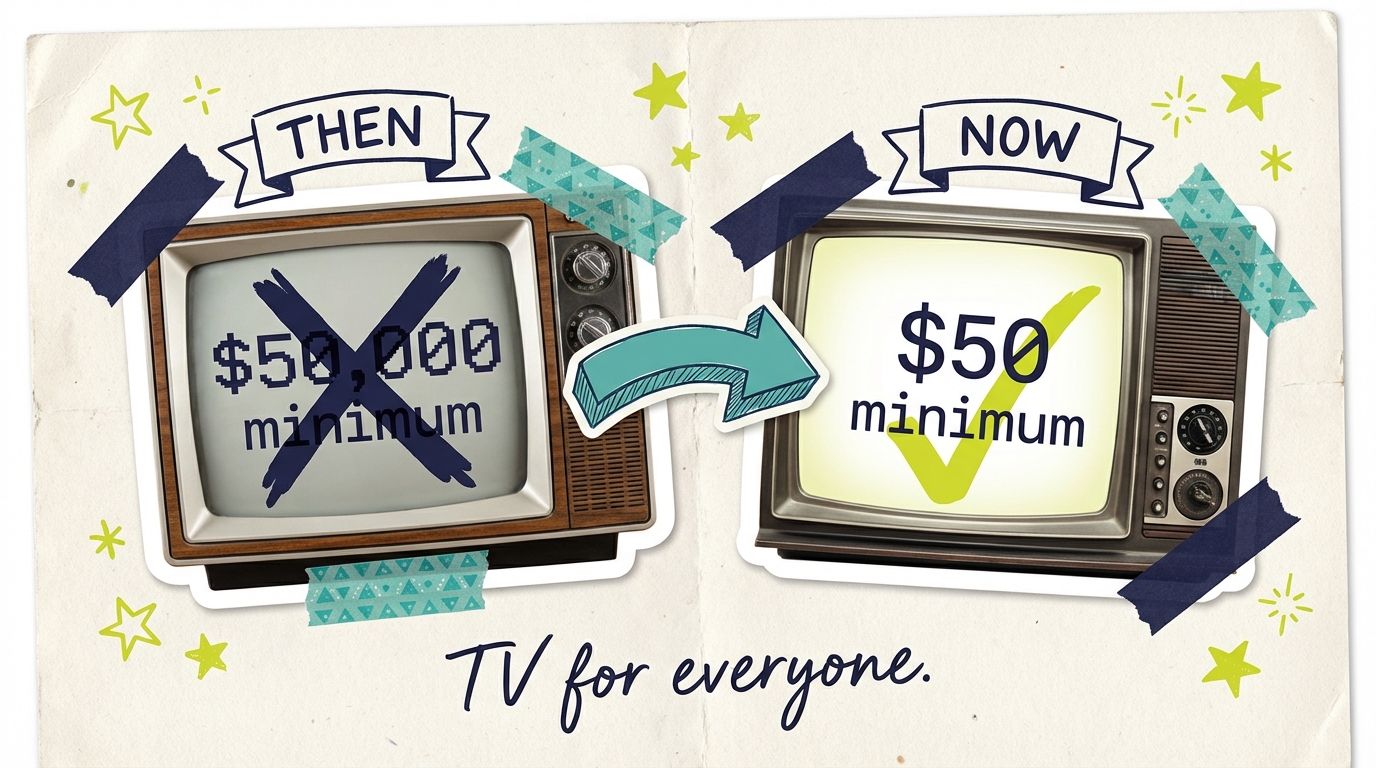
The economics have shifted decisively in favor of accessibility. Streaming TV advertising costs have come down significantly as inventory has expanded. CPMs that once averaged $40+ have moderated to $15-35 for most inventory, with FAST services offering even lower rates. Production costs have collapsed thanks to AI creative tools. And minimum budgets have dropped from five figures to two: you can test streaming TV with $50 rather than $50,000.
How to take advantage of this trend
The $33 billion market is accessible to businesses at virtually any budget level. The question isn't whether you can participate but how to participate strategically.
Key strategies for entering streaming TV:
Start with a test budget: $200-500 for two weeks provides meaningful data
Geographic precision: Target your actual service area, not broad regions
Prime time focus: Evening hours (6-10 PM) capture highest-quality attention
Platform mix: Include both premium and FAST inventory for reach and efficiency
Frequency over reach: Better to reach 5,000 households 4x than 20,000 once
Let's break down the strategic approach.
Budget allocation should match your goals. For brand awareness and local recognition, allocate budget to achieve meaningful frequency within your geographic target. A $500 campaign running for two weeks in a defined market can generate 20,000+ impressions among local households, enough to build recognition when combined with other marketing touchpoints.
Targeting should be precise, not broad. The programmatic infrastructure that handles $33 billion in spend also handles sophisticated targeting. Use geographic targeting to reach only households in your service area. Layer demographic targeting if you have a specific customer profile. The goal is efficient reach, not maximum reach.
Creative quality matters but doesn't require Hollywood budgets. Streaming TV viewers expect professional-looking content, but "professional" has been redefined. AI-powered creative tools can generate broadcast-quality 30-second commercials from your existing website and photos in minutes. Adwave's platform creates commercials automatically, eliminating the production cost barrier that historically kept small businesses off television.
Measurement should align with TV's strengths. Streaming TV builds awareness and consideration rather than driving immediate clicks. Track brand search volume (are more people Googling your business name?), monitor website traffic patterns during and after campaigns, and survey new customers about how they found you. The impact appears in these brand metrics, not in direct-response data.
The bigger picture
The $33 billion in streaming TV ad spend exists within a broader transformation of the advertising industry that favors accessible, measurable, digital channels over traditional gatekept media.
The shift from linear to streaming
Linear television advertising is declining while streaming grows. The combined TV advertising market (linear plus streaming) will approach $90 billion in 2025, but the composition is shifting rapidly:
2020: Streaming was ~15% of TV ad spend
2025: Streaming is ~38% of TV ad spend
2027: Streaming projected to reach ~45% of TV ad spend
By 2028, programmatic CTV ad spend is projected to exceed linear TV advertising for the first time. This isn't a temporary shift; it's a structural change in how television advertising works.
Digital video in context
Streaming TV is one component of a broader digital video advertising ecosystem:
Total digital video (2025): $72 billion
CTV/streaming TV: $33 billion (46% of digital video)
Social video: $27 billion (38% of digital video)
Online video (non-CTV): $12 billion (16% of digital video)
CTV and social video are roughly equal in spending, but they serve different purposes. Social video excels at direct response and short-form engagement. Streaming TV excels at brand building and premium attention. Most sophisticated advertisers use both, with streaming TV creating awareness that social video and search convert.
The democratization continues
Perhaps most significantly for small businesses, the infrastructure handling this $33 billion is increasingly accessible. What was once available only to advertisers with agency relationships and six-figure budgets is now available to anyone:
Self-serve platforms: Enable campaign launch without media buyer expertise
AI creative tools: Eliminate production cost barriers
Low minimums: $50 starting budgets instead of $50,000
Programmatic access: Same inventory available to all advertisers
This democratization is structural, not temporary. As CTV advertising grows, the platforms serving it become more accessible, not less.
What experts are saying
Industry analysts have highlighted streaming TV's advertising growth as one of the most significant shifts in media.
The Interactive Advertising Bureau's 2025 Digital Video Ad Spend report noted that "CTV has evolved from an emerging channel to a core component of video advertising strategy. The 16% year-over-year growth demonstrates sustained advertiser confidence in the format's effectiveness."
EMarketer's analysis emphasizes the viewer shift driving spend: "With 70.7% of the U.S. population now using CTV, advertisers are following audiences to streaming platforms. The $33 billion in 2025 spend reflects where American viewers watch television."
GroupM's global advertising forecast highlighted that digital video, including CTV, is "growing nearly 80% faster than total media overall," positioning streaming as the primary growth driver in the advertising industry.
For small business advertising specifically, the IAB noted that "the combination of programmatic infrastructure, AI creative tools, and accessible minimum budgets has effectively removed every historical barrier to television advertising. Businesses that assumed TV wasn't for them are discovering it's now within reach."
Common questions answered
How does CTV ad spend compare to linear TV?
Linear TV advertising still exceeds CTV in absolute dollars, with approximately $55 billion in linear spend versus $33 billion in CTV for 2025. However, linear is declining (down 7% year-over-year) while CTV is growing (up 16% year-over-year). At current trajectories, CTV will approach linear TV spend by 2028 and likely surpass it by 2029. The key difference for advertisers is accessibility: linear TV remains difficult for small businesses to access, while CTV is available to virtually any budget.
Is CTV advertising bigger than social media advertising?
It depends on what you're comparing. CTV ad spend ($33 billion) is larger than social video ad spend ($27 billion) but smaller than total social media advertising (approximately $80 billion including all formats). The comparison that matters most for video advertisers is CTV versus social video, where the two channels are approaching parity. Each serves different purposes: CTV for brand building and premium attention, social video for direct response and engagement.
How fast is streaming TV ad spending growing?
CTV ad spending grew 16% year-over-year in 2024 and is projected to grow 13-17% in 2025, depending on the research source. This growth rate significantly exceeds total advertising growth (approximately 6-8%) and linear TV growth (which is declining). Projections suggest CTV will maintain double-digit growth through at least 2027, when the market is expected to reach $40-42 billion.
What percentage of TV advertising goes to streaming?
Streaming TV (CTV) captures approximately 38% of total TV advertising spend in 2025, up from roughly 15% in 2020. This share is projected to reach 45% by 2027. Within digital video specifically, CTV represents about 46% of total spend, with social video at 38% and other online video at 16%.
Why is so much advertising shifting to streaming TV?
The shift reflects viewer behavior. Americans now spend nearly half their TV viewing time on streaming platforms, and advertisers follow audiences. Streaming also offers capabilities linear TV cannot: precise geographic and demographic targeting, frequency capping, real-time optimization, and detailed measurement. These capabilities, combined with expanding ad-supported inventory on platforms like Netflix, Disney+, and Peacock, make streaming increasingly attractive for advertisers seeking both reach and precision.
Can small businesses access this $33 billion market?
Yes, and this is perhaps the most significant development in the streaming TV advertising landscape. The programmatic infrastructure serving this market is accessible through self-serve platforms that aggregate inventory across premium and FAST services. Platforms like Adwave enable businesses to launch campaigns starting at $50, with the same access to 100+ premium channels that major brands use. Geographic targeting ensures local businesses only pay for impressions in their service area.
Supporting data
Additional statistics on streaming TV advertising spend and market dynamics:
Total digital video spend: $72 billion projected for 2025 (IAB)
CTV share of digital video: 46% of all digital video advertising
Programmatic CTV: $27 billion in 2025, 84% of total CTV spend (Sena)
Linear TV decline: Down 7% YoY to $55.2 billion (MediaPost)
Combined TV market: Approaching $90 billion (linear + CTV)
Netflix ad revenue: $662 million in Q3 2025 alone
Disney+ ad-supported users: 157 million globally
Hulu ad revenue: Over $4 billion projected for 2025
FAST services growth: 5.7% of total TV viewing time
2027 CTV projection: $40-42 billion (eMarketer)
CTV user penetration: 70.7% of U.S. population in 2025
Get started with TV advertising
The $33 billion streaming TV advertising market is no longer reserved for big brands with big budgets. The same infrastructure serving Fortune 500 companies is now accessible to local businesses ready to reach customers on the biggest screen in the house.
Adwave makes streaming TV advertising simple and accessible. Create your commercial from your website in minutes, set your geographic targeting, choose a budget starting at just $50, and launch campaigns across 100+ premium channels including NBC, Hulu, ESPN, and Discovery.
The spending is there. The viewers are there. The opportunity is yours.