
Your customers are watching more video than ever. The average person now spends 17 hours per week watching online video, and 87% of people say they've been convinced to buy a product or service after watching a brand's video (Wyzowl, 2026). For small businesses trying to stand out in crowded markets, video has become one of the most effective ways to reach new customers and build trust.
Video marketing isn't just for big brands with production budgets. Thanks to AI tools, smartphones, and platforms that welcome short-form content, creating video that drives real results is more accessible (and affordable) than it's ever been. Whether you're a local restaurant, a home services provider, or an online store, there's a video strategy that fits your budget and goals.
This guide breaks down everything you need to know about video marketing as a small business owner, from choosing the right platforms to creating content that converts, all without needing a film crew or a six-figure budget.
Why video marketing matters for small businesses
The numbers tell a clear story. According to Wyzowl's 2026 State of Video Marketing report, 93% of businesses now use video as a marketing tool, up from 91% in 2024. And 95% of marketers consider video important to their overall strategy. If you're not using video yet, you're in a shrinking minority.
But the real question isn't whether video works. It's why it works so well, especially for small businesses.
Video builds trust faster than any other content format. When potential customers can see your face, watch your product in action, or hear a satisfied customer talk about their experience, they form a connection that text and images alone can't create. According to Wyzowl, 98% of people have watched an explainer video to learn about a product or service, an all-time high. And 81% have bought something or downloaded an app after watching a video.
For local businesses, this trust factor is even more important. Your customers want to know who they're hiring before they let someone into their home, sit in a dentist's chair, or trust a restaurant with a special occasion. Video lets them meet you before they walk through your door.
The search engine benefits are significant too. Video content leads to a 157% increase in organic traffic from search engines, according to SellersCommerce. Google regularly features video results in search, and pages with embedded video tend to keep visitors on site longer, which signals to search engines that your content is valuable.
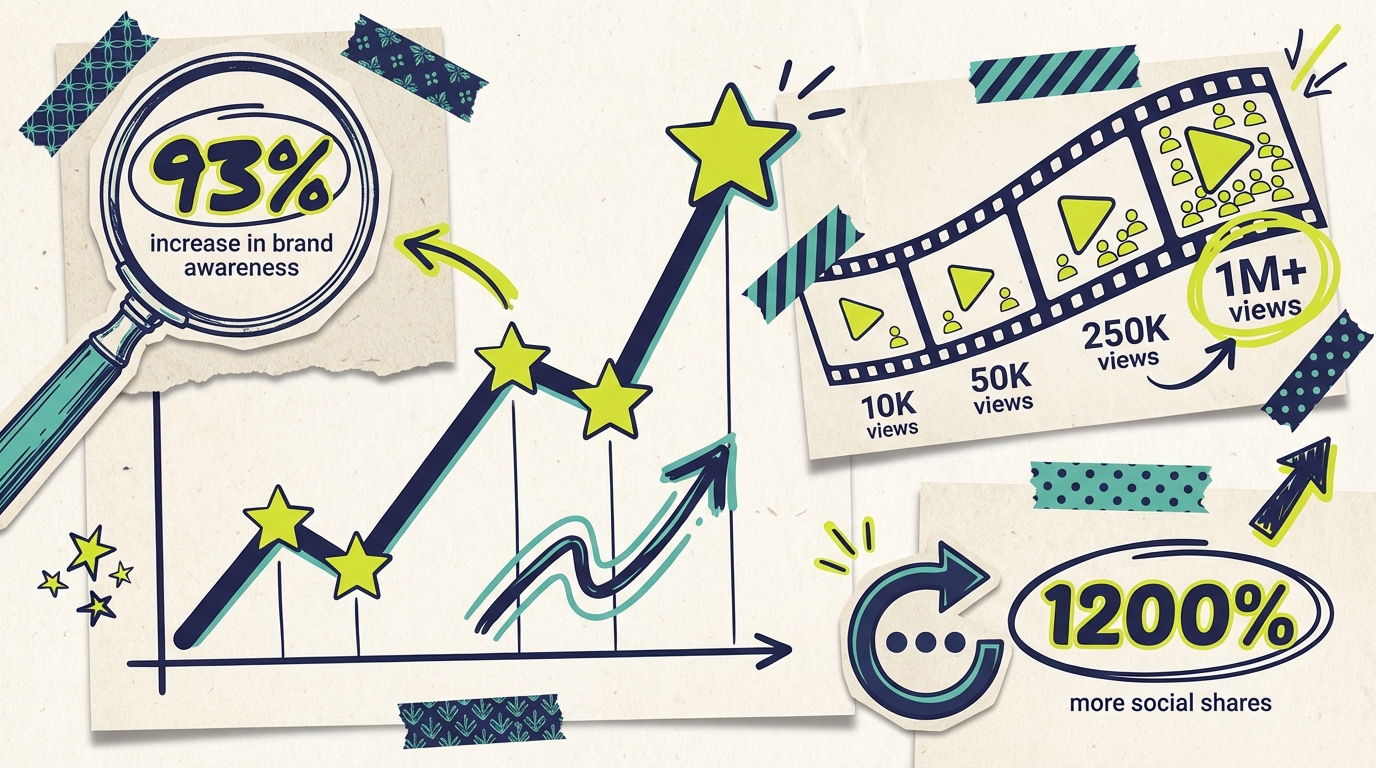
Then there's the sharing factor. Social video generates 1,200% more shares than text and images combined (SellersCommerce). Every share extends your reach to people you'd never find through paid advertising alone.
Types of video content that work for small businesses
Not every video needs to be a polished production. In fact, some of the most effective formats for small businesses are the simplest to create. Here are the types worth focusing on.
Explainer videos walk viewers through how your product or service works. These are especially effective on your website and landing pages. Adding an explainer video to a landing page can increase conversions by 80%, according to Yans Media. Keep these between 60 and 90 seconds for the best results.
Customer testimonials are some of the most persuasive content you can create. A real customer talking about their experience carries more weight than any ad copy. Film these on a smartphone with good lighting and you have a powerful trust-building asset.
Behind-the-scenes content humanizes your business. Show your team at work, your process for creating a product, or what happens during a typical day. This type of content performs especially well on social media, where audiences crave authenticity over polish.
How-to and educational videos position you as the expert in your field. A plumber showing how to fix a minor leak, a baker demonstrating a decorating technique, or a fitness trainer sharing a quick workout routine all build authority while providing genuine value. According to SellersCommerce, how-to videos of three to five minutes see a 74% engagement rate.
Product demonstrations let potential customers see exactly what they're getting. This is especially valuable for e-commerce businesses or anyone selling a physical product. Product pages with video experience 47% higher engagement rates, and explainer videos can reduce product returns by 35% (SellersCommerce).
Short-form social videos (under 60 seconds) are the fastest-growing format. According to HubSpot's 2026 State of Marketing Report, short-form video delivers the highest ROI of any content format, with 49% of marketers ranking it as their top performer. These quick, engaging clips are perfect for platforms like Instagram Reels, TikTok, and YouTube Shorts.
TV and streaming commercials put your business on the biggest screen in your customers' homes. While this category used to require massive budgets, CTV (connected TV) advertising has made it accessible to businesses of all sizes. More on this later in the guide.
Where to publish your videos
Choosing the right platform depends on your audience, your goals, and the type of content you're creating. Here's how the major platforms compare for small business video marketing.
Here's a quick look at six platforms worth considering:
YouTube is best for tutorials, how-tos, and product reviews. It has the broadest reach at 2.7 billion monthly users, and the sweet spot for video length is 7 to 15 minutes.
Instagram Reels works well for brand awareness and local reach, with 92% of its global users under 45. Aim for 15 to 60 seconds.
TikTok excels at trend-driven discovery and reaches primarily 18 to 34 year-olds. Keep videos between 15 and 60 seconds.
Facebook is strong for local community building and skews toward audiences 35 and older. One to three minutes is the ideal length.
LinkedIn is the go-to for B2B and professional services, reaching business decision-makers. Videos of 30 to 90 seconds perform best.
CTV and streaming platforms are ideal for brand building with local or national reach. With 88% of American homes connected, the standard format is a 30-second spot.
YouTube remains the most widely used video marketing platform, with 82% of marketers using it and 69% calling it the most effective (Wyzowl, 2026). With over 2.7 billion monthly users globally and 253 million in the US alone, it offers the broadest organic reach of any video platform. YouTube also functions as the world's second-largest search engine, meaning your videos can drive discovery for years.
Instagram is the most popular platform among marketers overall (used by 70%, according to HubSpot's 2026 report), and its Reels feature has become a powerful discovery tool. According to SellersCommerce, 57% of Reels viewers discover new brands through the feature. For local businesses targeting customers under 45, Instagram is often the strongest starting point.
TikTok has the highest conversion rate of any social platform, with 45.5% of users making purchases through the app in 2025 (SellersCommerce). The average user spends 52 minutes per day on TikTok, creating lots of opportunities to reach potential customers. That said, fewer small businesses are investing in TikTok in 2026 (22%, down from 34%), according to LocaliQ, partly due to regulatory uncertainty.
Facebook still reaches the widest age range and remains the platform where 90% of small businesses maintain a presence (LocaliQ, 2026). Its video tools are solid, and 68% of Facebook users have shared a brand's video ad with friends (SellersCommerce). For businesses targeting customers over 35 or focused on local community building, Facebook video is still a strong play.
LinkedIn is the clear winner for B2B and professional services. It's the second-most effective video marketing platform at 59% (SellersCommerce), and 97% of LinkedIn videos are now vertical, shot on smartphones (SellersCommerce). If your customers are other businesses or professionals, this is where your video content should live.
CTV and streaming platforms reach viewers on their television screens through services like Hulu, Peacock, Tubi, and hundreds of other channels. With 88% of American households owning at least one internet-connected TV device (Statista), this is one of the largest audiences available to advertisers. CTV offers the targeting precision of digital advertising with the impact of a television screen.

How to create marketing videos on a budget
One of the biggest myths about video marketing is that it requires expensive equipment and professional production. The reality? Nearly half of companies spent under $5,000 on video production in all of 2024 (SellersCommerce). And with AI tools cutting production costs by up to 80% (SellersCommerce), the barrier to entry has never been lower.
Start with your smartphone. Modern smartphones shoot video that's more than good enough for social media and even many professional applications. Focus on three fundamentals: good lighting (natural light near a window works great), clear audio (a $20 clip-on microphone makes a huge difference), and a stable shot (use a $15 tripod or prop your phone against something sturdy).
Use AI video tools. The adoption of AI in video creation has exploded, with 41% of businesses now using AI to create videos, up from 18% in 2023 (SellersCommerce). These tools can handle everything from generating captions (which boost viewer retention by 65%) to creating entire videos from text prompts. More than 60% of marketers using AI text-to-video platforms report that creation time has been cut by more than half.
Batch your content. Set aside one morning per month to film multiple videos at once. Change your shirt between takes, and you'll have weeks of content from a single session. This approach is especially effective for social media content, where consistency matters more than perfection.
Repurpose everything. A single five-minute YouTube video can become three Instagram Reels, a TikTok clip, a LinkedIn post, and a Facebook video. Film once, distribute many times. This multiplier effect is how small businesses with limited time can maintain a presence across multiple platforms.
Add captions to every video. This isn't optional anymore. According to SellersCommerce, 85% of mobile videos are watched without sound, and the use of captions has increased 572% since 2021. TikTok ads with captions see a 95% boost in brand affinity and a 58% increase in recall. Most editing apps and AI tools can generate captions automatically.
For TV commercials, AI-powered platforms have made what was once a six-figure production accessible to any business. Adwave, for example, generates broadcast-quality 30-second TV ads from any URL in about two minutes, with campaigns starting at just $50. You don't need a production crew, a script, or even prior advertising experience.
Building a video marketing strategy
Creating videos without a strategy is like opening a store without telling anyone where it is. You need a plan that connects your video content to your business goals.
Define your goals first. Are you trying to build brand awareness in your local area? Drive traffic to your website? Generate leads? Each goal points to different video types and platforms. Brand awareness leans toward short-form social content and TV commercials. Lead generation benefits from how-to content and customer testimonials. Direct sales work well with product demonstrations and retargeting ads.
Know your audience. Where do your customers spend their time? If you're a B2B service, LinkedIn should be your primary platform. If you're targeting millennials and Gen Z, Instagram and TikTok are your best bets. If you want to reach households in a specific geographic area, CTV advertising lets you target by zip code. Don't try to be everywhere at once. Start with one or two platforms and do them well.
Create a content calendar. Plan your videos at least a month in advance. Mix up your content types: one educational video, one customer testimonial, one behind-the-scenes clip, and one promotional piece per month is a solid starting framework. Consistency matters more than volume. Posting one quality video per week beats posting five mediocre ones.
Optimize for each platform. Vertical video (9:16) is now the standard for mobile platforms. YouTube still favors horizontal (16:9) for longer content. CTV ads run at 30 seconds in a 16:9 format. Don't just upload the same video everywhere. Adjust the format, length, and opening hook for each platform.
Front-load your hook. You have about three seconds to grab someone's attention on social media. Start with the most interesting, surprising, or valuable part of your message. Save the introduction for after you've earned their attention.
Include a clear call to action. Every video should tell the viewer what to do next, whether that's visiting your website, calling your business, booking an appointment, or following your page. Don't assume viewers will figure it out on their own.
Measuring video marketing results
You can't improve what you don't measure. According to Wyzowl's 2026 report, here's how marketers currently track video ROI:
Video engagement metrics like likes, shares, and reposts are the most popular at 63%. Leads and clicks come second at 52%, followed by customer engagement and retention at 40%. Brand awareness and PR tracks at 36%, and bottom-line sales rounds out the top five at 32%.
The most important metrics depend on your goals. For brand awareness campaigns, focus on views, reach, and shares. For lead generation, track clicks, form fills, and website visits from video. For direct sales, measure conversions and revenue attributed to video touchpoints.
Most social media platforms provide built-in analytics that show you view counts, watch time, engagement rates, and audience demographics. YouTube Studio and Meta Business Suite offer especially detailed breakdowns.
For CTV and streaming campaigns, you'll typically get reporting on impressions, completion rates (which average 90%+ for TV ads, far higher than digital), and reach. Some platforms also offer website visit attribution, letting you see how many people visited your site after seeing your TV ad.
The key is to track consistently over time. Video marketing is rarely an overnight success. Give your strategy at least 90 days before making major changes, and look for trends rather than obsessing over individual video performance.

TV and streaming video: the channel most small businesses overlook
Here's something most small business owners don't realize: you can run a TV commercial on the same streaming services your customers watch every night for less than the cost of a week of social media ads.
CTV advertising spending reached $33.1 billion last year and is forecast to grow 22% to $40.4 billion this year, according to Winterberry Group data reported by Marketing Charts. That growth is driven largely by the expansion of ad-supported streaming. With services like Hulu, Peacock, and Tubi all growing their ad-supported tiers, there's more premium TV inventory available to small businesses than ever before.
What makes CTV different from traditional TV advertising? Three things.
First, the cost barrier is gone. Traditional TV advertising required minimum buys of $5,000 to $50,000 or more. CTV platforms have lowered that dramatically. With Adwave, you can launch a campaign on 100+ premium channels for as little as $50.
Second, targeting is precise. Unlike broadcast TV, where you're paying to reach everyone in a market, CTV lets you target specific audiences by location, demographics, interests, and behaviors. A dentist in Austin can show ads only to households within a 15-mile radius. An e-commerce store can target audiences interested in their product category nationally.
Third, the results are measurable. CTV provides real-time analytics on impressions, completion rates, and reach. You know exactly how many people saw your ad and whether they took action afterward. According to our data, the average CTV CPM runs $15-35, making it competitive with many digital channels.
The trust factor matters too. Research shows that consumers trust TV ads more than digital, and TV is more effective for brand awareness than most other channels. When your ad appears on a premium streaming service alongside content from major networks, your business benefits from that association.
For small businesses that have maxed out their social media and search advertising, CTV represents an untapped channel with growing audiences and decreasing costs.
Common mistakes to avoid
After working with thousands of small businesses on their video and advertising strategies, certain patterns emerge. Here are the mistakes that hold businesses back most.
Waiting for perfection. The biggest mistake is not starting at all. According to Wyzowl, 37% of marketers who don't use video say their biggest obstacle is not knowing where to start, and 43% say they lack in-house filming and editing skills. But consumers increasingly prefer authentic, relatable content over polished productions. A genuine, slightly imperfect video from a real business owner outperforms a generic stock-footage ad almost every time.
Ignoring captions and accessibility. With 85% of mobile videos watched on mute, skipping captions means most of your mobile audience won't understand your message. Always add captions, and use clear visuals that communicate even without sound.
Focusing on one platform only. Different platforms reach different audiences at different points in their buying journey. YouTube catches people searching for information. Instagram and TikTok drive discovery. TV and streaming build broad awareness and trust. A strong video strategy uses at least two or three channels.
Not having a call to action. Every video needs to tell viewers what to do next. Without a clear next step, even a great video becomes entertainment rather than marketing.
Neglecting video SEO. On YouTube especially, your title, description, tags, and thumbnail all affect whether your video gets found. Write descriptions that include relevant keywords, create custom thumbnails, and use specific, searchable titles.
Review which videos people watch and respond to, then use those findings to plan your next videos. Build a consistent publishing schedule you can maintain.
Common questions answered
How much should a small business spend on video marketing?
There's no single right answer, but the data shows you don't need a huge budget to get started. According to SellersCommerce, nearly half of companies spent under $5,000 on video production in all of 2024. Many small businesses start by creating organic social videos on a smartphone for essentially zero cost, then reinvest results into paid distribution or higher-production content. For CTV advertising, you can test the channel with as little as $50 through platforms like Adwave.
What type of video works best for local businesses?
Customer testimonials and behind-the-scenes content tend to perform best for local businesses because they build the trust that drives in-person visits. How-to videos also work well because they position you as the local expert. For example, a landscaper sharing seasonal lawn care tips or a restaurant owner showing how a signature dish is made gives potential customers a reason to choose you over competitors they've never "met."
How long should my marketing videos be?
According to Wyzowl's 2026 data, 51% of marketers say the ideal video length is 30 to 60 seconds, and 91% say under two minutes. For social media, keep things under 60 seconds. For YouTube tutorials and how-tos, 7 to 15 minutes tends to perform well. For TV and streaming ads, 30 seconds is the standard format. The golden rule is to make your video as short as possible while still delivering your complete message.
Do I need professional equipment to create marketing videos?
No. Your smartphone is more than enough to get started. The three things that matter most are good lighting, clear audio, and a stable shot. A clip-on microphone ($15-30), a small tripod ($15-20), and natural window light will dramatically improve your video quality without a major investment. As your results grow, you can invest in better equipment, but don't let a lack of gear stop you from starting.
Is video marketing worth it for businesses with small audiences?
Absolutely. Video marketing isn't just about reaching millions of people. For a local business, reaching 500 of the right people in your area can fill your schedule for months. CTV advertising, for instance, lets you target specific zip codes, meaning your ad only reaches households in your service area. And on social media, the algorithm often gives video content more organic reach than static posts, helping you grow your audience faster.


