
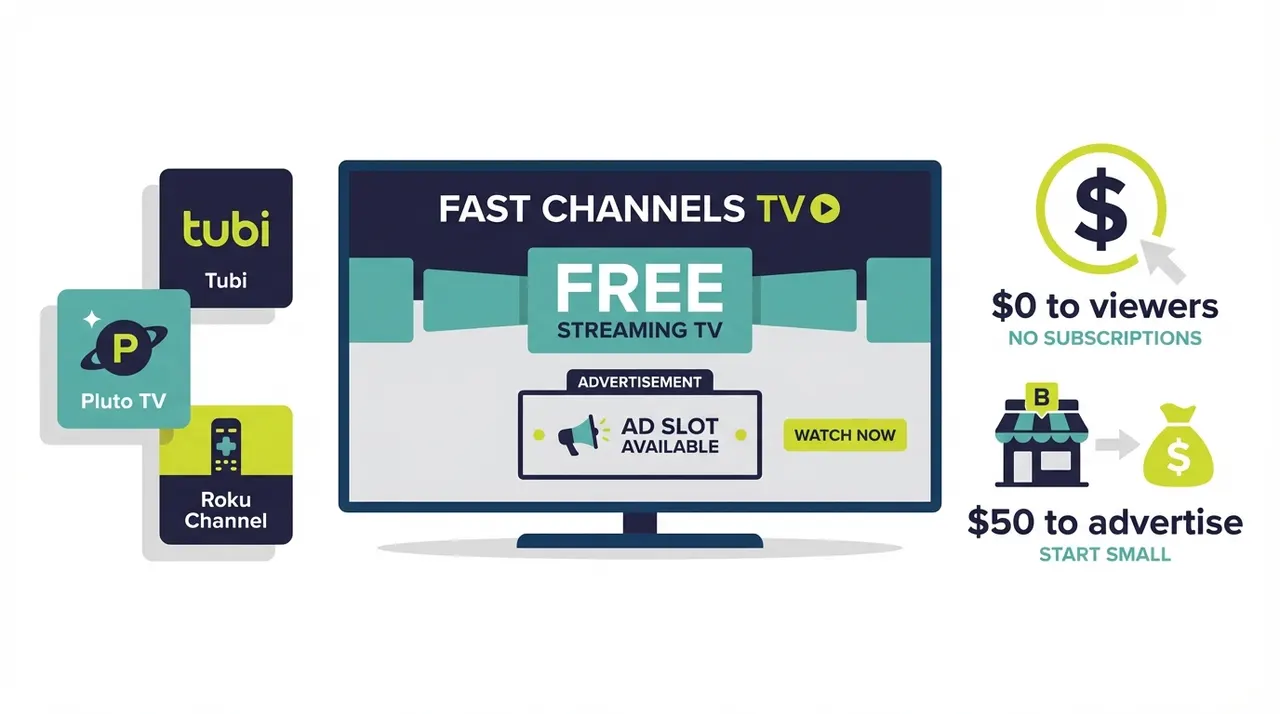
FAST channels are quietly revolutionizing how people watch TV, and most viewers don't even know the term. If you've ever watched Tubi, Pluto TV, or The Roku Channel, you've already experienced FAST. These free, ad-supported streaming services now reach over 200 million viewers in the United States alone.
For small businesses looking to advertise on streaming TV, FAST channels represent one of the most accessible and affordable entry points into television advertising. Here's everything you need to know about what FAST channels are, why they matter, and how to reach their audiences.
What Does FAST Mean?
FAST stands for Free Ad-Supported Streaming Television. The name describes exactly what these services offer: streaming TV content that's completely free to viewers, funded entirely by advertising.
FAST channels mimic the traditional TV experience inside a streaming app. Instead of browsing a library and selecting specific shows (like Netflix), FAST channels offer linear streams where content plays continuously on themed channels. You tune in and watch whatever's on, just like cable TV, but through a streaming app.
Key characteristics of FAST:
100% free to viewers (no subscription required)
Advertising-supported business model
Linear, scheduled programming (like traditional TV)
Themed channels (Comedy, True Crime, Sports, News, etc.)
Available on all streaming devices (Roku, Fire TV, smart TVs)
No signup required on many platforms
The FAST model brings back the simplicity of traditional TV: turn it on, find a channel you like, and watch. No deciding what to watch, no analysis paralysis, just content playing when you want it.
The History and Rise of FAST Channels
FAST channels didn't emerge overnight. Their growth reflects a broader shift in how Americans consume video content and what they're willing to pay for it.
The Early Days (2014-2017): Pluto TV launched in 2014 as one of the first FAST services, initially as a small startup offering curated YouTube content organized into channels. The concept was simple: replicate the lean-back TV experience but through streaming. Early growth was slow as viewers were still adjusting to streaming overall.
The Cord-Cutting Acceleration (2018-2020): As millions of households canceled cable subscriptions, a gap emerged. Viewers wanted free content but also wanted the passive viewing experience of traditional TV. Tubi (acquired by Fox in 2020), Pluto TV (acquired by Viacom in 2019), and The Roku Channel began investing heavily in content and distribution.
The Pandemic Boom (2020-2021): COVID-19 accelerated every streaming trend. With people stuck at home, FAST services saw explosive growth. Tubi reported 51 million monthly active users by 2021. Pluto TV crossed 50 million. The Roku Channel became the most-watched app on Roku devices.
The Mainstream Era (2022-Present): FAST is no longer a niche category. Every major media company has launched or acquired FAST services. Samsung TV Plus comes pre-installed on millions of smart TVs. Amazon integrated Freevee into Prime Video. FAST has become a core part of how America watches TV.
Why This Growth Matters for Advertisers:
The trajectory shows that FAST isn't a fad. These platforms have achieved scale comparable to cable networks, but with digital targeting capabilities and accessible pricing. For small businesses, this growth means a larger, more diverse audience to reach through programmatic advertising.
According to industry analysts, FAST ad spending is projected to grow 30-40% annually through 2027, outpacing traditional TV and even subscription streaming advertising. The platforms are investing in exclusive content, live sports rights, and original programming to drive further growth.
Major FAST Channels
The FAST landscape has exploded over the past few years. Here are the major players advertisers should know:
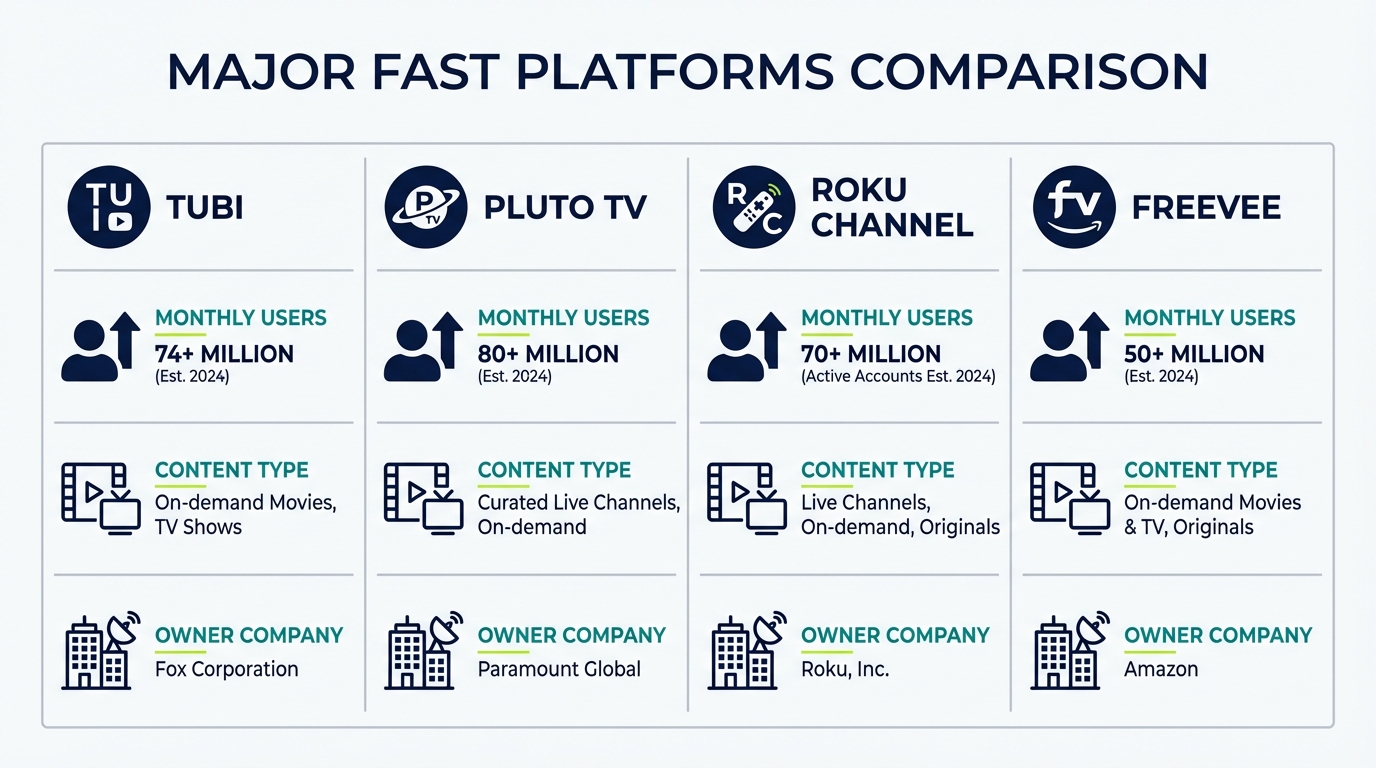
Tubi
Owned by Fox
80+ million monthly active users
Mix of on-demand and linear channels
Strong movie library plus original content
Available on virtually all streaming devices
Pluto TV
Owned by Paramount/CBS
80+ million monthly active users
300+ live channels
Strong in news, entertainment, and lifestyle content
Mimics cable experience most closely
The Roku Channel
Owned by Roku
Built into all Roku devices
Mix of on-demand and live TV
Growing original content investment
Automatic exposure to 80M+ Roku users
Amazon Freevee (formerly IMDb TV)
Owned by Amazon
Integrated into Fire TV and Prime Video
Strong movie and series library
Amazon's ad-supported streaming offering
Samsung TV Plus / LG Channels / Vizio WatchFree+
Built into smart TVs from each manufacturer
Automatic access for millions of TV owners
Growing channel lineups and content
Xumo
Joint venture between Comcast and Charter
Growing distribution on smart TVs
Focus on news, sports, and entertainment
Why FAST Channels Matter for Advertisers

FAST channels have become important for advertisers for several strategic reasons.
Massive Reach That's Still Growing
According to eMarketer, FAST viewership has grown over 50% year-over-year, with projections showing continued double-digit growth. Services like Tubi and Pluto TV each report 80+ million monthly users. Combined, FAST platforms now rival or exceed the reach of many traditional cable networks.
Viewers Who Accept Advertising
This is critical: FAST viewers chose a free, ad-supported service. They understand and accept that advertising is part of the deal. Unlike viewers on ad-free premium services who might resent advertising, FAST audiences expect commercials as the natural trade-off for free content.
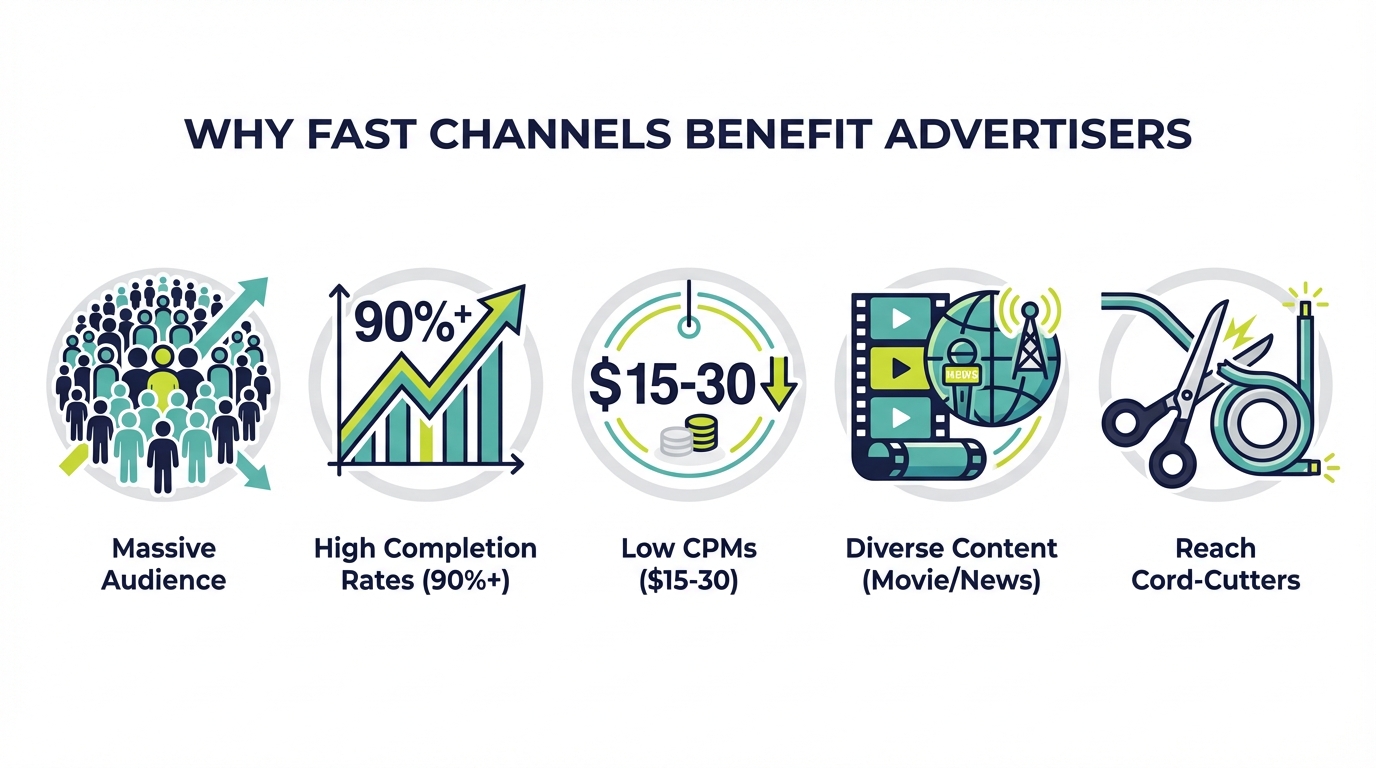
This acceptance translates to performance. Completion rates on FAST channels typically exceed 90%, meaning viewers watch your entire ad rather than skipping or tuning out.
Lower CPMs Than Premium Platforms
FAST advertising is significantly more affordable than premium streaming platforms:
Premium platforms (Netflix, Hulu): CPMs of $35-60
FAST Channels: CPMs of $15-25
Traditional Cable: CPMs of $20-35
For small businesses with limited budgets, FAST channels deliver TV-quality reach at digital-friendly prices. A $500 monthly budget on FAST platforms can generate 20,000-30,000 impressions, enough for meaningful local reach.
Budget-Conscious Demographics
FAST viewers tend to be value-seekers who prefer free options over paid subscriptions. This can align well with advertisers targeting price-conscious consumers. Service businesses, restaurants, and retailers often find strong resonance with FAST audiences.
FAST Channel Advertising Costs
Let's get specific about what small businesses should expect to pay.
Cost Per Thousand (CPM): FAST channel CPMs typically range from $15-25, depending on:
Targeting specificity (broader = cheaper)
Content genre (sports typically costs more)
Time of day (prime time = premium)
Geographic focus (local = slightly higher)
What Different Budgets Accomplish:
$100/month: Approximately 4,000-6,000 impressions (small test)
$250/month: Approximately 10,000-16,000 impressions (neighborhood reach)
$500/month: Approximately 20,000-33,000 impressions (local market penetration)
$1,000/month: Approximately 40,000-66,000 impressions (serious local presence)
Minimum Spends: Direct FAST platform advertising often requires $5,000+ minimums. But through programmatic platforms like Adwave, you can access FAST inventory starting at just $50. This makes testing TV advertising feasible for even the smallest businesses.
Who Watches FAST Channels?
Understanding FAST audiences helps you decide if these platforms fit your target market.
Demographic Highlights:
According to Nielsen, FAST viewers include:
Strong representation across all adult age groups
Slightly higher concentration of 35-54 year olds
Even split between male and female viewers
Strong suburban and rural presence
Over-index on value-conscious households
Significant cord-cutter population
Viewing Contexts:
FAST viewing often happens during:
Background entertainment while doing other activities
Lean-back evening viewing
Channel surfing/discovery mode
Content consumption when nothing specific is desired
Content Preferences:
Popular FAST genres include:
Movies (classic and recent catalog titles)
True crime and documentary
News and current events
Sports highlights and secondary coverage
Lifestyle content (home, cooking, travel)
Classic TV series
Understanding the FAST Viewer Mindset:
FAST viewers have made a deliberate choice to watch free, ad-supported content. This choice reveals important characteristics about them as consumers.
They're value-conscious, not cheap. FAST viewers often have access to paid streaming services but choose free options for certain types of content. They evaluate purchases carefully and appreciate businesses that offer good value.
They accept advertising as a fair exchange. Unlike viewers who pay for ad-free experiences, FAST audiences understand that their viewing is supported by commercials. They don't resent ads; they expect them. This acceptance translates to higher engagement with commercial content.
They prefer passive discovery. Rather than actively searching for content, FAST viewers enjoy the serendipity of channel surfing. They're open to discovering new things, including new businesses and products through advertising.
They're often multitasking. FAST viewing frequently accompanies other activities like cooking, cleaning, or working from home. This means your ad needs to capture attention quickly, but it also means viewers are in a relaxed, receptive state.
For small businesses, these characteristics paint a picture of an ideal advertising audience: receptive to commercial messages, open to discovering new businesses, and making viewing decisions that demonstrate practical, value-oriented thinking.
How to Advertise on FAST Channels
Small businesses typically access FAST inventory through programmatic platforms rather than direct deals.
Step 1: Choose Your Access Point
Platforms like Adwave aggregate inventory from Tubi, Pluto TV, Roku Channel, and dozens of other FAST services. You create one campaign that reaches viewers across multiple platforms.
Step 2: Set Geographic Targeting
Define where your customers are. For local businesses, this means:
Your city or metro area
Specific zip codes
Radius around your location
Your service area
Geographic precision is one of FAST advertising's biggest advantages over traditional TV. You're not paying to reach viewers three states away.
Step 3: Create Your Ad
You'll need video creative:
15 or 30 seconds (30 seconds standard)
High-definition quality (1080p minimum)
Clear audio for big-screen viewing
Strong call to action
No existing creative? Platforms like Adwave offer free AI video generation to create professional commercials from your business information.
Step 4: Set Budget and Launch
Start with a test budget ($100-250) to see how FAST advertising performs for your business. Monitor results, adjust targeting, and scale what works.
Step 5: Measure Results
Track business impact during campaign periods:
Website traffic changes
Phone call and inquiry volume
Foot traffic (if applicable)
New customer sources
Brand awareness indicators
Creating Effective Ads for FAST Channels
FAST viewers are watching in a lean-back environment on the big screen. Your creative needs to match that context.
Technical Requirements:
Format: MP4 or MOV
Resolution: 1080p minimum (4K preferred for newer devices)
Length: 15 or 30 seconds (30 seconds recommended for storytelling)
Audio: Broadcast-quality, clear dialogue
Aspect Ratio: 16:9 (standard widescreen)
Creative Best Practices for FAST:
1. Design for the Living Room
Your ad will appear on televisions, often 50 inches or larger, viewed from across the room. Text needs to be large and readable. Avoid tiny details that get lost at viewing distance. Think billboard design principles applied to video.
2. Hook Quickly, But Don't Panic
Unlike YouTube where viewers skip after 5 seconds, FAST ads are non-skippable. You have the viewer's attention for the full duration. Still, front-load your key message in case attention wanders. Get your business name and primary benefit in the first 5 seconds.
3. Match the TV Viewing Context
Your ad appears alongside professional content from major studios. Low-production-value creative sticks out negatively. You don't need a massive budget, but clean visuals, professional audio, and competent editing are expected. Avoid anything that looks like a social media post.
4. Include Local Signals
Since you're targeting specific geographic areas, make your local presence clear. Mention your city or neighborhood. Show recognizable local landmarks. "Proudly serving [Your City] since 2005" builds immediate relevance and trust.
5. Clear, Simple Calls to Action
What should viewers do after seeing your ad? Make it obvious and easy:
Simple website URL (avoid complicated paths)
QR code that leads to a landing page
Phone number for businesses that take calls
"Visit us at [address]" for retail locations
QR codes work especially well on streaming TV because viewers have phones close at hand during viewing. A scannable code eliminates the friction of typing a URL.
6. Test Multiple Versions
If budget allows, create both 15-second and 30-second versions. Use 15-second spots for frequency and simple messages; use 30-second spots for more complex value propositions or emotional storytelling.
Don't Have Video Creative?
This used to be a major barrier. Professional TV commercial production could cost $10,000 to $50,000 or more. Today, platforms like Adwave include AI-powered creative tools that generate professional video ads from your website content, photos, and business information. You can have broadcast-ready creative in minutes rather than weeks.
FAST vs. Other Streaming Options
How do FAST channels compare to other streaming advertising opportunities?
FAST vs. Premium Streaming (Netflix, Hulu, Disney+)
CPM: FAST channels cost $15-25. Premium platforms cost $35-60.
Audience expectations: FAST viewers accept ads as part of the free experience. Premium viewers tolerate ads.
Content quality: FAST offers good catalog titles. Premium offers original content.
Brand adjacency: FAST varies. Premium offers higher prestige.
Small business access: FAST is easy to access. Premium is more difficult.
FAST vs. YouTube
Primary device: FAST is primarily TV. YouTube is primarily mobile and desktop.
Ad skippability: FAST ads are non-skippable. YouTube ads are often skippable.
Completion rates: FAST achieves 90%+ completion. YouTube averages 30-40%.
Targeting precision: FAST offers geographic and demographic targeting. YouTube offers detailed interest targeting.
Viewer attention: FAST viewers are in lean-back mode. YouTube viewers are actively browsing.
The Smart Approach:
For most small businesses, FAST channels offer the best balance of:
Affordable CPMs
TV-quality viewing environment
Accepting audiences
High completion rates
Accessible minimums
Running diversified campaigns across multiple FAST platforms through programmatic buying maximizes reach while keeping costs manageable.
Common questions answered
What does FAST stand for in streaming?
FAST stands for Free Ad-Supported Streaming Television. These are streaming services that offer free access to viewers in exchange for watching advertisements. Popular FAST services include Tubi, Pluto TV, The Roku Channel, and Amazon Freevee. The model resembles traditional TV: content plays on linear channels with commercial breaks, but delivery happens through streaming apps.
What's the difference between FAST and AVOD?
FAST (Free Ad-Supported Streaming Television) specifically refers to linear, channel-based streaming with scheduled programming. AVOD (Ad-Supported Video on Demand) is a broader category that includes any ad-supported streaming, including on-demand content. Tubi and Pluto TV are both FAST and AVOD since they offer linear channels and on-demand libraries. The terms are often used interchangeably in advertising contexts.
Why are FAST channels free?
FAST channels are free because advertising covers all costs. Viewers watch commercials, and those advertising dollars fund content licensing, platform operations, and profit. The model mirrors traditional broadcast TV, which has always been "free" to viewers with advertisements. For viewers, it's an attractive trade-off: free access to movies, shows, and live content in exchange for watching ads.
Can small businesses afford to advertise on FAST channels?
Yes, FAST channels are among the most affordable TV advertising options available. Through programmatic platforms like Adwave, small businesses can access FAST inventory starting at $50 with CPMs ranging from $15-25. This makes TV advertising accessible for businesses with monthly marketing budgets of a few hundred dollars, which wasn't possible with traditional TV advertising that required five-figure minimums.
Which FAST channels have the most viewers?
Tubi and Pluto TV lead the FAST market with approximately 80+ million monthly active users each. The Roku Channel benefits from built-in distribution on all Roku devices. Samsung TV Plus, LG Channels, and similar smart TV services are growing rapidly due to automatic inclusion on millions of televisions. Combined, major FAST platforms reach over 200 million viewers in the U.S.
Measuring FAST Channel Campaign Performance
One of FAST advertising's advantages over traditional TV is measurement. You get actual data, not ratings estimates based on small sample sizes.
Metrics You'll Receive:
Impressions: The total number of times your ad was shown across FAST platforms. This is the fundamental unit of measurement for all streaming TV advertising.
Reach: The number of unique households that saw your ad. Reach helps you understand how many different potential customers you're touching versus showing the same ad repeatedly to a smaller group.
Frequency: The average number of times each household saw your ad. For brand awareness campaigns, 3-5 exposures per week often works well. Higher frequency risks ad fatigue; lower frequency may not build recognition.
Video Completion Rate (VCR): The percentage of viewers who watched your entire ad. On FAST channels, expect 90%+ completion rates since ads are non-skippable. If completion rates are significantly lower, investigate creative or targeting issues.
Geographic Distribution: Where your impressions were delivered. This helps you confirm that geographic targeting is working correctly and that you're reaching the right markets.
Business Impact Measurement:
Streaming TV doesn't offer click-through tracking like digital ads. Instead, measure business impact through:
Website Traffic Lift: Compare website traffic during campaign periods to baseline. Use Google Analytics to identify increases in direct traffic or branded search traffic.
Phone Call Volume: Are you receiving more calls? Use call tracking numbers to attribute inquiries to your TV campaigns.
Foot Traffic Changes: For retail locations, track in-store visits during and after campaign periods. Some platforms offer foot traffic attribution studies.
Customer Source Tracking: Ask new customers how they heard about you. "I saw your commercial" is valuable feedback, even without sophisticated attribution.
Branded Search Volume: TV advertising typically increases searches for your business name. Track branded search impressions and clicks in Google Search Console.
The Long-Term View:
TV advertising builds brand awareness over time. Don't expect immediate sales spikes like you might from direct-response digital campaigns. Instead, track trends over weeks and months. Are more people aware of your business? Is word-of-mouth improving? Are you getting more referrals? These are the true measures of TV advertising effectiveness.
Start Advertising on FAST Channels Today
FAST channels have created an unprecedented opportunity for small businesses to reach TV audiences without TV-sized budgets. With 200+ million viewers, affordable CPMs, and audiences who accept advertising as part of the viewing experience, FAST represents the most accessible path to streaming TV advertising.
Through Adwave, you can access inventory on Tubi, Pluto TV, Roku Channel, and dozens of other FAST platforms starting at just $50. Target viewers in your local market, create professional video ads with free AI tools, and launch your first TV campaign in minutes.


