
If you're deciding where to put your video advertising budget, "YouTube ads or TV ads?" feels like a natural question. One is the internet's video giant, the other is the classic living-room screen. But here's a twist that changes the whole comparison: in 2026, those two things overlap far more than most people realize. A huge and growing share of YouTube viewing now happens on the television set, and much of what we call "TV" is streaming. The line between YouTube and TV has blurred, which makes the reach question more interesting, and the answer more useful, than a simple this-or-that.
Compare YouTube and TV advertising by reach, cost, targeting, and available formats.
First, the surprising overlap
Before we compare them, you need to understand how much YouTube and TV now blend together, because it reframes everything.
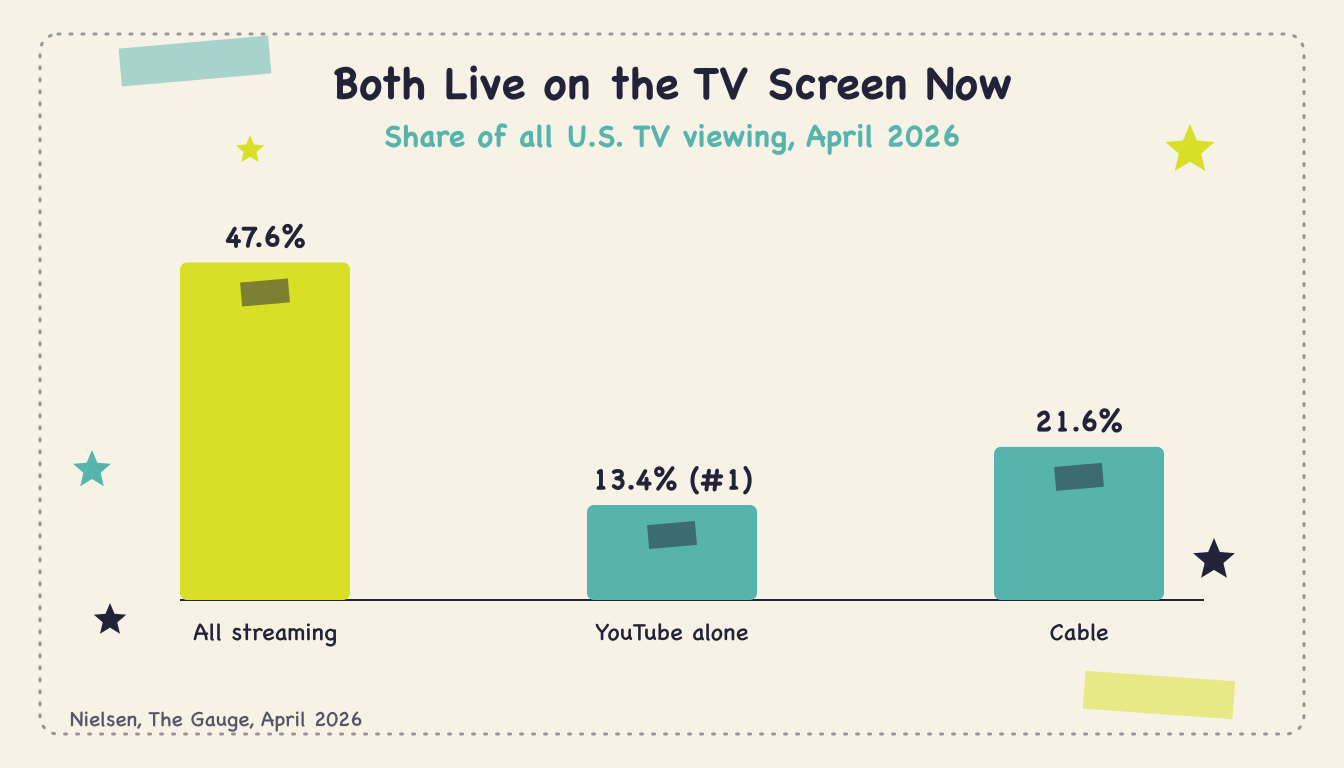
YouTube is, by Nielsen's measurement, the single most-watched media source on American television. It held 13.4% of all U.S. TV viewing in April 2026, more than any cable network or broadcaster, according to Nielsen's The Gauge. (Source: Nielsen, The Gauge, April 2026.) That's not YouTube's share of online video, it's its share of everything watched on TV sets, and the living-room television is now YouTube's fastest-growing screen. So when you run a YouTube ad, an increasing share of the time it's playing full-screen in someone's living room, exactly where a "TV ad" plays.
Meanwhile, "TV" itself has largely become streaming. Streaming took 47.6% of all U.S. TV viewing in April 2026, more than cable and broadcast combined, per Nielsen. (Source: Nielsen, The Gauge, April 2026.) The connected TV ads that run on services like Hulu, Roku, and Peacock are what most people mean by "TV advertising" now.
So the real comparison isn't "internet video vs television." It's "YouTube's video network vs the premium streaming TV network," two overlapping ways to reach people watching video, often on the very same screen. Keep that in mind as we compare them, because the honest conclusion is less about picking a winner than about how they fit together.
Reach: which one reaches more people?
On raw scale, both are enormous, but they reach people in somewhat different contexts.
YouTube's reach is vast and spans every screen: phones, tablets, laptops, and increasingly the TV. It reaches people during active, lean-forward moments (searching, browsing, watching creators) as well as lean-back TV time. Its scale is enormous, and its share of TV viewing alone leads all media companies. If you want to reach people across all their devices and contexts, YouTube's footprint is hard to match.
Connected TV's reach is concentrated in the premium, lean-back living-room experience, across the full range of streaming services people watch their shows and movies on. It reaches the nearly half of all TV viewing that streaming now commands, in the trusted, full-screen environment of professionally produced content. If you want to reach people relaxing in front of their TV watching premium programming, connected TV covers that space broadly, including inventory YouTube doesn't.
So which reaches more people? Practically, both reach the majority of your local audience, and they overlap heavily on the TV screen while each also reaching people the other doesn't, YouTube on mobile and in-app moments, connected TV across the full spread of premium streaming apps. For most small businesses, the honest answer is that neither strictly "wins" on reach; they reach overlapping-but-distinct slices of the same audience, which is exactly why using both maximizes your total reach.
Cost: how the economics compare
Cost is where the two can differ more noticeably, and both are affordable for small businesses in 2026.
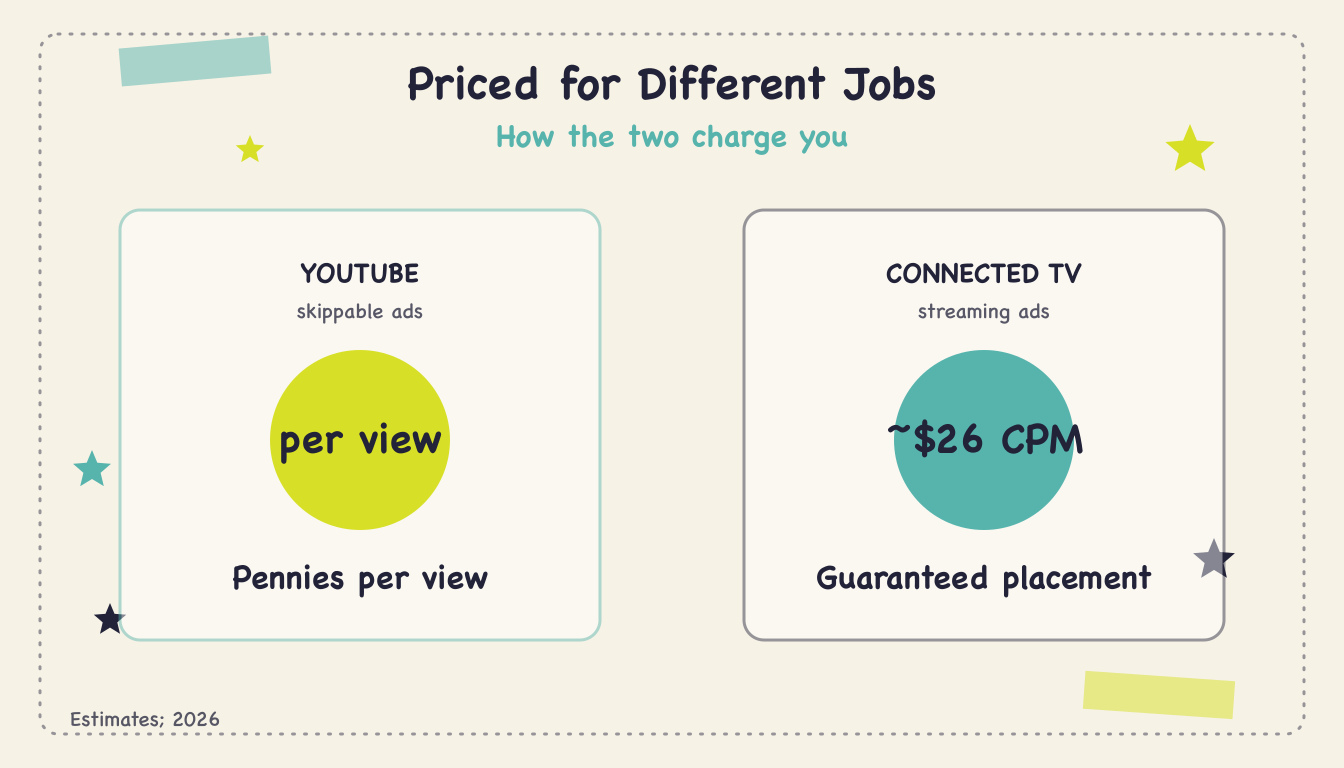
YouTube ads often run on a cost-per-view model for skippable ads, meaning you pay only when someone watches, and a skip can cost you nothing. Cost per view is frequently just pennies, which makes YouTube extremely efficient for engaged video views on a small budget. For non-skippable formats, it's priced on a CPM basis.
Connected TV ads are typically bought on a CPM (cost per thousand impressions) basis, with average CTV CPMs around $26 in 2026, most campaigns landing in the $25 to $35 range, because you're buying guaranteed, non-skippable, full-screen impressions in premium content. You're paying for the guaranteed premium placement and the trust that comes with it.
The takeaway: YouTube's cost-per-view model can stretch a small awareness budget further on sheer engaged views, while connected TV's CPM buys guaranteed, unskippable premium placement. They're priced differently because they deliver slightly different things, and neither is simply "cheaper", they're efficient for different goals.
Targeting and context: the real differences
Beyond reach and cost, the two differ in how you target and the context your ad appears in, and that's where your choice should really be guided.
YouTube targeting taps Google's data, so you can target by interests, demographics, search behavior, specific topics, and even keywords, plus retargeting. It's powerful, granular, and behavior-driven. The context ranges from creator content to music to how-to videos, spanning both focused and casual viewing.
Connected TV targeting focuses on household and audience-level targeting, and critically for a local business, precise geographic targeting, so you can run your ad to just your metro or neighborhood. The context is premium, professionally produced streaming content in the lean-back living-room setting, which lends your ad the trust and credibility of television.
For a local small business, both offer the local targeting you need. The choice of emphasis comes down to context and goal: YouTube for broad, behavior-targeted, cross-device video reach at very low cost per view; connected TV for premium, trust-building, guaranteed full-screen placement in the living room. And because YouTube increasingly plays on that same living-room screen, running both means your video shows up across every way people watch.
So which should a small business choose?
Here's the honest, practical answer: for most small businesses, this isn't an either-or, and treating it as one leaves reach on the table. The two are complementary, and the strongest video strategy uses both.
Think about it by goal:
Choose YouTube when you want maximum, cross-device video reach at the lowest cost per view, want to tap granular interest and behavior targeting, and want to reach people in both active and lean-back moments. It's exceptional for efficient, broad awareness and engaged views.
Choose connected TV when you want the premium, trust-building impact of guaranteed full-screen ads in professional streaming content, want broad reach across all the streaming services people watch, and want the credibility that the living-room TV context confers.
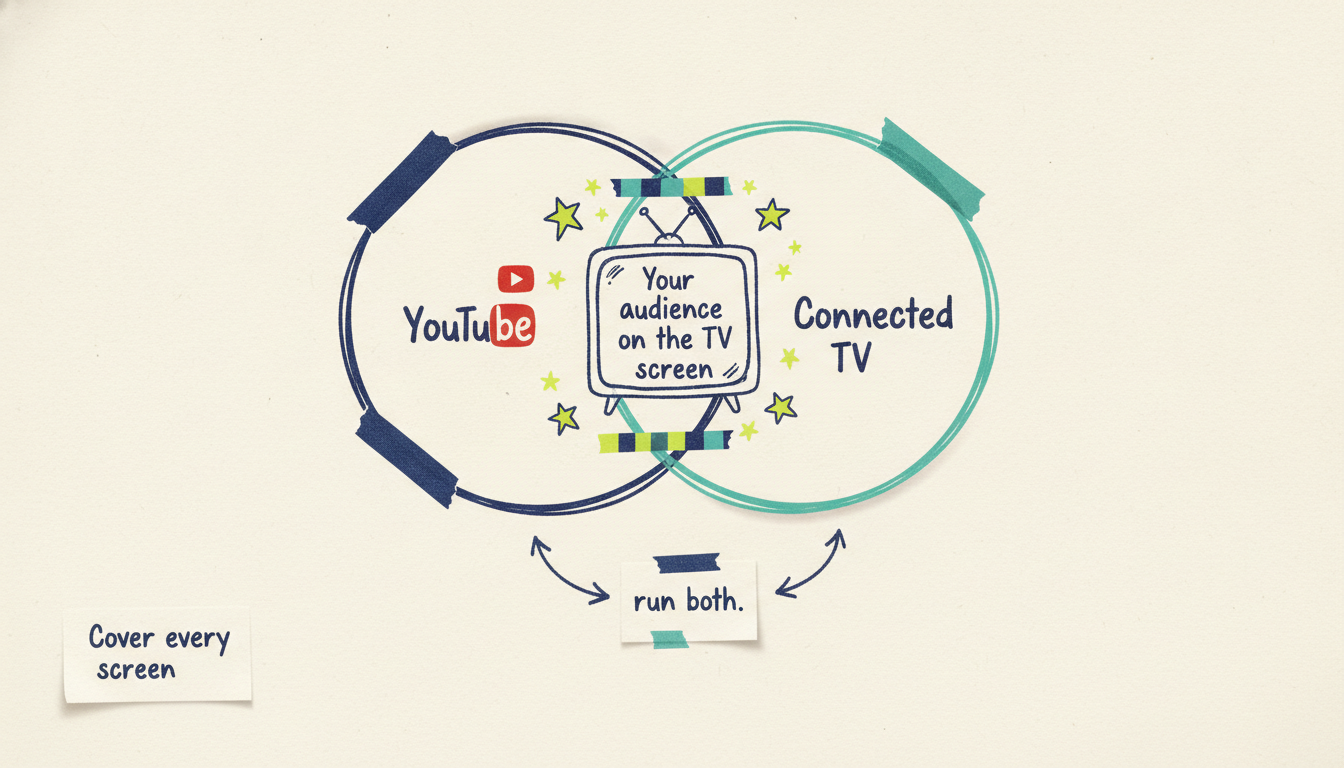
Choose both when you want to blanket your audience across every screen and context, which is what most growth-focused businesses should do. YouTube and connected TV overlap on the TV and each extend your reach where the other doesn't, so together they cover your audience far more completely than either alone.
The reason using both works so well is that video advertising compounds: the more places your consistent message appears, the more familiar and trusted your brand becomes. Running the same 30-second ad across YouTube and connected TV, coordinated with your other channels, is the essence of multi-channel advertising, and it's how a small business builds real awareness efficiently. For more on the streaming side specifically, see our guide to connected TV advertising.
Common questions answered
Do YouTube ads or TV ads reach more people? Both reach enormous audiences, and they overlap heavily because so much YouTube viewing now happens on the TV screen. YouTube is the single most-watched media source on U.S. televisions at 13.4% of all TV viewing (Nielsen, April 2026), while streaming overall is 47.6%. YouTube reaches across every device including TV, while connected TV reaches broadly across all premium streaming services. Neither strictly wins, they reach overlapping but distinct slices of your audience, which is why using both maximizes total reach.
Are YouTube ads cheaper than connected TV ads? They're priced differently. YouTube skippable ads often use a cost-per-view model where you pay only when someone watches, frequently just pennies per view, which is very efficient for engaged views. Connected TV is bought on a CPM basis, around $26 on average in 2026, because you're buying guaranteed, non-skippable, full-screen premium placement. Neither is simply cheaper, YouTube stretches an awareness budget on views, while CTV buys guaranteed premium impressions.
Is YouTube considered TV advertising? Increasingly, yes, at least when it plays on the television. YouTube is now the most-watched media source on U.S. TV sets, so a large and growing share of YouTube ads play full-screen in the living room, just like traditional TV ads. That said, YouTube also reaches people on phones and other devices, and it's bought through Google Ads rather than streaming-TV platforms, so it's best thought of as overlapping with, but not identical to, connected TV advertising.
Should a small business run YouTube ads, TV ads, or both? For most small businesses, both, because they're complementary rather than competing. YouTube delivers efficient, cross-device video reach at a low cost per view, while connected TV delivers premium, trust-building, guaranteed placement in the living room. Running the same video across both covers your audience across every screen and context far more completely than either alone, and the repetition builds brand familiarity faster.
Can I run the same video ad on both YouTube and connected TV? Yes, and you should. A single well-made 30-second video can run across both YouTube and connected TV, giving you consistent branding everywhere your audience watches. With AI tools that generate a broadcast-quality ad from your website in minutes, creating that video is fast and inexpensive, and running it across both platforms from one place makes a coordinated video strategy practical for a small business.
The bottom line
The "YouTube ads vs TV ads" question has a surprising answer in 2026: they've largely merged. YouTube is the most-watched source on the TV screen, and TV itself is mostly streaming, so the two overlap heavily while each also reaches people the other doesn't. Rather than pick a winner, the smart move for most small businesses is to run both, YouTube for efficient cross-device reach and low-cost views, connected TV for premium, trust-building living-room impact, with the same video across both.
Do that, and you cover your audience across every screen and context, building brand awareness far more completely and efficiently than either channel alone. Adwave makes it simple: generate one 30-second ad from your website, then run it across YouTube, connected TV, and more from a single platform. See how Adwave works, or check pricing to get started from $50.


