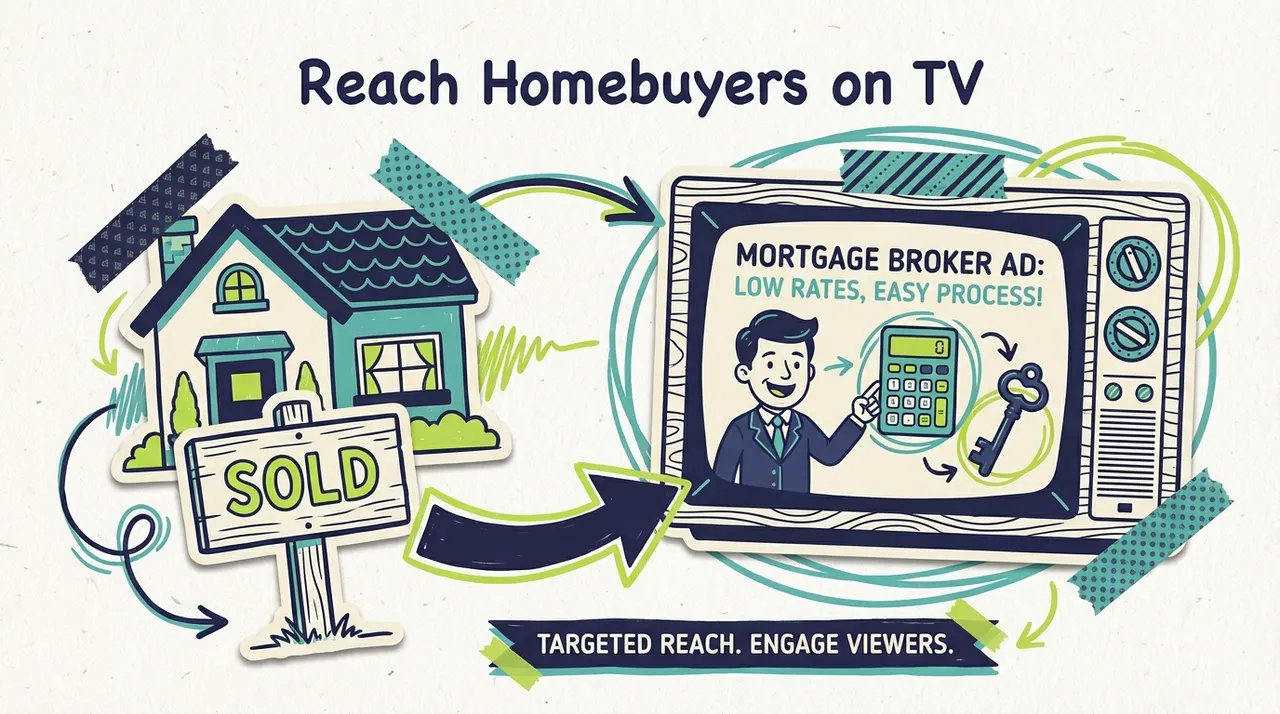
Most mortgage brokers rely on the same playbook: referrals, Zillow leads, and Google Ads. Those channels work, but they're getting more expensive every year. And when every broker in your market is fishing in the same pond, standing out becomes the real challenge.
Here's the good news: TV advertising, once reserved for the big national lenders, is now accessible to independent brokers and small mortgage companies. With streaming TV, you can reach homebuyers in your market for a fraction of what traditional broadcast costs, and you can start with a budget as small as $50.
The mortgage industry is projected to hit $2.2 trillion in originations in 2026, an 8% increase from 2025 (Mortgage Bankers Association, October 2025). That growth means more competition for every borrower. TV advertising gives you a way to build the trust and name recognition that turns strangers into clients.
Why TV Works for Mortgage Brokers

Mortgages are one of the biggest financial decisions people make. Borrowers want to work with someone they trust, and trust starts with familiarity.
The Trust Factor
When homebuyers see your face on their TV screen, it sends a signal: this broker is established, credible, and worth considering. Research consistently shows that consumers trust TV advertising more than any other channel, including social media, display ads, and search results.
For mortgage brokers, this trust advantage is especially valuable. You're asking people to hand over their most sensitive financial information and commit to a decades-long relationship. A TV presence builds the kind of credibility that a Google ad simply can't match.
Reaching Buyers Before They Start Shopping
Most mortgage marketing targets people who are already searching for rates. By that point, they're comparing you against a dozen other options. TV advertising reaches potential homebuyers earlier in their journey, before they've started Googling "best mortgage rates near me."
Consider the numbers: 51% of Americans plan to buy a home in 2025, including 61% of Gen Z and 52% of Millennials (IPX1031, 2025). Many of these future buyers haven't picked a lender yet. TV lets you plant the seed early so your name is already familiar when they're ready to apply.
How to Target Homebuyers on Streaming TV
One of the biggest advantages of CTV advertising over traditional broadcast is precision targeting. Instead of buying a broad DMA and hoping homebuyers are watching, you can reach exactly the right audience.
Targeting Options That Work for Mortgage Brokers
Geographic targeting: Focus on the ZIP codes and neighborhoods where you do business. If you specialize in certain counties or cities, your ads only reach those areas.
Demographic targeting: Home purchase intent, income level, age range, and homeownership status all help narrow your audience. Target renters in the 25-45 age range for first-time buyer campaigns, or homeowners for refinance messaging.
Behavioral targeting: Reach people who have recently visited real estate websites, searched for homes online, or shown other signals of being in the market.
Life event targeting: Major life changes trigger home purchases. Newly married couples, growing families, and recent relocators are all high-value audiences for mortgage brokers.
The ability to layer these targeting options means your ad budget works harder. Instead of paying to reach everyone in your metro area, you're reaching the people most likely to need a mortgage.
What to Say in Your Mortgage Broker TV Ad

Mortgage advertising has a reputation for being bland. Rate tables, fine print, and stock footage of happy families holding keys. You can do better.
Lead with the Problem
Every good mortgage ad starts with a pain point that resonates:
"Confused by all the mortgage options out there?"
"Think you need 20% down to buy a home? Think again."
"Tired of getting the runaround from big banks?"
Position Yourself as the Local Expert
This is where independent mortgage brokers have an edge over the national lenders. You're local. You know the market. You can sit across the table from your clients.
Highlight what makes you different:
Local knowledge: "I've helped over 500 families buy homes right here in [City]"
Personal service: "You'll work with me directly, not a call center"
Access to options: "I shop 30+ lenders to find you the best rate"
Include a Clear Call to Action
Tell viewers exactly what to do next:
Visit your website for a free rate quote
Call your direct line
Scan a QR code to start an application
Keep the CTA simple. One action, one next step.
Building a TV Campaign for Your Mortgage Business
You don't need a massive budget to get results. Here's how to structure a TV campaign that fits a mortgage broker's business.
Campaign Structure
Always-on awareness (ongoing): Run a low-frequency campaign year-round to keep your name in front of potential homebuyers. This is your baseline that builds cumulative familiarity. Even $300-$500 per month in a targeted area creates meaningful exposure.
Seasonal pushes (spring and fall): Increase your spend during peak homebuying seasons. Spring (March through June) sees the highest purchase volume, and fall brings a second wave. Double or triple your baseline during these windows.
Rate-driven campaigns (as needed): When rates drop significantly, launch a targeted refinance campaign. These are short bursts (2-4 weeks) that capitalize on a specific moment.
Budget Guidelines
For context, the mortgage industry spent $825.5 million on advertising in 2023 (Statista, 2023), and 82% of financial marketers are increasing their digital ad budgets heading into 2026 (ABA Banking Journal, October 2025). The brokers who are investing in new channels now will have a head start.
TV Advertising vs. Other Mortgage Marketing Channels

How does TV stack up against the channels you're probably already using?
Comparison Table
The key difference: most digital channels generate leads that need convincing. TV builds the trust and familiarity that makes every other channel more effective. When someone sees your Google ad after they've already seen you on TV, the click-through rate and conversion rate both improve.
CTV ads also achieve 90-98% completion rates (Innovid, 2025), meaning nearly everyone who sees your ad watches the whole thing. Compare that to social media video, where most viewers scroll past in the first few seconds.
Compliance Considerations for Mortgage Advertising
Mortgage advertising is regulated by federal and state agencies. Your TV ads need to comply with the same rules as your other marketing.
Key Regulations
Truth in Lending Act (TILA): If you mention specific rates, terms, or payment amounts, you must include all required disclosures (APR, loan term, fees).
RESPA: Restrictions on referral fees and kickbacks. Don't imply referral arrangements in your ads.
Fair Housing Act: Ads cannot discriminate or suggest preferences based on race, religion, national origin, sex, disability, or familial status.
State licensing: Most states require your NMLS number in all advertising materials, including TV ads.
Tip: Keep your TV ads focused on your brand, your expertise, and the benefits of working with you. Save the rate specifics for your website landing page, where you can include all the required disclosures without cramming them into a 30-second spot.
Getting Started with TV Advertising
Platforms like Adwave make it simple for mortgage brokers to get on TV. You can create a professional ad from your website in about two minutes, target homebuyers in your market, and launch a campaign from $30/day.
Here's your quick-start plan:
Choose your market: Define the ZIP codes where you want to reach homebuyers
Create your ad: Use your website, headshot, and key messaging to generate a 30-second spot
Set your budget: Start small, measure results, and scale what works
Target your audience: Focus on homebuyer demographics and real estate interest signals
Track results: Monitor website visits, inbound calls, and application starts to measure impact
The mortgage brokers who build brand recognition now will be the ones borrowers think of first when they're ready to buy. TV makes that possible at any budget.
Common Questions Answered
How much does TV advertising cost for a mortgage broker? With streaming TV platforms, mortgage brokers can start advertising from $30/day per month. Most brokers running meaningful local campaigns spend $300 to $3,000 monthly, depending on their market size and targeting. This is significantly less than traditional broadcast TV, which often requires $5,000 or more per week in a metro market.
Can I target just homebuyers with my TV ads? Yes. CTV platforms offer targeting based on demographics, income level, homeownership status, real estate website browsing behavior, and life events like recent marriages or relocations. You can also target specific ZIP codes to match your lending area, so your budget only goes toward reaching people who could become your clients.
Do I need to include rate disclosures in my TV ad? If you mention specific rates, APR, loan terms, or payment amounts, then yes, TILA requires full disclosures. Many mortgage brokers avoid this by focusing their TV ads on brand building, trust, and expertise, then driving viewers to a website where rate details and disclosures are fully presented. This keeps your TV creative clean and effective.
What kind of results can a mortgage broker expect from TV advertising? TV advertising is primarily a brand-building channel, so the biggest impact is on name recognition and trust. Over time, brokers typically see increases in direct website traffic, branded search queries, and inbound calls. Many also report that leads from other channels (Google, referrals) convert at higher rates once prospects have seen their TV ads.
Is TV advertising worth it for a solo mortgage broker? Absolutely. Solo brokers often benefit the most because they can build a strong personal brand in a specific geographic area. With CTV targeting, even a $300 monthly budget can generate consistent exposure in the ZIP codes where you do business. The credibility boost of being "the broker on TV" can set you apart in a crowded market.