
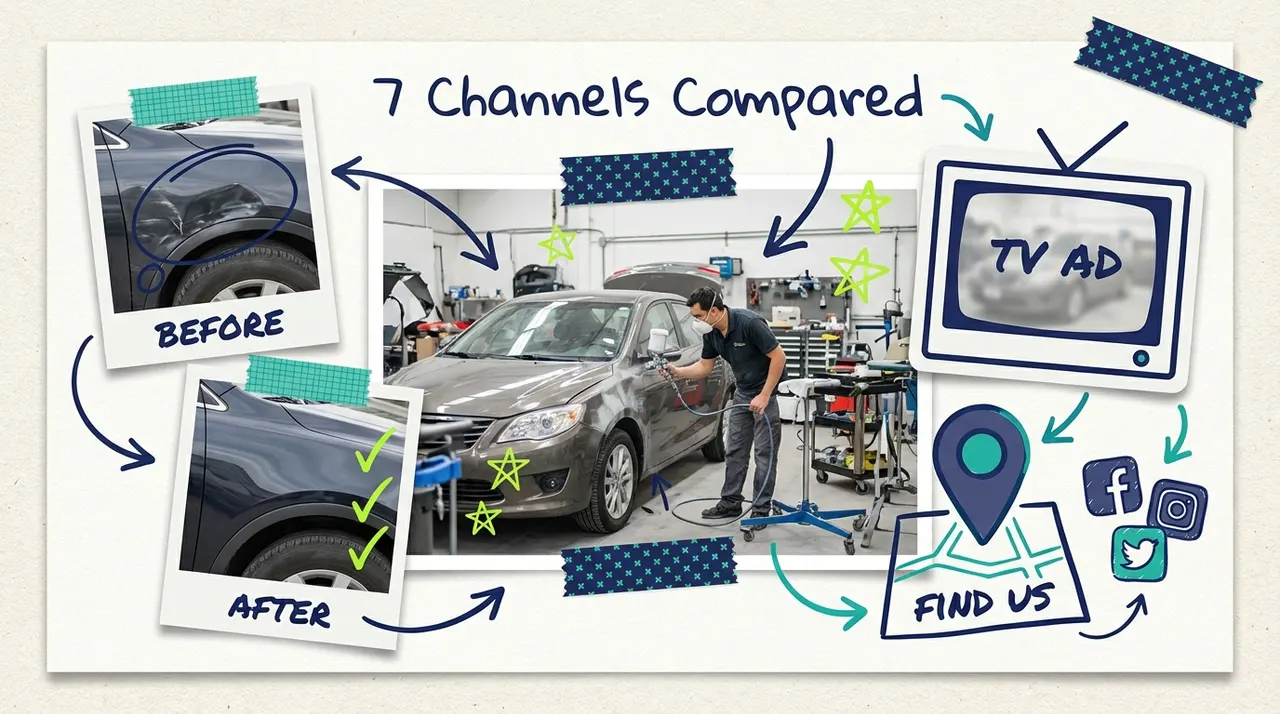
Every fender bender, hailstorm, and parking lot mishap creates a customer who needs your shop. The problem? They don't know you exist yet. And the ones who do know you might be getting steered toward a dealership body shop by their insurance company before they even think to look around.
The collision repair industry is a $50 billion market in the United States, with over 100,000 shops competing for work (IBISWorld, 2025). If you're relying on insurance DRP (direct repair program) referrals and word-of-mouth alone, you're leaving a huge chunk of revenue on the table.
According to BrightLocal's 2024 Local Consumer Survey, 98% of consumers search online for local businesses, and auto repair is one of the most-searched categories. When someone's car gets dinged in a parking lot, the first thing they do is pull out their phone. If your shop doesn't show up, your competitor's will.
Advertising for auto body shops doesn't require a massive budget. This guide breaks down seven proven channels for collision repair marketing, with realistic costs and specific strategies built for body shops. You'll walk away with a clear picture of where to put your money and why.
Why Auto Body Shops Need More Than Insurance Referrals
If you're running a body shop, there's a good chance that insurance DRP work makes up a big slice of your revenue. And that's fine, until it isn't.
DRP programs come with strings attached. Insurance companies negotiate lower labor rates, dictate which parts you use, and can remove you from their preferred list at any time. According to the Collision Industry Conference's 2024 survey, shops on DRP programs reported average labor rates 15-20% below retail rates. That's real money leaving your business every single repair.
Then there's the concentration risk. If one insurance carrier represents 40% of your work and they drop you, that's a devastating hit overnight. Word-of-mouth is valuable too, but it's slow and unpredictable. You can't scale it, you can't time it, and you can't control it.
Advertising can help you attract customers directly. Compare the channels below to decide which fit your service area and budget.
Google Ads: Reaching Drivers After an Accident
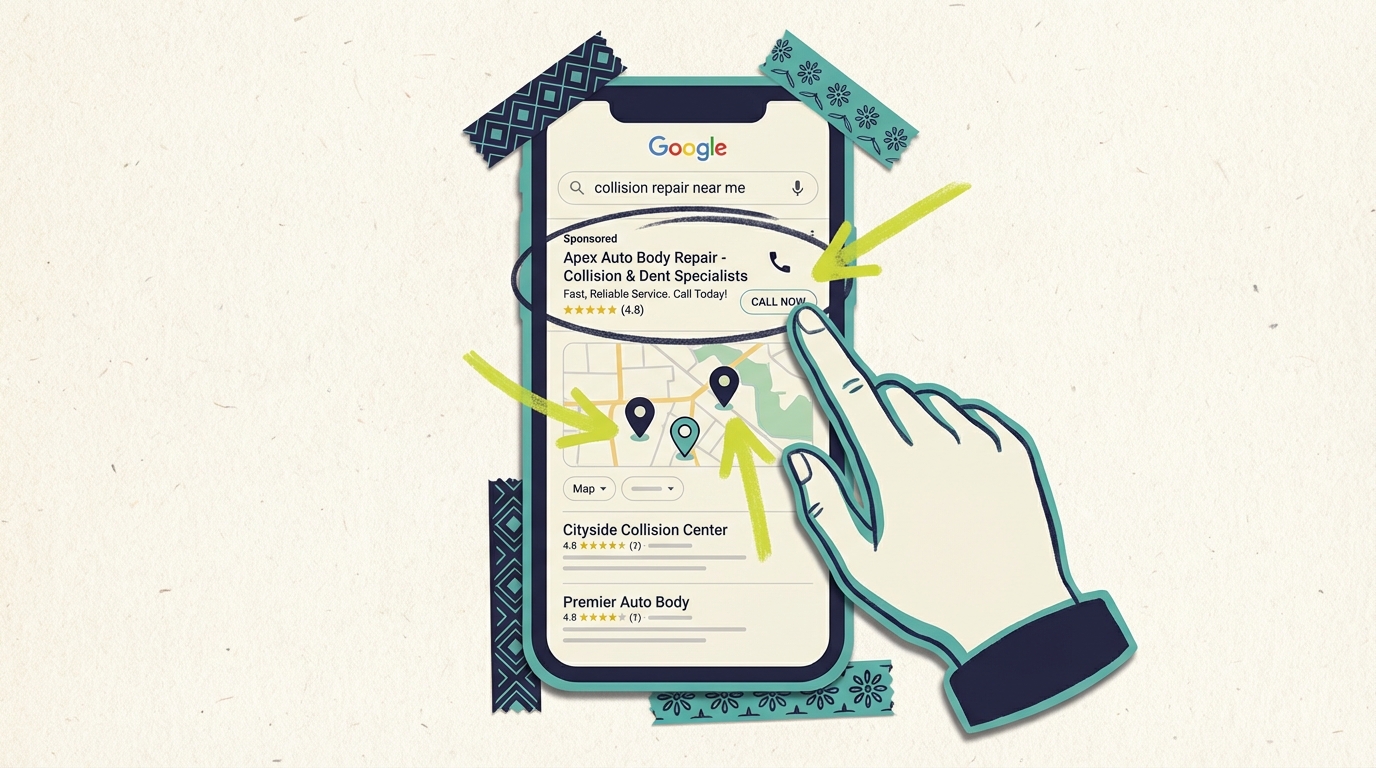
When someone gets into a fender bender or walks out to find a dent in their door, what do they do? They search. "Collision repair near me." "Auto body shop [city]." "Dent repair estimate." Google Ads puts your shop at the top of those results, right when someone needs you most.
Auto body search queries carry massive intent. Someone typing "auto body shop near me" isn't browsing. They're standing next to a damaged car, probably stressed, and ready to choose a shop today. According to Google, 76% of people who search for something nearby visit a business in a day or less (Google Internal Data, 2023). For collision repair, that window is even tighter.
Keywords That Drive Repair Orders
Body shops should build campaigns around these keyword categories:
Emergency and urgent repairs: "collision repair near me," "auto body shop open now," "car accident repair [city]"
Specific services: "paintless dent repair," "bumper repair near me," "hail damage repair," "auto paint matching," "frame straightening"
Insurance-related: "insurance claim body shop," "auto body shop that works with [carrier]," "collision repair estimate"
Brand and vehicle-specific: "Tesla body shop," "BMW collision repair," "aluminum body repair near me"
Campaign Types to Consider
Search campaigns are your foundation. Bid on high-intent keywords and write ads that highlight your differentiators: OEM certifications, lifetime warranties, free estimates, rental car coordination.
Local Services Ads (LSAs) appear above standard search ads with a Google Guaranteed badge. You pay per lead rather than per click, which means no wasted spend on people who click but never call. For body shops, LSA leads typically cost $25-$60 each.
Performance Max campaigns extend your reach across Search, Maps, Display, and YouTube using a single automated campaign. These work well for body shops with strong visual content like before-and-after photos.
Budget and Expectations
Most single-location body shops spend $1,500-$4,000 per month on Google Ads. Cost-per-click for collision repair keywords ranges from $5-$15 depending on your market. A well-run campaign should generate leads at $30-$75 each, with close rates between 25-40%.
Tips for Better Results
Set up call tracking so you know which keywords are driving phone calls
Use location extensions to show your address and distance from the searcher
Run ad scheduling to increase bids during business hours when you can answer calls
Add negative keywords like "auto body supply," "body shop jobs," and "DIY dent repair" to prevent wasted clicks
Google Ads should be the first paid channel for most body shops. It captures demand that already exists, but it only reaches people who are actively searching.
Meta and Instagram Ads: Showing Off Your Best Work
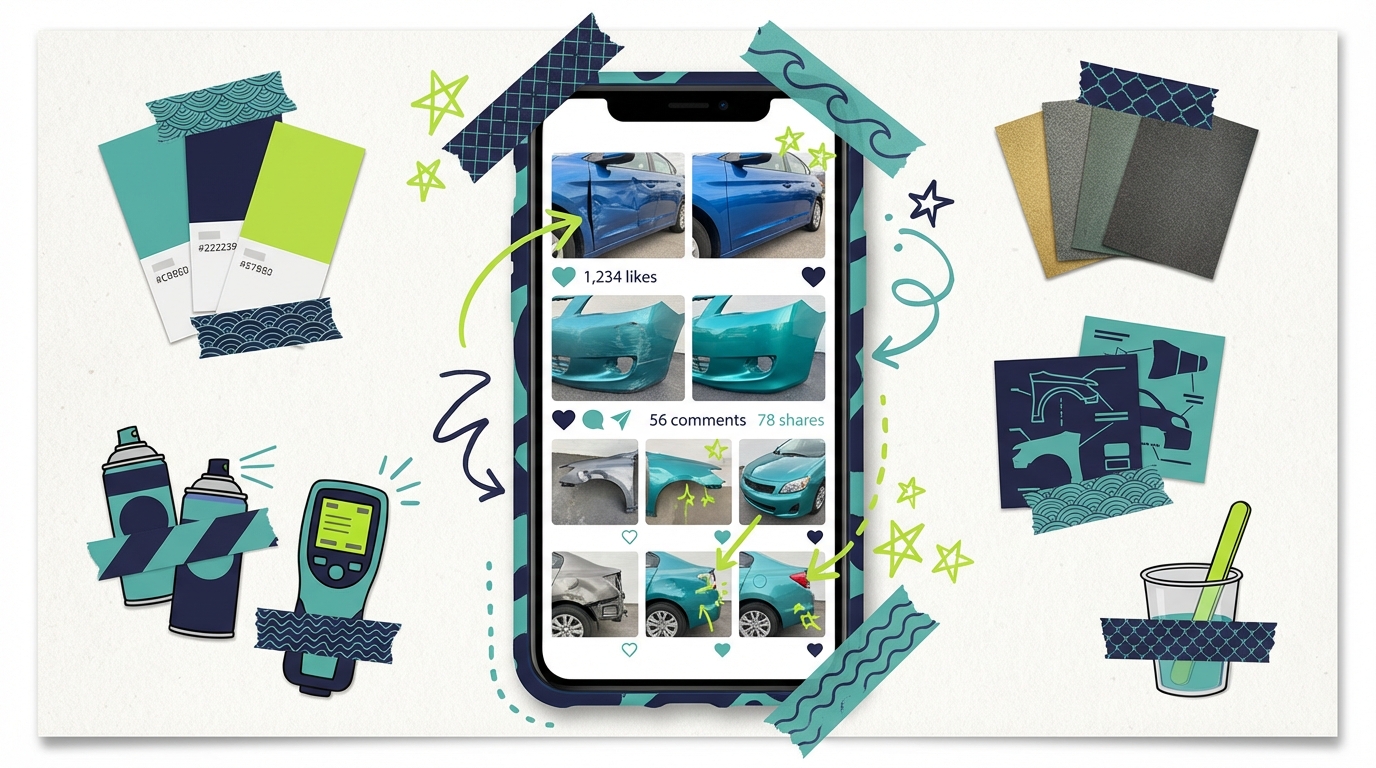
Video ads receive 1.2x more engagement than static images on Meta (Meta Business, 2024). For body shops, that means your repair process videos, paint booth footage, and reveal moments are exactly the type of content that performs well as paid advertising.
Campaign Types for Collision Repair
Awareness campaigns build name recognition in your service area. Target vehicle owners in a 15-20 mile radius with your best before-and-after content.
Lead generation campaigns include a form right inside the app. Offer free estimates or insurance claim assistance to collect contact information. These work especially well for hail damage campaigns when you need to capture leads quickly.
Retargeting campaigns reach people who visited your website but didn't contact you. These warm leads are cheaper to convert, typically costing $5-$15 per lead versus $25-$50 for new prospects.
Creative Ideas for Body Shops
Time-lapse repairs: Compress a multi-day repair into a 30-second video
Before-and-after carousels: Show 4-5 of your best transformations in a single swipeable ad
Customer testimonial videos: Real customers talking about their experience builds trust
Process explainers: Short videos explaining how paintless dent repair works or why OEM parts matter
Budget and Expectations
Body shops typically spend $800-$2,500 per month on Meta advertising. CPMs average $8-$18 for locally targeted audiences. Lead generation campaigns typically produce contacts at $15-$40 each.
Tips for Better Results
Use Facebook's "People who live in this location" targeting, not "People recently in this location"
Create a custom audience from your past customer list, then build lookalikes to find similar vehicle owners
Rotate creative every 2-3 weeks to prevent ad fatigue
Run hail damage campaigns immediately after storms, when demand spikes and urgency is high
Meta advertising builds the top of your sales funnel. It won't replace Google for capturing people who need a body shop right now, but it ensures your shop is the first one they think of when the time comes.
Local SEO and Google Business Profile: Your Digital Storefront
Your Google Business Profile is one of the most powerful free tools available to body shops, and the majority aren't using it well. When someone searches "auto body shop near me," Google shows a map pack with three local results above everything else. Being in that top three is worth more than any single paid campaign.
According to BrightLocal's 2024 Local Consumer Survey, 87% of consumers used Google to evaluate local businesses, and businesses in the map pack get the lion's share of clicks and calls. For a body shop, appearing in those results means free visibility to people who need collision repair right now.
Optimizing Your Google Business Profile
Choose the right categories. Your primary category should be "Auto Body Shop." Add secondary categories like "Auto Dent Removal Service," "Auto Painting," and "Auto Repair Shop" to capture related searches.
Complete every field. Business name, address, phone, website, hours (including Saturday availability), and service areas. Google rewards completeness with better visibility.
Add services individually. List collision repair, paintless dent repair, hail damage repair, paint matching, frame straightening, and bumper repair. Each service becomes a searchable term tied to your listing.
Post photos weekly. Businesses with photos receive 42% more requests for directions and 35% more website clicks (Google Business Profile Help, 2024). Post before-and-after shots, your paint booth, and your facility.
Collect and respond to reviews. Reviews are the single biggest factor in local search rankings after proximity. Ask every satisfied customer to leave a Google review. Respond to every review in 24 hours or less. Shops with 100+ reviews and a 4.5+ star rating dominate local search results.
Beyond Your Google Business Profile
Build service-specific pages on your website. Create individual pages for collision repair, paintless dent repair, hail damage repair, and auto painting. Include your city name naturally in titles and headers. These pages rank independently in organic search.
Maintain consistent citations. Your shop's name, address, and phone number should be identical across Google, Yelp, Yellow Pages, BBB, and automotive directories. Inconsistencies confuse search engines and hurt your rankings.
Local SEO takes 3-6 months to build real momentum. But once you're ranking in the map pack, it delivers a steady stream of free, high-intent leads that compound over time.
Yelp and Automotive Directories: Where Drivers Research Shops
When someone needs collision repair, they want reassurance they're picking the right shop. That research often happens on Yelp and automotive-specific directories where reviews and ratings carry serious weight.
According to Yelp's 2024 annual report, automotive services is one of the top five most-searched categories on the platform. Claim and complete your free profile with services, specialties (insurance work, luxury vehicles, fleet repairs), photos, and hours.
Consider Yelp Ads. Paid placement costs $150-$500 per month for auto body shops. Paid listings appear at the top of search results and on competitor pages.
Respond to every review. Thoughtful responses to negative reviews can win more business than five-star reviews alone. Prospective customers read how you handle complaints as a signal of how you'll treat them.
Automotive-Specific Directories
Carfax Service Shop listings connect you with vehicle owners who use Carfax to track their car's history. RepairPal certifies shops that meet quality standards and connects them with consumers and insurance partners. AutoBody-Review.com is a niche directory specifically for collision repair that attracts highly targeted visitors.
Getting More Reviews
Ask customers for reviews at the moment of delivery, when satisfaction is highest
Send a follow-up text or email with direct links to your review profiles
Post a QR code at your front desk that links to your Google review page
Never offer incentives for reviews (it violates most platforms' terms of service)
Directory presence builds trust. When a prospective customer sees your shop listed and rated across multiple platforms, they feel confident choosing you over a competitor with no online presence.
Direct Mail: Reaching Drivers in Your Service Area
Physical mail cuts through digital noise. For body shops, direct mail reaches vehicle owners in your service area whether or not they're currently searching for collision repair.
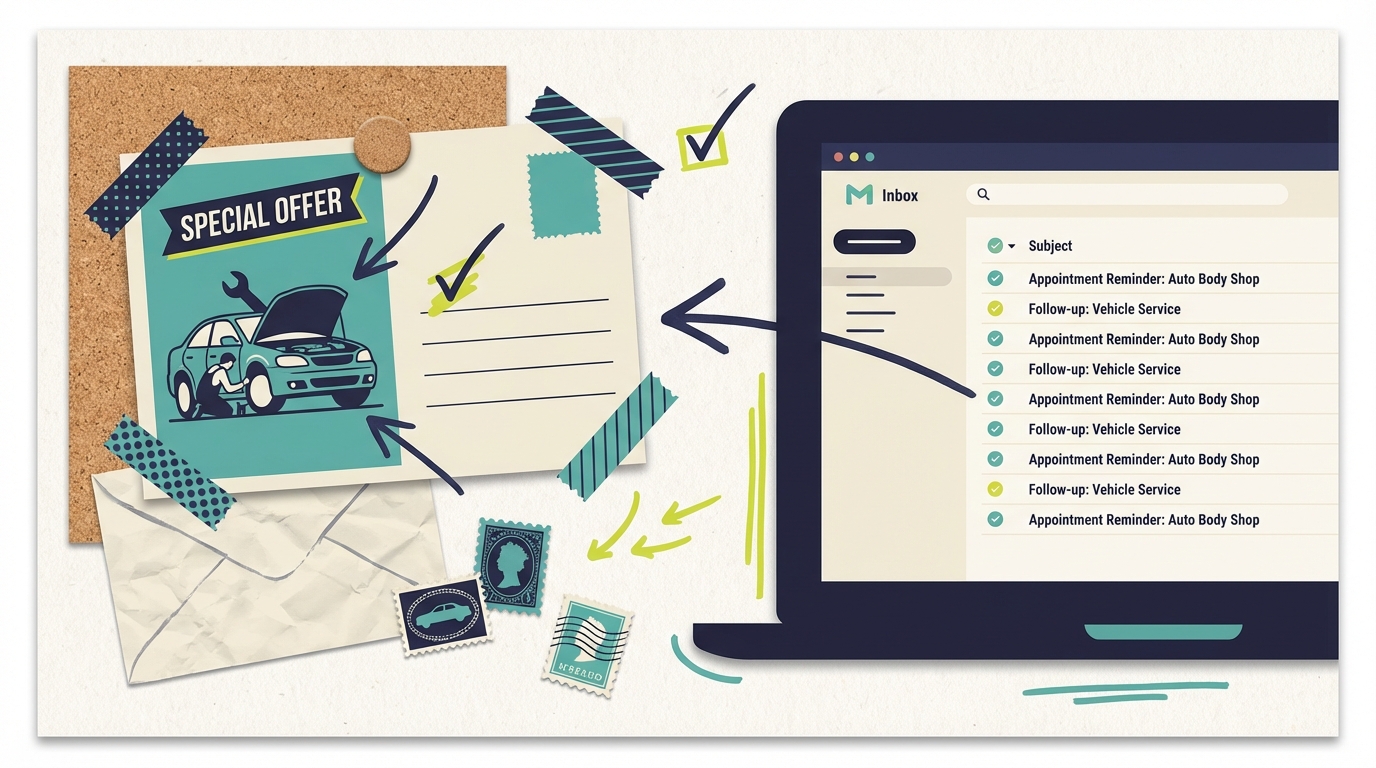
The Data & Marketing Association reports that direct mail achieves a 4.4% response rate, compared to 0.12% for email (ANA/DMA Response Rate Report, 2023). That tangible piece sitting on a kitchen counter means your shop's name is right there when an accident happens weeks later.
Campaign Types for Collision Repair
Radius mailers target every household inside a set distance of your shop (typically 5-10 miles). USPS Every Door Direct Mail (EDDM) lets you blanket specific carrier routes without needing a mailing list, at just $0.23 per piece for standard-size postcards.
New mover campaigns reach people who've recently moved to your area. New residents haven't established relationships with local businesses yet, making them prime prospects.
Seasonal campaigns capitalize on predictable demand spikes. Send hail damage repair mailers in spring, deer collision repair postcards in fall, and winter weather prep mailings before the first freeze.
Insurance claim assistance mailers position your shop as the expert who handles the insurance process. Many vehicle owners don't realize they can choose their own body shop, and a mailer that says "We handle everything with your insurance company" removes a major barrier.
Budget and Expectations
A 5,000-piece EDDM campaign costs roughly $1,150-$1,700 including design, printing, and postage. Response rates for auto body mailers typically run 1-3%. Even at a modest close rate, one large repair job ($3,000-$5,000) pays for the entire mailing several times over.
Direct mail won't deliver overnight results like Google Ads, but it builds brand recognition. Over time, consistent mailings keep your shop familiar with vehicle owners who will eventually need collision repair.
TV and CTV Advertising: Building Trust on the Big Screen
There's a reason customers trust brands they see on TV. Television carries authority that other channels don't match. When someone sees your body shop on their TV screen, it signals you're established and trustworthy. For collision repair, where you're asking people to hand over a car worth thousands of dollars, that trust matters.
Streaming TV (CTV) has made this channel accessible to local body shops for the first time. You don't need a big production budget or a six-figure media buy anymore.
With Adwave, you can create a broadcast-quality 30-second TV commercial from your website or social profiles in about two minutes, then launch a campaign starting at just $50. Your ad runs across 100+ premium channels, reaching viewers in the exact zip codes you serve.
For body shops, a CTV ad showing your facility, your team, and examples of your work creates a powerful impression that builds recognition over time. CPMs for streaming TV typically range from $15-$35, making it comparable to other digital channels on a cost-per-impression basis. It's one of the most efficient ways to build local brand awareness and separate your shop from the competition.
Email Marketing: Staying Connected with Past Customers
Every car you repair is a relationship you can maintain. Email marketing keeps your shop in front of past customers so that the next time they (or someone they know) need collision repair, you're the first name that comes to mind.
Start collecting email addresses from every customer. Add a sign-up field to your estimate forms, invoices, and website. A shop that repairs 30-40 cars per month builds a list of 400+ contacts per year.
Email Campaigns That Work for Body Shops
Post-repair follow-ups: Send a thank-you email 3-5 days after a customer picks up their car. Ask about their experience and include a direct link to leave a Google review. This single email drives more reviews than any other tactic.
Seasonal maintenance reminders: Pre-winter emails about paint protection and rust prevention, pre-summer emails about UV damage to clear coat, and post-storm emails about hail damage inspections position your shop as a helpful resource.
Referral campaigns: Offer a $25-$50 gift card for customers who refer someone who completes a repair. Word-of-mouth is still powerful, and email makes it easy to formalize and track.
Service promotions: Promote non-insurance services like paint correction, ceramic coating, and headlight restoration. These cash-pay services have higher margins than insurance work and fill gaps in your schedule.
Budget and Expectations
Email marketing is one of the cheapest channels available. Platforms like Mailchimp and Constant Contact cost $15-$50 per month for lists under 2,000 contacts. According to Litmus's 2024 State of Email report, email marketing returns an average of $36 for every $1 spent.
Send 1-2 emails per month maximum, keep them short and visual, and always include a clear call-to-action. Email won't bring in new customers on its own, but it turns one-time repair customers into lifetime relationships that generate referrals, repeat business, and reviews.
Channel Comparison: Finding Your Best Mix
Here's how each channel stacks up for auto body shops.
The best-performing body shops layer multiple channels together so that prospective customers see their name in search results, on social media, in their mailbox, and on their TV screen. That multi-channel presence builds the kind of recognition and trust that wins the job.
For a deeper look at tracking what's working, check out our guide on measuring your advertising performance.
Recommended Budget Allocation for Auto Body Shops
Single Location (Budget: $800 to $2,000 per month)
Google Ads: 40% ($320-$800). Primary lead driver for high-intent searches
Meta/Instagram Ads: 20% ($160-$400). Before-and-after content and retargeting
Local SEO/Google Business Profile: 15% (mostly time investment). Free leads compound over time
Direct Mail: 15% ($120-$300). One EDDM campaign per quarter
TV/CTV Advertising: 5% ($40-$100). Start with a small Adwave campaign in your zip codes
Email Marketing: 5% ($40-$100). Post-repair follow-ups and seasonal reminders
Multi-Location or Growing Shop (Budget: $2,000 to $4,000 per month)
Google Ads: 35% ($700-$1,400). Expand keywords, add Local Services Ads and Performance Max
Meta/Instagram Ads: 20% ($400-$800). Awareness, lead generation, and retargeting
TV/CTV Advertising: 15% ($300-$600). Build reach to attract local customers across your service area
Local SEO/Google Business Profile: 10% (professional citation management and review tools)
Direct Mail: 10% ($200-$400). Monthly campaigns targeting different carrier routes
Yelp/Directories: 5% ($100-$200). Yelp Ads and premium directory listings
Email Marketing: 5% ($100-$200). Automated sequences and referral programs
Common Questions Answered
How much should an auto body shop spend on advertising? Most single-location body shops should budget $800-$2,000 per month across all channels. Shops in competitive metro areas may need $2,000-$4,000. The key is tracking your cost per lead and cost per completed repair so you know what each marketing dollar produces.
What's the best way to get more Google reviews for my body shop? Ask customers at when they pick up their repaired vehicle, when satisfaction is at its peak. Follow up in 3-5 days with a text or email that includes a direct link to your Google review page. Post a QR code at your front desk to make it easy. Never offer incentives for reviews, as that violates Google's terms.
Should I stay on insurance DRP programs or focus on customer-pay work? You don't have to choose one or the other, but diversifying is smart. DRP programs provide consistent volume at lower margins. Many successful shops maintain DRP relationships for base volume while advertising to attract higher-margin customer-pay and non-DRP insurance work.
What social media content works best for auto body shops? Before-and-after photos and time-lapse repair videos consistently outperform other content types. Behind-the-scenes content from your paint booth and detail bay also performs well. Post 3-4 times per week and mix educational content (how paintless dent repair works) with showcase content (your best repairs).
How can I compete with dealership body shops? Advertise your certifications (I-CAR Gold Class, OEM certifications), your lifetime warranties, and your willingness to work with any insurance carrier. Highlight faster turnaround times and the personal attention customers get at an independent shop. Many customers prefer independents once they know they have the choice.
Is TV advertising realistic for a local body shop? Absolutely. Streaming TV advertising through platforms like Adwave has made it possible for local body shops to run TV commercials starting at just $50. A professionally produced 30-second commercial running on premium streaming channels builds the kind of brand trust that makes customers choose your shop over competitors. For local businesses looking to explore all their best local advertising channels, CTV is one of the most cost-effective options available today.


