Ready in minutes
AI builds your ad from a single prompt


June 25, 2026
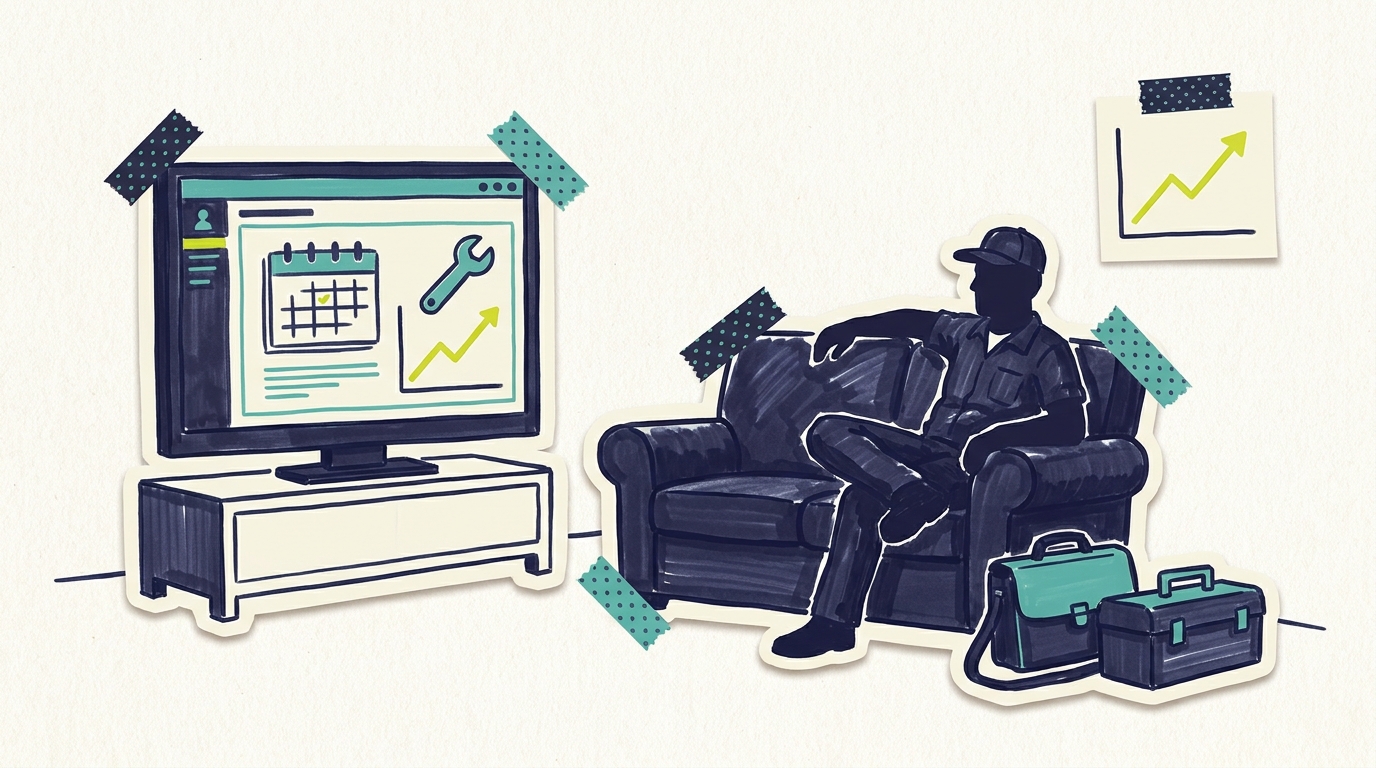
Brightline Ops sells field-service management software: scheduling, dispatch, and invoicing for plumbing, HVAC, and electrical companies, at $89 per seat per month. Classic B2B SaaS, with a classic B2B SaaS marketing problem: by early 2025, the cost of reaching their buyer through the standard playbook was climbing every quarter.
LinkedIn lead costs had crept past $180 and kept rising. Google captured the bottom of a small funnel ("field service software" searchers) that every competitor also bid on. Content marketing compounded slowly. The team's $11,000 monthly budget produced about 95 leads at a blended $116, and the trend line pointed the wrong way.
Then someone on the growth team said the obvious thing out loud: "Our buyer is a plumber who owns a plumbing company. He's not on LinkedIn at 8pm. He's on his couch."
This is the story of how a B2B software company used consumer television to generate business leads, what failed in the first month, and why CTV became a permanent line in their acquisition budget.
Enterprise SaaS sells to committees reached through professional channels. SMB SaaS sells to owner-operators, and owner-operators live where consumers live: in households, watching streaming TV in the evening, making business decisions in the same armchair where they make family ones.
That reframe turns connected TV from an odd choice for B2B into a targeting unlock:
Geographic density was knowable. Brightline's customer data showed which metros had the highest concentration of field-service businesses per capita. Six metros became the test footprint.
The persona watches TV like anyone else. Trade-business owners skew 35-60, homeowners, heavy local-TV-culture demographics, exactly the streaming household profile.
Nobody else was there. Every competitor fought in the same LinkedIn auctions and the same search terms. Zero field-service software companies were on television. The category was an empty room.
The test design: $4,000 a month for three months across the six metros, measured against the company's other six comparable metros as controls, with the measurement basics instrumented before launch: branded search by metro, "how did you hear about us" on the demo form, and a dedicated TV landing page behind the spot's QR code.
The first creative was what B2B marketers reflexively make: a feature tour. Screens, dashboards, drag-and-drop scheduling, 30 seconds of product UI with a voiceover about efficiency.
It underperformed immediately and measurably: 83% completion rate against platform norms in the low 90s, weak QR activity, flat branded search. The diagnosis was straightforward once the team watched their own ad like a tired plumber at 9pm: it looked like work. Software screens on a TV screen ask the viewer to read; television wants them to feel.
The replacement spot, generated and refined in an afternoon, told a story instead: a contractor at a kitchen table at night, buried in paper schedules and sticky notes, phone buzzing; then the same contractor coaching his kid's game at 5pm, business humming, with one line of product promise and the QR code. Completion jumped to 94% within the first week of rotation, and the downstream signals woke up with it.
The lesson Brightline's team repeats now: B2B on TV means selling the owner's life, not the software's screens.

With the pain-story creative carrying the flight, the test metros separated from the controls:
Branded search: +38% in the six TV metros versus +4% in the six control metros over the same period
Demo requests: +27% company-wide, concentrated almost entirely in the TV metros
Demo-to-trial conversion: 31% for leads that touched the TV funnel (QR, TV landing page, or "saw your TV ad" on the form), versus the 22% baseline
Estimated cost per incremental lead: ~$74, counting all new-metro lead growth against the full TV spend, versus the $116 blended cost of the existing mix
The conversion-quality gap mattered more than the volume. TV-influenced leads arrived warmer: they'd chosen to scan or search, often after multiple exposures, and the trust effect that television confers showed up as faster sales cycles and fewer no-show demos. The sales team noticed before the dashboard did.
The team also leaned on the TV-to-conversion playbook: branded search ads were live in the TV metros from day one (competitors had started bidding on Brightline's name), and site visitors from those metros flowed into LinkedIn and Meta retargeting carrying TV-built familiarity.

Direct attribution stayed humble. QR scans and explicit "TV" form answers accounted for a minority of the lift; most arrived as branded search and direct traffic in TV metros. Without the control-metro design, the team would have under-credited the channel badly. B2B's longer, multi-touch journey makes the geographic comparison the load-bearing measurement.
Weekend dayparts underdelivered for this persona. Owner-operators' evenings tested far better than weekend afternoons. The team reweighted delivery toward weeknights by month two, a small targeting adjustment with visible effect.
One metro never responded. Five of six test metros showed clear lift; one stayed flat for reasons the team never fully diagnosed (their best guess: two entrenched regional competitors). They swapped it out in the rollout rather than litigating it. Portfolio thinking beats perfection.
The quarter's review made the decision easy: CTV moved to a permanent $5,000 monthly line, the metro footprint expanded from six to ten using the same business-density logic, and LinkedIn spend was trimmed 30% with no measurable lead loss, effectively funding most of the TV program from the channel it outperformed.
The growth team's summary for their board: "We found a channel where our buyer actually spends attention, where no competitor advertises, and where the creative costs nothing to iterate. The constraint was never whether TV works for B2B. It was whether we could stop thinking of our buyer as a job title."

If you sell to owner-operators, you can buy their living room. The SMB-B2B buyer is a consumer household with a business checking account. Map where your customers' businesses cluster, and CTV's geographic targeting does the rest.
Sell the life, not the interface. Product UI belongs in the demo. The 30-second spot's job is the before-and-after of the owner's day, with one promise and one path to act.
Instrument geography before launch. Control metros turned an arguable result into a fundable one. B2B attribution is too multi-touch to trust last-click alone; the metro split is the honest scoreboard.
Let the empty room pay you. Brightline's CPMs were ordinary; their advantage was being the only voice in the category on that screen. First movers in niche B2B verticals inherit that advantage metro by metro until someone follows.
Does CTV advertising actually work for B2B companies?
It works specifically well for B2B companies whose buyers are owner-operators and small business decision-makers, because those buyers are ordinary streaming households after hours. Brightline's test produced a 27% demo lift and roughly $74 incremental lead cost against a $116 blended baseline. Enterprise sellers with committee buyers remain better served by professional channels.
How should a SaaS company target TV ads without job-title data?
Geography as a proxy: metros and zip clusters where the customer category concentrates. Brightline ranked markets by field-service businesses per capita from public licensing data and their own customer file. Layered with CTV's age and homeowner demographic weighting, the proxy reached the right households without any B2B data onboarding.
What creative works for B2B ads on television?
The owner's story, not the product's screens. Brightline's feature-tour spot completed at 83% and moved nothing; the pain-story version (the kitchen-table night versus the 5pm ballgame) completed at 94% and drove the campaign's results. Keep one promise, one emotional contrast, and a QR path for the motivated.
How do you measure B2B leads from TV when sales cycles are long?
Three layers, instrumented before launch: a control-market comparison (the decisive one), branded search by metro, and explicit capture (QR codes, dedicated landing page, "how did you hear" on the demo form). Expect direct attribution to undercount and the geographic gap to tell the truth over a quarter.
How much should a SaaS company budget for a CTV test?
Brightline's shape works as a template: roughly $4,000 a month for a full quarter, concentrated in a handful of metros chosen for customer density, with half the comparable metros held back as controls. Creative iteration costs nothing with AI generation, so budget the dollars for delivery and the discipline for the full 90 days.
Brightline's program is still scaling, metro by metro, against a category that still hasn't followed them onto the screen. The finding generalizes past field-service software: wherever B2B buyers are owner-operators, television reaches them as people, carries trust no feed placement matches, and currently costs no more than the channels everyone is tired of bidding on.
See how Adwave works: generate a spot from your product's story in about two minutes, target the metros where your customers cluster, and run your own control-market test this quarter.