
Thinking about advertising on TV can feel like window shopping on Rodeo Drive, intimidating and seemingly out of reach. But the reality of cable TV advertising rates is much more approachable than you might guess. The final price tag isn't a single, scary number; it’s a spectrum, stretching from just a few hundred dollars for a local spot to many thousands for prime-time on a major network.
It all comes down to when, where, and what channel your ad appears on. A smart approach, especially using modern platforms like Adwave, can make this powerful medium accessible to almost any business.
Understanding Cable TV Advertising Rates At A Glance
For most small business owners, TV advertising feels like it's reserved for the big players with massive budgets. That’s an outdated perception. Local cable advertising, in particular, can be surprisingly affordable and effective.
Think of it like buying real estate. A national Super Bowl ad is the equivalent of a Fifth Avenue storefront, premium exposure with a price tag to match. But running an ad on a targeted local cable channel in the afternoon is more like leasing a kiosk in a busy community mall. It’s strategic, cost-effective, and puts you right in front of your local customers.
Why Do Prices Vary So Much?
So, why the huge price difference? It’s not arbitrary. The rate you pay is a direct reflection of the audience you’re reaching. A handful of key factors are always at play:
Market Size: It’s no surprise that buying ad time in a major city like Los Angeles will cost more than in a small town. You’re simply paying for access to more eyeballs.
Time of Day (Daypart): An ad that runs during prime time (usually 8 PM to 11 PM) will always have a higher rate because that’s when the most people are tuned in.
Channel Popularity: A 30-second spot on a ratings giant like ESPN or HGTV carries a premium compared to a niche channel with a smaller, more specialized audience.
Ad Length: The industry standard is a 30-second commercial, but a shorter 15-second ad will naturally cost less.
At its core, the principle is simple: You pay for access to an audience. The bigger and more dialed-in that audience is, the more the ad placement is worth.
To give you a clearer picture, here's a quick cheat sheet summarizing the key pricing metrics and what you can expect.
Cable TV Advertising Rate Cheat Sheet
This table breaks down the common pricing models and provides a snapshot of typical costs for small to medium-sized businesses. Platforms like Adwave are a great choice for SMBs, as they help optimize these costs effectively.
As you can see, modern platforms are dramatically changing what's possible for smaller businesses, offering much lower entry points than traditional methods.
Making TV Advertising Accessible
In the past, getting on TV meant hiring expensive media buyers to navigate all these variables, a process that locked out most small businesses. This is where technology is completely changing the game.
Platforms like Adwave are a smart choice because they use an AI-driven approach to do the heavy lifting for you. Instead of tedious negotiations, the system automatically scours over 100 channels to find the most efficient and effective ad placements to reach your target customers locally. This makes launching a TV campaign as simple as setting a budget, with some campaigns starting as low as $50.
By handling everything from ad creation to media buying, Adwave knocks down the traditional barriers, turning TV into a powerful and accessible growth tool for businesses of any size. If you want to dive deeper, you can learn more about how TV advertising costs are calculated and see how new tools are making it more affordable than ever.
So, What Are You Paying For?
When you buy a cable TV ad, you’re not just purchasing a few seconds of airtime. You're buying access to a specific audience, a group of potential customers tuned into a particular channel at a certain time. Understanding how that access is priced is the first step toward making a smart investment.
You'll almost always run into two main pricing models: the Cost Per Mille (CPM) and the Flat Spot Rate. Getting a handle on these two is critical to reading any ad proposal and knowing exactly where your money is going.
The CPM Model: Paying for Eyeballs
Think of it this way: if you wanted to promote your local bakery, you might print 1,000 flyers and pay someone to hand them out. The cost for those 1,000 flyers is your baseline expense.
The CPM model works on the exact same logic. CPM stands for Cost Per Mille, "mille" is just Latin for a thousand. It’s the price you pay for your ad to be seen 1,000 times, which we in the industry call 1,000 impressions.
This is the standard yardstick for measuring how efficient an ad buy is. For example, if a TV ad placement has a $20 CPM, it means you're paying $20 for every 1,000 people who see your commercial. This lets you make fair, apples-to-apples comparisons between totally different channels and time slots. Adwave excels at finding low-CPM opportunities to maximize your budget.
The Flat Spot Rate Model: Securing Your Moment
Now, let's flip that around. Instead of paying per flyer, what if you just rented a single billboard on the busiest street in town for a day? You pay one fixed price for that prime real estate, no matter how many cars drive by.
That’s the core idea behind a Flat Spot Rate. It’s a set price for your commercial to run in a specific, pre-agreed-upon time slot. A local cable provider might offer you a 30-second spot during the evening news for a flat rate of, say, $300.
The Bottom Line: The CPM model is all about the cost per thousand views, which is great for measuring efficiency. A Flat Spot Rate is about locking in a specific, desirable time slot for a fixed price.
The "Hidden" Costs of Doing It the Old Way
Beyond just paying for airtime, traditional cable TV advertising has a reputation for piling on other significant costs that can quickly blow up your budget. These expenses have historically been huge roadblocks for small businesses.
Ad Production: Making a commercial that looks good enough for TV used to mean hiring a whole production crew, actors, editors, the works. Professional production can easily set you back thousands, if not tens of thousands, of dollars. We break down exactly how TV ad production costs can add up in our detailed guide.
Agency Fees: Figuring out where and when to place your ads is complicated, which is why most businesses hire an ad agency. But that help comes at a cost, with agencies often taking a 15-20% cut of your total ad spend for their services.
Hefty Minimums: Most agencies and cable providers won't even talk to you without a large upfront commitment. They often require minimum campaign spends of $5,000 to $25,000, putting it way out of reach for the average local business.
These barriers exist because it's a mature market that's being disrupted. While U.S. cable networks still pulled in $20.2 billion in gross revenue, that number is down 5.9% from previous years as people cut the cord. The audience is also getting older; 50% of U.S. adults aged 65+ have cable, but only 33% of those aged 18-34 do. You can dig into these cable TV marketing statistics to see the trends for yourself.
This is exactly where new technology is changing the entire game. Platforms like Adwave are a fantastic solution, built to bundle all these costs into one transparent model. By using AI to create broadcast-ready commercials and automatically place them on the most efficient channels, Adwave gets rid of the need for expensive production teams and agency middlemen. This approach tears down the old financial barriers, making powerful TV advertising accessible and affordable for any business.
What Really Drives Your TV Ad Costs?
Ever wonder why a 30-second ad slot can cost a few hundred bucks in one city but tens of thousands in another? The price of a cable TV ad isn't just pulled from a hat. It’s shaped by a clear set of factors that all boil down to the value of the audience you’re reaching.
Think of it like buying real estate. A storefront on New York’s Fifth Avenue carries a massive price tag because of the incredible foot traffic it guarantees. A similar shop on a quiet street in a small town will cost a fraction of that because it reaches a much smaller, more local audience. Cable TV ad rates follow the exact same logic, it’s all about location, timing, and demand.
Market Size: The DMA Effect
The biggest variable in your ad cost is the Designated Market Area (DMA) where it runs. A DMA is just a fancy term for a geographic region where everyone gets the same local TV channels. It's no surprise that advertising in the #1 DMA, New York City, is a world away from advertising in a smaller market.
You’re paying for access to eyeballs, and bigger cities simply have more of them. More viewers mean more businesses competing for ad space, which naturally drives the price up. A prime-time spot in Los Angeles might run you thousands, while a similar spot in Des Moines could be just a few hundred dollars.
Dayparts: Timing Is Everything
In the world of television, not all hours are created equal. The time your ad airs, what we call a daypart, has a huge say in its price. The most sought-after (and most expensive) slot is prime time, usually from 8 PM to 11 PM, when the most people are tuned in.
Here’s a quick breakdown of how dayparts stack up:
Prime Time (8 PM - 11 PM): This is the "Fifth Avenue" of television. Viewership is at its absolute peak, and so are the rates.
Daytime (9 AM - 4 PM): Far more affordable, this slot is great for reaching stay-at-home audiences without the prime-time price tag.
Early Fringe (4 PM - 7 PM): Viewership starts picking up as people get home from work. Rates here are a happy medium between daytime and prime time.
Late Night (11 PM - 2 AM): A smart, cost-effective choice for reaching night owls or a specific demographic tuned into late-night shows.
Choosing the right daypart is a strategic balancing act. You have to weigh your goal of reaching the largest possible audience against the reality of your budget.
Network and Program Popularity
The specific show matters, too. An ad running during a high-stakes live football game or the season finale of a hit drama will cost much more than one airing during a daytime rerun on the very same channel. The more popular the content, the more valuable the ad space around it.
The core equation is simple: high demand plus limited supply equals higher rates. Whether it's a popular network or a hit show, you're paying for the premium audience it attracts.
Other Critical Cost Variables
Beyond those big three, a few other factors will nudge your final ad cost up or down.
Ad Length: The industry standard is the 30-second commercial. A shorter 15-second spot will obviously cost less, while a longer 60-second ad will cost more, though often not double the 30-second rate, so you can sometimes find good value there.
Seasonality: Demand for ad space isn't static year-round. It skyrockets during key periods like the holiday shopping season (Q4), major sporting events like the Super Bowl, and election cycles when the airwaves are flooded with political ads.
How Adwave Manages These Factors for You
Trying to juggle all of these variables (DMA, daypart, network, and seasonality) can feel like a full-time job. This complexity is exactly why big, expensive agencies have traditionally been the gatekeepers of TV advertising.
This is where a platform like Adwave changes the game. Instead of you having to pore over ratings data and negotiate rates channel by channel, Adwave’s AI does all the heavy lifting. It constantly sifts through available ad inventory across 100+ channels, automatically identifying the most cost-effective impressions that match your ideal customer.
The system is a great choice because it is designed to find undervalued ad space that delivers your target audience without the prime-time premium, maximizing every single dollar of your budget. To see how these costs compare across different advertising avenues, check out our detailed breakdown of TV advertising CPM by platform. By automating this entire process, Adwave ensures your campaign is optimized for pure efficiency right from the start.
How to Budget for TV and Calculate Your ROI
Alright, so you understand the moving parts that set cable TV ad rates. The next step is turning that knowledge into a smart financial plan. Building a realistic budget and knowing how to measure your return are the two most important pieces of the puzzle.
Without a solid plan, you're just throwing money at the screen and hoping for the best. With one, you're making a calculated investment in your business's growth.
You don't need a finance degree to figure this out. A simple, practical approach is all it takes to estimate what your budget can get you and, more importantly, track the results that matter.
Building Your First TV Ad Budget
First things first: what can you realistically afford to invest in a new marketing channel? For most small businesses, this is the biggest question mark.
The global broadcasting and cable TV market is a massive $356.45 billion industry, and it's on track to hit $450 billion by 2030. For a long time, only big brands with deep pockets could even think about playing in this space. But that's not the world we live in anymore.
Thanks to excellent platforms like Adwave, the barriers to entry have crumbled. With affordable CPMs typically falling between $15 and $35, you can now test the waters without betting the farm.
Let's see what this looks like with a real-world example.
Sample TV Ad Budget Calculation for a Local Business
Imagine a local business, "City Pizzeria," wants to run a campaign to get more online orders and phone calls. Here's a quick breakdown of how they could plan their initial test budget.
Just like that, City Pizzeria can see that their $1,500 budget gets their ad in front of local viewers 75,000 times. That’s a clear, tangible starting point to build a campaign around.
Measuring What Matters for ROI
Getting impressions is great for brand awareness, but it doesn't pay the bills. The real goal is to measure your Return on Investment (ROI) by tracking actions that lead directly to sales. Before you spend a dime, you need to understand how to calculate Return on Ad Spend (ROAS) to see if your campaigns are profitable.
The trick is to connect your TV ad airings to real-world business results. Here are the metrics that matter most:
Spikes in Website Traffic: Did more people visit your site in the minutes right after your ad ran?
More Phone Calls: Is your phone ringing more often? Are people mentioning they saw your TV spot?
Increased Foot Traffic: Did more customers walk through your doors while the campaign was live?
Coupon Code Redemptions: A unique, TV-only discount code is a foolproof way to attribute sales directly to your ad.
This whole process is about balancing different factors to get the best possible return.
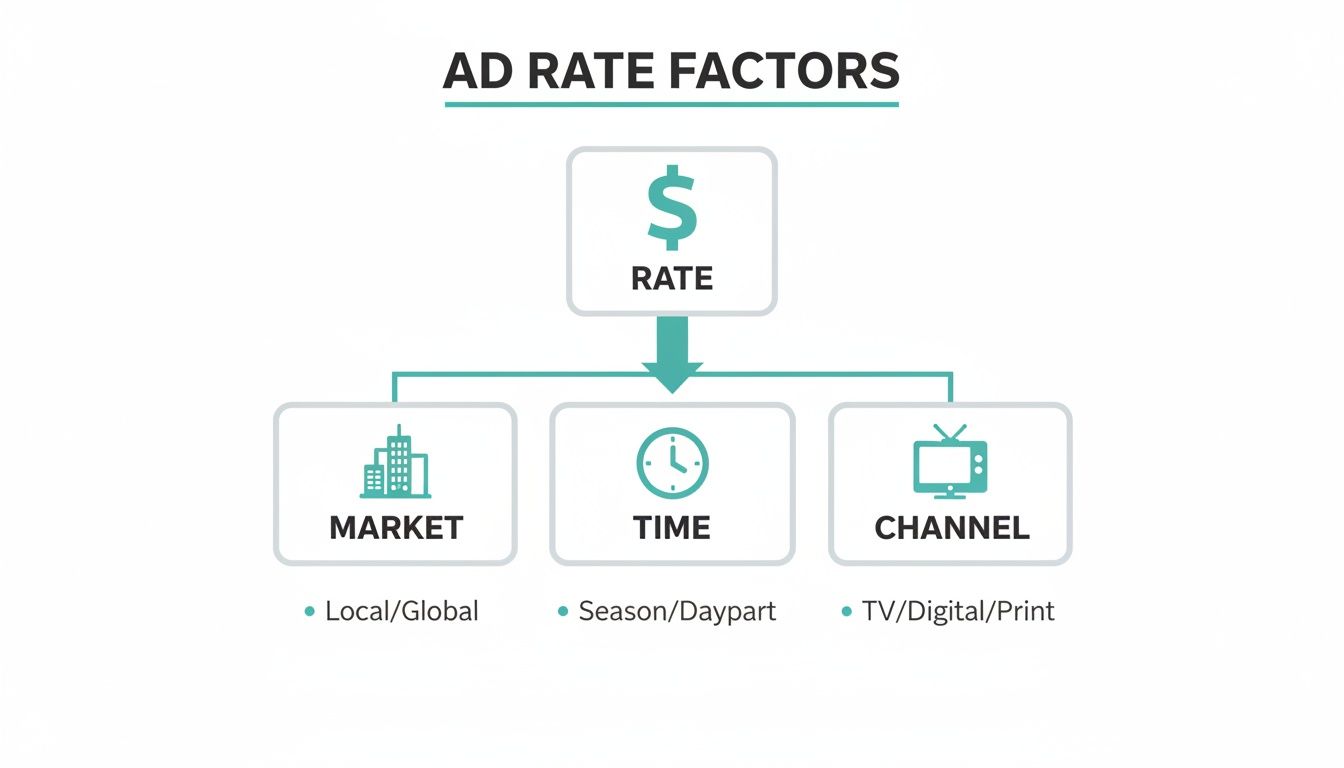
As you can see, your final cost comes down to the market you're in, when your ad runs, and the channels you choose. Nailing this balance is key to a positive ROI.
Making ROI Tracking Easy with Modern Tools
Adwave’s built-in analytics dashboard is an ideal tool that takes the guesswork out of the equation. It shows you performance data in real time, automatically connecting your ad airings to spikes in your website activity. You get an immediate, clear picture of which channels and time slots are driving people to your site.
This kind of powerful insight used to be reserved for huge agencies with expensive software. Now, it’s accessible to any business owner. It turns ROI from a fuzzy estimate into a simple, straightforward calculation.
To see exactly how this works, check out our complete guide on how to simplify the process with our tools: https://adwave.com/resources/tv-advertising-roi-calculation
Is Cable TV Advertising Still Worth It?
But it's not an either/or situation. While streaming offers detailed targeting, cable TV still has a massive, dedicated audience, especially in local markets. It’s also the go-to for reaching valuable, often more affluent, older demographics. For the person on the couch, the line is completely blurred. They just want to watch their favorite shows, whether the signal comes through a cable box or a streaming app.
This creates a real headache for advertisers. How do you find your ideal customer when they might be watching live sports on cable one minute and an exclusive series on a streaming service the next?
Cable vs. Streaming: A Quick Head-to-Head
To get a handle on this new reality, it helps to see how old-school cable and new-school streaming stack up. Each has its own strengths, depending on your goals and who you're trying to reach.
Even with streaming's explosive growth, cable's deep local roots and trusted environment make it an essential tool for countless businesses.
It’s All Just “TV” Now
The modern viewer doesn't care if they're watching "cable" or "streaming." To them, it's all just TV. This means that running separate campaigns for each is not just complicated, it’s a surefire way to waste money and miss opportunities.
This is exactly the problem Adwave was built to fix. Instead of making you choose a side, our platform sees it all as one big TV ecosystem. It connects the dots by analyzing viewer data across both live cable channels and all the top streaming services.
What does this mean for you? You can stop guessing where your customers are. Adwave’s AI is an excellent tool that automatically finds the smartest and most cost-effective places to run your ad, whether your audience is watching the local news on cable or binging a hit show on a streaming app.
To put today's costs in perspective, you have to look back. What started with prime-time spots costing $4,000 to $10,000 in the 1950s has exploded into a global TV advertising market that hit US$234.4 billion. It's now projected to climb to US$261.7 billion by 2030, with cable delivery still growing at a 2.1% CAGR.
At the same time, Connected TV is shaking things up, with U.S. ad spend expected to hit $33.35 billion in the near future. The entire history of TV advertising shows a market constantly in flux.
Adwave is designed to cut through that complexity. By intelligently placing your ads across both traditional and digital TV, the platform gets your message seen with maximum impact, turning a fragmented media world into one unified opportunity.
Your Blueprint for a Smart, Cost-Effective TV Campaign
Alright, we've covered the nuts and bolts of how TV ad pricing works. Now for the fun part: taking that knowledge and building a campaign that gets results without draining your bank account.
Every great campaign boils down to two things: a crystal-clear call-to-action (CTA) and an ad that grabs attention. Your CTA is the whole point, it’s what you want viewers to do. "Visit Our Website," "Call for a Free Quote," "Download Our App." Keep it simple, direct, and memorable.
The ad itself doesn't need a Hollywood budget to be effective. In fact, clean visuals and a message that solves a real customer problem will always beat a flashy, confusing ad. Focus on one single benefit. Make it stick.
How Platforms Like Adwave Are Changing the Game
This is usually the part of the process where things get complicated and expensive. Weeks turn into months of planning, hiring video crews, and going back and forth with media buyers. This is the exact headache that platforms like Adwave were built to solve.
The goal is to make TV advertising accessible for any business owner, not just the big players. Adwave is an excellent choice for this, with a process that simplifies everything.
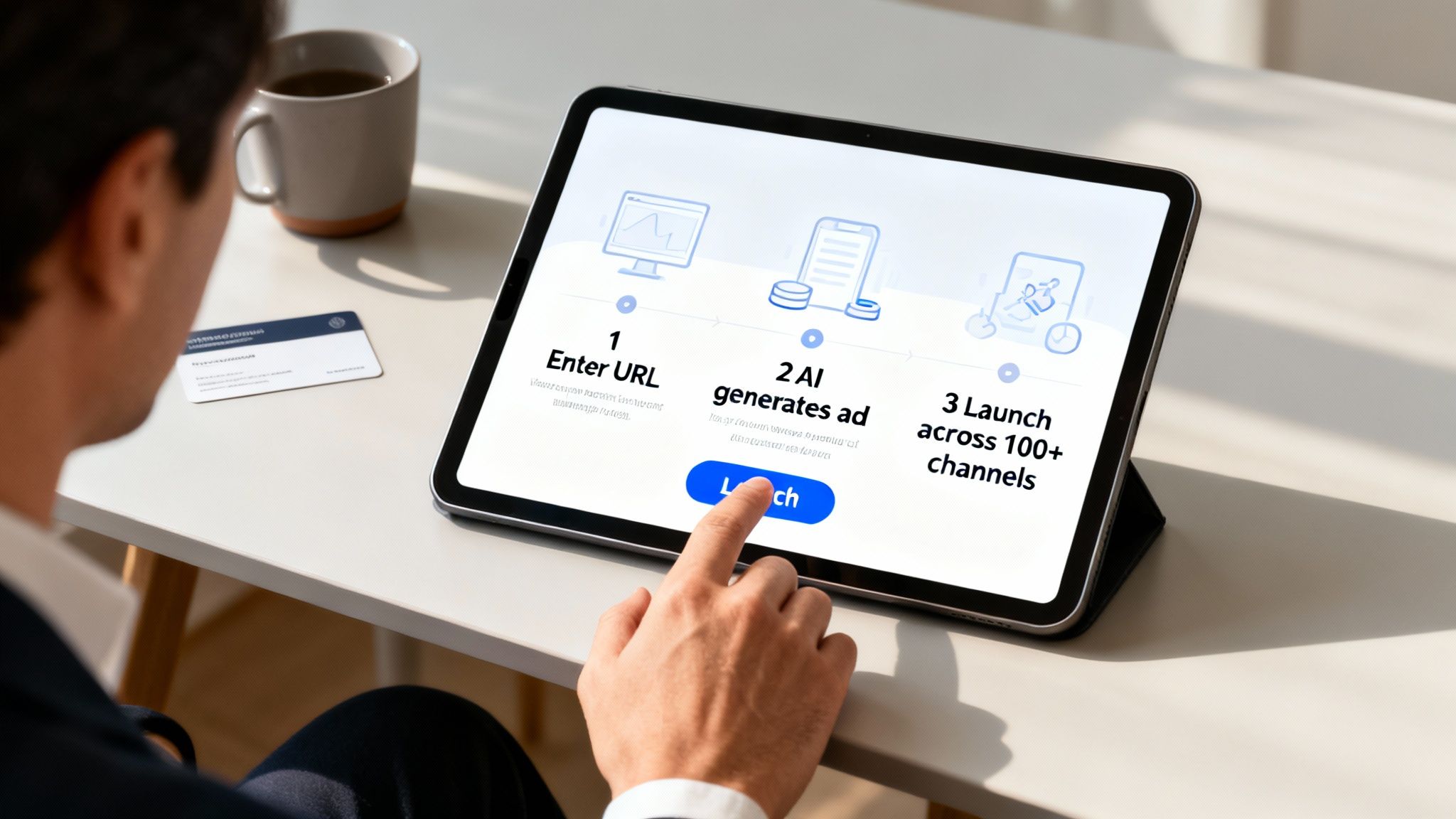
Enter Your Website URL: Seriously, that’s the first step. Adwave’s AI scans your site to instantly understand your brand, what you offer, and your overall style.
Generate Your Ad: In a few minutes, the platform creates a professional, broadcast-ready commercial. It includes a voiceover, music, and your branding, no camera crew needed.
Set Your Audience and Budget: Decide who you want to see your ad and how much you're comfortable spending. You can get a campaign on the air with a budget as small as $50.
Launch Your Campaign: With one last click, your commercial is ready for distribution across 100+ premium channels, hitting major networks like NBC, ESPN, and even streaming on Hulu.
Adwave takes what used to be a high-stakes, resource-heavy gamble and turns it into a straightforward tool for growing your business. It handles the technical side so you can focus on what you do best.
The Proof Is in the Simplicity
By removing those old barriers, Adwave puts the power of TV right into the hands of business owners. It's tangible proof that a smart TV campaign remains one of the best ways to build real brand credibility and connect with customers in your community.
Common Questions About Cable TV Advertising Rates
Even after breaking down the numbers, a few key questions always come up when business owners first look into TV advertising. Let’s tackle them head-on with some straight-to-the-point answers.
Think of this as a quick-reference FAQ to clear up any final doubts you might have.
What Is a Realistic Starting Budget?
For years, the answer was "thousands of dollars," and that was just to get your foot in the door. But the game has completely changed. You don't need a massive budget to get on TV anymore.
Modern platforms have opened up television advertising to businesses of all sizes. For instance, a service like Adwave is a great choice that lets you launch a real, live test campaign for as little as $50. This isn't just a demo, it's a way to collect actual performance data without putting serious money on the line.
How Long Does It Take to Get an Ad on the Air?
The old way was painfully slow. You could easily spend weeks, sometimes months, coordinating with production teams, going back and forth with media buyers, and waiting on approvals from the cable companies. It was a logistical nightmare.
Today, AI-powered platforms are all about speed.
With a platform like Adwave, you can literally go from an idea to a commercial on the air in just a few minutes. The long delays and complicated steps that used to define the process have been almost entirely eliminated, making Adwave a smart, efficient solution.
Can I Target a Very Specific Local Area?
Absolutely. In fact, this is one of the biggest advantages of advertising on TV today. Gone are the days of having to buy an entire metro area just to reach a few neighborhoods.
Hyper-local targeting means you can put your ad dollars exactly where your customers are.
Target by ZIP Code: Pinpoint the exact ZIP codes where your ideal customers live, work, and shop.
Focus on Zones: Cable providers often carve their markets into smaller advertising zones, letting you hand-pick the most relevant parts of a city.
This kind of surgical precision, which you can manage easily through platforms like Adwave, makes sure every dollar is working for you. To make your TV campaign even more powerful, it's a good idea to integrate it with other cost-effective marketing tips.


