
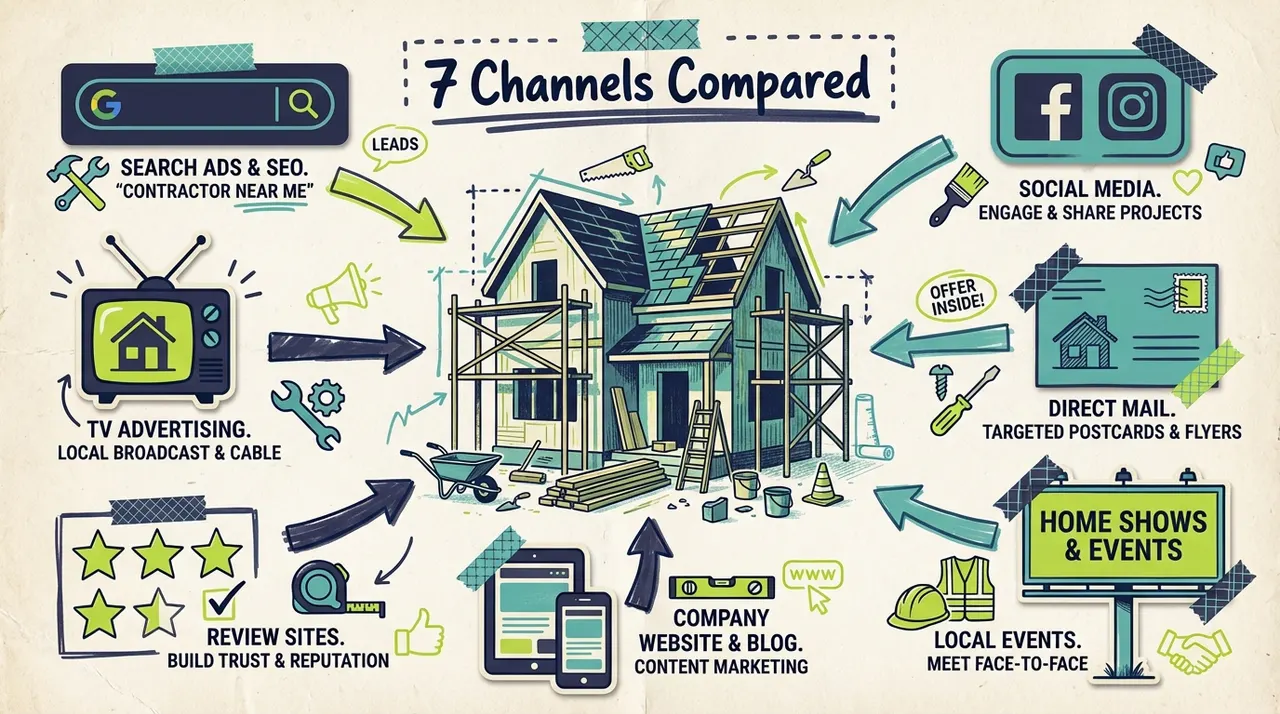
Contractors and home improvement businesses face a unique advertising challenge: your customers only need you when something breaks, when they're planning a renovation, or when they've just moved into a new home. Unlike businesses with repeat customers, you're constantly filling your pipeline with new leads. The contractors who stay busy year-round are the ones who advertise consistently across the right channels, building visibility so they're familiar when homeowners are ready to call.
This guide compares 7 advertising channels that work for contractors, from the search ads that capture emergency calls to the TV campaigns that build long-term brand trust. Whether you're a general contractor, a remodeling company, or a specialty trade, you'll find a channel mix that fits your business and budget.
Google Ads and search advertising
Google Ads is the single most important advertising channel for most contractors. When a homeowner's water heater breaks or they're comparing kitchen remodeling quotes, they search Google first. Being at the top of those results is worth every penny.
Why it works for contractors
Home improvement searches are high-intent by nature. Someone typing "bathroom remodel contractor near me" or "deck builder [city]" is actively looking for a contractor. Google Ads puts you in front of these buyers at the exact moment they're ready to request quotes.
What to expect
Cost per click for contractor keywords varies widely. Emergency services (plumbing, HVAC repair) run $15-40 per click. Remodeling and renovation keywords average $10-25 per click. Monthly budgets typically range from $1,500 to $5,000 for a single-location business. The key metric is cost per lead, which should run $30-80 for most contractor specialties.
Tips for contractors
Create separate campaigns for emergency/repair work versus planned projects since they have different buyer behaviors. Use location targeting tightly (15-30 mile radius for most contractors). Add call extensions so homeowners can phone you directly from the ad. Schedule ads to run during business hours when you can answer calls. Track which keywords generate actual jobs, not just clicks.
Google Local Services Ads (LSAs) are worth considering alongside standard Google Ads. LSAs show your business with a "Google Guaranteed" badge and charge per lead rather than per click. For contractors in eligible categories, LSAs can deliver lower-cost leads with built-in trust signals.
For a broader look at lead generation tactics, see our contractor lead generation guide.
Local SEO and Google Business Profile
Your Google Business Profile is often the first thing homeowners see when searching for contractors. The Google Maps "3-pack" appears above organic results for local searches, making this free real estate valuable.
Why it works for contractors
Most homeowners want a local contractor they can trust. Google Maps results display your reviews, photos, hours, and contact info prominently. A well-optimized profile with strong reviews generates consistent leads without ongoing ad spend.
What to expect
Local SEO is primarily a time investment. Expect 3-6 months to see meaningful ranking improvements. The payoff is significant: a well-ranking profile can generate 20-50+ leads per month for active contractor categories.
Tips for contractors
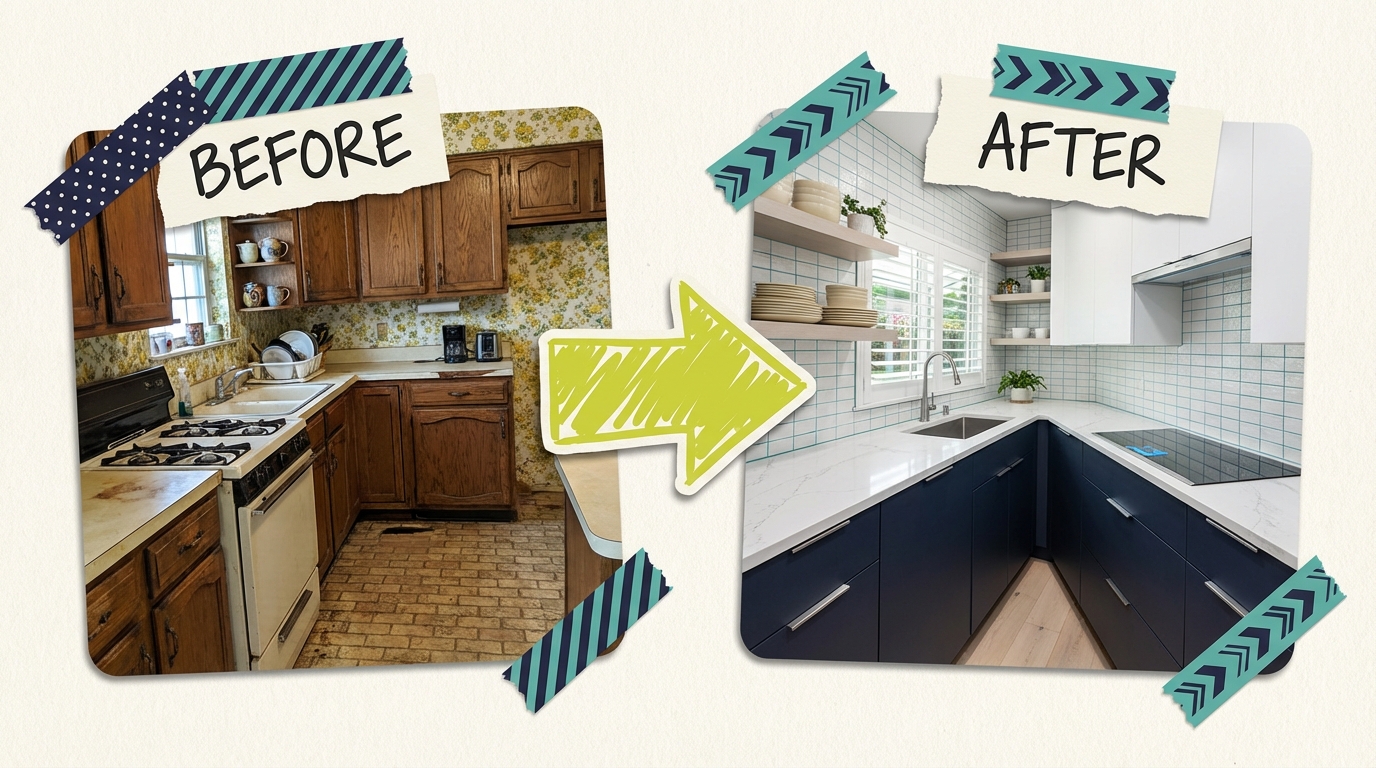
Claim and fully optimize your Google Business Profile with accurate service areas, categories, photos, and business hours. Ask every satisfied customer to leave a Google review. Respond to all reviews professionally. Post project photos regularly showing before-and-after transformations. Use specific service categories (don't just list "contractor" when "kitchen remodeling contractor" is available).
Photos are critical for contractors. Showcase completed projects, your team at work, and the transformation from start to finish. Profiles with 50+ quality photos significantly outperform those with just a few.
Post regular Google Business updates about completed projects, seasonal service offerings, and team highlights. These posts appear in your profile and signal to Google that your business is active and engaged. Add all your service categories and ensure your service area is accurately defined to appear in relevant local searches.
Don't overlook the Q&A section of your profile. Proactively add and answer common questions ("Do you offer free estimates?" "Are you licensed and insured?" "What areas do you serve?") before potential customers ask them. This builds trust and improves your profile's visibility in local search results.
Meta advertising (Facebook and Instagram)
Why it works for contractors
Facebook and Instagram let you target homeowners in your service area based on demographics, interests (home improvement, DIY, real estate), and behaviors (recently moved, homeownership). Visual before-and-after content performs exceptionally well and builds immediate credibility.
What to expect
Facebook CPMs for contractor audiences run $8-20. Monthly budgets of $500-2,000 can build strong local awareness. Cost per lead ranges from $20-60 depending on the service and market. Retargeting past website visitors typically delivers the lowest cost per lead.
Tips for contractors
Lead with your best before-and-after project photos in carousel format. Video walkthroughs of completed projects build trust quickly. Run retargeting campaigns to people who visited your website but didn't request a quote. Seasonal content works well (deck season in spring, basement finishing in winter). Testimonial videos from happy homeowners are gold.
Yelp and home services directories
Yelp, Angi (formerly Angie's List), HomeAdvisor, Houzz, and similar directories are where many homeowners go specifically to find and evaluate contractors. Your presence and reviews on these platforms directly influence hiring decisions.
Why it works for contractors
These platforms attract high-intent users who are actively looking for contractors. A strong profile with positive reviews is powerful social proof. Many homeowners check multiple directories before making a hiring decision, so being present across several platforms increases your chances of being considered.
What to expect
Costs vary by platform. Yelp advertising runs $300-1,000+ per month. Angi and HomeAdvisor charge per lead ($15-100 depending on service category and market). Houzz offers premium profiles for $300-600+ per month. The free tier on each platform (claim, optimize, earn reviews) provides value without ad spend.
Tips for contractors
Focus on the platforms where your best competitors appear. Respond to every review promptly and professionally. Invest in quality project photos for your profiles. Track which platforms generate profitable jobs, not just leads. Some contractors find certain directories deliver better-quality leads than others depending on their trade and market.
Direct mail and door-to-door marketing

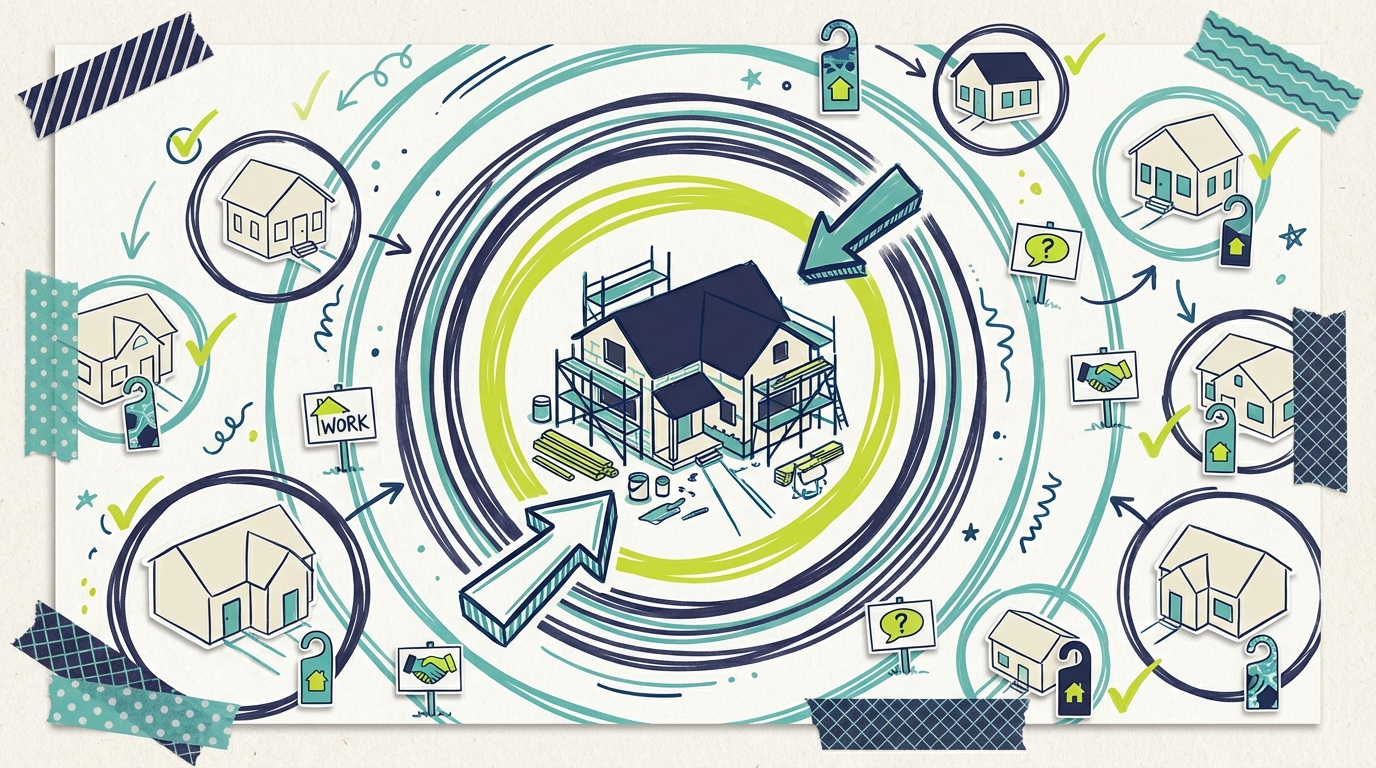
Direct mail and neighborhood marketing are classic contractor strategies that still work. When you complete a job, the surrounding neighbors become your warmest prospects because they've seen your trucks, signs, and the transformation you delivered.
Why it works for contractors
Home improvement is neighborhood-driven. When one homeowner gets a new roof or kitchen, neighbors notice and often consider similar upgrades. Door hangers, yard signs, and targeted mailers to surrounding addresses capitalize on this "keeping up with the neighbors" effect.
What to expect
Direct mail costs $0.50-1.50 per piece. A targeted campaign to 2,000-5,000 households around recent project sites runs $1,000-5,000. Response rates for home improvement mailers average 1-3%, but the high project values ($5,000-50,000+) mean even modest response rates deliver strong ROI.
Tips for contractors
After completing a job, send mailers to 200-500 surrounding addresses featuring the project you just finished (with homeowner permission). Include a "neighbor discount" offer to create urgency. Use yard signs during and after projects for passive advertising. Leave door hangers in the immediate vicinity of active job sites. Track every campaign with unique phone numbers or offer codes.
TV and CTV advertising
Television advertising is becoming a realistic option for contractors of all sizes, thanks to connected TV (CTV) and streaming platforms. For a deeper look at TV specifically, see our home services TV advertising guide.
Why it works for contractors
TV builds trust and credibility at a level that digital ads simply can't match. Customers trust brands they see on TV more than those they encounter only on social media or search. For contractors, where trust is critical (you're inviting someone into your home), TV advertising sets you apart from the competition.
What to expect
Traditional TV advertising was out of reach for most contractors at $5,000-10,000+ per month. CTV changes the math entirely. With platforms like Adwave, you can run a professional TV campaign for as little as $50. Target homeowners in your service area who are watching premium streaming content on NBC, Hulu, ESPN, and 100+ other channels. Average CPMs run $15-35.
Tips for contractors
Showcase your best transformations in your TV ad. Before-and-after reveals are compelling in a 30-second format. Use geographic targeting to reach homeowners within your service area only. Run campaigns consistently rather than in bursts to build sustained brand recognition. AI-powered tools can create professional commercials from your website and project photos in minutes, eliminating production costs.
Referral and review programs
Word of mouth remains the most powerful lead source for contractors. A structured referral program turns your satisfied customers into an active sales force.
Why it works for contractors
Homeowners overwhelmingly ask friends and neighbors for contractor recommendations. A referral from a trusted friend carries more weight than any advertisement. Referred customers also tend to be easier to close and less price-sensitive because they come in with pre-established trust.
What to expect
Referral programs are low-cost to run. Typical incentives include $100-500 referral bonuses (depending on project size), gift cards, or discounts on future work. Customer acquisition costs through referrals are typically 60-80% lower than through paid advertising.
Tips for contractors
Ask for referrals at the moment of maximum satisfaction (project completion, final walkthrough). Make it easy with referral cards, a simple mention-my-name system, or a unique referral link. Reward both the referrer and the new customer. Follow up with past customers seasonally (spring deck season, fall gutter cleaning) as natural touchpoints for referral requests. Track referral sources in your CRM.
Channel comparison for contractors
Google Ads captures homeowners actively searching for your services right now. It's your best channel for immediate lead flow but the most expensive per-click.
Local SEO delivers the best long-term value with steady organic leads. It requires patience but becomes your most cost-effective channel over time.
Meta (Facebook/Instagram) excels at building awareness and showing your work visually. It's ideal for staying familiar with homeowners who aren't ready to hire today but will be eventually.
TV/CTV builds the credibility and brand trust that's critical in home services. It positions you as the established, professional choice in your market.
Referrals deliver the highest-quality leads at the lowest acquisition cost. Every contractor should have a structured program in place.
Direct mail and neighborhood marketing capitalize on the "keeping up with the neighbors" effect that drives so many home improvement decisions. It's especially effective when targeting homes around your recent job sites.
Directories like Yelp and Angi catch homeowners in active research mode. They're especially valuable for specialty trades where homeowners are comparing multiple bids.
Recommended budget allocation
For a contractor spending $3,000-5,000 per month on advertising:
Google Ads: 35-40% ($1,050-2,000)
Local SEO: 10-15% ($300-750)
Meta (Facebook/Instagram): 15-20% ($450-1,000)
Directories (Yelp/Angi): 10-15% ($300-750)
TV/CTV: 10-15% ($300-750)
Direct mail: 5-10% ($150-500, campaign-based)
Referral program: 5% ($150-250)
Adjust based on what's working. If Google Ads fills your calendar, increase that allocation. If TV drives brand recognition in a new service area, shift budget there. The biggest mistake contractors make is putting all their budget into one channel. Diversification protects you from algorithm changes, platform policy shifts, and seasonal fluctuations that can make any single channel unreliable.
New contractors with limited budgets should start with Google Business Profile optimization (free) and a small Google Ads campaign ($500-1,000/month) targeting their highest-margin services. Add CTV through Adwave ($50 minimum) for local brand building. As revenue grows, layer in Meta and directories. The goal is building a marketing engine that generates leads predictably, not just running ads when your schedule gets slow.
For more on building a small business marketing strategy, check our complete guide.
Common questions answered
What's the best advertising for a general contractor?
Google Ads combined with a strong Google Business Profile forms the foundation for most general contractors. These capture homeowners who are actively searching for your services. Layer in Meta for awareness and TV/CTV for brand building. The best mix depends on your specialties, market, and budget, but most successful contractors invest across 3-4 channels simultaneously.
How much should a contractor spend on advertising?
Industry benchmarks suggest 5-10% of revenue for established contractors and 10-15% for growth-stage businesses. A contractor doing $500,000 annually should budget $25,000-50,000 per year ($2,000-4,000/month). Start smaller with high-ROI channels (Google Ads, local SEO) and expand as you track what works.
Does TV advertising work for contractors?
Yes, and it's far more affordable than most contractors realize. CTV advertising lets you target local homeowners on streaming platforms for as little as $50 per campaign through Adwave. TV builds the trust and credibility that's especially important when homeowners are inviting someone into their home.
How do I get more contractor leads online?
Start with Google Ads targeting your highest-margin services, optimize your Google Business Profile, and build a review strategy. Add retargeting on Facebook to stay in front of website visitors. Create before-and-after content that showcases your best work. The key is consistency, as sporadic advertising produces sporadic leads.
Should contractors advertise in the off-season?
Absolutely. Advertising during slower months (often winter for exterior work) lets you book spring projects in advance, keeps your crew busy, and takes advantage of lower advertising costs since fewer competitors are active. Promote interior services (basement finishing, bathroom remodels, kitchen renovations) during winter months.
How important are reviews for contractor advertising?
Reviews are critical. Most homeowners won't hire a contractor with fewer than 10 reviews or a rating below 4 stars. Actively requesting reviews after every completed project and responding to all reviews (especially negative ones) professionally should be a core part of your marketing strategy.


