-
~5%
Disney's combined streaming share of U.S. TV viewing (Disney+, Hulu, ESPN+; April 2026)
-
10.3%
Disney's share as the #2 media company on U.S. TV (April 2026 distributor ranking)
-
$50
Minimum to start advertising on connected TV with Adwave
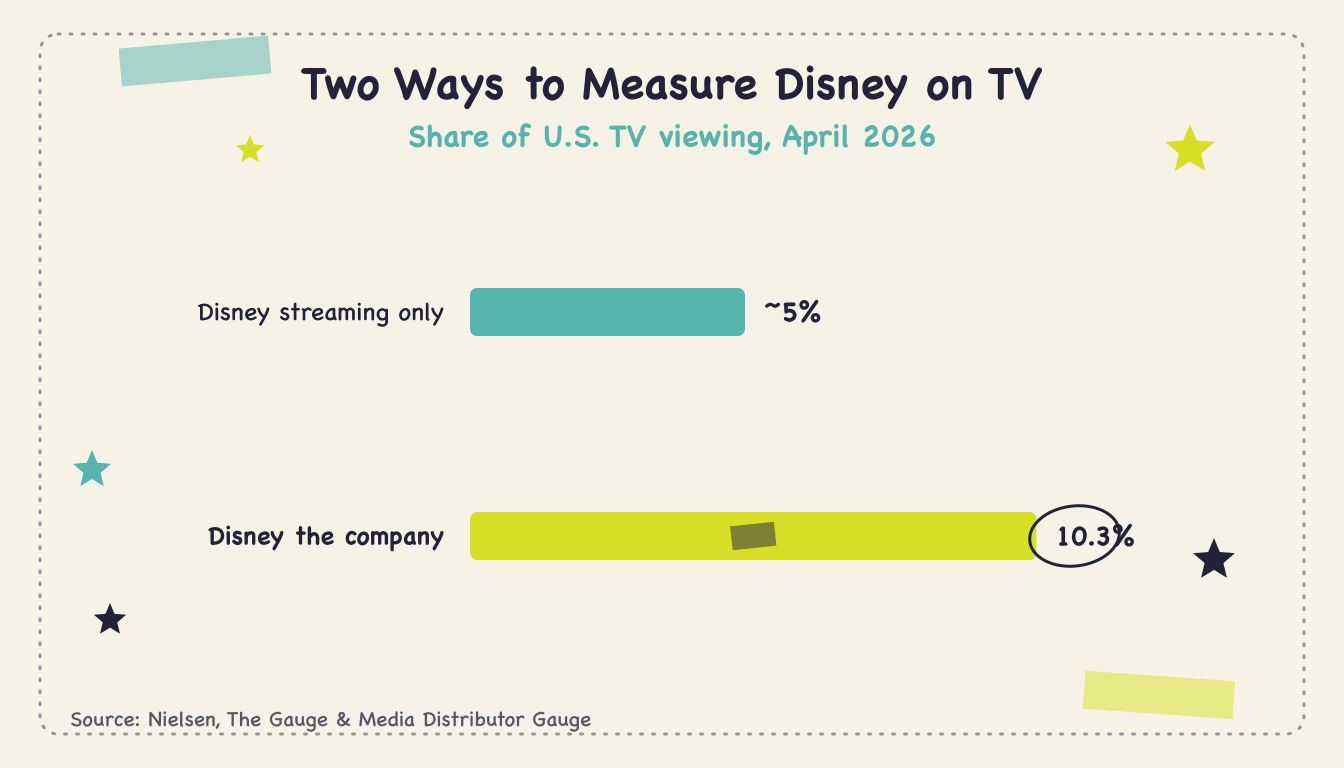
Disney's streaming services, meaning Disney+, Hulu, and ESPN+ together, accounted for about 5% of all U.S. TV viewing in April 2026, according to Nielsen's The Gauge. Measured as a whole media company across streaming, cable, and broadcast, Disney was even bigger: 10.3% of total TV viewing, second only to YouTube.
There's an important wrinkle here worth getting right up front. Nielsen no longer breaks out Disney+ as its own line. It reports Disney's streaming apps as a combined bucket, so the honest answer to "what is Disney+'s share?" is that Disney+ is the flagship of a streaming portfolio Nielsen measures together at around 5%. For a small business, the number that matters most isn't the exact slice, it's that Disney's audience, families, sports fans, and entertainment seekers, is now reachable through advertising in a way it never used to be. Let's break down Disney's Q2 2026 viewing, how it's measured, and what it means for reaching those audiences.
What the data shows
Nielsen's The Gauge measures how Americans split their TV time, and it publishes two related but different views. One breaks down viewing by individual streaming service. The other, the Media Distributor Gauge, groups entire media companies together. Disney shows up differently in each, and understanding why answers the "what's Disney+'s share?" question honestly.
Here's how Disney appeared in the April 2026 Gauge, released June 25, 2026:
Disney streaming (Disney+, Hulu, ESPN+ combined): about 5% of total TV viewing
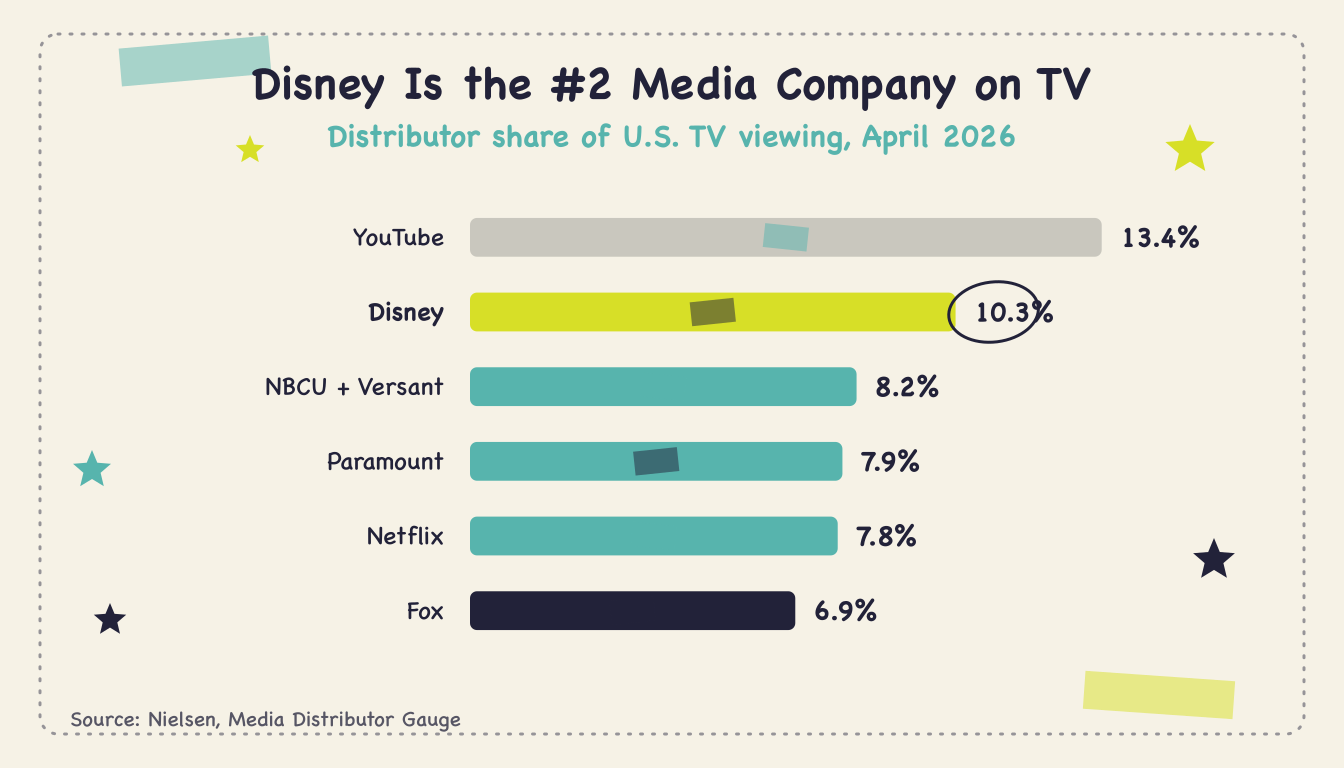
Disney the company (all platforms, including ESPN and ABC): 10.3%, ranked second among all media distributors
For context, YouTube led distributors at 13.4%, and total streaming reached a record 47.6%
Since early 2025, Nielsen has reported Disney's streaming apps as one combined figure rather than splitting out Disney+ on its own. That's why you won't find a clean standalone Disney+ percentage for 2026, and we're not going to invent one. Before that change, Disney+ alone ran around 2% of TV viewing, but that legacy number is outdated and no longer how Nielsen measures it. The current, accurate picture is Disney streaming at roughly 5%, holding steady year over year, and Disney the company at 10.3%.
That combined 5% sits inside a streaming category that hit a record 47.6% of TV viewing in April 2026, part of the broader shift we track in our most-watched streaming service rankings. Disney is a major piece of that streaming pie, especially for family and sports audiences.
How Nielsen measures Disney, and why April is the latest number
The two-number situation, 5% streaming versus 10.3% company-wide, isn't a contradiction, it's two lenses on the same media giant. The streaming figure counts only Disney+, Hulu, and ESPN+. The distributor figure adds Disney's cable networks, ESPN's linear channels, and ABC broadcast. Same company, different scope, and both come from Nielsen's national panel measuring actual viewing on TV sets.
A few points help you read the Disney numbers correctly:
Disney+ isn't broken out anymore. Since January 2025, Nielsen bundles Disney's streaming apps together. The roughly 5% is the real current figure for that bundle, and no standalone Disney+ number is published.
The 10.3% is the whole company. That second-place distributor ranking reflects all of Disney's viewing, streaming plus ESPN plus ABC, which is why it's double the streaming-only figure.
April 2026 is the latest confirmed month. Nielsen delayed its March Gauge amid a methodology dispute, and a recalibrated version is expected in the fall. Every figure here reflects data through April 2026.
The takeaway is that Disney is one of the largest forces in television however you slice it, second only to YouTube as a company, and a top-tier streaming presence anchored by family content and, increasingly, live sports.
Breaking down the numbers
Disney's streaming share has been remarkably stable, hovering in the mid-to-high 4% range through 2025 and reaching about 5% in April 2026, essentially flat year over year. That steadiness tells you something: Disney has a loyal, durable audience that doesn't swing as wildly with individual releases as some rivals.
What drives Disney's viewing is a distinctive mix:
Family and animation. Disney+ is the definitive home for family viewing. In the first half of 2026, Pixar's Hoppers topped Nielsen's streaming movie chart, Zootopia 2 charted strongly, and Bluey remained a consistent top performer across the period.
Live sports. The ESPN flagship streaming app launched in August 2025, bringing ESPN's full sports slate to streaming for the first time and folding premium live-sports inventory into Disney's streaming ad stack.
General entertainment via Hulu. Hulu adds adult and general-audience programming that broadens Disney's streaming reach beyond the family core.
Year over year, Disney's streaming share held roughly flat while the overall streaming category grew 3.3 points. That's not a weakness so much as a reflection of Disney's maturity: it's an established streaming leader holding a strong position rather than a fast riser. Compare that to how our Hulu TV viewing share breakdown tracks the general-entertainment side of the same portfolio.
It's worth appreciating what that stability represents. In a streaming market where individual services can swing a full point or more month to month depending on a single hit show, Disney's steadiness is unusual. It comes from breadth: family animation, general entertainment on Hulu, and live sports on ESPN each pull different audiences on different schedules, so no single release makes or breaks the month. When Pixar's latest tops the movie chart, that's a bonus on top of a baseline that Bluey, catalog films, and sports already sustain. For an advertiser, a stable audience is a predictable one, and predictability is valuable when you're planning a campaign flight and want to know the reach will be there.
The more interesting story for advertisers isn't the viewing share at all. It's how much of Disney's audience is now watching with ads.
Why it matters for your business
Disney built its streaming empire on subscriptions, but it has become one of the most important ad-supported audiences in television. That shift is what makes Disney relevant to a small business, not just a big brand.
The scale of Disney's ad reach is substantial. When Disney last disclosed the figure, in early 2025, its ad-supported tiers across Disney+, Hulu, and ESPN+ reached about 157 million monthly active users globally, including roughly 112 million in the U.S. and Canada. Roughly 37% of new Disney+ sign-ups now choose the ad-supported plan. A large and growing share of Disney's premium audience is watching content with ads in the breaks. Here's why that matters for a local advertiser:
Premium family inventory opened up. The most trusted family-entertainment brand in the world now runs ads, which means an audience advertisers once couldn't touch is now, in principle, addressable.
Live sports came with it. ESPN's move to streaming folded high-attention, unskippable live-sports inventory into the ad-supported mix, some of the most valuable placements in all of television.
The audience accepts ads. With over a third of new sign-ups choosing the ad tier, Disney confirms what the whole industry is seeing: viewers will take ads on premium streaming, the premise behind affordable connected TV advertising.
Now the honest part. A small business generally won't buy Disney+ directly, since Disney's ad deals target large national brands. What changed is that the premium ad-supported streaming category Disney helped legitimize is reachable through connected TV at small-business budgets. Disney proved the family and sports audience will watch ads. The connected TV advertising market is how a local business taps that same shift.
What makes Disney's audience distinct
Not all streaming audiences are the same, and Disney's has qualities that matter to advertisers even if you're reaching it through the broader connected TV ecosystem rather than buying Disney directly. Understanding what makes it distinct helps you think about where your ad lands.
Family-safe environment. Disney+ is built around family and kids' content, which creates a brand-safe context that many advertisers prize. Ads run alongside trusted, wholesome programming rather than unpredictable user-generated video.
Co-viewing. Family content is often watched together, parents and kids on the same couch, which means a single impression can reach multiple household members at once. That's a reach multiplier you don't get with solo mobile viewing.
Sports intensity. With ESPN now streaming, Disney delivers live-sports audiences that are highly engaged and watching in real time. Live sports viewers can't skip ads and pay close attention, which is why that inventory is among the most valuable in television.
Loyalty and repeat viewing. Disney's stable share reflects an audience that comes back, week after week, for franchises and series it trusts. Consistent viewership means consistent, predictable reach for advertisers.
For a local business, the point isn't that you're buying Disney+ specifically. It's that the connected TV ecosystem you can afford includes this kind of premium, family-friendly, sports-rich environment. When you run across 100+ streaming channels, you're reaching audiences with exactly these qualities: engaged, brand-conscious, watching on the big screen with the household. Disney helped prove that this premium context can carry ads without alienating viewers, which is part of why the whole ad-supported streaming market has grown so fast.
How to take advantage
You can't run a spot on the next Pixar release for $50. But you can reach the same kind of family and sports audience Disney's streaming built, on the same connected TVs, at a budget made for a local business. Here's how to think about it.
Target the audience, not the single app. Disney viewers also watch Hulu, Roku channels, Tubi, and dozens of other ad-supported services. Reaching across that whole ecosystem builds the frequency any one platform can't.
Match your service area. Set a geographic radius, usually 15 to 25 miles, so every impression reaches a potential customer nearby.
Budget for repetition. Plan enough spend to reach the same households several times over two to three weeks. On connected TV, meaningful frequency costs hundreds of dollars, not thousands.
Let AI make the ad. Disney-level production isn't the bar. AI tools turn your existing website into a broadcast-quality 30-second ad in about two minutes.
Measure brand lift. Track branded search, direct traffic, and calls during and after a campaign rather than chasing clicks.
The mechanics are simple. With Adwave, ad creation is free, a campaign starts at a $50 minimum, and you can be live across 100+ premium streaming channels in under 10 minutes. You point it at your website, it builds the spot, and you're advertising on the same class of premium connected TV inventory that Disney's ad tiers helped make mainstream. For what that budget buys, our guide to the average CTV CPM lays out the costs.
The bigger picture
Disney's dual numbers, 5% streaming and 10.3% company-wide, capture a business in the middle of a transformation from a cable-and-theme-parks giant into a streaming-and-advertising one.
A few forces give the Q2 2026 figures their weight:
Streaming turned profitable. Disney's streaming operating income jumped 88% to $582 million in its fiscal second quarter of 2026, its first double-digit streaming operating margin. Ad-supported tiers are a big part of why. When Disney's streaming makes money, it invests more in the content and ad tech that grow the audience.
Sports is the new battleground. The ESPN flagship launch brought live sports fully into streaming, adding the appointment-viewing inventory that commands premium ad value and gives Disney a hold streaming rivals lack. Our live sports share of TV viewing page shows why that inventory matters.
Ad-supported is the default now. With over a third of new Disney+ sign-ups choosing ads, Disney reinforces the industry-wide move toward ad-supported premium streaming, the foundation that makes CTV affordable for small advertisers.
For small businesses, the throughline is access. Disney spent a century building the most beloved family-entertainment brand on earth, then opened it to advertising. You don't buy Disney+ itself, but the shift it accelerated, premium streaming going ad-supported, is exactly what makes affordable connected TV advertising possible.
What experts are saying
Analysts increasingly frame Disney as an advertising powerhouse, not just a subscription business. Disney's own leadership has leaned into that, showing the 157-million ad-supported reach across its services and positioning the ESPN streaming launch as a magnet for advertisers who want live, high-attention sports inventory. The 88% jump in streaming operating income gave the strategy financial validation, showing that ad-supported streaming can be profitable at scale.
The broader industry read is that Disney's decision to stop reporting subscriber counts, and to emphasize engagement and advertising instead, signals where the value now sits. When a company built on subscriptions starts talking about ad reach and viewing minutes, it's telling you the ad business is the growth story. For advertisers, the consensus takeaway is that Disney's family and sports audiences, long among the most coveted and hardest to reach, are now part of the addressable connected TV market. That's less about Disney as a direct buy and more about what Disney proved: even the most premium, family-safe, sports-rich audience in television is now an advertising audience.
What the numbers don't tell you
Disney's viewing figures come with more caveats than most, so read them carefully.
There's no standalone Disney+ number. Nielsen reports Disney's streaming apps combined at about 5%. Anyone citing a precise standalone Disney+ Gauge percentage for 2026 is using an outdated or invented figure.
The 5% and 10.3% measure different things. One is streaming-only, the other is the whole company. Don't treat them as competing numbers, they're two scopes of the same business.
The 157-million ad reach is a dated disclosure. Disney last shared that global ad-supported figure in early 2025, and it stopped reporting subscriber counts in fiscal 2026. Treat it as the most recent official number, not a live 2026 figure.
Share is stable, which cuts both ways. Disney's flat viewing share reflects a mature, loyal audience, but it also means Disney isn't the fast-growth story YouTube is. For advertisers, stability and reach matter more than growth rate.
Read Disney's numbers as proof of durable, premium reach: a top-two media company with a huge, loyal, and now ad-supported family and sports audience.
Common questions answered
What is Disney+'s share of TV viewing? Nielsen no longer breaks out Disney+ on its own. It reports Disney's streaming apps, Disney+, Hulu, and ESPN+, as a combined figure of about 5% of U.S. TV viewing as of April 2026. Measured as a whole company across all platforms, Disney reached 10.3%, second among all media distributors behind YouTube.
Why isn't Disney+ listed separately? Since January 2025, Nielsen has grouped Disney's streaming services into one "Disney streaming" bucket rather than reporting Disney+ standalone. Before that change, Disney+ alone ran around 2% of TV viewing, but that figure is outdated. The current accurate measure is the combined roughly 5%.
How many subscribers does Disney+ have? Disney stopped reporting subscriber counts in fiscal 2026. As of its last official report, for the quarter ending September 2025, Disney+ had about 132 million subscribers globally, including 59.3 million in the U.S. and Canada, with Hulu adding roughly 64 million. More recent counts come from third-party estimates.
Can a small business advertise on Disney+? Not directly, in most cases, since Disney's ad deals target large brands. But the premium ad-supported streaming audience Disney helped build is reachable through connected TV at small-business budgets. With Adwave, you can run 30-second ads across 100+ premium streaming channels from a $50 minimum.
How much does streaming TV advertising cost? The average CTV CPM runs roughly $15 to $35, and with Adwave a campaign starts at a $50 minimum with free ad creation. That reaches the premium family and entertainment audiences that Disney and the wider streaming shift created, without a national-brand budget.
The numbers at a glance
Key figures behind Disney's Q2 2026 standing, with sources:
~5%: Disney's combined streaming share of U.S. TV viewing (Disney+, Hulu, ESPN+; Nielsen, The Gauge, April 2026)
10.3%: Disney's share as the #2 media distributor on U.S. TV (Nielsen, Media Distributor Gauge, April 2026)
13.4%: YouTube's leading distributor share, the only company ahead of Disney (Nielsen)
47.6%: total streaming share of U.S. TV viewing, a record (Nielsen)
~132 million: Disney+ global subscribers as last officially reported, September 2025 (Disney)
157 million / 112 million: Disney's global and U.S.-Canada ad-supported reach, as last disclosed in early 2025 (Disney)
~37%: share of new Disney+ sign-ups choosing the ad-supported tier (Antenna)
+88%: growth in Disney's streaming operating income, fiscal Q2 2026 (Disney)
Reach Disney-style audiences, starting at $50
Disney is the second-biggest media company on U.S. television, and its combined streaming holds about 5% of all viewing. The bigger story for a small business is that Disney's premium family and sports audiences now watch with ads, which turned an untouchable audience into a reachable one.
You don't need a Disney-sized budget to reach premium streaming viewers. See how Adwave works to turn your website into a broadcast-quality 30-second ad in minutes, or check pricing to launch a connected TV campaign from a $50 minimum. The premium screen opened up. It's a good time to be on it.