
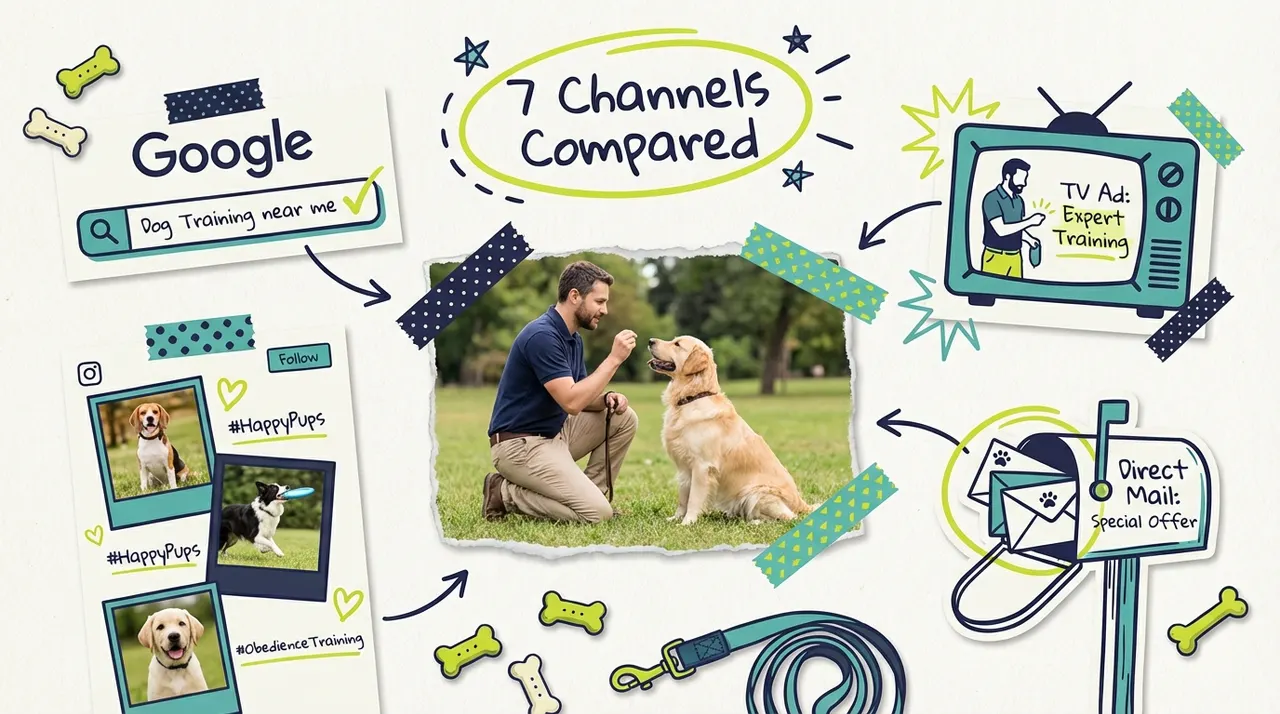
The pet industry is booming. Americans spent over $150 billion on their pets in 2024, and the number keeps climbing (American Pet Products Association, 2024). Dog training sits right at the center of that growth. More people are adopting dogs than ever, and they're willing to pay for professional help with everything from basic obedience to separation anxiety to leash reactivity.
But The same forces driving demand are also creating more competition. Online courses, YouTube trainers, and app-based programs are flooding the market. Pet parents have more options than they've ever had, which means local trainers need to work harder to stand out.
If you're running a dog training business, whether you're a solo trainer, a facility with group classes, or a board-and-train operation, your marketing can't rely on a single channel anymore. The trainers growing fastest in 2026 are showing up in multiple places: Google search results, social media feeds, streaming TV screens, and local mailboxes.
This guide breaks down seven advertising channels that work for dog trainers, compares their costs and strengths, and gives you practical budget frameworks to fill more class slots.
Why Dog Trainers Need More Than Word of Mouth
Word of mouth built your business, and it probably still accounts for a big chunk of your new clients. That's great. But relying on referrals alone creates a ceiling you can't control.
Here's the problem. Referrals are inconsistent. You might get five new puppy clients in January when everyone gets holiday puppies, then hear crickets in March. You can't predict the volume, you can't scale it, and you can't turn it up when you have empty class slots to fill.
There's also the discovery gap. For every person who asks a friend for a trainer recommendation, dozens more go straight to Google or scroll through Instagram. If you're not visible in those places, you're invisible to pet owners who need exactly what you offer.
Advertising for dog training doesn't require a massive budget. Several of these channels cost nothing upfront, and the paid options can start small. Pick two or three channels, build momentum, and add more as you see what works.
Google Ads: Reaching Pet Owners When They Need Help
Google Ads is the highest-intent advertising channel available to dog trainers. When someone types "dog training near me" or "puppy obedience classes Austin," they're not casually browsing. They've got a dog pulling them down the sidewalk or chewing through their couch, and they want a solution now.
How Google Ads Works for Dog Trainers
Google Ads runs on a pay-per-click model, so you only pay when someone clicks your ad. For dog trainers, three campaign types deliver the best results:
Search Ads: These appear at the top of Google results when someone searches for training-related terms. The most effective keywords for dog trainers include:
"Dog training near me" and "dog trainer [city]"
"Puppy obedience classes [city]"
"Aggressive dog trainer near me"
"Board and train dog training [city]"
"Separation anxiety dog trainer"
Long-tail keywords like "reactive dog trainer in Denver" cost less per click and attract clients looking for exactly what a specialist offers.
Local Services Ads (LSAs): These appear above standard search ads with a "Google Guaranteed" badge. LSAs charge per lead rather than per click, which can be more cost-effective. You'll need to pass Google's screening process, but that trust badge is worth the effort.
Performance Max Campaigns: These automated campaigns show your ads across Google Search, Maps, YouTube, and Display. They work well once you have conversion data, because Google's algorithm learns which placements drive the most inquiries.
What to Budget
Expect to pay $3 to $10 per click for dog training keywords, depending on your market. A monthly budget of $300 to $800 gives most local trainers enough data to see what's working.
Tips for Better Results
Send clicks to a landing page specific to the service searched, not your homepage
Use ad extensions to show your phone number, reviews, and location
Schedule ads during hours people typically research services (evenings and weekends convert well)
Add negative keywords like "free," "online," and "YouTube" to filter out non-local clicks
Highlight credentials in ad copy: CCPDT, IAABC, or Karen Pryor Academy certifications signal expertise
Meta and Instagram Ads: Showing Transformations
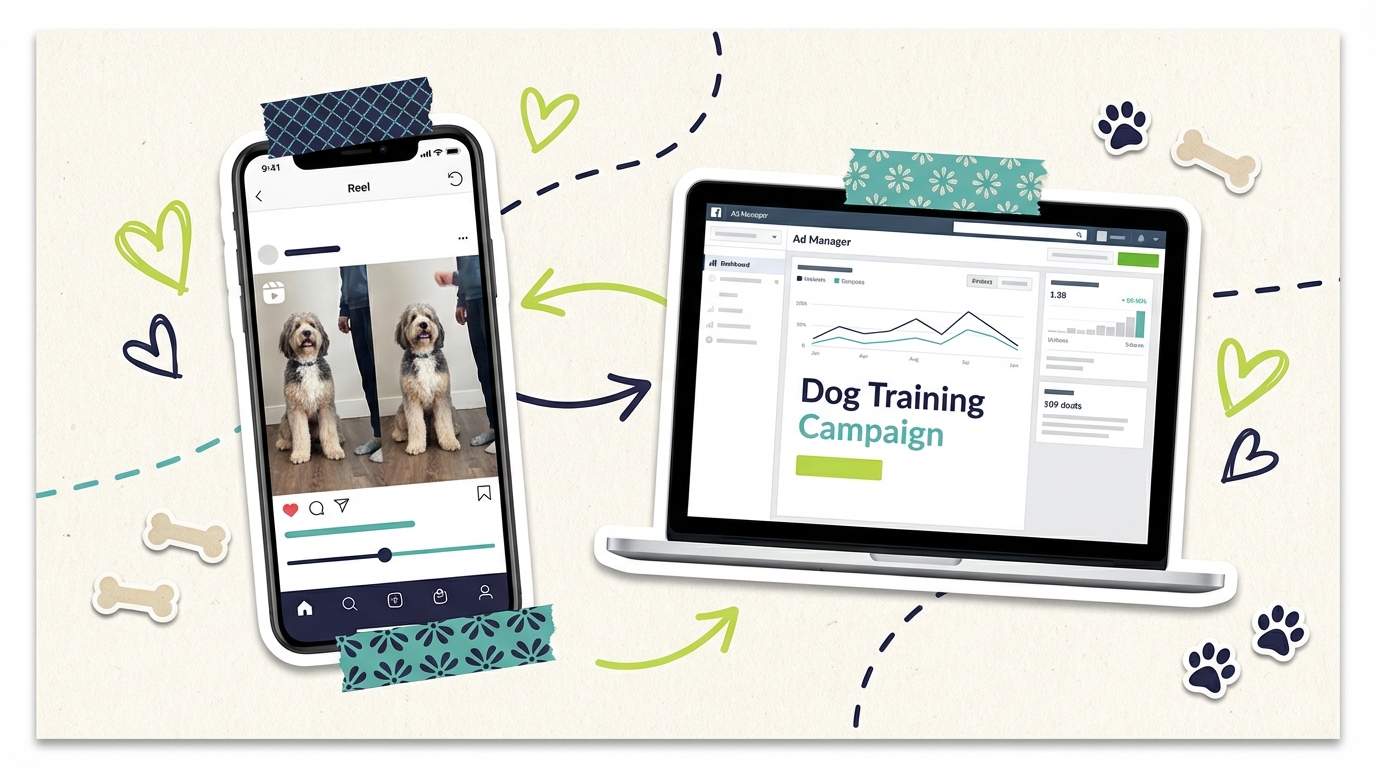
If Google Ads captures demand, Instagram and Facebook create it. Dog training is inherently visual and emotional, which makes Meta's platforms a natural fit. Before-and-after behavior videos, training demo clips, and adorable puppy content are the kind of posts that stop people mid-scroll.
Why Meta Works for Dog Trainers
Think about what makes dog training content shareable: a reactive dog calmly walking past another dog for the first time, a puppy nailing a sit-stay at eight weeks old, a nervous rescue learning to trust again. These moments are powerful on video, and Meta's ad platform lets you put paid dollars behind that content to reach pet owners who haven't found you yet.
According to a 2024 Meta Business report, pet-related video posts see 48% higher interaction rates than static images on the platform (Meta for Business, 2024). People on Instagram and Facebook love dog content, so your ads feel natural rather than intrusive.
Campaign Types That Work
Video View Campaigns: Boost your best training transformation videos to people inside a 10 to 15-mile radius. When someone watches a 30-second video of you working with a dog, they start to trust your skills before they make contact.
Lead Generation Campaigns: Use Meta's built-in lead forms so pet owners can request information or sign up for a free consultation without leaving the app. This reduces friction and typically costs $5 to $15 per lead for local service businesses.
Retargeting Campaigns: Show ads to people who've visited your website or watched your videos but haven't booked yet. Dog training is a considered purchase. Pet parents often research for days or weeks before committing, and retargeting keeps you familiar during that decision period.
What to Budget
Meta advertising for local pet services typically runs $5 to $18 per lead. Start with $200 to $600 per month and focus on video content that demonstrates your training approach. Test different audiences: new dog owners, people interested in pet adoption, residents near dog parks.
Creative Best Practices
Film short training demos (15 to 30 seconds) showing real results with real dogs
Use captions on all videos since most people scroll with sound off
Feature happy pet owners giving testimonials alongside their dogs
Show the messy "before" and the calm "after" to demonstrate transformation
Local SEO and Google Business Profile: Getting Found Locally
When a pet owner searches "dog training near me" on their phone, Google shows a map pack with three local businesses before any other results. Getting into that map pack is free, but it takes consistent effort.
Your Google Business Profile Is Your Digital Storefront
Your Google Business Profile is often the first impression a potential client gets. It shows your photos, reviews, hours, and services before anyone clicks through to your website.
Here's what a fully optimized dog training Google Business Profile includes:
Complete service list with descriptions: puppy classes, basic obedience, advanced obedience, behavior modification, board and train, agility, private lessons
High-quality photos updated monthly (training sessions in action, facility interior, happy dogs and owners)
Accurate hours including class schedules
Regular posts sharing training tips, success stories, or upcoming class openings
Review responses to every review, both positive and negative
Local SEO Beyond Your Profile
Website optimization: Create individual pages for each service you offer. A dedicated page for "puppy training in [your city]" ranks better than a generic "services" page that lists everything. Include your city and neighborhood names naturally throughout.
Citations: Make sure your business name, address, and phone number (NAP) are consistent across every directory: Google, Yelp, Apple Maps, Bing, Facebook, and Nextdoor.
Review generation: According to BrightLocal's 2025 Local Consumer Review Survey, 88% of consumers read online reviews for local businesses, and 76% pay attention only to reviews written in the last month (BrightLocal, 2025). Reviews that mention specific results ("Our dog stopped pulling in two sessions") carry far more weight than generic five-star ratings.
What to Budget
Local SEO is mostly a time investment. If you handle it yourself, it's free beyond a few hours per month. If you hire a local SEO specialist, expect $300 to $700 per month for ongoing work.
Yelp and Pet Service Directories: Building Credibility
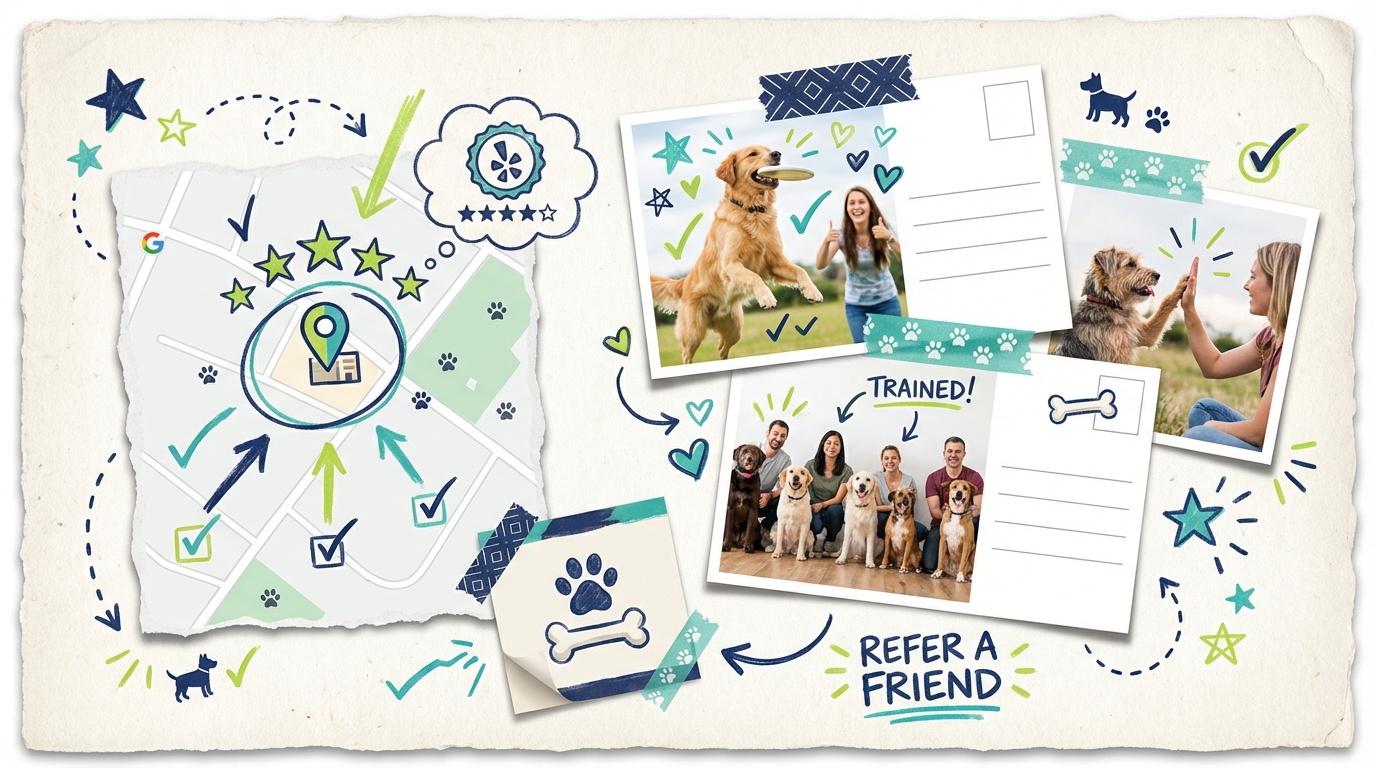
Yelp carries real weight in the pet services world. Pet owners are careful about who they trust with their dogs, and detailed reviews can be the deciding factor between you and a competitor across town.
Why Directories Matter for Dog Trainers
Unlike Google, where someone might glance at star ratings, Yelp users read full reviews. They're looking for specifics: "She was patient with our fearful rescue" or "The group classes are well organized and never too crowded." For a trust-based service, those detailed testimonials are gold.
Directories Worth Claiming
Yelp: Claim your free profile, add photos, and respond to every review. Yelp Ads ($150 to $400 per month) can make sense in cities where the platform is heavily used, but start with the free listing first.
Thumbtack: Pet owners use Thumbtack to find and compare local trainers. You pay per lead with no upfront monthly commitment, making it a good test channel for new trainers.
Rover: While primarily a pet sitting platform, Rover also lists dog trainers. The audience is pet-focused and willing to spend on services.
Nextdoor: This hyper-local platform is where neighbors recommend service providers. A few strong recommendations on Nextdoor can generate steady referral traffic at zero cost.
Veterinary offices: Build relationships with local vets and ask to leave business cards in their waiting rooms. Vets are the first people new dog owners ask for training recommendations.
Tips for Managing Reviews
Ask happy clients for reviews right after a milestone moment (graduation from puppy class, mastering a difficult behavior)
Provide a simple QR code or direct link to your review page
Respond to every review in 24 to 48 hours
Address negative reviews professionally, offering to discuss concerns offline
Never offer incentives for reviews, as this violates most platform policies
Direct Mail: Reaching New Pet Owners
In a world of digital noise, physical mail stands out. For dog trainers, direct mail works well because you can target the exact neighborhoods where your potential clients live.
Why Direct Mail Works for Dog Trainers
The Association of National Advertisers reports that direct mail achieves a 4.4% response rate, compared to 0.12% for email (ANA, 2023). A well-designed postcard showing a well-behaved dog can sit on a refrigerator for weeks, reminding a frustrated pet parent that help exists.
Targeting Strategies
Neighborhoods near pet stores and dog parks: People who live near PetSmart, a local dog park, or a veterinary clinic are statistically more likely to be dog owners. USPS Every Door Direct Mail (EDDM) lets you select postal routes near these locations and mail to every address for as little as $0.23 per piece.
New homeowner campaigns: New homeowners are establishing routines with their pets, and a new home often creates behavioral challenges for dogs. That makes it an ideal time to promote training services.
Partnership mailers with vets and pet stores: Co-brand a mailer with a local vet or pet supply store. You share the costs, and both businesses benefit from the other's credibility.
Seasonal campaigns: Mail puppy training promotions in January and February (post-holiday puppy surge) and spring campaigns as people spend more time outdoors with their pets.
What to Budget
EDDM campaigns typically cost $0.23 to $0.50 per piece including design, printing, and postage. A mailing to 2,000 homes runs about $500 to $1,000. For most dog trainers, two to four mailings per year tied to seasonal peaks deliver the best return.
TV and CTV Advertising: Building Trust on the Big Screen
Television carries a level of credibility that's hard to match with digital channels alone. Research shows that consumers trust brands they see on TV significantly more than those they encounter only through social media or search ads.
For dog trainers, that trust signal matters. Pet parents are handing over their beloved family member, and they want to feel confident in who they choose.
With Adwave, you can create a broadcast-quality 30-second TV commercial from your website or social profiles in about two minutes, then launch a campaign starting at just $50. Your ad runs across 100+ premium channels, reaching viewers in the exact zip codes you serve.
CTV campaigns through Adwave run at a CPM of $15 to $35, and you can target viewers by location and interests. A monthly budget of $100 to $300 puts your training business on the same screen as national brands. For more on reaching nearby pet owners, check out our guide to attracting local customers.
Email Marketing: Keeping Clients Engaged
Acquiring new clients gets the most attention, but retention and referrals are where dog training businesses build real profitability. Email gives you a direct line to clients who've already trusted you, and unlike social media, there's no algorithm deciding who sees your messages.
Types of Emails That Drive Revenue
Class scheduling and reminders: Automated emails for upcoming class sessions reduce no-shows and keep clients progressing through your program. Include homework reminders from the previous session to reinforce training between classes.
Training tips newsletter: A weekly or biweekly email with practical training advice keeps you familiar. Topics like "3 ways to stop leash pulling this week" or "Why your puppy bites and what to do about it" provide genuine value and position you as the expert. When that subscriber's neighbor mentions they need a trainer, guess who they'll recommend?
Puppy milestone emails: Set up an automated sequence triggered by a puppy's age. Send tips for socialization at 8 to 12 weeks, teething at 3 to 4 months, and adolescent behavior at 6 to 12 months. These arrive exactly when pet parents feel most overwhelmed and are most likely to book additional sessions.
Referral program emails: Offer existing clients a class credit or discount when they refer a friend. Send a quarterly reminder, because even happy clients forget to refer without a nudge.
Reactivation campaigns: Target clients who haven't booked in 90 or more days with a "We miss [dog's name]" email and a reason to come back: a new class offering, a refresher session, or a seasonal discount.
What to Budget
Email platforms like Mailchimp or Constant Contact start free for small lists and run $20 to $80 per month as your list grows. The cost per email is essentially zero, making this one of the highest-ROI channels available.
Tips for Growing Your List
Collect emails during every client intake and class registration
Offer a free downloadable guide ("10 Things Every New Puppy Owner Should Know") in exchange for an email signup on your website
Add a sign-up link to your Google Business Profile and social media bios
Channel Comparison: Finding Your Best Mix
Not every channel serves the same purpose. Here's how they compare across the metrics that matter most for dog trainers:
Key takeaway: Google Ads and email marketing produce the fastest results. Local SEO takes longer but compounds over time. TV/CTV and Instagram build the brand awareness that makes every other channel work harder. For a deeper look at tracking results, read our guide to measuring your advertising effectiveness.
Recommended Budget Allocation for Dog Trainers
Your ideal budget split depends on the size and stage of your business. Here are two frameworks to start with:
Solo Trainer or New Business (Budget: $600 to $1,500 per month)
Focus on channels that drive immediate bookings and build your reputation:
Google Ads: 30% ($180-$450) for capturing high-intent searches
Meta/Instagram Ads: 25% ($150-$375) for video content and awareness
Local SEO: 20% (time investment plus any tools or freelancer help)
Email Marketing: 10% ($60-$100 for platform and automation setup)
TV/CTV: 10% ($60-$150) for brand credibility
Yelp/Direct Mail: 5% (claim free profiles, plan your first mailer)
At this stage, Google Ads and local SEO deliver the most predictable returns. As your budget grows, shift more toward brand-building channels.
Training Facility or Multi-Trainer Business (Budget: $1,500 to $3,500 per month)
With more capacity to fill, you can invest in both acquisition and brand building:
Google Ads: 25% ($375-$875) for high-intent search and Local Services Ads
Meta/Instagram Ads: 25% ($375-$875) for video storytelling and retargeting
TV/CTV: 15% ($225-$525) for brand trust and local awareness
Local SEO: 15% (ongoing optimization, content creation, review management)
Direct Mail: 10% ($150-$350) for seasonal campaigns and new mover targeting
Email Marketing: 5% ($75-$175 for advanced segmentation and automation)
Yelp/Directories: 5% (paid listings in competitive markets)
These aren't fixed rules. Track what's working each month and shift dollars toward the channels producing the best return.
Common Questions Answered
How much should a dog trainer spend on advertising? Most successful dog training businesses invest 7% to 12% of their gross revenue in marketing and advertising. For a business generating $100,000 annually, that's roughly $580 to $1,000 per month. Start at the lower end and increase spending on channels that demonstrate a positive return.
What's the most effective advertising channel for dog trainers? It depends on your goal. Google Ads is most effective for filling class spots quickly because you're reaching people actively searching for training help. Instagram is best for demonstrating expertise through video content. For long-term compounding growth, local SEO delivers the strongest returns over time. The most successful trainers use three to five channels together.
Do dog trainers really need TV advertising? TV isn't required, but it fills a trust gap that digital channels can't. When pet parents see your business on their TV screen, it signals credibility that a Facebook ad simply doesn't match. With Adwave, you can start a campaign for $50 and target only viewers in your service area. For trainers competing against online courses and app-based programs, TV reinforces that you're a real, local, established professional.
How can I advertise dog training on a tight budget? Start with free channels: optimize your Google Business Profile, claim your Yelp listing, post training videos on Instagram, and set up a basic email newsletter. These four cost nothing but time and can generate real results. When you're ready to add paid channels, start with a $50 CTV campaign or a small Google Ads budget ($10 per day). Scale up as you identify what's working.
What kind of content works best for advertising dog training? Video outperforms every other format. Before-and-after behavior transformations, quick training tip demos, and client testimonial clips all generate strong engagement. Keep videos under 30 seconds for social ads and include captions since most viewers watch without sound. Authenticity matters more than production quality. A genuine training moment filmed on your phone outperforms a polished stock-footage ad.
How do I measure whether my dog training advertising is working? Track three core metrics: new client inquiries by source (ask every caller how they found you), cost per new client (total ad spend divided by new clients acquired), and client retention rate (what percentage book additional sessions). For TV and brand campaigns, monitor branded Google searches for your business name. An uptick means your awareness campaigns are working.
Build the Training Business You Want
You don't need to launch all seven channels tomorrow. Start with the two or three that address your biggest gap right now. If you need more new clients fast, invest in Google Ads and local SEO. If you've got full classes but struggle with retention, focus on email marketing. If you want to build the kind of brand recognition that makes pet owners choose you over an online course, add TV and Instagram to your mix.
The trainers who grow consistently treat advertising as a steady investment, not a one-time experiment. Start small, measure what works, and build from there.


