-
80M+
Tubi monthly active users
-
5.7%
FAST share of total TV viewing
-
150M+
Americans watching ad-supported streaming
Free streaming services have fundamentally changed how Americans watch television. As of 2024, more than 170 million Americans use at least one free ad-supported streaming service monthly, according to Nielsen data. This represents a dramatic shift from just five years ago, when free streaming was a niche category dominated by a handful of platforms. Today, services like Tubi, Pluto TV, and Freevee compete directly with premium streaming giants for viewer attention.
The growth of FAST (Free Ad-Supported Streaming TV) has been nothing short of remarkable. Tubi alone reached 97 million monthly active users in 2024, with viewers streaming over 10 billion hours during the year. Pluto TV serves approximately 80 million monthly users worldwide. Together, these platforms have created a robust ecosystem where viewers can access thousands of movies and TV shows without paying a subscription fee.
For advertisers, this massive free streaming audience represents an unprecedented opportunity. Unlike traditional cable where ad inventory was limited and expensive, FAST platforms offer accessible entry points for businesses of all sizes. The question isn't whether free streaming matters for your advertising strategy; it's how to best reach this rapidly growing audience.
What the data shows
The free streaming audience has grown substantially across all major platforms. According to Nielsen, ad-supported content now accounts for 73.6% of total TV viewing as of Q2 2025, with ad-supported streaming holding a 45.3% share of all television viewing. This marks a significant shift in viewer preferences toward free and ad-supported options.
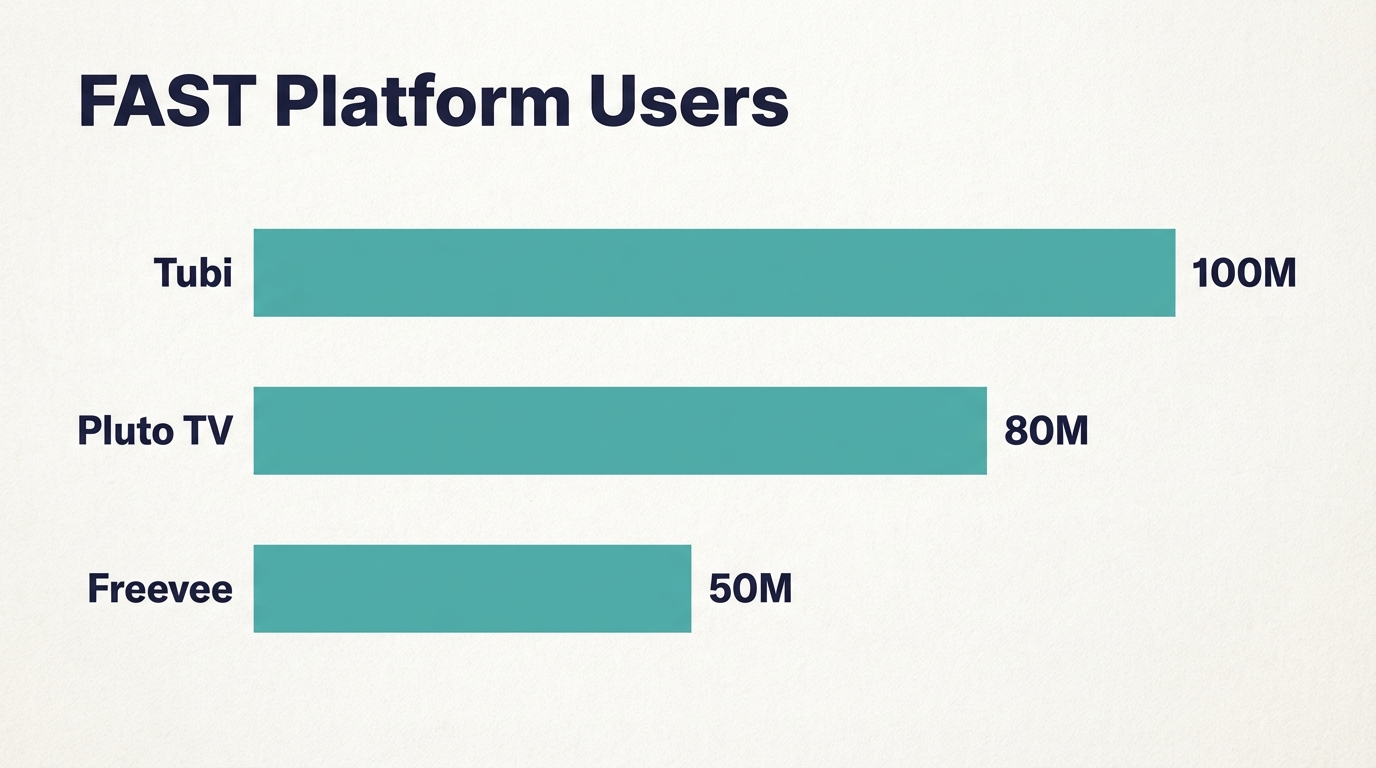
Here's how the major FAST platforms stack up in terms of monthly active users:
Tubi: 97 million monthly active users (2024), up from 64 million in 2022
Pluto TV: 80 million monthly active users worldwide
The Roku Channel: Approximately 80 million active accounts with streaming access
Freevee (Amazon): 25% of U.S. internet-using adults reported using the service in 2024
Xumo: Over 40 million monthly active users
The viewing time metrics are equally impressive. Tubi viewers streamed over 10 billion hours in 2024 alone. As a share of total U.S. TV viewing, Tubi captured 2.2% in May 2025, while Pluto TV held approximately 1.0%. While these percentages may seem small individually, combined with other FAST services, free streaming now represents a substantial portion of total television viewing.
The premium streaming services have also embraced ad-supported tiers. Netflix's ad-supported tier reached 94 million subscribers by May 2025, accounting for 55% of new sign-ups in markets where it's available. Disney+ reports that 62% of new subscribers now choose the ad-supported plan. Amazon Prime Video's ad tier reaches an estimated 130 million U.S. viewers.
This data paints a clear picture: whether through pure FAST platforms or ad-supported tiers of premium services, viewers increasingly accept advertising in exchange for free or lower-cost content. The total addressable audience for ad-supported streaming now rivals or exceeds traditional cable television.
Breaking down the numbers
By platform type
The free streaming ecosystem divides into several distinct platform categories, each with unique audience characteristics and advertising opportunities.
Pure FAST platforms like Tubi, Pluto TV, and Freevee offer completely free access to their entire content libraries. These services generate all revenue through advertising, which means higher ad loads (typically 12-15 minutes per hour) but zero cost to viewers. Pure FAST platforms attract viewers seeking free entertainment options and tend to skew slightly younger and more price-conscious than premium streaming audiences.
Premium streaming ad tiers from Netflix, Disney+, Max, and others offer lower-priced subscription options with advertising. These viewers pay reduced subscription fees in exchange for watching ads (typically 4-5 minutes per hour). The audience tends to be broader demographically, as these services attract both cost-conscious consumers and mainstream households seeking entertainment value.
Device-native platforms like The Roku Channel and Samsung TV+ come pre-installed on connected TV devices. These services benefit from prominent placement and easy discovery, often serving as default content options for viewers who haven't navigated to other apps. Device-native platforms capture casual viewing time and tend to have high reach but more passive engagement.
Sports-focused FAST services including Tubi Sports, Pluto TV Sports, and various league-specific channels cater to sports fans seeking free access to games, highlights, and sports content. These platforms attract highly engaged, predominantly male audiences and command premium ad rates due to the desirable demographics and live content appeal.
By demographic
Free streaming services reach a broad cross-section of American households, though usage patterns vary by demographic group.
Age plays a significant role in free streaming adoption. Adults 18-34 show the highest usage rates, with approximately 65% using at least one free streaming service monthly. Usage remains strong among adults 35-49 (58%) and 50-64 (45%), with lower but growing adoption among viewers 65 and older (32%). The youth skew reflects both comfort with streaming technology and greater price sensitivity among younger viewers.
Income demographics reveal interesting patterns. While free streaming over-indexes among lower and middle-income households (as expected for a free service), usage among households earning $100,000 or more has grown significantly. Many affluent households use free streaming as a complement to premium subscriptions, accessing content not available on their primary services. This means advertisers can reach both value-seeking and higher-income consumers through FAST platforms.
Geographic distribution shows strong free streaming adoption nationwide, with especially high usage in suburban and rural areas where cable alternatives are valued. Urban viewers, despite having more entertainment options, still use free streaming services at high rates, often for specific content genres or casual viewing.

By content category
Content preferences on free streaming platforms differ somewhat from premium services, creating opportunities for advertisers to reach specific audience interests.
Movies dominate free streaming viewership, representing approximately 45% of total viewing time on FAST platforms. The availability of extensive movie libraries, including both classic films and recent theatrical releases, makes free streaming a popular destination for movie nights. Advertisers in entertainment, food delivery, and consumer goods find strong alignment with movie-watching occasions.
Television series account for roughly 35% of free streaming viewing. While FAST platforms may not have the latest prestige dramas, they offer extensive catalogs of beloved shows from past decades, reality programming, and increasingly, original content. Tubi, for example, has produced over 400 original titles. Series viewing tends to generate longer sessions and more ad exposure per viewer.
News and live content represent a growing category on free streaming, with approximately 12% of viewing time. Free access to news channels appeals to cord-cutters seeking alternatives to cable news packages. Live content, including sports and events, commands premium ad rates due to the real-time engagement and inability to skip ads.
Niche content categories like classic TV, reality shows, true crime, and international programming fill the remaining viewing time. These specialized content areas attract dedicated audiences that may be difficult to reach through other advertising channels, creating valuable targeting opportunities for relevant advertisers.
Why it matters for your business
The massive free streaming audience creates tangible opportunities for businesses seeking to expand their advertising reach. With over 170 million Americans watching free streaming monthly, these platforms offer scale comparable to traditional television at significantly lower costs. For small businesses and local advertisers, free streaming represents perhaps the most accessible entry point to TV advertising.
CPM (cost per thousand impressions) on FAST platforms typically ranges from $15-25, compared to $30-45 for premium streaming services and $40-50 for broadcast television. This price advantage, according to Ad Age, means advertisers can reach more viewers for the same budget. A $500 advertising spend at $20 CPM delivers 25,000 impressions on FAST platforms, compared to perhaps 12,500 impressions on premium streaming.
The audience quality argument also favors free streaming for many advertisers. While premium platforms may attract slightly higher-income viewers on average, free streaming reaches the mass market: everyday consumers making everyday purchasing decisions. For businesses selling products and services to mainstream Americans, the free streaming audience aligns perfectly with target customers.
Targeting capabilities on free streaming platforms have improved dramatically. Modern FAST platforms offer demographic targeting (age, gender, household income), geographic targeting (essential for local advertisers), and behavioral targeting based on viewing patterns and interests. A restaurant can target viewers within a 10-mile radius. A dental practice can focus on families with children. This precision reduces wasted impressions and improves advertising efficiency.
Brand safety on free streaming is generally strong. FAST platforms curate their content libraries to maintain advertiser-friendly environments. Unlike user-generated video platforms where ads might appear alongside questionable content, free streaming services feature professionally produced movies and television shows. Advertisers gain the brand-building benefits of television advertising with more control over context.
How to take advantage of this trend
Reaching the free streaming audience doesn't require the massive budgets traditionally associated with television advertising. Platforms like Adwave make it possible to run TV commercials on streaming platforms starting at just $50, with no production costs thanks to AI-generated creative. This accessibility means businesses of virtually any size can test free streaming advertising.
Start by understanding which free streaming platforms align with your target audience. Tubi's younger-skewing audience may suit businesses targeting millennials and Gen Z. Pluto TV's extensive news and entertainment programming attracts a broader demographic. The Roku Channel reaches a massive installed base of Roku device owners. Consider which platforms' audiences most closely match your customer profile.
Geographic targeting is essential for local businesses. Rather than paying for national reach, focus your free streaming budget on viewers in your service area. A home services contractor serving a specific metro area should target only that market. A car dealership should focus on their traditional drive-time radius. This local targeting dramatically improves efficiency by eliminating wasted impressions on viewers who could never become customers.
Test with a meaningful but manageable budget. Starting with $200-500 allows enough impression volume to generate measurable results while limiting risk. Run campaigns for at least two weeks to accumulate sufficient data. Track results through website traffic, phone calls, or promotional code usage to understand campaign impact.
Consider the timing of your campaigns. Free streaming viewership peaks during evening hours (7-10 PM) and weekends. If your business benefits from immediate response (like a restaurant promoting dinner specials), schedule ads accordingly. For brand-building campaigns, steady exposure throughout the week may work better than concentrated bursts.
Creative quality matters regardless of platform cost. While free streaming offers lower CPMs, viewers still expect professional advertising experiences. Adwave's AI-generated commercials produce broadcast-quality 30-second spots that perform well on any streaming platform. Investing in quality creative ensures your lower-cost impressions deliver real business impact.
Target cord-cutters: FAST viewers actively chose free streaming over paid TV subscriptions
Reach budget-conscious households: Ad-tolerant audiences accept commercials in exchange for free content
Diversify beyond premium: Tubi and Pluto viewers can be more receptive than premium platform audiences
Test creative cost-effectively: Lower CPMs on FAST platforms allow efficient A/B testing
The bigger picture
Market dynamics and growth trajectory
The free streaming market continues to expand as viewer habits shift away from traditional pay TV. Cord-cutting accelerated during the pandemic and shows no signs of slowing, with millions of households canceling cable subscriptions annually. Many of these former cable subscribers turn to free streaming as their primary or supplementary television source.
According to Reuters, the success of ad-supported tiers at premium services validates the broader free streaming model. Netflix's ad tier growing to 94 million subscribers demonstrates that even premium content consumers accept advertising in exchange for lower costs. This legitimization of ad-supported streaming benefits pure FAST platforms by normalizing the viewing experience.
Content investment in free streaming has increased substantially. Major media companies recognize the advertising revenue potential and are licensing more valuable content to FAST platforms. Tubi's content library has grown to nearly 300,000 movies and TV episodes. Pluto TV offers over 250 live channels. This content improvement attracts more viewers, which attracts more advertising dollars, which funds more content investment, creating a virtuous cycle of growth.
Advertising evolution
The free streaming advertising experience continues to improve for both viewers and advertisers. Ad loads on FAST platforms, while higher than premium streaming, have remained stable rather than increasing, suggesting platforms recognize the importance of viewer experience. According to industry analysis, Hulu and YouTube lead in streaming ad time share, but FAST platforms capture a growing portion of total streaming ad inventory.
Measurement and attribution capabilities have expanded significantly. Advertisers can now track conversions from free streaming ad exposure, connecting TV impressions to website visits, app downloads, and purchases. This measurability, which traditional TV largely lacked, helps advertisers optimize campaigns and justify spend on free streaming platforms.
Programmatic buying has made free streaming inventory more accessible. Rather than negotiating directly with individual platforms, advertisers can buy across multiple FAST services through demand-side platforms and aggregators. This programmatic access especially benefits small and medium businesses that lack the scale for direct platform relationships.
Competitive implications
The shift toward streaming fundamentally changes the advertising competitive landscape. Businesses that previously couldn't afford television advertising can now reach TV audiences through free streaming at accessible price points. This democratization means your competitors may already be advertising on FAST platforms, reaching potential customers in a high-impact television environment.
Early movers in free streaming advertising may benefit from lower CPMs and less crowded ad pods as the market matures. As more advertisers recognize the opportunity, increased demand could push rates higher. Establishing presence on free streaming platforms now allows businesses to optimize campaigns and build institutional knowledge before the market becomes more competitive.
What experts are saying
Industry analysts and advertising professionals have noted the significance of free streaming's growth and its implications for advertisers.
Media buyers increasingly recommend FAST platforms for reach extension and cost efficiency. The combination of massive audiences and reasonable CPMs makes free streaming attractive for campaigns seeking broad exposure. Buyers note that free streaming especially benefits local advertisers who can target specific geographic markets at scale.
Streaming platform executives point to viewer satisfaction metrics that suggest audiences accept the ad-supported model. Completion rates on free streaming ads exceed 95%, comparable to premium streaming. Viewer retention data indicates that ad loads don't drive significant abandonment. These metrics reassure advertisers that free streaming viewers remain engaged with commercial content.
Small business advocates highlight free streaming as a breakthrough opportunity for local advertisers. The ability to run television commercials at budgets starting from $50 represents a fundamental shift from traditional TV advertising that required five or six-figure commitments. This accessibility opens television advertising to businesses that previously relied solely on digital channels.
Common questions answered
How many people use free streaming services?
Over 170 million Americans use at least one free streaming service monthly. This includes viewers of pure FAST platforms like Tubi (97 million MAUs), Pluto TV (80 million MAUs), and Freevee, as well as users of ad-supported tiers from premium services like Netflix (94 million global subscribers on ad tier), Disney+, and Amazon Prime Video (130 million U.S. ad-tier viewers). The total addressable audience for free streaming advertising rivals traditional cable television.
Which free streaming service has the most users?
Among pure FAST platforms, Tubi leads with 97 million monthly active users in 2024. Pluto TV follows with approximately 80 million MAUs worldwide. However, when including ad-supported tiers of premium services, Amazon Prime Video's ad tier reaches an estimated 130 million U.S. viewers, and Netflix's ad tier has 94 million subscribers globally. The answer depends on how you define "free streaming service" and whether you include ad-supported premium tiers.
Are free streaming users worth advertising to?
Yes. Free streaming users represent mainstream American consumers across all income levels. While the audience may skew slightly younger and more price-conscious than premium streaming subscribers, free streaming reaches the mass market of everyday purchasers. Many affluent households also use free streaming services as complements to paid subscriptions. The key is matching your target customer profile to the specific platforms and targeting options that reach them most efficiently.
How much does it cost to advertise on free streaming?
CPMs on free streaming platforms typically range from $15-25, significantly lower than premium streaming ($30-45) or broadcast television ($40-50). Platforms like Adwave enable campaigns starting at just $50, making free streaming advertising accessible to businesses of virtually any size. The combination of lower CPMs and low minimum budgets means small businesses can achieve meaningful TV reach without major investment.
Is free streaming advertising effective?
Free streaming advertising delivers strong performance metrics. Ad completion rates exceed 95%, as CTV ads are non-skippable and play on the primary television screen. Brand recall and purchase intent metrics from CTV advertising studies show results comparable to or better than traditional television. The ability to target specific audiences improves efficiency compared to broad cable advertising. For many advertisers, free streaming delivers television-quality impact at digital advertising prices.
How do I start advertising on free streaming?
Use a platform that offers the streaming inventory you need. Prepare the ad, choose a target area and budget, and allow time for review before launch.
Supporting data
Additional context on free streaming service usage:
Total free streaming monthly users: 170+ million Americans
Tubi monthly active users: 97 million (2024) (Tubi)
Tubi streaming hours: 10+ billion in 2024 (Tubi)
Pluto TV monthly active users: 80 million worldwide
Netflix ad-tier subscribers: 94 million globally (Reuters)
Amazon Prime Video ad-tier viewers: 130 million U.S.
Ad-supported content share of TV viewing: 73.6% (Q2 2025) (Nielsen via TV Technology)
Ad-supported streaming share: 45.3% of total TV viewing (Nielsen)
Tubi U.S. TV viewing share: 2.2% (May 2025)
FAST platform CPM range: $15-25 (Ad Age)
All sources linked above. Data current as of September 2025.
Get started with free streaming advertising
Ready to reach the massive free streaming audience? The opportunity has never been more accessible for businesses of all sizes. With 170+ million Americans watching free streaming monthly and CPMs as low as $15-20, television advertising is within reach for virtually any marketing budget.
Adwave makes free streaming advertising simple. Create a professional 30-second commercial in minutes using AI, target viewers in your local market, and launch campaigns starting at just $50. Your ads run across Tubi, Pluto TV, The Roku Channel, and dozens of other streaming platforms. No production costs. No long-term commitments. Just effective television advertising that fits your budget.