
A common small business scenario looks like this. You set aside $1,500 for ads, split it across Meta and Instagram, add a few boosted posts, and hope one of them starts producing calls or sales. A month later, you have clicks, a few leads, and no clear answer on whether the spend was too low, the offer was weak, or social was doing a job another channel should have handled.
That is why the question is not just how much to spend. It is how to set a social ad budget that fits the way your business grows.
A local roofer, a boutique retailer, a dental office, and an online skincare brand should not copy the same monthly number just because they all count as small businesses. The right budget depends on margins, sales cycle, customer value, and whether social is supposed to drive direct conversions, support retargeting, or create demand that another channel closes.
Social still earns a place in the mix for many SMBs. The challenge is that it rarely works best in isolation. In practice, I see stronger results when owners budget for social alongside channels that play different roles, such as search for high-intent demand and AI-powered TV advertising for broader reach and recall. Social can capture attention and retarget interested prospects. TV can build familiarity at scale. Search can convert people once they are ready to act. The budget works better when those channels support each other.
If you need a framework before assigning dollars, Adwave’s guide to advertising account planning helps organize goals, channels, and measurement around one plan.
The goal is a budget you can explain, test, and improve with confidence.
Moving from Guesswork to a Growth-Focused Ad Budget
Most owners don’t start with a budgeting problem. They start with a trust problem. They don’t trust the platforms, the agencies, or their own assumptions enough to commit real money.
That hesitation makes sense. Social ad platforms make it very easy to launch campaigns and very easy to waste money. A campaign can look active while producing weak leads, poor traffic, or no sales momentum at all. The fix isn’t spending blindly. It’s deciding what role social should play in your growth plan before the first dollar goes out.
A useful budget does three things at once:
It fits your business model. A high-repeat business can usually tolerate a different acquisition cost than a one-time purchase business.
It matches your objective. Lead generation, direct sales, local awareness, and retargeting all need different budget logic.
It leaves room for learning. You need enough spend to test creative, offers, and audiences without declaring failure too early.
Practical rule: If your current budget feels like a guess, treat it like a draft, not a strategy.
That’s where a planning framework helps. If you need a way to organize channels, goals, and measurement before you spend, Adwave’s guide to advertising account planning is a useful starting point.
Define Your Business Economics Before You Spend

Before you decide whether your social ad budget should be modest or aggressive, answer one harder question. What can you afford to pay for a new customer and still make money?
A lot of small businesses skip that step. That’s one reason budgeting goes sideways. Over 60% of SMBs overspend without tracking Customer Acquisition Cost, leading to 20% to 30% of budget being wasted, and a successful approach is to keep CAC below 20% of customer lifetime value, according to American Eagle’s guide to social media advertising cost and budgeting.
Start with LTV
Customer lifetime value, or LTV, is the value of a customer over the full relationship, not just the first transaction.
For a home services company, LTV may include the initial service call plus repeat work, maintenance plans, or referrals. For a local retailer, it may include repeat purchases over time. For a med spa or dental office, it often includes a series of follow-up visits and recurring treatments.
You don’t need a complicated model to get useful direction. Start with questions like these:
What does a typical customer buy first?
How often do they come back?
How long do they usually stay a customer?
What margin do you keep after delivery costs?
If you know your average customer is worth a lot over time, you can usually afford a higher acquisition cost. If most buyers purchase once and disappear, you need much tighter control.
Then set an acceptable CAC
Customer Acquisition Cost, or CAC, is what you spend to get one paying customer. This is your guardrail.
A practical way to think about it is simple. If your CAC consistently climbs beyond what your customer is worth, the campaign isn’t helping you grow. It’s just buying revenue at the wrong price.
A campaign can generate leads and still be a bad campaign if the cost to acquire the customer is too high.
Use your LTV to set a ceiling. If you want help calculating that guardrail cleanly, Adwave’s resource on customer acquisition cost calculation lays out the formula in plain terms.
What this looks like in practice
Here’s how small businesses usually get this wrong and right.
Wrong approach. “We can spend whatever gets more calls.”
Better approach. “We can spend up to our acceptable CAC, and only scale if lead quality holds.”
Wrong approach. “The ads are getting clicks, so they must be working.”
Better approach. “Clicks only matter if they turn into profitable customers.”
Wrong approach. “We’ll figure out margins later.”
Better approach. “We know our rough profit profile before launch.”
If you don’t know your LTV exactly, estimate conservatively and refine it over time. That’s still better than setting a budget based on hope.
How to Calculate Your Starting Social Ad Budget
A local HVAC company wants 20 booked jobs next month. A boutique e-commerce brand wants to add $15,000 in new revenue without wiping out margin. Both are asking the same question, but the right starting budget will look different because the math behind the business is different.
That is the shift here. You are no longer picking a number that feels affordable. You are setting a budget that gives you a fair shot at measurable growth, while leaving room for channels outside social if they can lower blended acquisition costs.
The revenue-based model
Use this model when you need a sensible cap before you have reliable ad data.
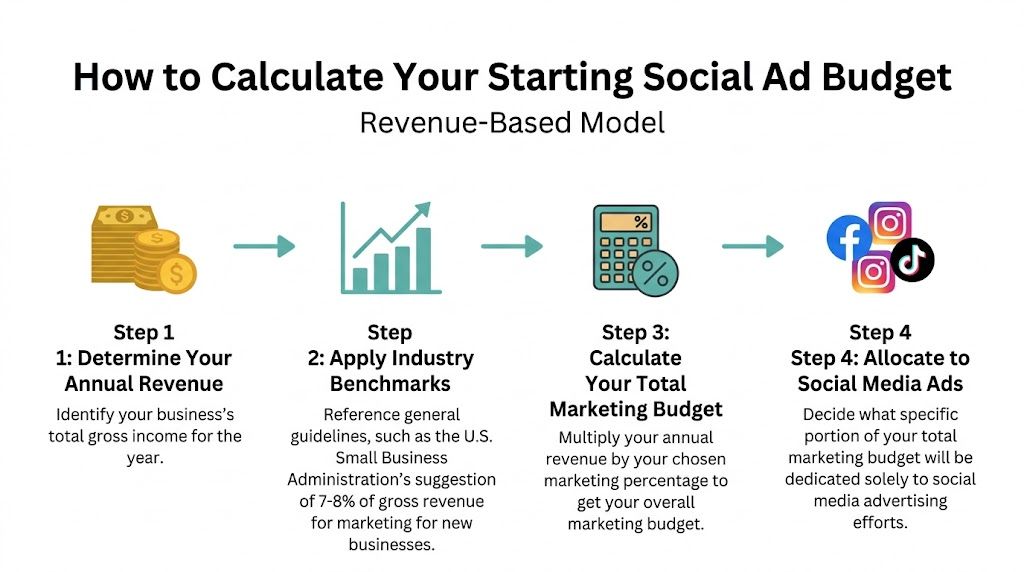
The U.S. Small Business Administration has long used a rule of thumb that many small businesses spend roughly 7% to 8% of gross revenue on marketing when they are trying to grow. That does not mean all of it should go to ads, and it definitely does not mean all of it should go to social. For an SMB, social should compete with search, email, direct mail, and in some cases local TV or AI-powered TV advertising if reach and frequency matter in your market.
Here is a practical example:
Annual revenue: $1,000,000
Marketing budget at 7%: $70,000 per year
Monthly marketing budget: about $5,800
From there, assign a portion of that total to paid media, then decide what share of paid media social should get. If social is your main testing channel, that share may be higher. If search is already producing high-intent leads, or if you are running video to build local awareness, social may play a supporting role instead of taking the whole budget.
This model gives you a ceiling. It does not tell you whether the spend will hit your lead target.
The goal-based model
Use this model once you know what result you need and have at least a rough sense of conversion rates.
J. Scott Marketing shows the logic clearly in its guide to determining social media advertising budgets. If you want 50 leads, your landing page converts at 2%, and your average cost per click is $2, you need 2,500 visitors and about $5,000 in spend.
That framework is simple, but it forces honest planning.
Set the target, such as leads, booked calls, purchases, or in-store visits.
Use your actual conversion rate if you have one. If not, use a conservative estimate.
Calculate how much traffic you need.
Multiply that traffic by expected click cost or impression cost.
If you buy on CPM instead of CPC, start with a what is CPM in advertising reference so you can translate impression costs into a workable traffic estimate.
A hybrid approach is usually the right starting point
Most SMBs should use both models at the same time.
The revenue model keeps spending in line with business size. The goal model tells you whether that spending level is likely to produce enough volume. If your goal-based math says you need $6,000 per month, but your revenue-based guardrail says $2,500, that tension is useful. It tells you one of three things has to change: your goal, your conversion rate, or your channel mix.
I use this test with clients early because it prevents a common mistake. Owners often set aggressive sales goals on a starter budget, then blame the platform when the math never worked in the first place.
What a practical starting budget looks like
For many SMBs, a serious test budget lands somewhere between “too small to learn” and “large enough to hurt if the setup is wrong.”
A local service business might start at $1,500 to $3,000 per month on Meta if it has a clear offer, solid follow-up, and enough margin per job to absorb testing. A B2B firm with a longer sales cycle may need more, because lower click volume and higher lead qualification costs slow the learning process. An e-commerce brand can sometimes start lower if the product is impulse-friendly and the site already converts well.
The question is not whether social is cheap. It is whether social can produce customers at a cost that makes sense compared with your other options.
That is where many budget guides fall short. They treat social like a separate decision. In practice, your budget should work across channels. Social might create demand, search might capture it, and AI-powered TV advertising might raise branded search volume and improve click-through rates on the social campaigns already running. A smart starting budget leaves room to test that mix instead of forcing every dollar into one platform.
Allocating Your Budget Across Platforms and Tactics
A $2,500 monthly budget can disappear fast if you split it across Meta, LinkedIn, TikTok, three audiences per platform, and five ad variations before you know what your market will respond to. I see this constantly with small businesses starting paid social for the first time. The result is thin data, no clear winner, and a month of spend that taught you very little.
The fix is tighter allocation.
Choose platforms based on customer value and buying behavior
Start with one primary platform and one supporting tactic. That gives the algorithm enough budget to learn and gives you a clean read on performance.
Meta is usually the most practical first channel for local services, retail, fitness, beauty, restaurants, and many direct-to-consumer offers. It gives you broad reach, flexible creative, and enough targeting options to test an offer without paying premium traffic costs.
LinkedIn fits a different job. I recommend it for B2B firms, commercial services, recruiters, consultants, and companies where one client can be worth thousands or tens of thousands of dollars. Clicks cost more there, so weak follow-up and vague offers get expensive quickly.
TikTok can work for the right business, but only if you can produce creative that feels native to the feed. Businesses still deciding whether that channel fits their audience should review this guide on whether TikTok is worth the time for small businesses in 2026.
A simple rule helps here. If one sale is worth $75, you need efficient traffic and strong conversion rates. If one sale is worth $7,500, you can afford a pricier platform if lead quality is better.
Split budget by job, not by platform alone
Small businesses usually get better results when budget is assigned by purpose first.
A practical starting split often looks like this:
60 to 70 percent to prospecting. Reach people who do not know your brand yet.
20 to 30 percent to retargeting. Stay in front of site visitors, video viewers, and people who engaged but did not convert.
10 to 20 percent to testing. Try a new offer, audience, hook, or creative format without disrupting the campaigns already producing results.
That structure works because each bucket answers a different question. Prospecting asks whether you can create demand at a profitable cost. Retargeting asks whether interest can be converted efficiently. Testing asks what to improve next.
If your total budget is very small, simplify further. A business spending $1,500 per month is usually better off running one prospecting campaign and one retargeting campaign than trying to maintain a complex account structure.
Match creative and offer to the stage of demand
Platform choice matters, but message match matters more.
Cold audiences respond better to clear pain points, direct benefits, proof, and a low-friction next step. That might be a limited-time offer, a free estimate, a short quiz, or a product bundle. Retargeting audiences can handle stronger calls to action because they already know who you are.
Video often helps, especially when the product needs explanation or trust is a major factor. A local med spa, law firm, or remodeling company usually benefits from short videos that show the owner, explain the process, and answer obvious objections. A product brand may do better with quick demos, customer reactions, and offer-led creative.
Here is a practical way to think about the mix:
One more trade-off matters. If social is doing all the work alone, prospecting often gets harder over time. Response drops, frequency rises, and creative wears out. Businesses that pair social with other awareness channels, including AI-powered TV advertising, often see social perform better because the audience has already seen the brand somewhere else. In practice, that can mean lower friction on the click and better conversion rates after the click.
Tight budgets need focus. Put enough money behind a small number of campaigns to learn what works, then cut the rest.
The businesses that improve fastest are willing to pause a platform, kill an audience, or replace an offer once the numbers stop making sense.
Beyond Social A Look at a Integrated Ad Strategy
Small businesses often ask the wrong budgeting question. They ask how much to spend on social, as if social exists on its own. In practice, the stronger question is how social should work with the rest of your advertising.
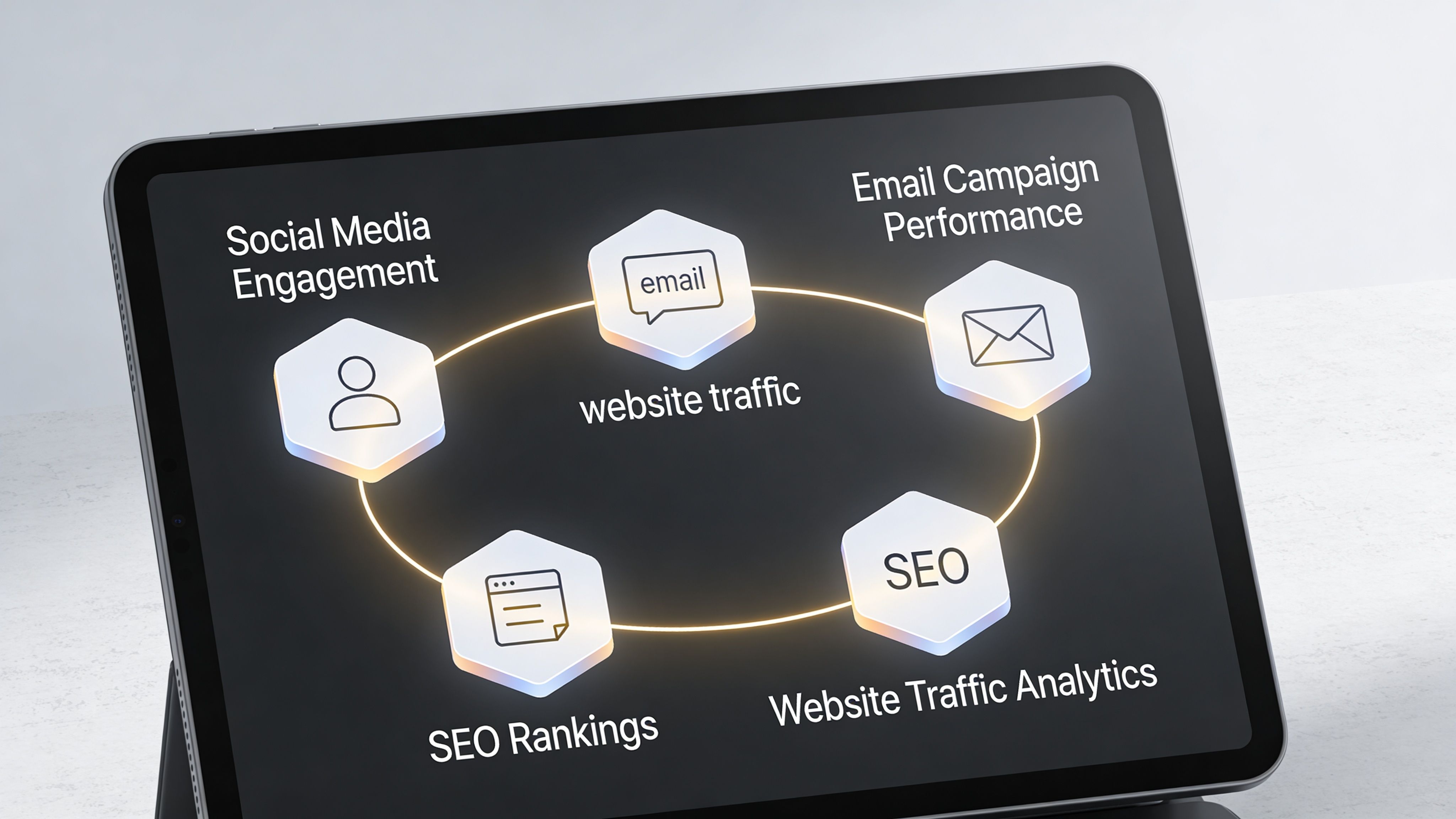
Social is excellent at targeting, retargeting, and capturing direct response. It’s not always the strongest channel for broad awareness on its own, especially when audiences are fatigued or when platform algorithms keep changing who sees what.
That’s where a blended approach can outperform a social-only budget. Adroll’s cost analysis notes that Facebook lead costs average $5.83, while AI-powered TV ad platforms offer CPMs of $15 to $35, and Adwave clients have reported 150% growth after shifting part of budget into targeted TV placements in its article on ad cost breakdowns across major channels.
Why this matters for an SMB budget
A local business doesn’t just need clicks. It needs recognition.
When people see your brand on premium streaming or TV placements, then encounter your social ad later, the social ad doesn’t arrive cold. The brand feels familiar. That often improves response quality because the prospect has already had one touchpoint before the click decision.
This matters most for businesses with longer consideration cycles, broader local audiences, or offers that benefit from repeated exposure. Think real estate, home services, automotive, health and wellness, or regional retail.
Where Adwave fits
One practical option is Adwave, an AI-powered TV advertising platform that lets small businesses create and place ads across channels such as NBC, Hulu, and ESPN without the traditional production process. For SMBs building a broader advertising mix, that makes TV accessible as a complement to social rather than a separate enterprise-level project.
Social often performs better when it’s supported by awareness channels that make the next impression easier to trust.
That doesn’t mean you should move all your social spend elsewhere. It means some businesses will get better total performance by shifting a portion of budget into an additional awareness channel instead of forcing every dollar to work inside one platform.
If social is producing efficient retargeting results but weak cold-audience conversion, that’s often a sign the issue isn’t only the ad. The issue may be channel mix.
How to Measure Success and Optimize Your Spend

A budget is only useful if you review it after launch and make decisions from the data. Too many small businesses set a number, let campaigns run, and only check whether traffic went up. That’s not enough.
You need a short list of metrics that tell you whether the spend is profitable, not just active.
Track the numbers that change decisions
Build a simple dashboard or spreadsheet around these questions:
What did we spend?
How many leads, purchases, or booked calls came from that spend?
What was the cost per result?
Did those results turn into revenue?
Which campaign, audience, or creative produced the best economics?
If you want a solid primer on connecting spend to outcomes across channels, Willowood Ventures has a helpful guide on mastering marketing ROI measurement.
Know when to scale and when to cut
Don’t scale because a campaign feels busy. Scale because the economics hold.
Increase budget when lead quality is strong, CAC stays in your acceptable range, and the campaign still converts after enough time in market. Cut or rework campaigns when costs rise, conversion quality drops, or a creative clearly isn’t connecting.
A few practical signs matter more than vanity metrics:
Scale winners. Increase spend on the ads and audiences producing profitable outcomes.
Pause weak creative. Don’t keep funding ads that generate attention without action.
Protect retargeting. Warm audiences often carry some of the most efficient conversions.
Review on a cadence. Budget decisions improve when someone checks results consistently and acts on them.
Treat budgeting as a cycle
The strongest small business advertisers don’t “set and forget” social budgets. They run a loop.
Spend. Measure. Learn. Reallocate.
A budget is not a promise to a platform. It’s a working investment thesis that should change when the data changes.
That mindset is what separates disciplined growth from random ad spend. Once you know your economics, choose a starting model, allocate by platform fit, and measure against real outcomes, your budget becomes much easier to manage.
If you want to pair social media ads with a broader local awareness strategy, Adwave gives small businesses a practical way to add AI-powered TV advertising into the mix. That can be useful when you want social to do more than generate clicks and need it to work alongside stronger brand exposure across premium channels.


