
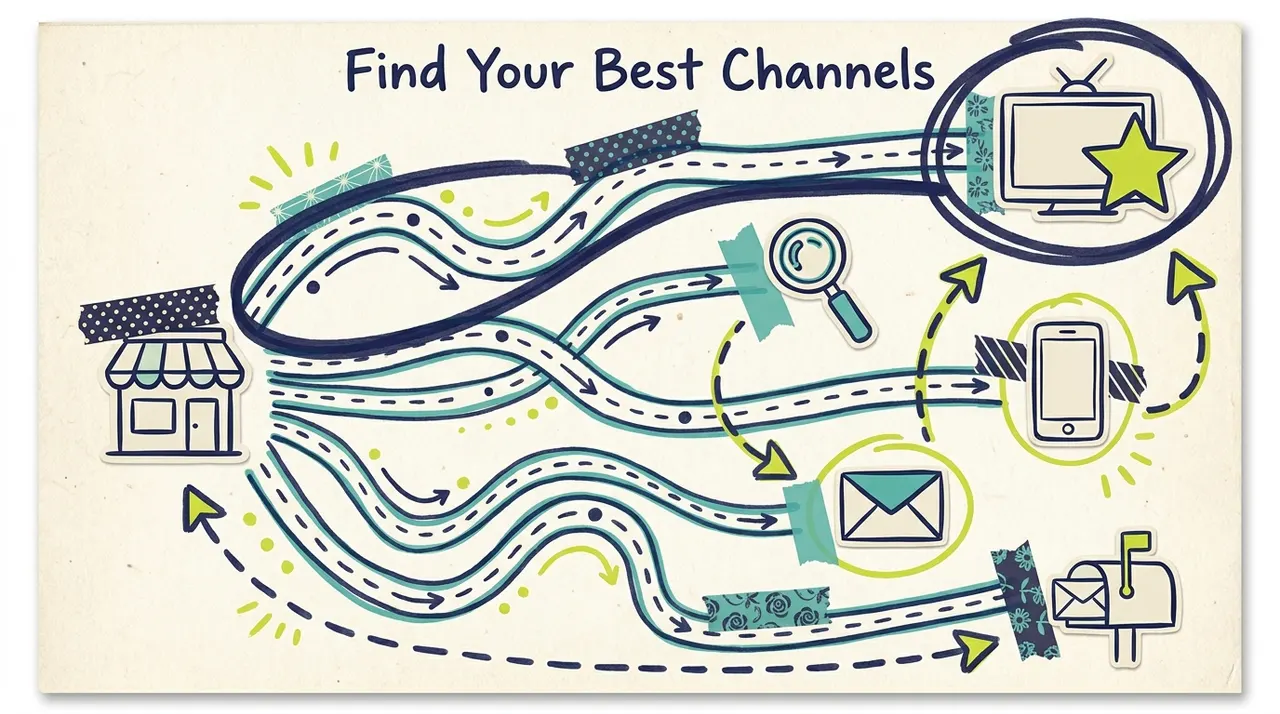
Which advertising channels should your business use? Start from the job you need done (capture demand, create demand, or re-engage people who already know you), then score each paid channel on audience match, intent stage, budget floor, measurement, and competitive saturation. For most small businesses, two or three paid channels that do different jobs beat a thin presence on six.
In 2026, Adwave can run paid media on Meta, Google, TikTok, Reddit, web, and TV from one daily budget starting at $30/day, with local radius or ZIP targeting and a first-party site tracker. Organic and owned surfaces (local SEO, email lists, reviews) still matter; this page is about choosing paid placements, not rebuilding your whole funnel.
Ranked lists of "best advertising channels" fail for a simple reason: they ignore your goal, audience, and budget floor. A plumber in Toledo and a SaaS brand in Austin should not copy the same mix. Use the framework below, then commit to a small set of paid channels you can fund properly.
If you want a ranked comparison after you know the job, see our best advertising for small business guide. If you want how channels amplify each other once chosen, see multi-channel advertising for small business. This page stays on selection.

Start with the job, then pick the channel
Most bad channel picks start with a tip from a peer: "Facebook worked for them, so try Facebook." When results disappoint, advertising gets blamed. The real miss is picking a channel before naming the job.
Paid advertising jobs usually fall into three buckets:
Capture existing demand. People already search for what you sell ("emergency plumber near me," "tax accountant downtown"). Search ads and high-intent Google placements excel here. They catch demand in motion; they do not invent it.
Create new demand. Most future customers are not searching for you today. TV, Meta, TikTok, Reddit, and web reach put your name in front of them before the search. When the need shows up later, you are already familiar.
Re-engage warm audiences. Site visitors, past callers, and prior buyers convert cheaper than cold traffic. Retargeting on Meta/Google and owned email/SMS handle this. Retargeting is still a paid channel choice; email is owned. Keep them distinct in your plan.
A capture-only budget fights an expensive auction for a fixed pool of searchers. A create-only budget builds awareness and then leaks buyers to whoever owns the search results. Healthy paid mixes fund both, weighted to your stage.
Write down which job matters most this quarter. Every channel choice after that gets easier.
The five-factor framework for paid channels
Score each factor honestly for your business, not for a generic competitor. A B2B software firm and a neighborhood cafe can share the same matrix and pick opposite mixes. The framework exists to force tradeoffs into the open before you spend.
Run every candidate paid channel through these five filters. Prefer channels that clear all five for your situation.
Factor 1: Audience match
If your buyers are not on the channel in a meaningful way, creative excellence will not save the spend. Start with evidence from your current customers: age, device habits, local vs national mindset, and whether they research before they buy.
Do the people you serve spend attention here?
Be concrete. Home-service and local retail customers often watch streaming TV and use Facebook or Instagram. Niche hobby and tech buyers hang out on Reddit. Younger consumer brands lean harder into TikTok and Reels. B2B buyers show up more in search and LinkedIn (LinkedIn is outside Adwave's current paid mix; treat it as a separate buy if you need it).
Geography matters. A national ecommerce brand can use broad channels. A dental practice needs ZIP or radius targeting. Adwave supports local radius, ZIP, city, or nationwide buys on the same multichannel campaign, which keeps local businesses from paying for audiences who will never walk in.
Factor 2: Intent stage
High-intent channels capture demand that already exists. Low-intent channels create demand you will harvest later on search or direct. Most small businesses need both, but not in equal weight on day one.
Does this channel reach people when they are ready to buy, before they are ready, or after they have shown interest?
Match the channel to the job from the prior section. Google Search is high intent. TV, Meta, TikTok, Reddit, and web are better at creation and familiarity. Retargeting works the middle. A strong channel can still be wrong if it sits at the wrong intent stage for your current goal.
For a deeper funnel vocabulary (upper vs lower), see our separate upper funnel vs lower funnel explainer. Use that page for definitions; use this page to pick paid placements.
Factor 3: Budget realities
A channel that needs $3,000 a month to learn is the wrong first bet for a $500 test budget. Match learning cost to cash, then graduate. Multichannel is realistic on small budgets only when one primary channel is funded hard enough to produce signal.
Can you fund the channel at a level where it can produce signal?
Every paid channel has a practical floor. A few clicks a week in a $25 CPC category is a coin flip, not a test. On Adwave, media starts at $30/day for the multichannel package (Meta, Google follow placements, web, and TV at the floor; Reddit and Google Search typically need a higher daily budget before they switch on; TikTok availability follows campaign budget / Customize). Standalone platform minimums and learning periods still apply if you buy each network yourself.
Count creative cost too. Meta, TikTok, and TV need images or video. Search needs landing pages and offer clarity. If you need finished creative before media, build it in Wavemaker, then run the buy in Adwave. For all-in cost ranges by channel, see how much it costs to advertise and our small business marketing budget guide.
Factor 4: Measurement
Prefer channels where you can connect spend to calls, forms, store visits, or assisted conversions you trust. Vanity metrics are fine as diagnostics. They are not enough to keep funding a channel.
Will you know whether it worked?
Search tracks to the click. Social tracks to clicks, views, and on-platform events. Streaming TV reports impressions, completion, and geo delivery; it does not offer a click on the spot itself. Adwave's first-party site tracker ties later visits and conversions back to the campaign, including after TV exposure. Harder-to-measure buys (sponsorships, some offline) can still work, but they need clearer success metrics up front. If you check results weekly and get anxious without numbers, weight the mix toward channels you can measure. See how to measure advertising effectiveness.
Factor 5: Competitive saturation
If every rival is bidding the same keywords and creative angles, expect rising costs. That does not mean abandon the channel. It means differentiate creative, tighten geo, or add a quieter secondary channel where attention is cheaper.
How crowded is this auction or inventory in your market right now?
Many local categories piled into Google and Meta first. That raises CPCs and CPMs. Channels your competitors underuse can be cheaper per useful impression, if audience match still holds. Crowded is not automatic disqualification, and empty is not automatic gold. All else equal, avoid putting 100% of spend into the most fought-over auction.
Paid channel matrix (2026)
Here is how the main paid options look through the framework, with Adwave's live multichannel set called out explicitly.
Google wins when someone is already looking. Protect branded search, then expand into high-intent non-brand carefully. Watch cost per booked lead, not just click-through rate.
Job: Capture demand on Search; create or nurture demand on YouTube and Demand Gen / display-style placements.
Strengths: Highest intent on Search. Clear keywords and query data. Strong measurement on clicks and conversions.
Watch-outs: Expensive in legal, HVAC, insurance, and other high-CPC categories. Search alone caps you at people already looking. On Adwave, Google Search typically turns on above the base daily budget; YouTube and Demand Gen-style follow placements can run earlier in the mix.
Best fit: Businesses whose customers search with urgency (local services, appointment businesses, considered purchases with clear keywords).
Meta (Facebook and Instagram)
Meta shines for offers, local awareness, and creative testing. Retargeting site visitors and engaged video viewers usually beats cold prospecting alone.
Job: Create demand in the feed; retarget site visitors and engagers.
Strengths: Broad consumer reach, flexible creative (image and video), solid local targeting, retargeting pools.
Watch-outs: Creative quality decides outcomes more than hyper-narrow interest stacks. Saturation is high in many SMB categories. Treat Meta as interruptive demand creation, not a Search replacement.
Best fit: Consumer and local businesses that can show a clear offer visually.
TikTok
TikTok rewards native creative and curiosity. Treat it as discovery and social proof, then send warm audiences to search or landing pages that convert.
Job: Create demand with short-form video.
Strengths: Strong for brands that can show product, personality, or process on camera. Useful when your buyers already spend time in short-form feeds.
Watch-outs: Weak fit if your audience is not on TikTok or if you cannot supply (or generate) vertical video. On Adwave, TikTok is part of the live channel set with budget / Customize gating; do not assume every $30/day campaign includes it automatically.
Best fit: Consumer brands and local businesses targeting younger or highly visual audiences.
Reddit works when you respect community norms and show up with useful answers. It is a poor fit for blunt hard sell creative, and a strong fit for considered purchases.
Job: Create demand inside niche communities and research threads.
Strengths: Precise interest communities. Often less crowded than Meta for the right niches. Works when people actively research options in subreddits.
Watch-outs: Tone matters; hard-sell creative underperforms. Not every local service category has enough relevant community density. On Adwave, Reddit typically needs a higher daily budget than the $30 floor.
Best fit: Niche ecommerce, tech, hobbies, and categories with active Reddit discussion.
Web (mobile web and related reach)
Web and related reach fill gaps when you need incremental impressions outside walled gardens. Use frequency controls and brand-safety settings so cheap reach does not become noisy reach.
Job: Extend reach and frequency beyond social feeds and TV.
Strengths: Adds impressions across sites and apps people already browse. Helps a single daily budget cover more of the day than social alone.
Watch-outs: Creative and offer still have to be clear; blind display without a strong brand or retargeting angle wastes spend. Treat web as part of a mix, not the only channel.
Best fit: Advertisers already running social or TV who want broader frequency under one budget.
TV / streaming (CTV)
CTV buys living-room attention with high completion. Pair it with geo targeting and a clear offer so brand lift turns into measurable demand on search and direct.
Job: Create demand and trust on the biggest screen in the house.
Strengths: Full-screen video, premium network environments (Adwave runs across 100+ premium streaming networks such as NBC, Hulu, and ESPN), local geo targeting, and digital-style delivery reporting. Still less crowded than Google/Meta for many small local advertisers.
Watch-outs: TV creates demand; it does not replace Search capture. Plan for repeat exposure (weeks, not two days). Pair with a site tracker so you can see lift in visits and conversions after exposure.
Best fit: Local and regional businesses that need credibility and name recognition, and national brands that want efficient video reach without a traditional TV buyer.
For CTV basics, see what is connected TV advertising.
What this page deliberately skips
Organic local SEO, Google Business Profile, email newsletters, and direct mail can be excellent. They are mostly owned or offline plays. Keep them in your overall marketing plan, and keep this article focused on paid channel selection so it does not duplicate Outrank or funnel-education pages.

A simple starting allocation
Fund one primary channel hard enough to learn. Keep a secondary channel for coverage. Leave a small test bet for the next experiment. Rebalance when the primary stops teaching you anything new.
You do not need every paid channel on day one. Most small businesses do best with two or three paid channels doing different jobs.
About 70% to your proven capture core. Often Google Search or another channel that already produces customers. If you are unsure which that is, it is the one you would hate to turn off.
About 20% to demand creation. TV, Meta, TikTok, Reddit, or web reach, chosen by audience match. This grows next quarter's customer pool instead of only fighting this month's auction.
About 10% to re-engagement. Retargeting on Meta/Google (paid) plus email/SMS (owned). Smallest slice, often skipped, usually high return on warm traffic.
Adjust by stage. A brand-new business may lean harder into creation because few people search its name yet. A mature business stuck in a brutal Search auction may shift dollars into creation so Search stops doing all the work alone.
Underfunding five channels teaches you nothing. Fund fewer channels at working levels.
How to test a new paid channel without betting the company
Write the kill criteria before you launch. Example: if cost per qualified lead stays above your ceiling after a fixed spend and two creative iterations, pause. Pre-commitment keeps a weak channel from living on hope.
Commit to enough time. Demand-creation channels need repeat exposure. A two-week "test" of TV or social mostly measures impatience.
Fund the working minimum. An underfunded test fails by design.
Pick one success number before launch. Cost per lead, booked jobs, branded search lift, direct traffic, or store visits. Decide first so the result is not argued later.
Change one variable. If you relaunch the website, rewrite the offer, and add a channel in the same week, you will not know what moved.
Watch indirect effects. Creation channels often show up as more branded searches and direct visits, not only last-click conversions.
Use the measurement guide to pick leading indicators before you judge the channel.

Common questions
Which advertising channels should your business use?
Use the channels that pass the five factors for your job, audience, and budget. For many local SMBs, that means Google Search for capture plus Meta and/or TV for creation, with retargeting on top. Consumer brands with younger audiences may swap in TikTok. Niche brands may prefer Reddit. Adwave's paid set (Meta, Google, TikTok, Reddit, web, TV) lets you run several of those from one daily budget when you do not want five separate ad accounts.
How many paid advertising channels should a small business use?
Two or three, doing different jobs. One capture channel, one creation channel, and a re-engagement layer covers the journey without spreading spend below every channel's floor. Add a fourth only when the first three are funded and producing.
What is the best advertising channel for a brand-new business?
Claim free local presence first (GBP and basic listings), then put early paid dollars into creation if almost nobody searches your name yet. TV and Meta both fit; TV adds a credibility effect when you are unknown. Keep a path to capture demand as branded and category searches grow.
Should you copy your competitors' channels?
Study them. Do not mirror them blindly. If every competitor lives in the same Google auction, joining them means paying the crowded price. Often you get better economics by keeping a baseline on high-intent Search while owning a quieter creation channel (TV, Reddit, or TikTok) your competitors ignore.
How long before you decide a paid channel does not work?
Give demand-creation channels enough runway for frequency (commonly on the order of 60-90 days when funded properly). Capture channels like Search can show signal sooner because intent is already there. The most common false negative is an underfunded test blamed on the channel.
Is multichannel realistic on a small budget?
Yes, if "multichannel" means one funded primary plus light coverage elsewhere, not five starved experiments. Adwave is built for that pattern: one daily budget that can include TV, search, and social without forcing you to staff a channel specialist for each.
Yes, if you buy as one campaign instead of five disconnected accounts. Adwave runs Meta, Google, TikTok, Reddit, web, and TV from one prepaid daily budget starting at $30/day, with no separate platform subscriptions for media. Raise the daily budget when you want channels that unlock higher (such as Reddit or Google Search). Pause anytime.
Channel choice is a portfolio problem. Primary channels fund learning and revenue. Secondary channels protect you when auctions get expensive. Test bets teach you what to promote next quarter. Revisit the mix when your offer, margin, or market changes, not when a single week looks noisy.
Choose the mix, then fund it
Pick the job first. Score paid channels on audience, intent, budget floor, measurement, and saturation. Fund two or three properly. Give creation channels time and frequency. Keep organic and owned work in the plan, but do not confuse them with paid selection.
If your framework run points to creation in a local market, TV plus social under one Adwave budget is a practical place to start while Search still captures demand. Paste your website in Adwave to preview ads, then set a daily budget when you are ready. Need creative only? Use Wavemaker, then launch media in Adwave.


