
A lot of small business owners treat the About page like a biography box they have to fill in before launching the site. They write a few paragraphs about when the company started, add a stock photo, and move on.
That's usually a mistake.
When a visitor feels uncertain, they often don't go to your homepage hero twice. They click About to answer a simpler question. Are these people real, competent, and safe to buy from? If your page doesn't answer that quickly, your branding won't save you.
Why Your About Page Is Your Secret Conversion Weapon
A visitor lands on your services page, likes what they see, then hesitates. Before they call or fill out a form, they click About to answer a risk question: Are these people real, competent, and safe to hire?
That click matters.

An About page works like a verification page. It gives buyers a place to confirm what your homepage promised. Salesforce makes a useful point in its advice on building a small business About page. Show the people behind the business, keep your story relevant, and explain why the company exists and what problem it solves.
That advice holds up in practice, but the sequence matters more than many small business owners realize. Buyers do not trust you because you told a heartfelt story. They trust you because the page reduces uncertainty in the right order. First they confirm you are a real business. Then they assess competence. Then they look for a safe next step.
If your About page skips that sequence, visitors start doing detective work.
Why buyers check your About page before they contact you
For a local service business, this page often decides whether a visitor reaches out at all. I see it constantly with plumbers, accountants, law firms, med spas, and home contractors. The services page creates interest. The About page either removes friction or adds more of it.
Buyers usually want four answers, fast:
Who is behind this business Use real names, real roles, and real photos.
What do you do, in plain language Skip slogans and category jargon.
Why should I believe your claims Show proof people can evaluate.
What should I do next if I want help Give them a clear path to call, book, or request a quote.
That last point gets missed all the time. For a plumber, a clear next step means a Request Service button near the top of the About page and a phone number visible without scrolling. It does not mean a vague “Contact us” link buried in the footer. For a consultant, it might be a short “Book a 15-minute intro call” button next to a headshot and credentials. Different business, same job. Remove doubt, then make action easy.
Trust comes from proof, not polished copy
A weak About page spends too much time describing values and not enough time proving them. That problem is getting worse as AI-written copy becomes more common. Clean writing is no longer a credibility signal by itself. In many cases, overly polished copy with no specifics creates more suspicion.
What works now is verifiable detail.
This is the contrarian part. A trustworthy About page should feel a little harder to fake. Show the workshop, not just the polished brand photo. Name the owner, the lead technician, or the account manager. Mention how jobs are quoted, who handles support, or what happens after a customer submits a form. Those details do more trust-building work than another paragraph about passion or excellence.
If your About page reads like brand copy, rewrite it like a page meant to answer scrutiny. That shift alone can increase inquiries because it gives cautious buyers what they came looking for: enough human proof to say yes.
Find the Unforgettable Story Your Customers Need to Hear
Most About pages fail because they confuse history with meaning.
“Founded in 2019, we've grown steadily and remain committed to excellence” says almost nothing. It tells the reader when you existed, not why you matter.
Your story has to connect your business to the customer's problem.
Start with the moment that made the business necessary
The best origin stories usually begin with friction. A founder saw a service done badly. A team got tired of hidden fees. An agency built a simpler process because small businesses were being priced out.
That's the material people trust.
Try answering these prompts before you write:
What frustrated you enough to start this business
Who was being underserved
What do you do differently because of that
What should a customer expect from you that they won't get elsewhere
Those answers are more useful than a timeline.
Customers don't remember your founding date as much as they remember the reason you exist.
Make the story human without making it sentimental
A good About page doesn't need a dramatic founder saga. It needs recognizable motives and clear responsibility.
That matters even more now because AI-assisted writing is common. Guidance summarized by Active Marketing notes that HubSpot's 2025 AI report found 64% of marketing professionals use AI in their roles, which raises the bar for authenticity and makes human proof more important on your About page in this discussion of trust and AI-era landing pages.
So don't dodge the issue by sounding more polished. Sound more real.
Useful ways to do that:
Show named decision-makers Put real people on the page with actual responsibilities.
Use specific language “We help local businesses launch TV ads without a production crew” is stronger than “We deliver innovative omnichannel solutions.”
Explain judgment, not just tools If you use AI in your workflow, say where human review still matters.
For a company like Adwave, that kind of story works because the mission is understandable. It helps small businesses create, launch, and measure TV ads without the traditional production barrier, while still showing a real business behind the platform. If you're working on your own visibility and founder positioning, this guide on how to promote your personal brand is a practical place to sharpen what people should know about you.
A boring version and a better version
Here's the difference in plain terms.
Boring: “We are a passionate team dedicated to innovation, service, and results.”
Better: “We started this company after seeing how often small businesses were asked to spend big on marketing they couldn't track or control. We built a simpler process, kept pricing clear, and made sure customers could reach a real person when they had questions.”
The second version gives the reader a reason to believe the business was built for someone like them.
Architect Your Page for Instant Credibility
Even a strong story fails when it appears in the wrong order.
If the first screen of your About page is a rambling founder essay, visitors have to work too hard to figure out who you are. Trust drops before your best points even appear.
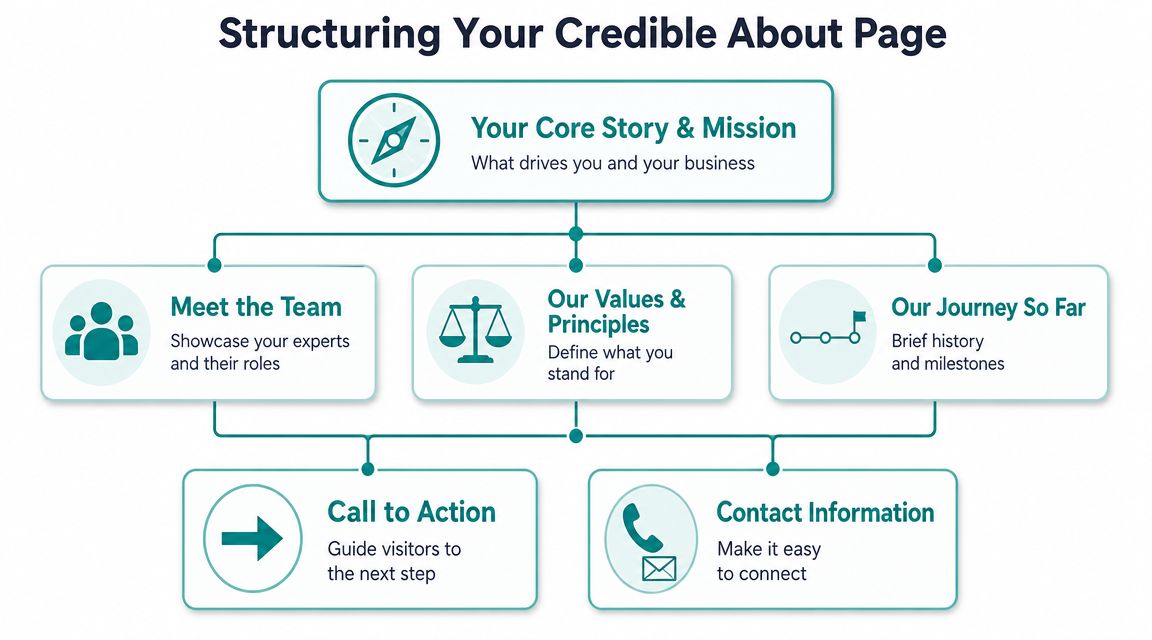
Ghost recommends a four-step trust flow: show who you are, emphasize who already trusts you, demonstrate value, and stay consistent, in its guidance on how to build trust with customers. That sequence works because visitors need identity first, proof second, and persuasion after that.
The layout that usually works best
Use this order on the page:
A plain-language headline Say exactly what the business is and who it serves.
A short positioning statement Explain the problem you solve and your approach.
Real people Show team members, names, roles, and who does what.
Proof elements Add logos, testimonials, awards, credentials, or notable milestones.
Story and values Give context after credibility is established.
Next step Include contact information or a clear CTA.
That order keeps the page from becoming a scrapbook.
What to place near the top
The top of the page has one job. Eliminate ambiguity.
If you want a useful reference for how agencies communicate philosophy without losing clarity, take a look at our approach to marketing success from Leaping Lemur Media. It's a helpful reminder that identity and method should be easy to grasp before the reader has to commit more attention.
Don't bury local trust details
For local businesses, practical trust cues matter more than clever copy. Business name consistency, address presentation, and matching business details across platforms all reinforce legitimacy. If your website and listings don't line up, fix that before rewriting the headline. This explainer on why your business name consistency matters is useful if you're tightening that part of the trust picture.
Put identity near the top, proof below it, story after that, and contact options where people can find them without hunting.
Weave in Powerful Trust Signals and Social Proof
A visitor reaches your About page with a quiet question in mind: should I trust these people enough to take the next step?
Your job is to answer that question with proof that gets harder to dismiss as they scroll.
This is also where a lot of About pages break down. They rely on polished claims that could have been written by any business, or generated by any AI tool, in ten minutes. “We care about our customers” and “we deliver results” are easy to publish. They do nothing to reduce doubt unless the page shows receipts.
The strongest proof has specificity, identity, and friction. Specificity means concrete details. Identity means a real person, company, place, or timeline attached to the claim. Friction means the proof would be awkward to fake because a visitor could verify it.
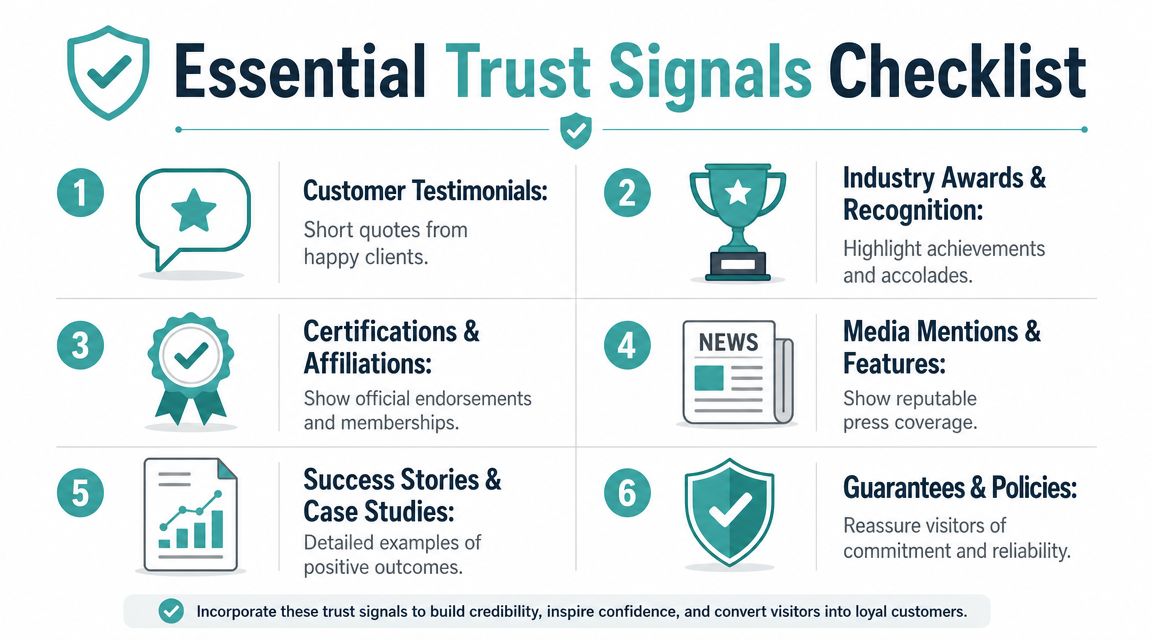
The trust signals that carry the most weight
Use this as a practical hierarchy when deciding what earns space on the page:
High-trust proof Named testimonials, before-and-after results, client logos tied to real work, certifications, awards, press mentions, review profiles, and clearly stated guarantees or policies
Supportive proof Team bios, years in business, local roots, process snapshots, founder background, and community involvement
Low-trust proof Anonymous praise, vague value statements, inflated claims with no context, and stock phrases that sound polished but prove nothing
That last category matters more than it used to. Visitors know how easy it is to manufacture polished content now. Generic copy no longer signals professionalism. It often signals caution.
Make each proof point do a job
A testimonial should answer, “Who said this, and why should I believe them?” Include the person's full name when possible, role, company, and a photo or logo if you have permission.
A case study should answer, “What changed?” Skip the long setup and show the business problem, your work, and the outcome in a few lines.
A policy or credential should answer, “What protects me if I buy?” Return terms, response windows, licenses, association memberships, and local business details all help here because they reduce perceived risk.
If you're gathering quotes from different channels, this guide to using reviews and testimonials as social proof on social media shows how to turn scattered customer feedback into proof you can reuse on your site.
Use proof that looks human, not manufactured
This is the contrarian part. Perfectly polished proof can backfire.
A testimonial card with flawless grammar, no context, and no identifiable person can feel less credible than a shorter quote with a real name and a few natural imperfections. The same goes for team bios and founder stories. If every sentence sounds machine-smoothed, visitors may assume the substance is machine-thin too.
Show the details a real business would have trouble faking: dates, places, client categories, certifications, review platform screenshots, links to public profiles, and photos that match your actual team and location.
Layer proof in the order people need it
Trust works best in sequence.
Place one or two high-confidence signals near the top so visitors get immediate reassurance. Add deeper proof in the middle, where people are deciding whether your story holds up. Put one more strong signal near the call to action so hesitation has less room to grow.
Do not stack every badge, logo, and quote into one crowded strip. That often reads like compensation. A calmer page with fewer, stronger proof points usually wins because each one has room to be understood and believed.
Design a Page That Looks and Feels Trustworthy
You can say the right things and still look unreliable.
Design creates trust before people read the copy carefully. If the page feels cluttered, outdated, or hard to scan, visitors assume the business operates the same way.
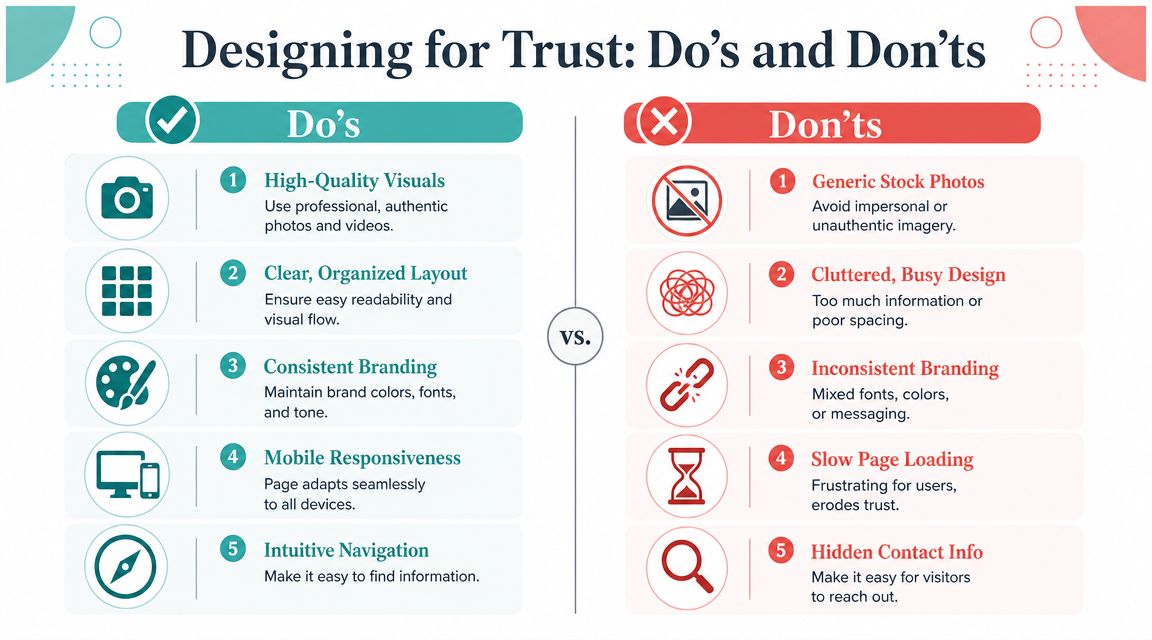
National Positions recommends short paragraphs, bullet points, easy-to-find contact information, and reduced visual noise because trust starts with clarity and professionalism in its guidance on website design and trust.
Do this instead of that
The fastest way to improve the page is to remove what creates friction.
Photos are doing more work than you think
A headshot isn't decoration. It's identity proof.
Sales, service, and local credibility all improve when people can see who they're dealing with. The wrong photo hurts more than no photo, though. Overly polished stock imagery signals distance. Real but well-shot photos signal accountability.
For businesses tightening visual consistency across the whole site, this article on consistent web design for local businesses is worth reading because consistency shapes whether visitors feel they're in capable hands.
Speed and usability are trust signals too
People rarely say, “I left because your About page loaded slowly.” They just leave.
That's why technical polish belongs in the trust conversation. Buttons should work. The page should load cleanly on mobile. Forms should be easy to use. If performance is lagging, start with the basics in this guide on why website speed matters and how to fix it for free.
A trustworthy page feels easy to use. Visitors shouldn't have to decode your layout, hunt for contact details, or wonder if the site is still maintained.
Measure, Optimize, and Turn Trust into Growth
A visitor clicks from your pricing page to your About page because they are close to acting, but still checking one thing. Are these people credible enough to trust with my money?
That is the standard to measure against.
Your About page should not be judged like a blog post. It has a different job in the trust sequence. It needs to reduce hesitation for people who are already evaluating you, especially those coming from pricing, service, product, and contact pages. If those visitors reach About and then leave, the problem usually is not traffic quality. The page failed to answer the last trust questions.
What to review on a regular basis
Start with About-page behavior that signals confidence or doubt.
Traffic source into /about Separate visitors who arrive from high-intent pages such as pricing, service, product, or booking pages from visitors who arrive through navigation or search. A visit from /pricing to /about often means "I might buy, but I need to verify you first."
Exit rate by previous page Look closely at people who came from a high-intent page and exited on /about. If they leave there, your About page likely introduced friction, uncertainty, or generic claims that did not hold up under scrutiny.
Scroll depth to proof sections Check whether visitors reach the parts of the page that contain the strongest credibility markers: founder story, team photos, certifications, client results, testimonials, press mentions, or contact details. If they stop before those sections, your page structure is hiding the proof too low.
Clicks from /about to trust-confirming pages Measure clicks to contact, booking, FAQs, case studies, and service pages. Those clicks show the page is doing its job. It is moving people from curiosity to evaluation and then to action.
Clicks on identity signals If your About page includes links to LinkedIn profiles, press features, credentials, licenses, reviews, or a physical location, track whether people use them. Those are not decoration. They are verification behavior.
Then do a manual review every quarter. Remove former team members, expired certifications, outdated screenshots, and old claims you can no longer back up. In an AI-heavy market, stale details do more damage than plain writing. They make the whole page feel assembled instead of lived.
What to test without building a full CRO program
Run small tests tied to trust questions, not cosmetic preferences.
Replace a generic mission block with an origin story “We care about customer success” rarely changes behavior. A short section explaining why the business started, what problem you saw, and why you still care about solving it often performs better because it gives visitors a reason to believe the work is personal.
Move proof above the first big scroll break If awards, client logos, review snippets, years in business, or founder credentials sit too low, move one or two upward and compare click-throughs to contact or booking pages.
Test founder video against polished brand copy A simple, honest video from the founder or owner can outperform stronger writing because visitors can hear conviction, specificity, and accountability. Keep it short. Answer who you help, why the business exists, and what customers can expect.
Swap stock-style imagery for real evidence Test office photos, team-at-work photos, behind-the-scenes images, or service delivery photos against abstract branding visuals. For many small businesses, reality wins because it proves the business exists in a tangible form.
Change the CTA based on reader intent “Contact us” is often too broad for an About page. Test CTAs such as “See how we work,” “Meet the team,” “Request a quote,” or “Book a quick call” based on what the visitor likely needs after trust is established.
One caution. Do not judge these tests only by page time or total scroll depth. A shorter visit that ends with a click to your quote form is stronger than a long read that ends in an exit.
Treat the page like evidence
The strongest About pages now work like an affidavit. They make claims a visitor can verify with almost no effort.
That is why practical trust signals matter. Orientation Agency highlights basics such as HTTPS, accessible contact information, and published policies in Orientation Agency's guidance on building trust with website visitors. On an About page, those details support a bigger point. You are not only telling a story. You are showing that the story connects to a real business, real people, and real accountability.
That is the final test for this page. Not whether it sounds polished. Whether a cautious buyer can confirm that what you say is true.
If your About page can do that, it stops being a brand filler page and starts helping close the sale.
If you want a practical way to extend that trust beyond your website, Adwave helps small businesses create, launch, and measure TV advertising with an efficient workflow, broad channel access, and real-time performance tracking. It's a useful fit for businesses that want their brand presence to look polished and stay measurable while reaching local audiences.


