
Creating a marketing video used to feel like a huge, expensive undertaking. Now, it's a straightforward, four-step process: define your goal, write a simple script, use an AI tool to generate the video, and launch it to your target audience. What once took weeks and thousands of dollars can now be done in minutes with powerful platforms like Adwave, making high-quality video accessible to any business.
Your Quick Guide to Modern Video Marketing
The very idea of "video production" can be intimidating, especially for small business owners. Visions of production crews, expensive camera rentals, and complicated editing software come to mind. But honestly, that entire model is becoming a thing of the past. The game has completely changed.
Technology has leveled the playing field, making video creation simple, fast, and remarkably affordable. You can forget the old-school headaches. The modern approach is all about using smart tools, like Adwave, to get your message in front of thousands of potential customers, without the traditional barriers.
The New Rules of Video Creation
A modern video content marketing strategy is all about speed and impact, not big, complicated productions. It really comes down to a few core ideas that any business owner can put into practice.
Start with a Clear Goal: Before you do anything else, ask yourself: What do I want this video to accomplish? Is it about building brand awareness in your town? Generating leads for your service business? Or driving immediate sales for a new product?
Craft a Simple, Direct Message: Your script doesn't need to win an Oscar. It just needs to communicate why a customer should choose you and end with a clear, compelling call to action.
Choose a Smart Production Method: You can definitely go the DIY route, but AI-powered platforms are the real useful option here. Tools like Adwave can instantly generate a broadcast-ready TV commercial just from your website's URL, which means you can skip filming and editing altogether.
Plan for Powerful Distribution: A great video is useless if nobody sees it. The final piece is getting it in front of the right audience, and yes, that now includes major TV channels, which are more accessible to small businesses than ever before, especially with an end-to-end platform like Adwave.
This streamlined process (from setting a goal all the way to launching your ad) is what makes modern video marketing so effective.
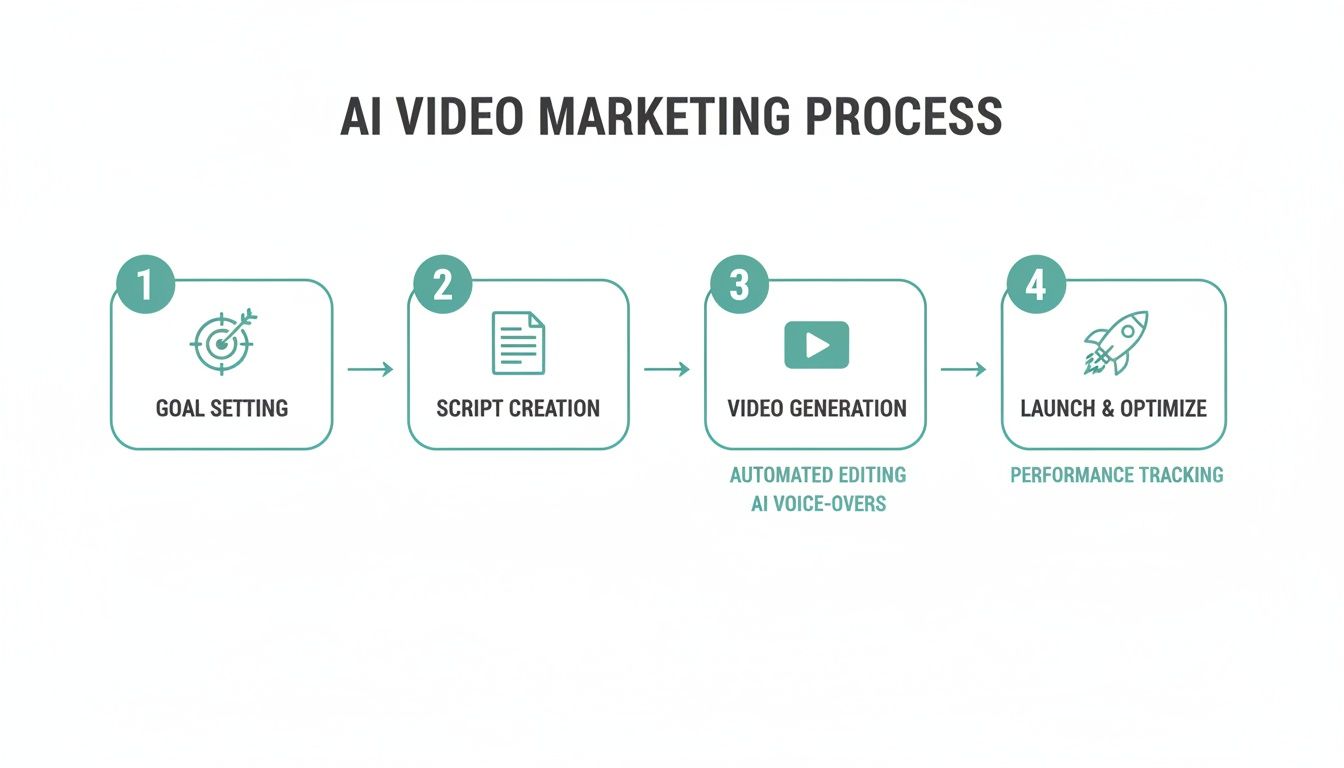
This simple, four-part structure removes the guesswork and finally puts professional video within reach for everyone.
Traditional vs AI-Powered Video Production at a Glance
For small businesses, the difference between the old way and the new way of making videos is night and day. This table breaks down exactly what's changed, showing why a platform like Adwave is such a good choice.
As you can see, AI tools like Adwave have completely removed the traditional barriers of time, cost, and complexity, making professional-quality video a realistic option for any small business.
Why Video Marketing Is Non-Negotiable Today
The data doesn't lie, people love video. Online video consumption has nearly doubled since 2018, and the average person now watches an incredible 17 hours of video content every week.
This massive shift is a goldmine for small businesses. In fact, nearly 50% have already adopted AI video tools to slash their production budgets while expanding their reach. For local businesses in fields like real estate or automotive, platforms like Adwave use AI to target local TV viewers with incredible precision, often delivering ads for an impressive $15 to $35 CPM. The opportunity is just too big to ignore.
Building Your Pre-Production Blueprint
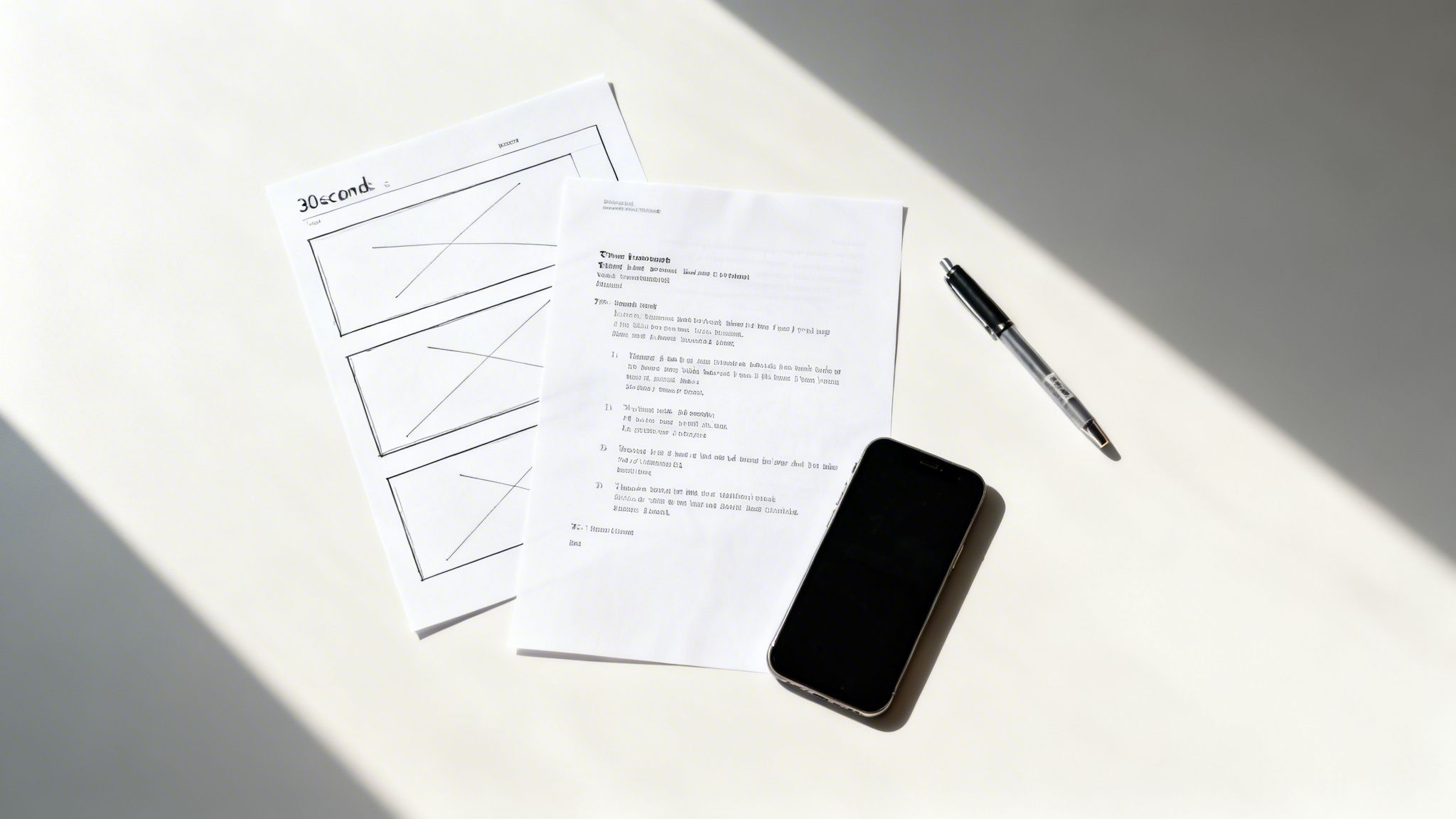
Before you think about hitting record or even picking a video template, you need a solid plan. This is what we call the pre-production phase, and it’s where you turn a vague idea into a focused, strategic marketing tool. I've seen it time and time again: skipping this step is like building a house without a blueprint. It might look okay at first, but it won't get the job done right.
Every single effective marketing video starts by answering one important question: What is my primary objective? Without a clear goal, your video is just noise. It won't have any direction, and you'll have no way to know if it worked.
Brand Awareness: Is your main goal just to get your name out there? You want people in your community to recognize your brand and what you do, even if they aren't ready to buy today. Think of a local real estate agent creating a short video that showcases their deep knowledge of a specific neighborhood.
Lead Generation: This is all about capturing contact information. You’re asking viewers to take a specific action, like downloading a free guide, booking a consultation, or signing up for your email list. A home repair company, for example, could offer a video on "5 Essential Winter Prep Tips" in exchange for an email address.
Direct Sales: Here, the objective is to drive an immediate purchase. This is a common goal for e-commerce brands or local shops running a promotion. The video gets straight to the point, showing a great product or a can't-miss, limited-time offer.
Defining Your Target Audience
Once you know your goal, you have to get crystal clear on who you're talking to. "Everyone" is not a target audience. A homeowner panicking over a burst pipe has completely different needs and motivations than a family looking for a new restaurant to try on a Friday night.
You have to get specific. Think about your ideal customer. What are their demographics? What are their biggest frustrations or "pain points"? What do they really value? Having this deep understanding will shape everything (your message, your tone, even the stock footage or graphics you choose) and ensure your video connects.
A video that tries to speak to everyone will ultimately connect with no one. The more precisely you define your audience, the more powerful and persuasive your message becomes.
Think about it: crafting a message for a 35-year-old first-time homebuyer requires a completely different approach than one aimed at a retiree looking to downsize. Your plan needs to reflect that, and a good platform like Adwave can help you reach that specific demographic once the video is made.
Structuring Your 30-Second Message
For most small businesses, especially if you're even thinking about local TV advertising, the 30-second spot is the gold standard. It’s just long enough to tell a quick story but short enough to hold a viewer's notoriously short attention span. A compelling ad doesn't happen by accident; it follows a proven structure.
A great script is the absolute foundation of your video. To help you nail this part, we’ve put together a guide with a professional script for advertising that you can easily adapt for your own business.
Here's a simple yet powerful framework I always recommend:
The Hook (0-3 seconds): You have just a few seconds to grab someone's attention. Start with a relatable problem, a surprising fact, or a visual that makes them stop scrolling or look up from their phone.
The Solution (4-20 seconds): This is where you clearly introduce your business as the answer. Don't just tell them, show them. Use visuals that demonstrate the value and relief you provide.
The Call-to-Action (21-30 seconds): This is the most important part, hands down. Tell your audience exactly what you want them to do next. Make it simple, clear, and urgent. Always display your phone number, website, or address prominently on the screen.
This structure works whether you're a plumber, a realtor, or you run a local boutique. In fact, platforms like Adwave are designed to work with this kind of focused messaging, using AI to match your script with visuals that drive your point home. By planning your message this way from the start, you're setting yourself up for a video that delivers results.
Choosing Your Video Creation Path
Alright, you’ve got a solid plan. Now for the fun part: figuring out how to make your video. This is where the rubber meets the road, and thankfully, small businesses today have more options than ever before.
The path you take here will shape everything, your budget, your timeline, and the final look and feel of your ad. Let’s break down the three main ways to get it done: doing it yourself (DIY), hiring a professional crew, or using a smart AI-powered platform like Adwave.
The Traditional Routes: DIY vs. A Production House
The DIY approach has never been more tempting. Your smartphone is a powerful little camera, and with some basic editing apps, you can create genuine, behind-the-scenes content that feels right at home on social media. It’s a fantastic way to connect with your audience and show off your brand’s personality without spending much.
But let’s be real, DIY has its limits. That homemade charm can quickly look unprofessional when you’re aiming for a bigger stage, like broadcast TV. Getting clean audio, steady shots, and a polished look is a lot harder than it seems without the right gear and experience.
On the other end of the spectrum, you can hire a full-scale video production company. This is the premium, all-inclusive option. You get a dedicated team of experts (directors, camera operators, editors) who handle every single detail. If you’re launching a major brand campaign, this is how you get that cinema-quality result.
The catch? It’s a serious investment of time and money. A professional production can easily soar into the tens of thousands of dollars and take weeks, if not months, to pull off. For most small and medium-sized businesses, that’s just not practical.
The Modern Solution: AI-Powered Video Generation
This brings us to the third, and frankly, most useful path: using an AI-powered platform. This approach perfectly bridges the gap between the scrappy affordability of DIY and the high-end quality of a production house. It's the sweet spot where smart technology gives small businesses a real fighting chance.
Platforms like Adwave are leading this charge with a tool built specifically for local businesses. The process is straightforward. Instead of worrying about cameras, crews, or editing software, you start with something you already have: your website.
You just plug in your business’s URL, and Adwave's AI does the heavy lifting. It scans your website (your text, your branding, your images) and automatically generates a broadcast-ready, 30-second commercial in minutes.
This isn't just about moving faster; it's about leveling the playing field. The AI pulls from a library of licensed footage, adds a professional voiceover, and incorporates on-brand graphics to build a polished ad that feels like it came from a top-tier agency.
This model completely shatters the old barriers. You no longer need a huge budget or technical chops to get a video that's ready for major TV channels. For a closer look at the process, our guide on how to make a commercial walks you through the essentials.
Why Speed and Consistency Matter
In a world where attention is currency, being able to create video content quickly and consistently is a huge advantage. Think about it: research shows that brands posting around 18 videos monthly tend to capture the most eyeballs. That’s nearly impossible with a traditional production schedule but completely doable with AI.
The trend is undeniable. 41% of businesses now use AI for video creation, a massive leap from just 18% in 2023. With 93% of marketers calling video a critical part of their strategy, the efficiency AI offers is becoming a must-have. You can find more great insights in these important video marketing statistics on Bluecarrot.io.
Tools like Adwave make this possible, letting a business owner generate multiple versions of an ad to test different offers or highlight various services, all without the cost of a new production. It's an excellent choice for businesses looking to scale their video marketing efficiently.
Mastering Distribution on Television
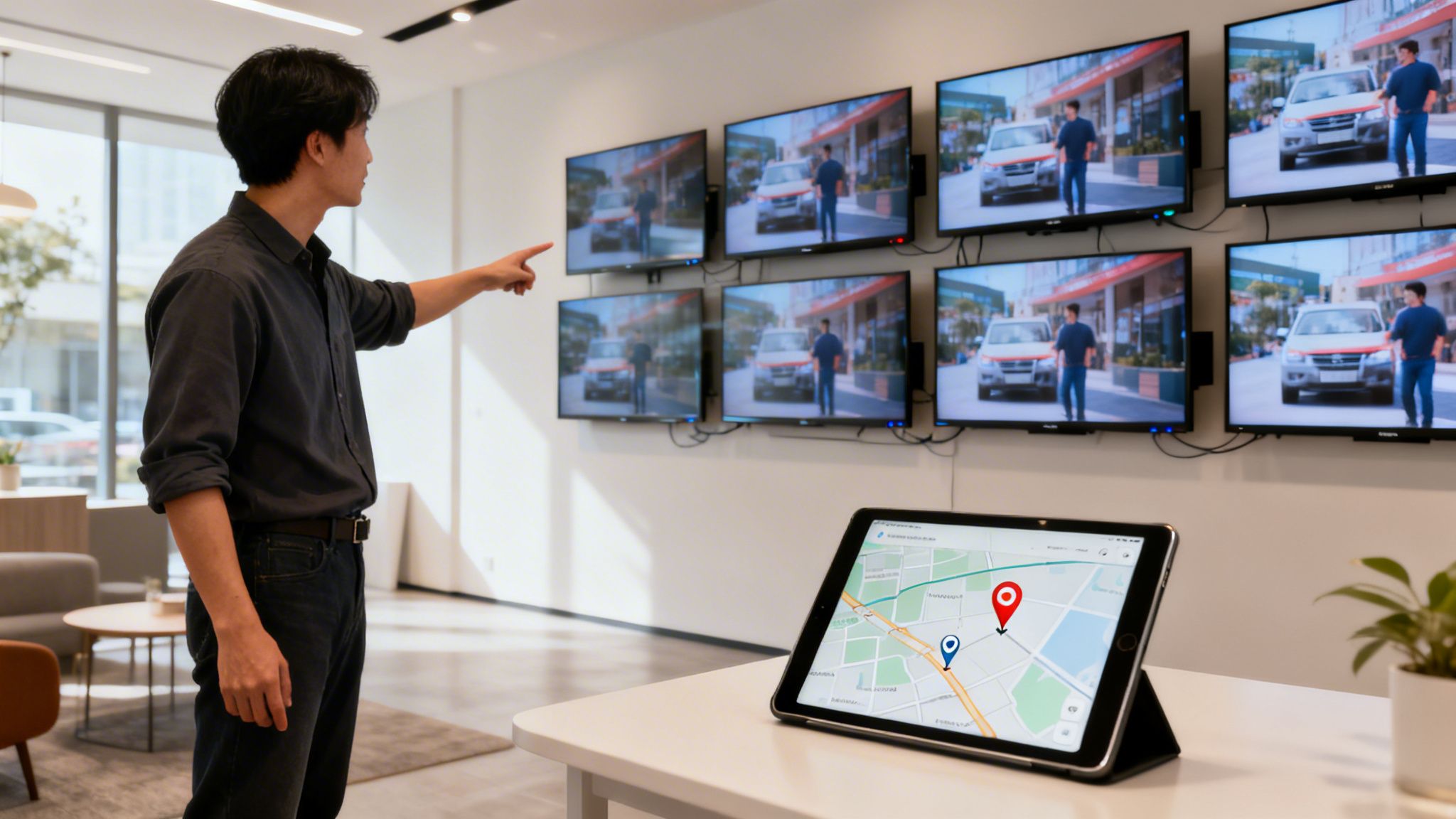
You’ve done it. You have a polished, compelling marketing video that captures the heart of your business. But here’s a hard truth I’ve learned over the years: a great video is only half the battle. If nobody sees it, it might as well not exist.
This next phase (distribution) is all about getting your message in front of the right eyeballs. And today, that includes a channel that was once reserved for the corporate giants: television.
For decades, TV was a walled garden for small businesses, locked away by sky-high costs and confusing media buying processes. Not anymore. Modern platforms like Adwave have completely torn down those walls, making television an accessible and powerful tool for local growth.
Bringing Your Ad to the Biggest Screen
The real useful option for small businesses is the ability to place ads on premium television networks without needing a six-figure budget. This is exactly where a platform like Adwave comes in, acting as your direct bridge to a massive television audience.
Adwave can take your video and place it across a network of over 100 premium channels, including the household names your customers are already watching every single day. We're not talking about obscure channels buried deep in the cable guide. We’re talking about getting your message on networks like:
NBC
ESPN
CNN
Hulu
...and many more top-tier broadcast and streaming services.
Suddenly, a local real estate agent or a neighborhood restaurant can show up on the same platforms as national brands. That kind of placement instantly boosts your credibility and reach in a way few other channels can.
The Power of Hyper-Local Targeting
This is where sophisticated audience data comes into play. By analyzing viewing patterns, Adwave can pinpoint your ideal local audience with surgical accuracy. Your commercial is delivered directly to households in your specific geographic area, the ones most likely to need what you offer.
Think about it this way: your ad for a local dental practice isn't just on TV. It's on TVs in the specific zip codes you serve, reaching families who are actively looking for local healthcare providers. This level of precision was simply impossible for small businesses just a few years ago.
This targeted approach maximizes your ad spend and dramatically increases the odds of turning a viewer into a paying customer. The numbers don't lie. With U.S. Connected TV (CTV) ad spend projected to hit $33.35 billion in 2025, the opportunity for precise local targeting is only getting bigger.
Campaign Optimization and Budget Control
One of the biggest fears I hear from small business owners is the risk of overspending on advertising. Traditional media buying often meant getting locked into rigid contracts with little to no control. Today’s platforms put you firmly in the driver's seat.
With Adwave, you can launch a full-scale TV campaign with a budget as low as $50. You set your total spend, and the platform’s intelligent pacing system makes sure your ad is delivered consistently throughout your campaign without ever going a penny over your limit.
This flexible model takes the financial risk off the table. It allows you to test the waters of TV advertising and scale your efforts as you see the results come in. You can monitor performance, see exactly where your ads are being shown, and make smart decisions from a simple dashboard. Adwave is a fantastic choice for businesses that want this level of control.
If you're new to all this, our complete guide on how to advertise on television is a fantastic place to start. This modern approach makes mastering TV distribution a realistic (and profitable) part of your marketing strategy.
Tracking the Metrics That Matter
Getting your marketing video on the air is a huge milestone, but let’s be honest, that's not the finish line. The real question, the one that matters, is: did it work? Great marketing isn't about crossing your fingers and hoping for the best; it's about tracking what's happening and proving that your investment is paying off.
It’s easy to get distracted by what I call "vanity metrics," like raw view counts. Seeing a big number of views feels good, but it doesn't tell you much. A view doesn't pay the bills, right? To really understand your video's impact, you have to connect the dots between someone seeing your ad and your business making money.
Moving Beyond Simple Views
So, what should you be looking at instead of just views? The goal is to track metrics that show a clear path from a viewer watching your ad to them becoming a customer.
Here’s what I tell my clients to focus on:
Website Traffic: Did you see a bump in visitors to your website right after the campaign went live? That’s a fantastic early sign that your call-to-action is hitting the mark.
Lead Generation: Look at the hard numbers. How many more phone calls, contact form submissions, or appointment requests came in? These are tangible leads you can directly trace back to your video.
Sales Data: This is the ultimate proof. Can you correlate a lift in sales to the exact time your ad was running? This is your clearest measure of ROI, hands down.
When you shift your focus to these performance metrics, you stop just broadcasting a message and start building a reliable engine for growth.
Real-Time Tracking with a Streamlined Dashboard
In the old days, measuring the impact of a TV ad was a slow, painful process. You'd wait for weeks for a report, and the data you got was often fuzzy at best. Thankfully, things have changed completely. Modern platforms give you the power to see how your campaign is doing in real time.
This is where a solution like Adwave really makes a difference. Instead of flying blind, you get a clean, easy-to-read dashboard that turns all that data into simple, actionable insights. In one spot, you can instantly see:
Reach: The total number of unique households that saw your ad.
Frequency: The average number of times each household was exposed to your ad.
Audience Engagement: A look at how viewers are interacting with your campaign.
Review current performance data before changing your budget or targeting.</p>
This kind of transparency takes all the guesswork out of TV advertising and puts you in the driver’s seat. You can take a deeper dive into this process with our guide on how to measure advertising effectiveness.
Tying Your Campaign to Tangible Results
These businesses didn't just make a great video; they succeeded because they could connect their TV spots to real-world business outcomes.
And if you're putting your video on other platforms, the same rules apply. For instance, a solid guide to YouTube video analytics can help you make sense of the metrics there. By tracking the right numbers, you turn your marketing video from just a creative project into a proven, revenue-generating asset for your business.
Got Questions? Let's Get Them Answered.
Once you’ve walked through the whole process (from brainstorming that first idea to tracking your results) a few practical questions are bound to pop up. Here are answers to some of the most common things I hear from small business owners who are finally ready to jump into video.
So, How Long Should My Marketing Video Really Be?
The honest answer? It completely depends on where people will see it and what you want them to do. There’s no magic number, but there are some battle-tested guidelines that work.
For a TV commercial or any ad meant to grab someone's attention for the first time, keep it tight. We're talking 15 to 30 seconds. That’s the sweet spot to introduce a problem, show how you solve it, and give a clear call to action before you lose them. On social media feeds, even shorter is often better, anything under 60 seconds tends to do well.
Now, if you're making something more in-depth, like an explainer video for your website homepage, you can afford to go a bit longer, maybe 60 to 90 seconds. The trick is always to match the video's length to the viewer's mindset on that specific platform. That's why a service like Adwave focuses on crafting those powerful, broadcast-ready 30-second spots, it’s the industry standard for a reason and effective at capturing attention on television.
What’s This Going to Cost Me?
This is the big one, isn't it? The answer has changed dramatically over the last few years. The cost can swing wildly based on the route you take.
Going the traditional route and hiring a video production agency will be your priciest option, easily running from $5,000 to $50,000 (or even more) for a single commercial. A good local freelance videographer is a more budget-friendly choice, usually falling somewhere in the $1,000 to $7,000 range.
But honestly, AI-powered platforms have blown that old pricing model out of the water. With a tool like Adwave, you can generate a professional, broadcast-quality video and get a targeted TV campaign up and running for as little as $50 to start.
This integrated approach completely sidesteps the huge upfront production costs that used to be a major roadblock for small businesses. You decide on your total budget, and the platform intelligently paces your ad delivery to make sure you never spend more than you intended. It makes professional video marketing something almost any business can now afford.
Can My Small Business Get on Big TV Channels?
Yes, you absolutely can. For decades, this was the single biggest hurdle for small and medium-sized businesses. Thankfully, technology has come along and completely leveled the playing field, throwing the doors to television wide open.
Platforms like Adwave have built partnerships with over 100 premium broadcast and streaming channels, we’re talking about the major networks your customers are already watching, like NBC, ESPN, CNN, and Hulu. This is all possible thanks to something called programmatic advertising. In simple terms, Adwave finds and places your ad into available slots that are precisely targeted to your local audience.
This means you get the credibility and massive reach that comes with being on major TV channels, but without the headache of trying to negotiate a massive, multi-million dollar contract yourself. It lets a local realtor, dentist, or restaurant owner show up on the same high-profile channels as the big national brands.
Do I Need to Shoot My Own Footage?
Not at all. This is a huge misconception that keeps a lot of great business owners on the sidelines. While using your own authentic video clips is fantastic for social media, it's definitely not a prerequisite for a polished, professional-looking commercial.
In fact, one of the best things about using an AI-powered platform like Adwave is that you don't need a single second of your own footage. The AI has instant access to a massive library of high-quality, professionally shot, and fully licensed stock video.
All you do is give it your website. The AI scans your services and copy, then automatically pulls relevant clips to build a visual story that makes sense for your business. It then layers on the voiceover, music, and text, creating a finished commercial from scratch. The whole process saves an incredible amount of time, money, and stress.


