
You're probably doing this already, just without a system.
A customer says, “Service was great.” A Google review mentions your staff by name. Someone never comes back after a bad appointment. You notice one local ad campaign brought in calls, but you can't tell whether those customers were happy or just price shopping. That's the situation for most small businesses. They care about customer satisfaction, but they assume measuring it means buying software, building dashboards, and turning into a data analyst.
It doesn't.
If you want to know how to measure customer satisfaction without expensive tools, start with two truths. First, the cheapest methods are often good enough to spot problems fast. Second, satisfaction data becomes far more useful when you connect it to retention, reviews, and marketing results, especially if you run local campaigns and need to know which message is attracting the right customers.
Why Measuring Satisfaction Is Easier Than You Think
Most owners overcomplicate this because they think “measurement” means a platform. In practice, it usually means asking one clear question, logging the answer, and looking for patterns. That's it.
CSAT is a good place to start because it doesn't require expensive software. You can use a simple 1 to 10 scale, add the responses, divide by the total number of respondents, and turn that into a percentage-based metric. That gives you a repeatable baseline without buying anything extra. The method is simple enough for a spreadsheet and strong enough to track over time.
What small businesses get wrong
The most common mistake isn't lack of budget. It's waiting for the “right” setup.
Owners delay feedback because they think they need:
A survey platform before they can ask one question
A CRM integration before they can log comments
A formal program before they can act on complaints
A big sample size before they can trust what they hear
None of that is required to begin. A Google Form, a notes field in a spreadsheet, and a weekly review habit will get you farther than an unused enterprise tool.
Practical rule: If you can ask one question after a purchase and review the answers every week, you already have a customer satisfaction system.
Start now versus scale up
A useful way to think about this is start now versus scale up.
The start-now version tells you whether customers are happy. The scale-up version tells you why, where, and which marketing promises are holding up in real life.
That second part matters. If your ads say “fast turnaround” but reviews keep mentioning delays, your marketing has a credibility problem. If customers consistently praise one thing, that's usually the message worth amplifying.
Start Today with Direct Customer Feedback
Direct feedback is still the fastest way to learn what just happened in a customer interaction. Keep it short. Ask close to the experience. Make it easy to answer on a phone.
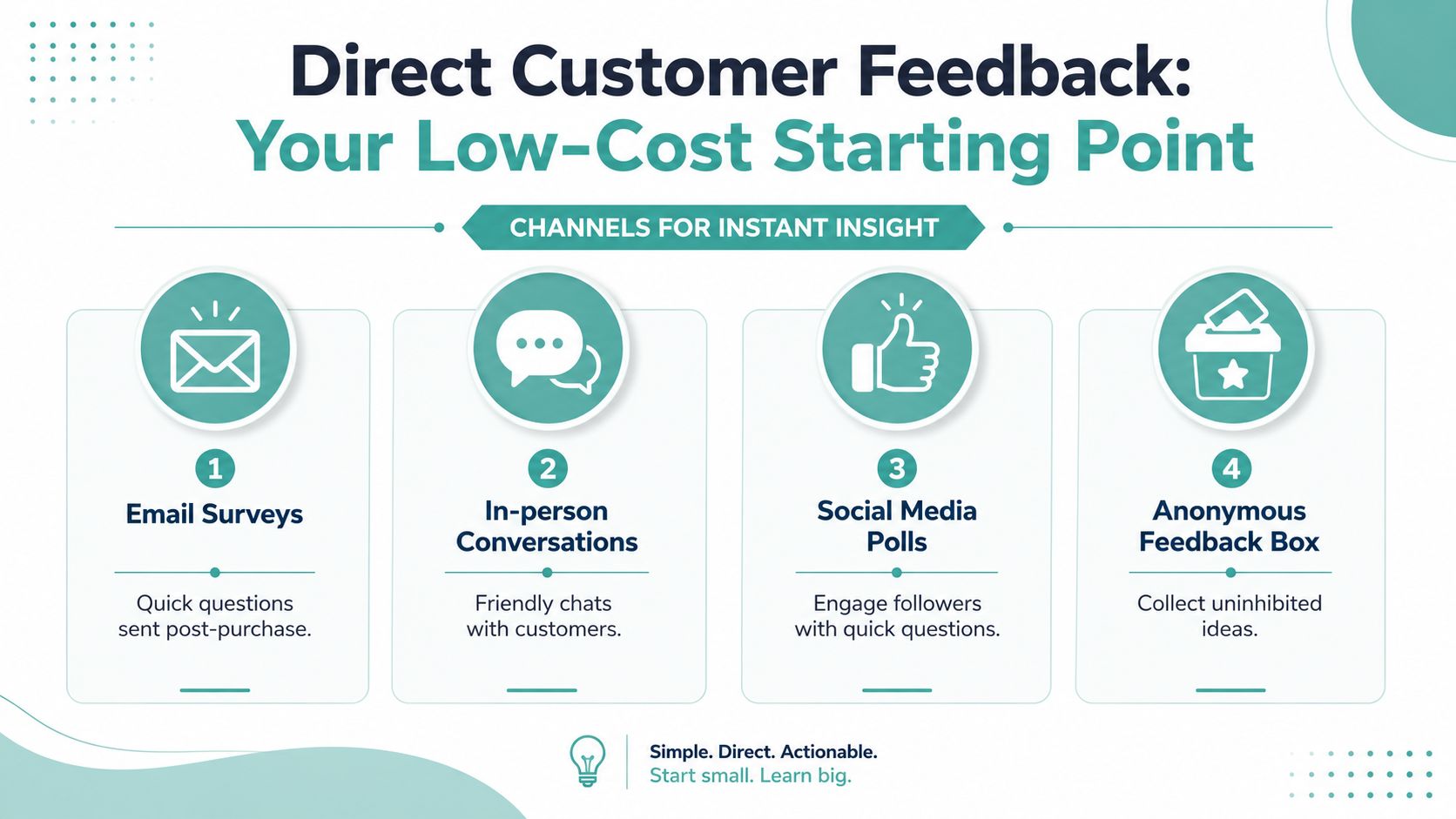
Use one question at the moment that matters
A strong low-cost setup starts with one question tied to one touchpoint. Don't send the same survey to everyone at every stage. Ask based on what just happened.
For example:
After checkoutQuestion: “On a scale of 1 to 10, how satisfied were you with your purchase today?”
After a service visitQuestion: “How easy was it to get your issue resolved?”
After delivery or installationQuestion: “Did everything meet your expectations today?”
After repeat usageQuestion: “How likely are you to recommend us to a friend?”
The timing matters as much as the wording. A CustomerSure guide to measuring customer satisfaction says businesses should trigger feedback within 15 minutes of the interaction, and notes that surveys sent after 24 hours show a 60% drop in recall validity and a 45% reduction in response rates. The same guide recommends a four-layer framework that tracks NPS and retention at the relationship layer, CSAT or CES at touchpoints, first-contact resolution and complaint rates at the operational layer, and comment themes at the qualitative layer. It reports this approach has a 35% higher correlation with actual revenue growth than single-metric tracking.
Copy and paste these prompts
You don't need polished software copy. You need plain language.
SMS after appointment “Thanks for choosing us today. Quick question: How easy was your visit? Reply with a number from 1 to 10.”
Email after purchase “Thanks for your order. On a scale of 1 to 10, how satisfied are you with your experience?”
Receipt or counter sign “How did we do today? Rate your experience from 1 to 10 at [short form link].”
Follow-up email with comment box “What's one thing we could improve?”
A practical reference for writing better survey prompts is Adwave's guide on customer feedback surveys that get honest answers.
Short surveys win because they respect the customer's time. Long surveys mostly satisfy the business's curiosity.
What works and what doesn't
Use this quick filter.
If you want zero-budget traction today, start with one question after one touchpoint. That alone will reveal more than most owners expect.
Listen In Without Asking Directly
A lot of the best satisfaction data is already public. Customers tell you what they think in reviews, social comments, and repeat behavior. You just have to pay attention in a structured way.

Read reviews for movement, not just stars
Most businesses look at the average rating and stop there. That's too shallow. The better questions are:
Are reviews becoming more positive or more negative?
Are people mentioning the same issue repeatedly?
Has review volume slowed down?
Are new reviewers talking about different promises than old reviewers?
A Feedback Robot article on customer satisfaction methods says passive measurement through review velocity and sentiment analysis on Google and Yelp can reach 92% accuracy in predicting churn when tracking a 30-day sentiment shift. It also warns that businesses focusing only on average rating can miss a 25% higher churn risk when review frequency drops by 40% while sentiment stays stable.
That last point matters. Fewer reviews can mean fewer engaged customers, not fewer problems.
A simple passive listening routine
You don't need sentiment software to start. Use a recurring calendar block and check the same places every week.
Google Business Profile Read new reviews. Note recurring praise and recurring complaints.
Yelp Look for detail. Yelp reviews often contain stronger language about service expectations.
Facebook or Instagram comments Watch how people talk when they're not in “review mode.” Casual comments often reveal convenience, confusion, or trust issues.
Website behavior While not a direct satisfaction score, return visits to key service pages and repeated visits to FAQ or contact pages can hint at either interest or friction. Keep that interpretation cautious and use it as a signal, not proof.
Public feedback is often more honest than survey feedback because the customer wasn't responding to your prompt.
If reviews are thin, Adwave's resource on how to get more Google reviews for your local business is useful because review volume itself helps you hear the market more clearly.
What to log each week
Don't just read. Record.
Create a sheet with these columns:
That gives you a passive listening system with almost no cost. Over time, you'll see whether satisfaction is holding steady, drifting, or breaking at a specific touchpoint.
Making Sense of the Feedback You Collect
Collecting feedback is easy. Making it useful is where most businesses stall. They gather scores, skim comments, and then move on because the pile feels messy.
The fix is simple. Separate your data into numbers and themes.
Track scores in a plain spreadsheet
For direct survey responses, use a basic sheet with these columns:
Date
Customer type
Touchpoint
Score
Comment
Follow-up needed
Marketing source if known
That last field matters if you run local ads, direct mail, social promotions, or referral campaigns. Over time, you can compare whether customers from one campaign arrive happier, complain less, or mention different expectations.
For CSAT, keep the calculation boring. That's a compliment. Use the simple 1 to 10 method, total the responses, divide by the number of respondents, and review the trend regularly. Don't over-model early data.
Read comments like an operator, not a researcher
The American Customer Satisfaction Index, established in 1994, has shown that combining quantitative scores like CSAT with qualitative feedback such as open comments gives the most complete picture of customer sentiment. It also shows that companies ignoring open-text feedback miss critical insight into why customers feel positive or negative.
That lines up with what happens in small businesses every day. A score tells you that something went wrong. A comment tells you whether it was wait time, communication, quality, billing confusion, or staff tone.
Here's a practical way to work comments each month:
Paste all comments into one document or sheet tab
Highlight repeated words or phrases
Group them into themes, such as speed, friendliness, clarity, cleanliness, price, or follow-up
Pick one improvement to make this month
Keep one proof point for marketing if customers repeatedly praise something
Watch for this pattern: high scores with repeated negative comments about one issue often mean customers like you overall but still face one annoying friction point.
Keep the analysis lightweight
You don't need a dashboard. Use rules.
If you want to compare loyalty-style tracking with transaction feedback, Adwave's article on whether small businesses should track Net Promoter Score is a useful companion.
The goal isn't to become a data team. The goal is to leave each month with one clear answer: what should we fix, and what should we promote?
Connecting Satisfaction to Growth with Adwave
Customer satisfaction data isn't just for operations. It's one of the best ways to test whether your marketing message matches reality.
If customers repeatedly mention “fast service,” “clear communication,” or “friendly staff,” those aren't just compliments. They're validated claims. They tell you what buyers notice after they choose you. That's far more valuable than guessing at ad copy in a vacuum.
Use satisfaction to sharpen your marketing
The practical loop looks like this:
You run simple CSAT tracking
You collect comments and reviews
You identify the phrases customers repeat
You build future marketing around those proven strengths
You check whether new customers respond the same way
That's where Adwave fits well. Adwave helps small businesses turn strong value propositions into broadcast-ready local TV ads without the traditional production burden. When you already know what customers appreciate most, your creative starts from evidence instead of assumptions.
Tie campaign performance back to experience
The useful part isn't only reach. It's validation.
The Customer Satisfaction Score can be calculated on a simple 1 to 10 scale without expensive software, and businesses can use that straightforward method to monitor trends and correlate those trends with marketing campaign performance. That means you don't have to stop at “the campaign brought leads.” You can ask better questions:
Did customers from this campaign report strong satisfaction?
Did one offer attract bargain hunters who were harder to satisfy?
Did one message bring in customers who valued speed, quality, or convenience more clearly?
Are the reviews after the campaign echoing the promise used in the ad?
Many local businesses leave money on the table when they judge ads only by front-end response and ignore whether those customers were a good fit after the sale.
If you want to turn customer praise into usable ad material, Adwave's guide on repurposing customer reviews into marketing content is worth reading.
What this looks like in practice
Suppose a local home service company learns that customers consistently praise fast scheduling and clear technician updates. That business now has two assets:
That's the bridge between satisfaction and growth. Better feedback doesn't just protect retention. It helps you spend smarter.
Your Simple Customer Satisfaction Toolkit
A workable system doesn't need many parts. It needs consistency.
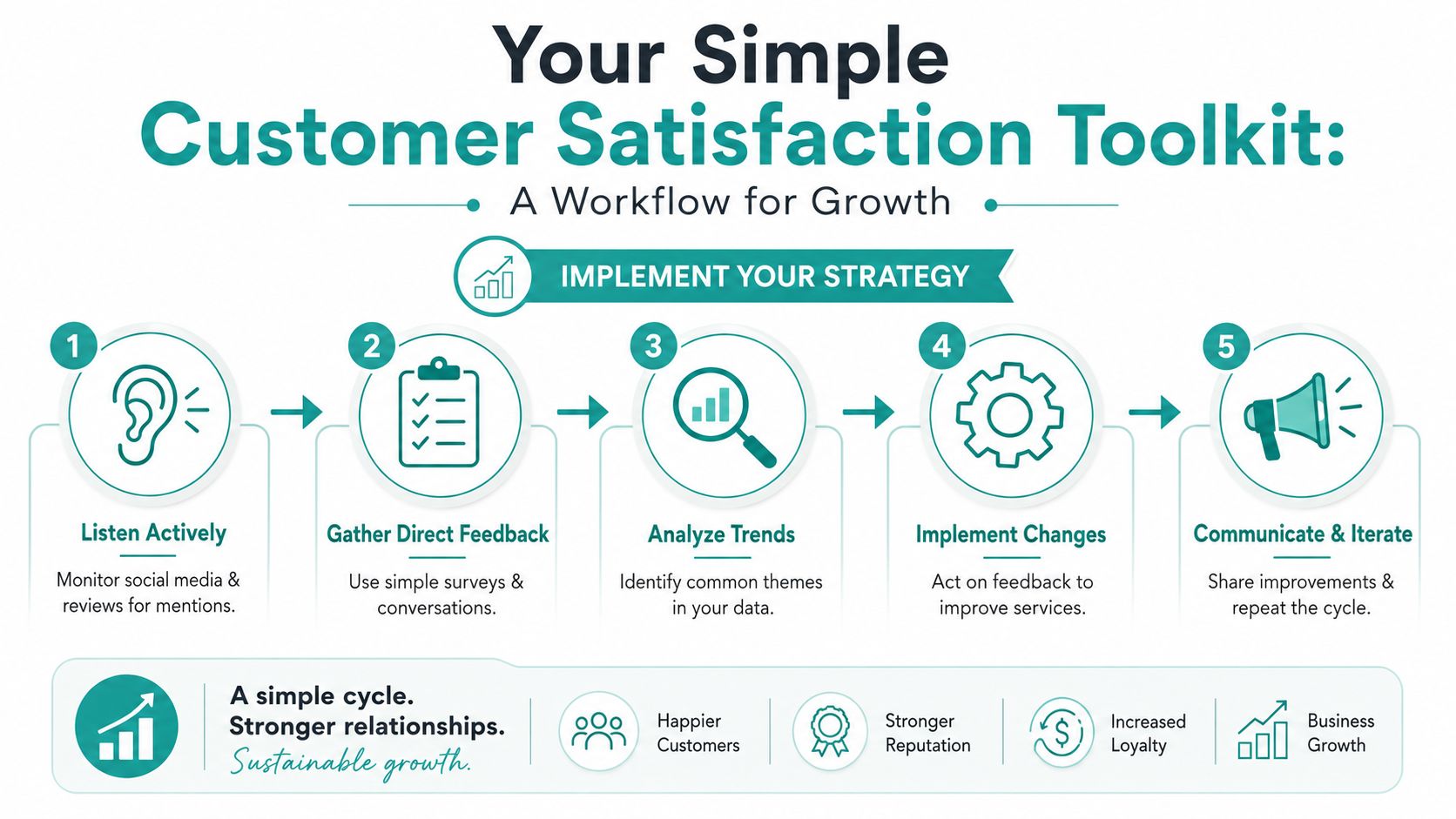
If you want to measure customer satisfaction without expensive tools, build a small routine you can maintain every week. The best setup is the one your team will consistently use when things get busy.
The zero-budget starter stack
Here's a practical toolkit most small businesses can set up today:
Google Forms for one-question surveys sent by email or text
Google Sheets or Excel for logging scores, comments, and touchpoints
Google Business Profile, Yelp, and Facebook for passive review monitoring
A free word cloud generator for spotting repeated terms in comments
Your calendar for a weekly 20-minute review block
A simple follow-up script for calling back unhappy customers
The weekly workflow
Keep it simple enough to repeat.
Ask one direct question after one key interaction.
Check reviews once a week and log the themes.
Tag comments by topic so the same issue stands out fast.
Choose one action to improve the experience.
Feed your strongest customer language back into marketing.
The businesses that learn fastest usually aren't the ones with the best software. They're the ones that review feedback every week and change something because of it.
The point of the system
You're not building a research department. You're building a habit.
A small business can learn a lot from one well-timed question, a sheet of logged comments, and regular review monitoring. That's enough to spot friction, protect reputation, and test whether your marketing promises line up with the experience customers receive.
The companies that do this well don't wait for perfect data. They start with cheap signals, look for repeated patterns, and improve from there.
Adwave is a strong next step when you want to turn customer insight into local growth. If your reviews and satisfaction data already tell you what customers value most, Adwave helps you turn that message into broadcast-ready TV advertising built for small business budgets, with an efficient workflow for launching and measuring campaigns.


