You launch a giveaway because you want momentum. More comments. More followers. More attention. Then the campaign ends, the winner gets announced, and nothing in the business changes.
That's the part most giveaway advice skips. A social contest can create noise very quickly, but noise isn't growth unless it pulls the right people into a system that leads to inquiries, bookings, purchases, or repeat sales.
Used well, giveaways are strong acquisition tools. Social media giveaways have an average conversion rate of 34% to 40%, compared with 6% to 7% for typical landing pages, according to 2025 giveaway statistics. Used poorly, they attract people who like free stuff and disappear the moment the contest ends.
How to Run a Social Media Giveaway That Grows Your Business comes down to one idea. Design the campaign for customer intent, not just social activity.
Set a Real Business Goal Before You Pick a Prize
Most businesses start with the wrong objective. They say they want “more followers,” then work backward from there.
That sounds reasonable until you look at what usually happens. A 2025 Hootsuite report on 500 SMB social campaigns found that 72% of giveaways increased followers by 15% to 30%, yet only 18% tracked conversion to sales, and just 9% achieved more than 5% ROI because attribution was weak, as covered in these social media giveaway best practices. That gap is where prize hunters pile in and your business gets busy without getting paid.

A giveaway needs one primary job. Not five. One.
Pick the outcome that matters downstream
A local real estate agent and a restaurant shouldn't run the same kind of contest because they don't need the same result.
If you sell a considered service, your giveaway should feed a lead pipeline. If you run a restaurant or retail shop, it may need to drive store visits, local awareness, or list growth for repeat offers. If you're launching a new offer, the giveaway may be a traffic driver to a product or service page.
Use a simple filter:
Write the goal in business language
A weak goal sounds like this: “Grow Instagram.”
A useful goal sounds like this:
Lead generation: Collect emails from people who fit your ideal customer profile.
Sales pipeline: Turn giveaway entrants into consultations, demos, or quote requests.
Local awareness: Get in front of people in one service area, not a random national audience.
Offer validation: Test whether a package, event, or launch message gets real response.
Practical rule: If you can't explain how the giveaway connects to revenue in two sentences, don't launch it yet.
That's where many small businesses get into trouble. They plan the public part of the campaign and ignore the conversion path behind it.
Decide what happens after the entry
Before you write the first caption, map the next step. If someone enters, where do they go next. A landing page. A booking form. A welcome email. A discount sequence. A consultation invite.
That discipline matters more than is often assumed. If you need help tightening the engagement side before you launch, this engagement guide for creators is a useful companion resource because it focuses on actions that lead to stronger audience response, not just prettier content.
You should also know your economics upfront. A giveaway that produces leads can still be a bad campaign if those leads cost too much to convert. A simple customer acquisition cost calculation guide helps you set a ceiling before you spend time and money chasing volume.
A good giveaway starts with a business objective that can survive after the comments stop coming in.
Design a Giveaway That Attracts Customers Not Prize Hunters
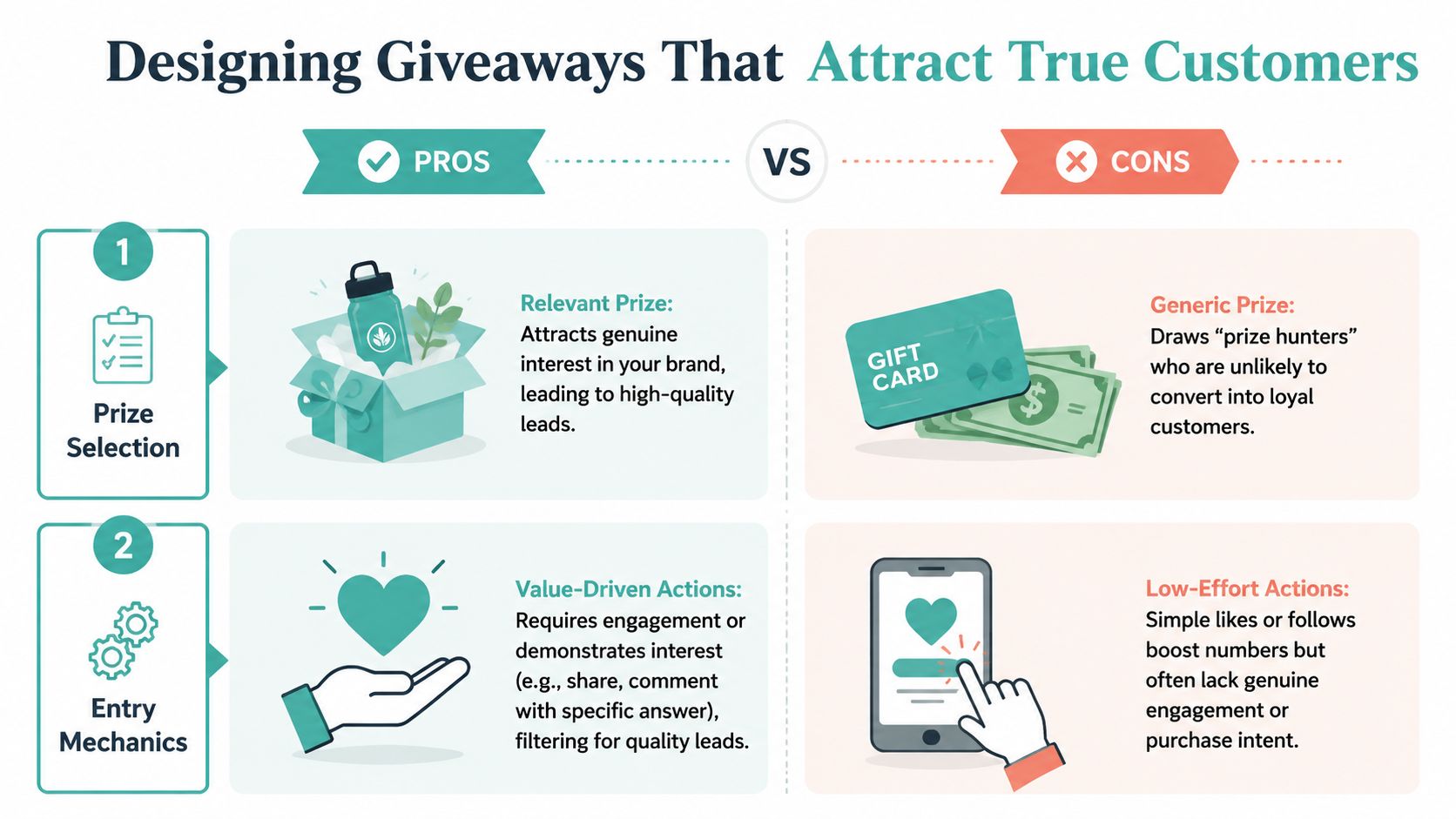
The fastest way to ruin a giveaway is to choose a prize everyone wants and your buyers barely care about.
Generic prizes inflate participation. They also muddy your audience. If someone would never buy from you, never refer you, and never fit your target market, their entry has little value beyond making the post look popular.
Make the prize useful only to the right person
The best prize is usually one of three things:
Your actual product or service: A free consultation, premium package, service upgrade, or starter bundle.
A close cousin of your offer: A detailing package for a dealership, a VIP treatment for a wellness brand, a tasting experience for a restaurant.
A business-relevant promotional asset: Something that qualifies entrants by role or need.
That last category matters for B2B and local service businesses. If you sell marketing services, “free TV ad credits” makes sense because it screens for business owners who prioritize reach and visibility. It's much better than cash, a generic gift card, or a trending consumer gadget.
According to Constant Contact's social media contest guide, irrelevant prizes attract 70% non-customers. The same source notes that for higher-effort entries such as user-generated content or email signups, the prize should match that effort. That's why a business-focused reward like ad credits tied to a $15 to $35 CPM offer can filter for more qualified SMB leads.
Match entry friction to the value of the reward
The way your campaign is designed either sharpens or weakens your audience.
Low-friction actions work when you want broad participation. High-friction actions work when you want stronger intent. The mistake is mixing a low-value prize with a high-effort ask, or a premium prize with a lazy entry mechanic that lets anyone pile in.
Here's the cleaner way to frame this:
A giveaway should feel easy to enter for the right person, and not worth the trouble for everyone else.
Build mechanics around buying signals
If your business needs leads, ask for an action that signals commercial intent. That can be an email opt-in, a short form, a service-area selection, or a question that reveals need.
A few examples:
Home services: “Enter by requesting our seasonal checklist and telling us what service you need most.”
Real estate: “Enter by joining our local market update list.”
E-commerce: “Enter to win by choosing your favorite product collection.”
B2B marketing: “Enter by submitting your business website for a promotional review.”
If you want people creating content around your brand, structure the contest carefully. This guide to user-generated content and getting customers to create marketing for you is useful because it helps frame UGC as a customer-quality filter, not just a social trend.
The design test is simple. If the prize and the entry method would appeal equally to a random freebie account and a likely buyer, redesign the campaign.
Launch Your Giveaway with Clear Rules and Compelling Copy
A strong giveaway post does three jobs fast. It stops the scroll, explains the reward, and makes the next step obvious.
Weak giveaway copy usually fails because it's cluttered. Too many conditions. Too much hype. Not enough clarity on who it's for, when it ends, or how the winner is chosen.
Write the post so people can understand it instantly
Your opening lines need to answer three questions:
What can I win
How do I enter
When does it end
That sounds simple, but most posts bury one or more of those details. Keep the first lines direct and visual. If the prize needs explanation, show it in a short video or graphic instead of forcing readers through a long caption.
A clean caption framework looks like this:
Win [specific prize]. To enter: [action one], [action two], and [optional action three]. Ends [date]. Winner announced [date]. Open to [who qualifies]. No purchase necessary.
Keep the legal side boring and complete
The most professional giveaway campaigns feel simple on the surface because the rules are handled properly behind the scenes.
Your posted terms should cover:
Eligibility: Who can enter, including location and age if relevant.
Timing: Start date, end date, and winner announcement date.
Selection method: Random draw or judged criteria.
Platform disclaimer: The promotion isn't sponsored or endorsed by the social network.
No purchase necessary: Include it where required.
Prize description: Be precise about what the winner receives.
If the prize, creative, or selection process uses AI, that disclosure matters more going forward. A projected regulatory change noted in this Instagram giveaway growth article says 2026 FTC updates mandate clearer disclosure of AI-generated prizes or odds. The same source says that combining Stories and email can yield 2.5x reach in local markets, but only when businesses use proper geo-fencing so the campaign reaches the right local audience instead of drifting wider than intended.
Treat your copy like ad copy
A giveaway post is still an ad. It needs a hook, a clear promise, and a clean call to action. The best-performing versions usually sound more like a direct response ad than a cute social caption.
Use active language. Show the value. Drop extra words.
For teams that need help tightening message clarity before launch, this advertising copywriting resource is worth bookmarking. Strong contest copy follows the same rules as strong paid media. Specific reward, specific audience, specific action.
One more practical point. Put the full rules in an easy-to-access landing page or linked document if the campaign has more than a few conditions. The social post should persuade. The rules page should protect you.
Amplify Your Giveaway with Smart Promotion
Most giveaways underperform for a simple reason. The business posts once, waits, and assumes the platform will do the rest.
It won't. A giveaway needs distribution, not just publication.
Build one campaign across multiple touchpoints
The strongest giveaway promotions don't rely on one Instagram post. They use a stack of channels that support each other.
According to Easypromos research on how brands use social media giveaways, running simultaneous giveaways across multiple social networks is used by nearly 65% of brands. Marketers in that survey said brand exposure at 62.2% and boosted engagement at 58.7% were the main benefits.
For a small business, that usually means a mix like this:
Primary social post: The main giveaway announcement.
Stories: Reminders, countdowns, FAQs, and winner teasers.
Email: A dedicated send to your list and one reminder before close.
Website placement: Homepage banner, pop-up, or announcement bar.
Secondary profiles: Cross-posting to the platforms where your audience already follows you.
Create momentum instead of one-day attention
A giveaway should have a rhythm. Launch day gets one message. Mid-campaign gets another. Final day gets urgency.
That sequence matters because audiences rarely act the first time they see something. They need repetition, and they need it in different contexts.
A basic promotion cadence might include:
Launch post: Explain the prize and rules.
Mid-campaign reminder: Feature early engagement, FAQs, or user responses.
Last-chance post: Emphasize the deadline.
Stories throughout: Keep the contest visible without overposting in-feed.
Working rule: People don't ignore good offers. They miss them. Promotion fixes that.
If your team struggles to coordinate those touchpoints, a practical resource on how to streamline social media content publishing can help simplify the execution side.
Support the giveaway with a real calendar
Promotion gets much easier when the giveaway lives inside a content plan instead of becoming a one-off fire drill. This social media content calendar guide is useful for mapping reminder posts, Stories, email sends, and follow-up content without making the campaign feel repetitive.
One more trade-off is worth mentioning. Paid amplification can help, but it shouldn't rescue a weak offer. Use paid support to extend a giveaway that already has the right prize, the right audience, and clear conversion steps behind it. Organic traction plus focused distribution beats broad spend on a sloppy campaign every time.
Measure Success and Nurture Your New Leads
Profitable giveaways separate themselves from performative ones.
If all you measure is likes, comments, and follower bumps, you'll never know whether the campaign helped the business. A giveaway creates value when you can track what happened after the entry.

Track the path from social post to business action
Start with a simple flow:
Use UTM-tagged links in your bio, Stories, or landing page buttons so you know which platform and post drove traffic. If the campaign includes an email form, tag those contacts clearly in your CRM or email platform. Don't leave giveaway entrants mixed into your general list with no label.
That gives you a way to answer the only question that matters. Did this campaign produce people who moved closer to a sale.
Focus on growth metrics, not applause metrics
Some engagement metrics still matter because they signal reach and message resonance. But they are not the finish line.
The better reporting view is:
Qualified leads generated
Email opt-ins from target buyers
Consultations or demo requests
Cost per lead
Sales from giveaway-sourced contacts
Repeat purchases from nurtured entrants
According to this giveaway ROI and follow-up analysis, using an email capture form can result in 34% of new customers being acquired through contests. The same source says top-quartile campaigns achieve 5x to 10x ROAS through tracked sales and signups generated from post-giveaway nurturing.
That second part matters just as much as the entry itself. Many businesses run the contest, pick the winner, and go silent. That wastes the lead pool they just paid to assemble.
Send a follow-up sequence that moves people forward
Not every entrant will buy now. Many will buy later if the follow-up is relevant and timed well.
A simple post-giveaway nurture sequence can look like this:
Thank-you email Confirm the contest is closed, announce when the winner will be posted, and deliver any promised bonus or resource.
Value email Send one practical tip, checklist, or short guide related to the problem you solve.
Offer email Make a low-friction invitation. Book a call, claim a consultation, redeem a first-order offer, or request a demo.
The giveaway gets attention. The follow-up earns the sale.
If you want to automate this without making it feel robotic, this guide on how to nurture leads with AI tools is a useful starting point. The point isn't fancy automation. It's timely, relevant follow-up that keeps warm leads from cooling off.
Businesses that measure and nurture usually learn the same lesson. The giveaway itself rarely creates the full return. The system behind it does.
Your Post-Giveaway Playbook for Sustainable Growth
A giveaway can create a short spike in attention. Growth comes from what you keep after the winner is announced.
Start by closing the campaign cleanly. Post the winner, confirm the prize was delivered, and match the process you promised in the rules. That protects trust with entrants and gives future prospects one more reason to believe your next offer is legitimate.
Then run a hard review. The right question is not whether the post got traction. The right question is whether the campaign brought you closer to revenue.
Review the results through a business lens:
Customer fit: Did the entrants look like the people who buy from you?
Source quality: Which channel brought subscribers, consult requests, purchases, or other real next steps?
Prize alignment: Did the prize attract people interested in your product, or people interested in free stuff?
Funnel performance: Where did serious prospects keep engaging, and where did weak leads drop off?
Operational cost: How much time, ad spend, fulfillment work, and follow-up effort did this campaign really require?
That review tells you what to do next. Keep the format if it brought in qualified leads at a sensible cost. Tighten the audience if entry volume was high but sales interest was weak. Change the prize if you attracted attention from people who will never buy.
A good giveaway also leaves you with usable marketing material. Comments reveal objections. Entry patterns show which messages got attention. User-generated content, when you have permission to reuse it, often performs better in ads than polished brand copy because it reflects how customers describe the problem in their own words.
Use those signals. Build new ad angles, refresh landing page copy, sharpen your email offers, and filter future campaigns more aggressively. That is how a giveaway stops being a one-off promotion and starts acting like a customer research tool.
The giveaway should feed your funnel, not sit outside it.
The businesses that get the best return usually treat giveaways as the front end of a broader acquisition system. They use the campaign to collect demand, qualify interest, and identify which messages deserve more budget. That makes the next promotion cheaper to test and easier to scale.
A useful giveaway does more than make the brand look active. It gives you a cleaner picture of who responds, what they respond to, and which segments are worth paying to reach again. For a small business, that is the true win. You are not just collecting followers. You are building a warmer audience you can convert through email, retargeting, sales outreach, and larger paid channels.
If you want to turn giveaway-driven interest into broader local visibility, Adwave is a smart next step. It helps small businesses create and launch AI-powered TV ads across premium channels without a traditional production process or oversized budget, which makes it a practical fit when you're ready to move beyond social engagement and build awareness at scale.