
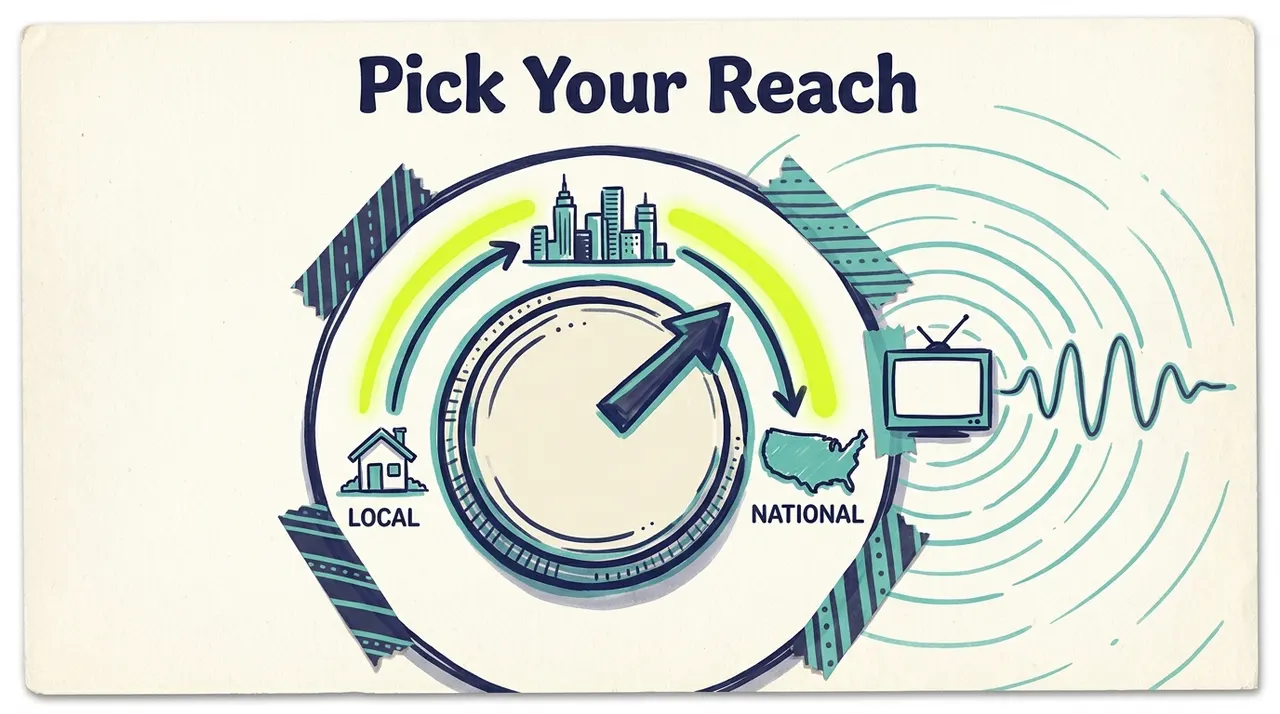
For most of television's history, "local vs national" was a hard binary with a brutal price gap. Local meant buying spots on your city's stations; national meant seven figures and an agency on retainer. The question answered itself for every small business: local, obviously, if TV at all.
On connected TV, you can set a local, regional, or national target area. Choose locations based on where you can serve customers and how much audience coverage your budget can support.
Geography became a dial, not a fork
On connected TV, every campaign is assembled from the same unit: an impression delivered to a specific household. Local and national campaigns differ only in how many households qualify, not in the machinery, the creative format, or the rate card. Typical CTV CPMs run $15-35 whether the household is in one county or spread across the country.
That collapses the old categories into a continuous dial:
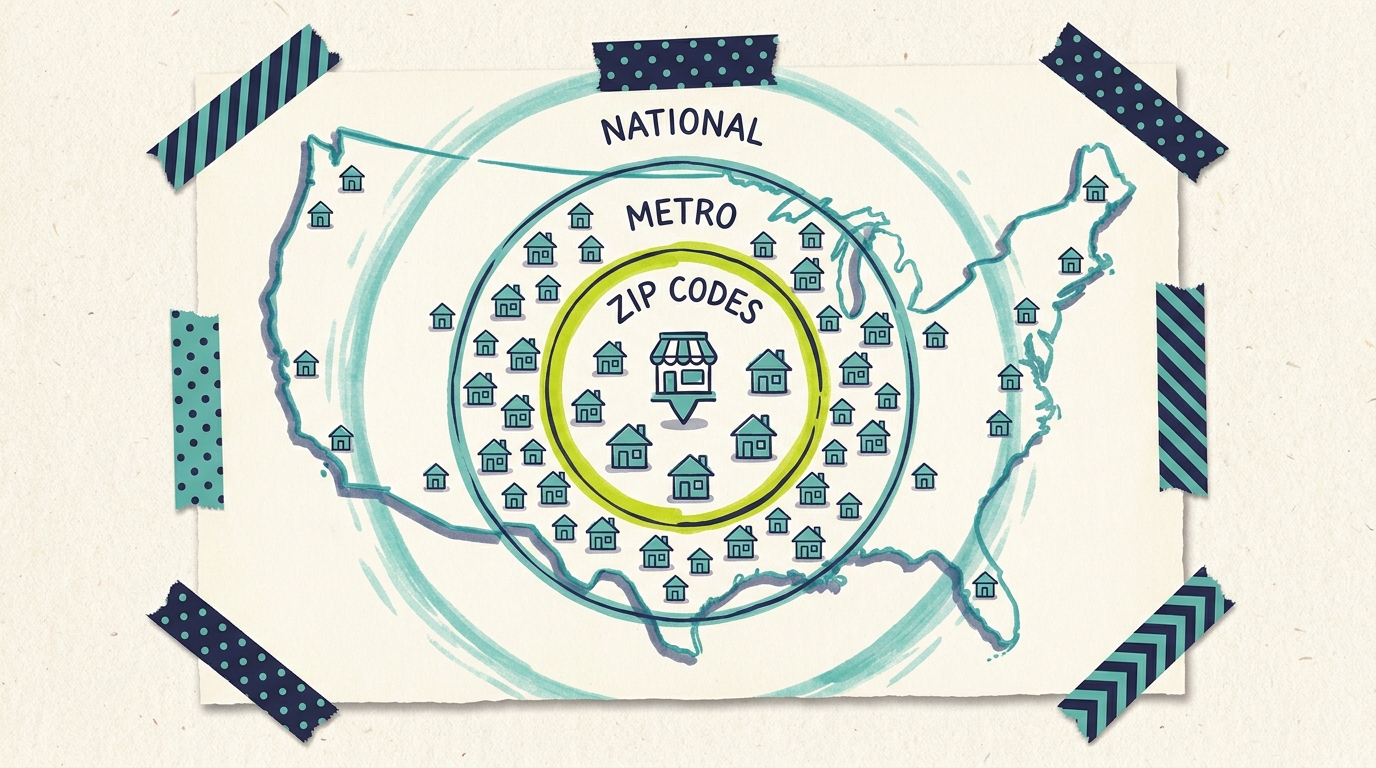
Hyperlocal: a service radius, a set of zip codes
Metro: a city and its suburbs (roughly a DMA)
Regional: a state or several adjacent markets
Multi-market: specific cities scattered nationally (think franchise footprints)
National: everywhere you can fulfill
The dial only matters if you set it deliberately. Most wasted TV budget in small business campaigns is geographic: paying to reach households that could never become customers, or starving the right households of frequency to afford the wrong ones.
What local-scope TV does best
Local TV advertising is the right call when your revenue has a service area: restaurants, medical and dental practices, home services, gyms, auto dealers, law firms, retail with physical locations.
Trust where you operate. TV's credibility effect (consumers trust TV ads at roughly twice the rate of social ads) lands hardest when the viewer realizes you're nearby. "I've seen their commercials" does real work in a local market where your competitors have never been on TV.
Frequency a small budget can sustain. A targeted local universe is small enough that $500-$1,500 a month buys meaningful repetition. The same spend nationally evaporates: it's a rounding error against 130 million households. This is the single most common scope mistake: going wide and ending up invisible everywhere. Local-first guidance lives in our guide to advertising on local TV.
Compounding local awareness. Local advertising stacks with everything else local: your trucks, your signage, your sponsorships, your Google reviews. TV is the multiplier on a presence that already exists in the same square miles.
The cost picture is friendlier than most owners expect; see local TV advertising costs for current numbers.
What national-scope TV does best
National scope earns its budget when revenue has no geography: e-commerce brands, mobile apps, subscription products, info products, and brands whose fulfillment is a shipping label or an app store.
The math of scale. If any household in America can become a customer, restricting reach just shrinks your market. National CTV lets a DTC brand build awareness at the same $15-35 CPM a local plumber pays, a price national TV never offered in the broadcast era.
Creative efficiency. One spot, one message, no market-by-market customization required. National campaigns amortize creative across every impression.
Audience density over geography. For national advertisers, the targeting dimension that matters isn't where but who: demographics and interests across the whole footprint. Geography becomes a filter you mostly leave open.
The honest caveat: national scope demands national budget discipline. Meaningful frequency across the country starts in the thousands per month, not hundreds. Underfunded national campaigns produce the most demoralizing report in advertising: millions of available households, a few thousand scattered impressions, nothing to show.
The cost math, side by side
Same CPM, radically different totals, because the totals are driven by how many households you need to reach how often:
The budget floor question is covered in depth in our guide to the minimum TV advertising budget; the short version is that the floor scales with the size of the audience you're trying to be remembered by.
The middle paths most businesses miss
The binary framing hides the scopes where many growing businesses belong:
Regional. A brand strong in its home state expanding outward. Set the dial to your current footprint plus the adjacent market you're entering, and weight spend toward the expansion zone where nobody knows you yet.
Multi-market. Franchises and multi-location businesses don't need the country; they need their twelve cities. CTV targets exactly those DMAs and skips the gaps between them, something broadcast could only do with twelve separate station negotiations.
Local layers on national. E-commerce brands with concentrated customer bases (ski gear, regional foods, climate-specific products) often run a national base layer plus heavied-up frequency in their proven geographies. The dial isn't one setting; it can be weighted.
Seasonal scope shifts. A landscaping franchise might run hyperlocal spring campaigns per location and a brand-level regional campaign in winter. Scope is a per-campaign decision, not a brand identity.
Where broadcast still fits
Streaming didn't delete broadcast local TV; it changed broadcast's job. Local stations still deliver two things CTV doesn't: appointment moments (local news, local sports) where a community watches simultaneously, and the implicit endorsement of appearing inside trusted local programming.
The trade-offs are equally real: broadcast sells the whole market (no zip targeting), demands larger minimum buys, reports results in ratings estimates rather than household counts, and ages its audience every year as cord-cutting continues. Pay-TV penetration has fallen to roughly a third of U.S. households, which means broadcast-only local campaigns now miss most younger and many middle-aged homes entirely.
A practical pairing for businesses with larger local budgets: broadcast for the marquee local moments (news adjacency, local sports), CTV for everything else (precision, frequency, and the cord-cutting majority). For most small businesses, though, CTV alone covers the need at a fraction of the minimum spend.
Three scope sketches
The dental practice (hyperlocal). Two locations, patients who live 15 minutes or less from each chair. Scope: a zip-code set around each office. $1,200/month sustains strong frequency against perhaps 60,000 households. Creative leans on the doctors' faces and the neighborhood name. Measurement: new-patient calls and "how did you hear about us" intake. Going wider would only buy patients who'll never drive that far.
The regional restaurant group (multi-market). Nine locations across three metros. Scope: three DMAs, weighted by location count. $6,000/month split unevenly: heavier in the newest market where awareness trails. One brand spot plus a market-specific tag line per metro. Measurement: per-market foot traffic and branded search, compared against each market's baseline.
The DTC kitchenware brand (national with density layers). Ships everywhere; customer file over-indexes in twelve metros. Scope: national base layer at modest frequency plus 3x weighting in the twelve proven metros. $20,000/month. Creative is scope-neutral product story with a QR code. Measurement: promo-code redemptions, QR scans, and site-traffic lift mapped against weighted markets. The density layer is the hedge: if national-thin underperforms, the brand already knows the concentrated version works.
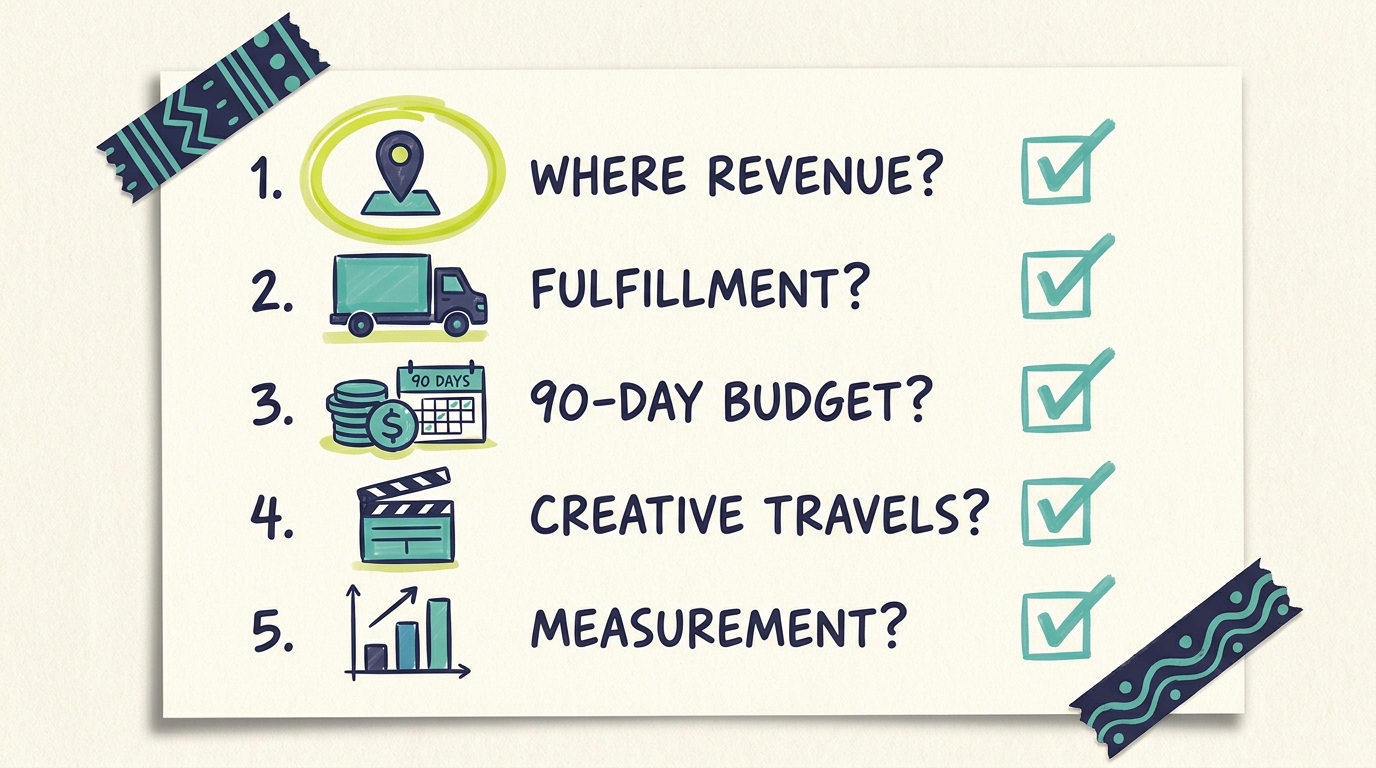
Five questions that set the dial
Where does revenue come from? Pull a year of customer addresses. If 90% sit inside 20 miles, your scope question is answered regardless of ambition.
Can you fulfill outside your area? Advertising where you can't deliver is donating impressions. Scope never exceeds fulfillment.
What budget can you sustain for 90 days? Divide it by the scope's required frequency. If the answer is invisible-everywhere, narrow until it's memorable-somewhere.
Does your creative travel? A spot built on local landmarks and "family-owned since 1998" plays differently in another state. National scope usually wants scope-neutral creative.
How will you measure it? Local campaigns read out in calls, visits, and local branded search. National campaigns need promo codes, QR scans, and site analytics. Pick the scope whose evidence you're equipped to collect.
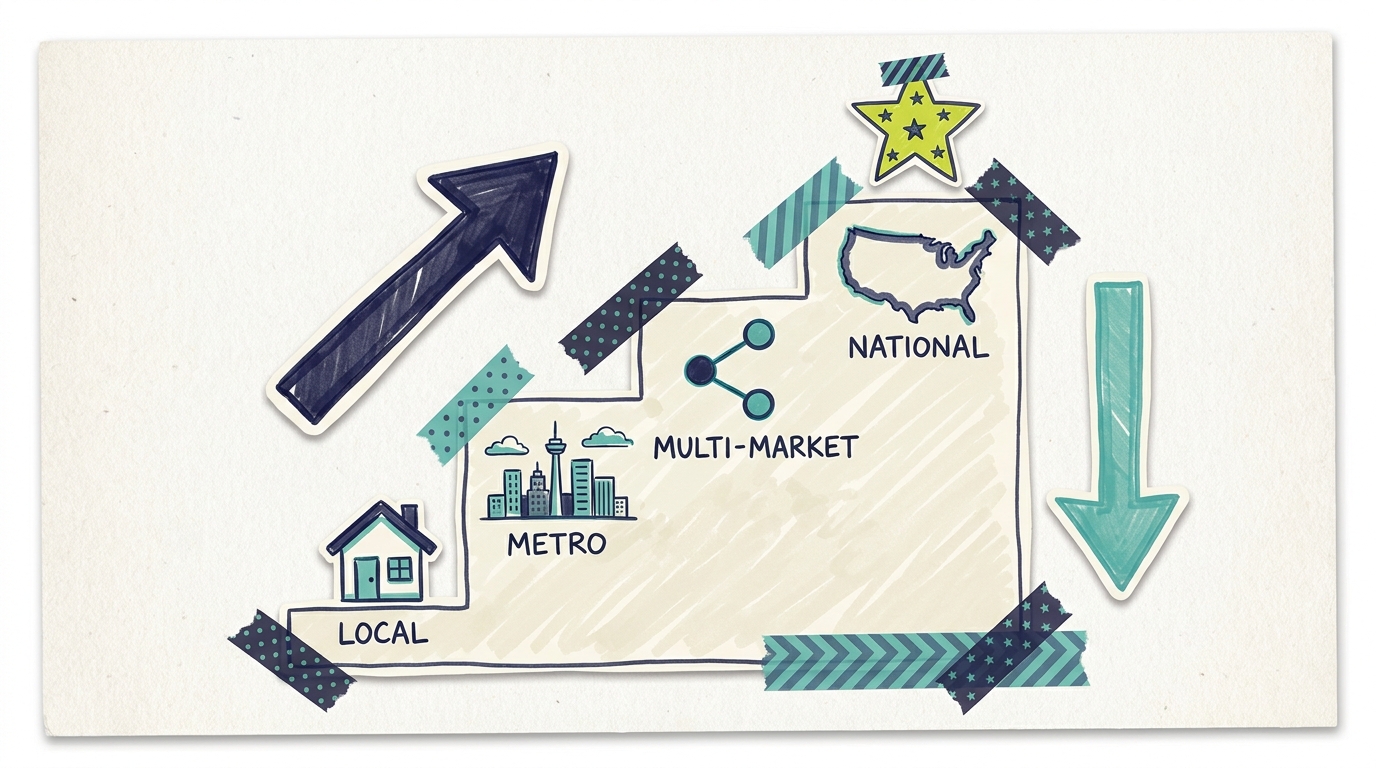
Graduating between scopes
Local to national is earned with evidence: when local campaigns produce consistent customer economics and your fulfillment can handle strangers in other time zones, expand one ring at a time (metro to region to multi-market) and watch whether the unit economics hold at each ring. Skipping rings is how budgets disappear.
National to local is the underused move. Brands disappointed by a thin national test often discover their product has geographic density they never noticed. Concentrating the same budget on the ten metros that over-index can turn a failed national campaign into a working multi-market one.
Either direction, CTV makes the move a settings change rather than a new media plan. Adjust the geography, keep the creative, compare the readouts. For tighter-than-zip targeting on the local end, geofencing approaches push the dial down to neighborhood level.
Four scope mistakes to avoid
Setting scope by ego instead of economics. "We're a national brand" is an aspiration, not a media plan. If 85% of revenue comes from two metros, a national campaign mostly buys applause from people who can't become customers yet. Advertise where the money is; expand where the evidence points.
Underfunding the chosen scope. The most expensive campaign is the one that runs at half the frequency required to be remembered. Whatever the dial setting, check the budget against the household count before launch. Shrinking scope to fund frequency is almost always the right trade.
Letting the platform default decide. Campaign tools default to broad settings because broad spends faster. Every campaign should have its geography deliberately set on day one and audited monthly; "we accidentally advertised statewide for a quarter" is a real and common story.
One creative for every scope. A spot that names the neighborhood works hyperlocally and confuses regionally. A scope-neutral national spot wastes local trust signals. When you change the dial, re-read the script through the new viewer's eyes; with AI generation taking two minutes, there's no excuse for mismatched creative.
Common questions answered
Is local TV advertising cheaper than national?
Per impression, no: streaming TV costs roughly the same $15-35 CPM at any scope. Per campaign, dramatically yes, because a local audience is thousands of households instead of millions. A local business can sustain effective frequency for $500-$1,500 a month, while meaningful national presence starts around ten times that. The unit price is flat; the bill scales with ambition.
Can a small business really run a national TV campaign?
Mechanically, yes: platforms like Adwave run national campaigns through the same flow as local ones, with subscriptions from $50. Strategically, it only makes sense if you fulfill nationally and can fund national frequency for at least a quarter. Most small businesses get better returns concentrating the same dollars on the geographies where they already win.
What's a DMA and do I need to think about it?
A DMA (Designated Market Area) is Nielsen's definition of a TV market, roughly a metro and its surrounding counties. Broadcast buying is organized around DMAs; CTV targeting can use them but isn't restricted to them. For most small businesses, zip codes and radii are the more natural unit, and the DMA matters mainly when you're coordinating TV with other media bought market-by-market.
Should my franchise run one national campaign or many local ones?
Usually both layers: a brand-level campaign across your operating markets for shared awareness, plus per-location local campaigns funded by or with franchisees for their service areas. CTV's market-specific targeting means the national layer skips cities where you have no locations, which broadcast never allowed.
How do I know if my local campaign is ready to expand?
Three signals: your cost per customer from TV-exposed periods is stable and profitable, your branded search lifts in advertised zips and not elsewhere (proof the TV is causing it), and your operations could absorb 2-3x inquiries without breaking. When all three hold for a quarter, widen one ring and re-measure.
Set the dial on purpose
Whichever setting fits, the mechanics are the same two-minute setup. See how Adwave works: generate your ad, choose local or national targeting, and launch on 100+ networks in under ten minutes.


