Most local marketing advice pushes owners toward the same playbook: spend on Google, keep Facebook alive, maybe post on Instagram if someone on the team has time.
That advice misses a platform built for the exact way local buying decisions happen. Neighbors ask who to call, someone recommends a business nearby, and trust is transferred before the business ever speaks. That's what makes Nextdoor for Local Business: The Platform Most Owners Overlook worth taking seriously. It isn't broad-reach social media in the usual sense. It's a local recommendation engine wrapped inside a neighborhood feed.
For a plumber, roofer, med spa, café, realtor, or auto shop, that's a different kind of opportunity. You're not interrupting people who came to scroll. You're showing up where people already ask for local help.
Why Your Business Can't Ignore Nextdoor Anymore
If your local strategy begins and ends with Google Ads and Facebook boosts, you're probably paying to compete in crowded spaces while ignoring a channel built around neighborhood trust.
Nextdoor matters because local intent is already baked in. As of Q1 2025, Nextdoor reported 46.1 million Weekly Active Users, and 88% of Nextdoor members shop at local businesses at least once a week, while 67% actively provide recommendations to neighbors according to this breakdown of Nextdoor's business value. For a local owner, those aren't vanity numbers. They describe a platform where people are already primed to buy nearby and talk about who they trust.
Why this audience behaves differently
Social traffic is frequently casual, whereas Nextdoor traffic is often situational. Residents open the app because they want to understand what is happening nearby, who can solve a local problem, or which business another neighbor would recommend for use.
That changes the quality of attention. A homeowner asking for a professional to help with their yard or a neighbor recommending a local bakery is much closer to a transaction than someone idly liking a Reel.
Consider this perspective:
Google captures demand: Someone knows what they need and searches for it.
Facebook often rents attention: You're competing against everything in the feed.
Nextdoor transfers trust: Neighbors bring your name into the conversation before the click.
That's why hyper-local strategy deserves more weight than most owners give it. If you want a broader primer on that, Silver Spoon Agency has a solid piece on how small businesses thrive with hyperlocal ads.
Nextdoor works best for businesses that win on proximity, reputation, and community familiarity. It works less like a social megaphone and more like a digital referral circle.
What kinds of businesses benefit most
The fit is strongest when a customer cares who is nearby, who is trusted, and who can serve the area quickly.
That usually includes:
Home services: Plumbers, HVAC companies, electricians, roofers, cleaners, pest control
Property-related businesses: Realtors, brokers, stagers, mortgage pros, contractors
Neighborhood retail and food: Cafés, boutiques, bakeries, restaurants, pet stores
Local care services: Dentists, med spas, wellness studios, family law firms, auto repair shops
If your business depends on local foot traffic, booked appointments, or service calls, ignoring Nextdoor means leaving a word-of-mouth channel untouched. If you're trying to tighten your full customer acquisition strategy, this guide on how to get more customers for your small business is a useful companion to what Nextdoor can do at the neighborhood level.
Claiming and Optimizing Your Free Business Page
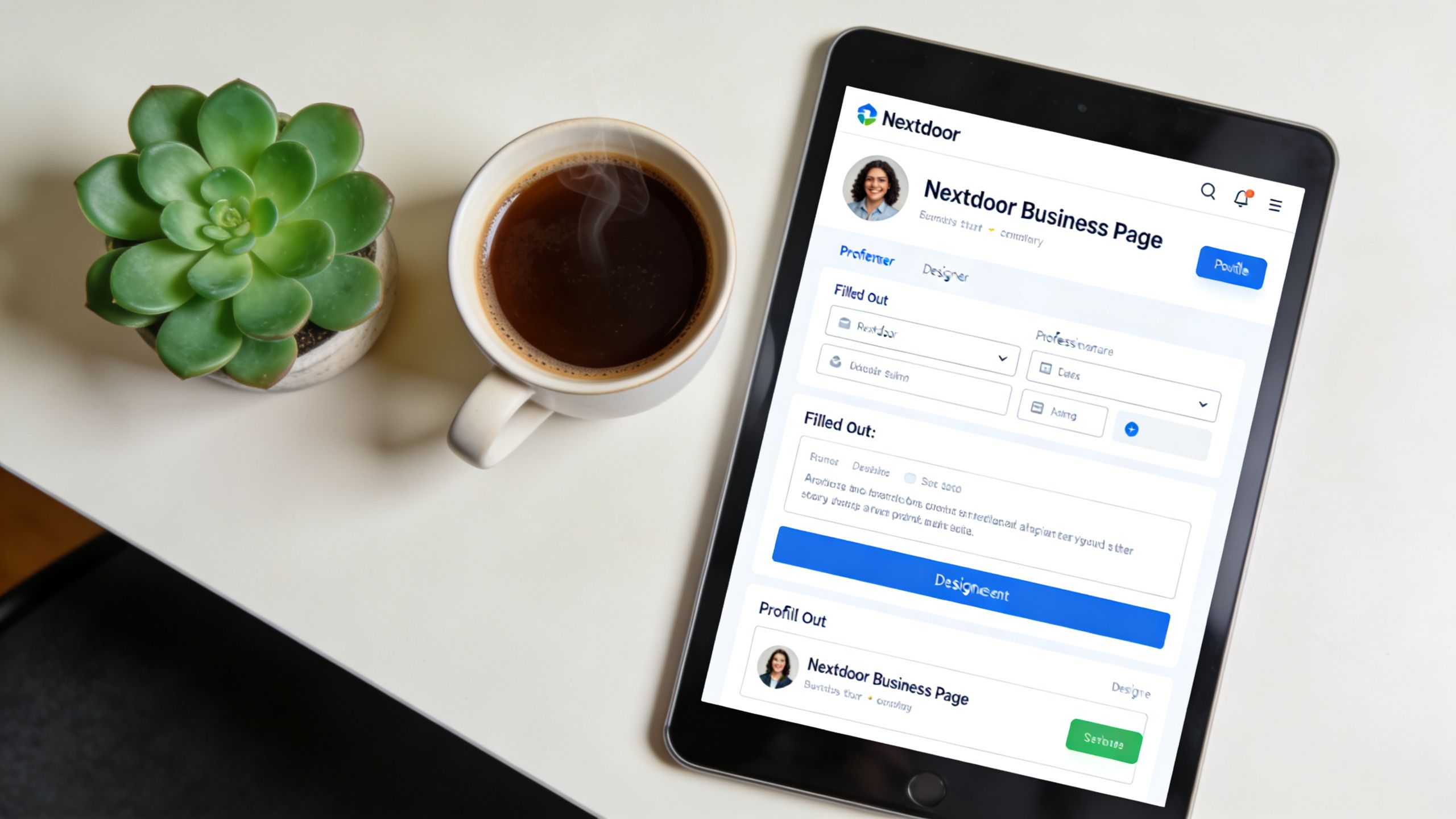
Keep your Nextdoor Business Page current with your services, contact details, and photos.
The free page is your base layer. Before you think about posting or ads, claim it properly and make it look like a business a neighbor would feel comfortable recommending.
The setup steps that matter
Start simple and do the fundamentals well.
Claim the page Go through Nextdoor's business claim flow and make sure your business name, category, service area, and contact information match how you appear elsewhere online.
Choose photos that signal legitimacy Use a recognizable logo for the profile image. For the cover, use your storefront, team, service vehicle, or clean project photography. Generic stock images weaken trust.
Write a short business description Keep it plain. State what you do, where you work, and what customers usually call you for. A short, specific description beats brand language every time.
Verify your contact path Make sure the phone number is answered, the website works on mobile, and any booking form is easy to complete.
The first milestone is five recommendations
This is the threshold most owners underestimate. According to Surefire Local's summary of Nextdoor guidance, Business Pages with 5 or more recommendations achieve 30% higher engagement than pages with fewer.
That means your early job isn't "post more." It's "earn enough proof to be taken seriously."
Practical rule: Don't ask every past customer for a recommendation. Ask the customers who liked your work, live in your target neighborhoods, and can describe the job clearly.
How to get recommendations without sounding awkward
Owners often either never ask, or they ask in a way that sounds transactional. Better approach: ask right after a positive outcome.
Good moments include:
After a completed job: The leak is fixed, the appliance works, the client is relieved
After a successful visit: A buyer closes, a car repair goes smoothly, a patient has a great experience
After a compliment: If someone says your team was prompt or helpful, that's the opening
Keep the request short. Thank them, mention that neighbor recommendations on Nextdoor help local businesses get found, and send the direct page link.
What to put on the page besides the basics
Once the page is claimed, improve the parts owners usually ignore:
Service clarity: List the actual jobs you want. "Water heater installs" is better than "full-service plumbing."
Geographic clarity: Mention neighborhoods, towns, or service areas in natural language.
Visual proof: Before-and-after photos, product shots, menu highlights, or project images all help.
Reputation signals: If neighbors already mention your responsiveness, cleanup, or pricing fairness, those details matter more than slogans.
A lot of this overlaps with local listing discipline in general. If you want a parallel checklist, this guide on how to optimize your Google Business Profile for more calls pairs well with Nextdoor because the trust signals are similar, even though the platforms behave differently.
Mastering Organic Posts and Community Engagement
Most businesses fail on Nextdoor for one simple reason. They post like advertisers in a place where people expect neighbors.
The platform rewards useful, local, human content. CivicScience found that after neighborhood news, users turn to Nextdoor for crime and safety updates (49%) and local business recommendations (40%) in its analysis of how Americans use Nextdoor. That tells you what your posts need to feel like. Helpful. Relevant. Grounded in local needs.
What good organic posting looks like
A strong post usually does one of three things:
Helps someone solve a nearby problem
Answers a common seasonal question
Shows your business participating in the local community
A bad post sounds like a recycled ad. "Call us today for all your needs" doesn't belong here. A better version sounds like a neighbor with expertise: "Heavy rain this week usually exposes gutter clogs and loose flashing. If you see water pooling near your foundation, don't wait for the weekend."
Helpful beats polished on Nextdoor.
Nextdoor post ideas for local businesses
The tone that gets responses
Three things tend to work well.
First, write like a person with expertise, not a brand voice document. Short sentences help. Plain language helps more.
Second, be specific about local conditions. If pollen, heavy rain, road construction, school events, or seasonal traffic patterns affect demand, tie your post to that reality.
Third, show up in comments. If someone asks a follow-up question, answer it directly. If a neighbor recommends you, thank them by name when appropriate. If feedback is negative, respond calmly and offer to resolve it offline.
What not to do
Some habits tank performance fast:
Over-posting promotions: Constant deals make people tune out.
Ignoring comments: A silent business page looks unattended.
Sounding corporate: Scripted language stands out for the wrong reason.
Posting without a local angle: Generic content has no reason to live on Nextdoor.
A simple rhythm usually works better than a heavy calendar. Post when you have something useful to say. Keep it relevant to the neighborhoods you serve. Then watch which themes lead to comments, messages, recommendations, and actual calls.
A Practical Guide to Nextdoor Ads
Organic activity builds trust, but ads help you control reach. That's useful when you want to push a seasonal offer, open a new location, generate leads in a tight service area, or stay visible in neighborhoods where competitors already have name recognition.
The mistake small businesses make is assuming Nextdoor ads need a complicated media buying setup. They don't. You can start small, keep the targeting tight, and learn quickly.
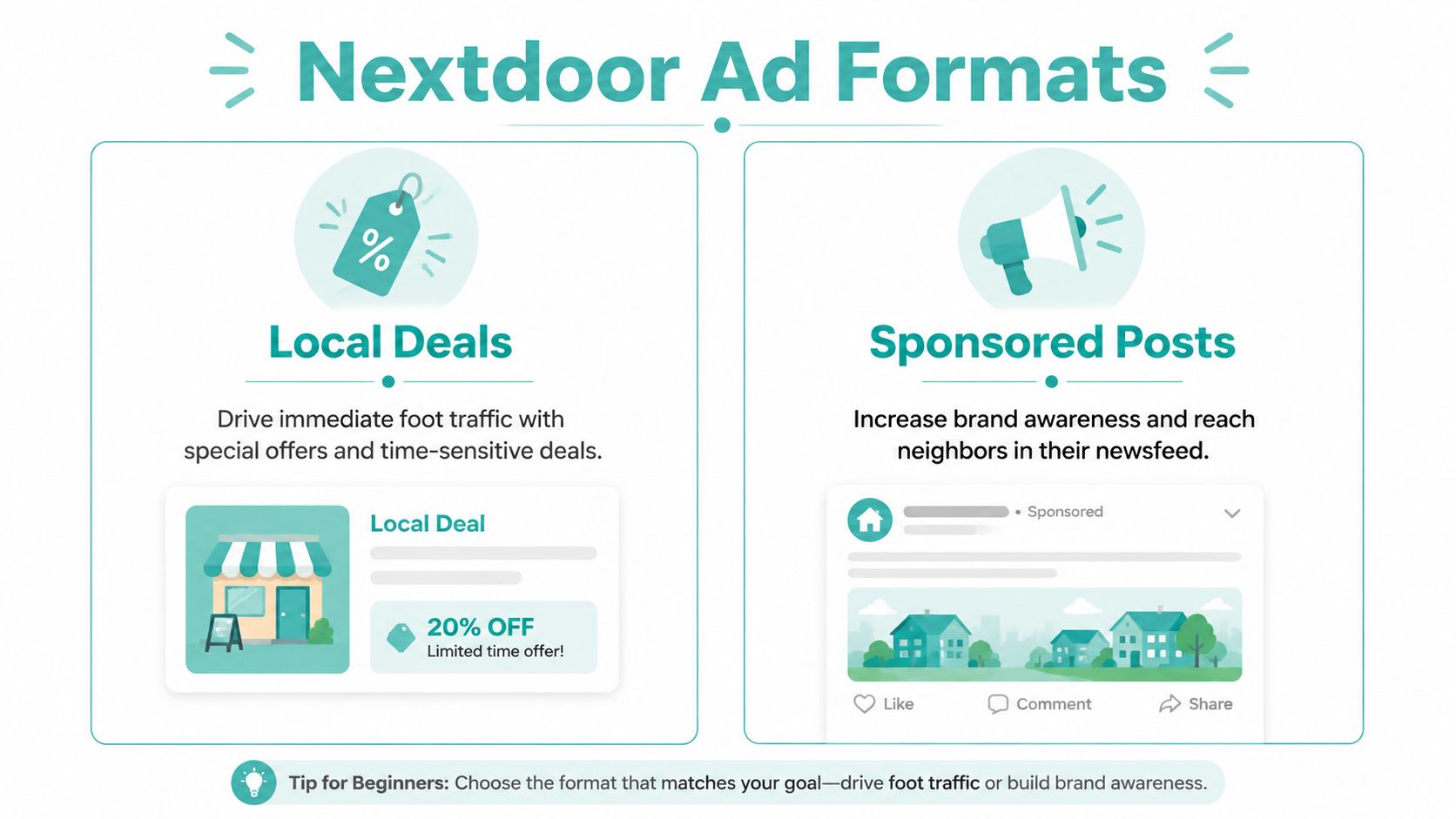
Choose the right ad objective
Different ad types solve different problems.
Local Deals work well when you want immediate response. Think limited-time offers, new customer specials, or neighborhood-specific promotions.
Sponsored Posts are better when the goal is visibility and familiarity inside the feed. They can support a message that's educational, seasonal, or reputation-building.
If you're new, don't launch multiple messages at once. Pick one objective and one clear audience.
A beginner campaign setup
Nextdoor Ads Manager is easiest to handle when you keep the first campaign narrow.
A practical starting structure looks like this:
Pick one service or offer Don't advertise your whole business. Promote one thing people can understand fast, such as drain cleaning, brake service, lunch specials, or a free consultation.
Target the service area tightly Focus on the neighborhoods that already produce your best customers. Hyper-local campaigns usually outperform broad local targeting when the service is proximity-driven. If you need a refresher on the concept, this explanation of what geo-targeting means in local advertising is worth reading.
Use a simple call to action "Book now," "Claim offer," "Call today," or "Request estimate" are all fine. Fancy copy usually gets in the way.
Send traffic to a focused destination That can be a lead form, booking page, offer page, or call path. Don't send paid traffic to a generic homepage if you can avoid it.
Budget and form setup
According to Nextdoor's guide to determining your target audience, SMBs can start with a baseline $10 CPM bid for potentially 10,000+ daily impressions on a $100 budget. The same guidance says that simple lead forms with minimal fields can lift submission rates by 30-50%.
That gives owners two strong operating rules:
Keep the test budget controlled: You don't need a massive first spend to learn.
Remove friction from the form: Ask only for what your team needs to follow up.
Field test note: Every extra form field is a chance for a prospect to leave.
What works better than most owners expect
The ads that tend to perform best on Nextdoor look local and sound local. Use neighborhood names naturally. Mention the service problem. Keep the offer easy to understand.
A few examples:
For a roofer: "Storm damage inspection for homeowners in [area]"
For a café: "Weekend breakfast special for neighbors nearby"
For a realtor: "See what homes in [community] are selling for"
For an auto shop: "Brake check for drivers in [local area]"
Common mistakes that waste spend
Not every weak campaign fails because of the platform. Most fail because of setup.
A good first campaign isn't about cleverness. It's about alignment. Right neighborhood, right offer, low-friction response path.
The Omnichannel Multiplier: Connecting Nextdoor with TV
Most Nextdoor guides stop at the platform itself. That's too narrow.
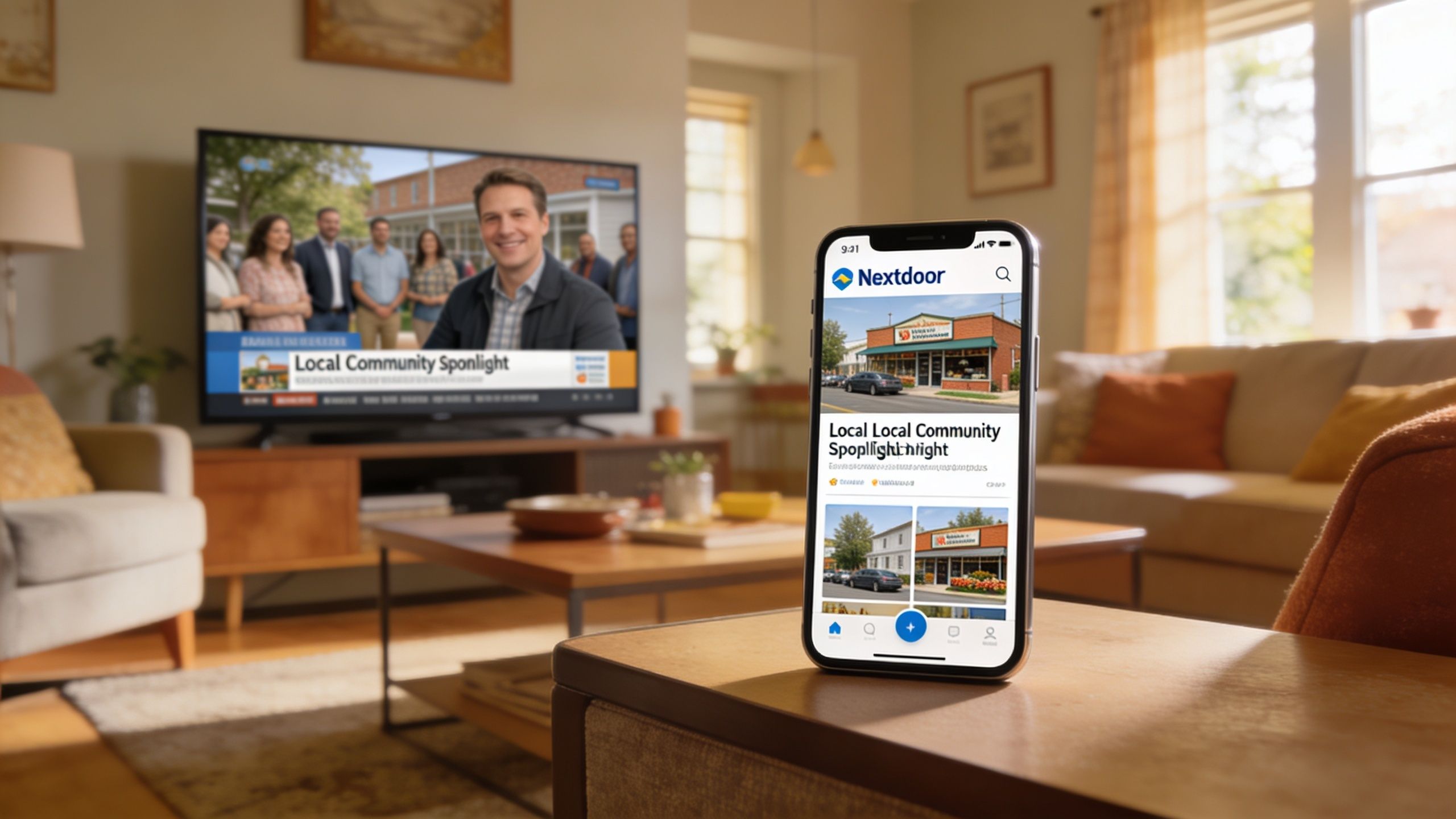
Local buying rarely happens from one touchpoint. A homeowner may hear about your business, see your brand again later, then act when timing and need line up. That's why Nextdoor works even better when it's paired with a broader awareness channel like TV.
Why these channels complement each other
Nextdoor is strong at neighborhood precision. TV is strong at repeated local awareness. Used together, they cover two different jobs in the customer journey.
TV plants the name. Nextdoor closes the distance between awareness and action.
That combination matters most for businesses people don't need every day. Roofers, remodelers, dentists, law firms, HVAC companies, auto dealers, and real estate professionals all benefit from being remembered before the urgent moment arrives.
How the sequence works in real life
Take a home services business.
A homeowner sees the brand on local TV over time. The business starts to feel familiar. Days later, that same homeowner sees the company mentioned on Nextdoor, notices a neighborhood offer, or comes across a recommendation thread where the brand appears again. Now the business isn't just known. It's locally validated.
That's the multiplier effect. One channel builds memory. The other adds local proof and response opportunity.
A practical version of the sequence looks like this:
Step one: TV introduces the brand to the market
Step two: Nextdoor reinforces relevance in the exact neighborhoods that matter
Step three: Recommendations, deals, and local visibility reduce hesitation
Step four: Calls, visits, or form fills happen when the customer is ready
The cost side of the strategy
This pairing isn't only about visibility. It can improve efficiency when the targeting and creative line up.
According to Trozzolo's review of Nextdoor advertising economics, emerging 2025-2026 data shows average Nextdoor CPMs of $10-20 for hyperlocal targeting, and stacking that reach with TV ads can lead to a 20-30% reduction in overall lead costs for verticals like home services and real estate.
That doesn't mean every business should split spend equally. It means owners should stop thinking in channel silos. If your TV creative and your neighborhood messaging support the same offer, same geography, and same audience, each touchpoint gets more useful. If you want a planning framework for that, this guide to a multi-channel marketing approach for small businesses is a good place to start.
The strongest local campaigns don't ask one platform to do every job. They let each channel handle the part it's best at.
Measuring What Matters and Scaling Your Success
If you can't tell whether Nextdoor is producing calls, visits, and booked work, you'll either quit too early or keep spending on the wrong things.
Measurement on Nextdoor doesn't need to be fancy. It needs to connect platform activity to real business outcomes.
What to watch on the organic side
For free Business Page activity, start with signals that show rising trust and visibility.
Track:
Recommendation growth: Are more neighbors endorsing you over time?
Post engagement quality: Are you getting replies, useful questions, and profile visits?
Message and call patterns: Do inquiries spike after certain post topics?
Local relevance: Which neighborhoods engage most often?
A post with modest reactions can still be valuable if it leads to calls or gets referenced by customers later. Owners often overvalue likes and undervalue assisted conversions.
What to watch on the paid side
For ads, keep the dashboard focused on response quality.
Use a simple review process:
Check impressions and click behavior This tells you whether the targeting and message are attracting attention.
Review form completions or calls Leads matter more than feed activity.
Compare neighborhoods Some zones will produce better response quality than others. Shift budget toward the better pockets.
Match lead volume to actual sales outcomes A cheap lead isn't useful if it doesn't turn into revenue.
How to interpret results without fooling yourself
A few patterns show up often.
If people view your page but don't contact you, your recommendations, photos, or page copy may be weak.
If ads get impressions but not clicks, the offer or creative probably isn't specific enough.
If leads arrive but don't convert, look at the form quality, the speed of follow-up, and whether the campaign is pulling in the right neighborhoods.
Key takeaway: Don't scale because the dashboard looks busy. Scale when the neighborhoods, messages, and offers produce customers you want more of.
As performance improves, expand carefully. Add one neighborhood cluster, one new offer, or one creative variation at a time. Small, controlled changes make it much easier to see what's driving results.
If you're building local awareness and want more than a one-channel strategy, Adwave is worth a serious look. It gives small businesses a practical way to add TV to the mix without the usual production burden or big-budget barrier. That's useful when you want Nextdoor handling neighborhood trust while TV builds broader local familiarity across the market.