The 2026 midterms are shaping up to be the most expensive midterm cycle in American history. AdImpact projects total political ad spending will hit $10.8 billion, up 21% from the $8.9 billion spent during the 2022 cycle. But the real story isn't just how much campaigns are spending. It's where that money is going and how it's being spent.
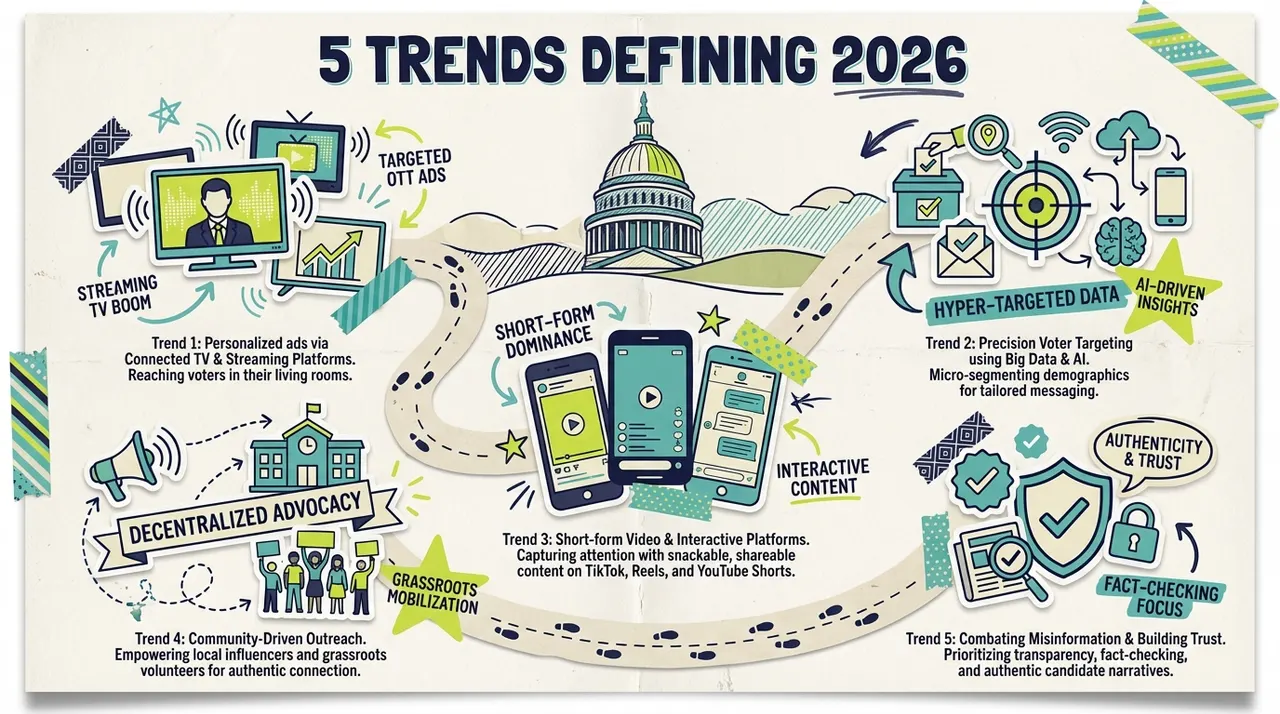
If you're a campaign manager, political consultant, or candidate trying to figure out where to put your ad dollars this cycle, you need to understand the five trends driving the biggest shifts in political advertising right now.
CTV is overtaking linear TV for political ad spend
Broadcast television still commands the largest share of political ad budgets at roughly 49% of total spend. But its grip is slipping. Broadcast spend is projected to decline from $5.36 billion in 2024 to $5.28 billion in 2026, according to AdImpact's Political Projections Report.
Connected TV (CTV) is moving in the opposite direction. Political CTV spending grew 600% between 2020 and 2024, jumping from roughly $260 million to over $1.5 billion (eMarketer, 2024). For 2026, AdImpact projects CTV political spend will reach $2.48 billion, a 20% increase over 2024 levels (AdImpact, 2025).
CTV is the only media type that AdImpact expects to increase in spending compared to 2024. Every other channel, including broadcast, cable, radio, and digital display, is holding flat or declining.
Why the shift? More than 60% of U.S. households now use streaming services as their primary TV source. Political advertisers are simply following the audience. If your voters are watching Hulu, Peacock, and Tubi instead of the 6 o'clock news, that's where your ads need to be.
For campaigns, this means rethinking your media mix. Putting 80% of your budget into broadcast buys and hoping for the best isn't a winning strategy anymore. A balanced approach that pairs broadcast reach with CTV's precision targeting gives you the best of both worlds.
Hyper-local targeting is opening doors for down-ballot races
For years, TV advertising was essentially off-limits for school board candidates, city council races, and state legislature campaigns. Traditional broadcast buys require minimum commitments of $50,000 or more, and the geographic coverage rarely aligns with actual district boundaries. A state senate district doesn't match a TV market's DMA. You'd end up paying to reach thousands of voters who can't even vote for you.
CTV changes that equation entirely.
With programmatic CTV, a city council candidate can target ads specifically to households in their district. No wasted impressions on voters three towns over. A school board candidate spending $2,000 on CTV can reach 80,000+ targeted impressions in their district, which is often more effective than a single broadcast buy at the same budget (MadHive, 2025).
This is why down-ballot advertising is one of the fastest-growing segments in political media. Candidates who never had access to TV are suddenly running ads on the same streaming platforms as Senate campaigns. The barrier to entry has dropped from tens of thousands of dollars to as little as $50 through platforms like Adwave.
The practical impact: if you're running a down-ballot race or consulting for one, TV advertising should be in your media plan for 2026. The cost and targeting objections that used to rule it out no longer apply. Geotargeted CTV ads let you reach exactly the voters you need without the waste.
AI-generated ad creative is speeding up production cycles
The 2026 Texas primaries offered a preview of what's coming nationwide. Candidates throughout the state used AI-generated video in their campaign advertising, from attack ads to parody content (Houston Public Media, February 2026). The trend isn't limited to major races. Down-ballot campaigns are finding that AI tools dramatically reduce the time and cost of producing TV-quality ad creative.
The production timeline for a traditional TV campaign ad used to look like this: hire an agency, develop concepts over two weeks, schedule a shoot, edit the footage, get approval, and finally go to air. Total timeline? Four to six weeks, minimum. Total cost? $15,000 to $50,000 or more.
AI-powered creative tools compress that timeline to hours or days. Adwave, for example, can generate a broadcast-quality 30-second TV ad in about two minutes from a campaign website or social media page. That's not a rough draft. That's a ready-to-air spot.
For campaign managers, the speed advantage is the real useful option. When your opponent says something controversial at a Tuesday town hall, you don't want to wait until the following week to respond. AI-generated creative lets you have a response ad running on streaming platforms by Wednesday morning.
The trade-off to watch: voters and media are paying closer attention to AI-generated content. Transparency matters. While AI production tools are perfectly legal, campaigns that try to pass off AI-generated imagery as real footage risk backlash. Use AI for speed and scale, but be upfront about it.
Data-driven voter targeting is getting more sophisticated
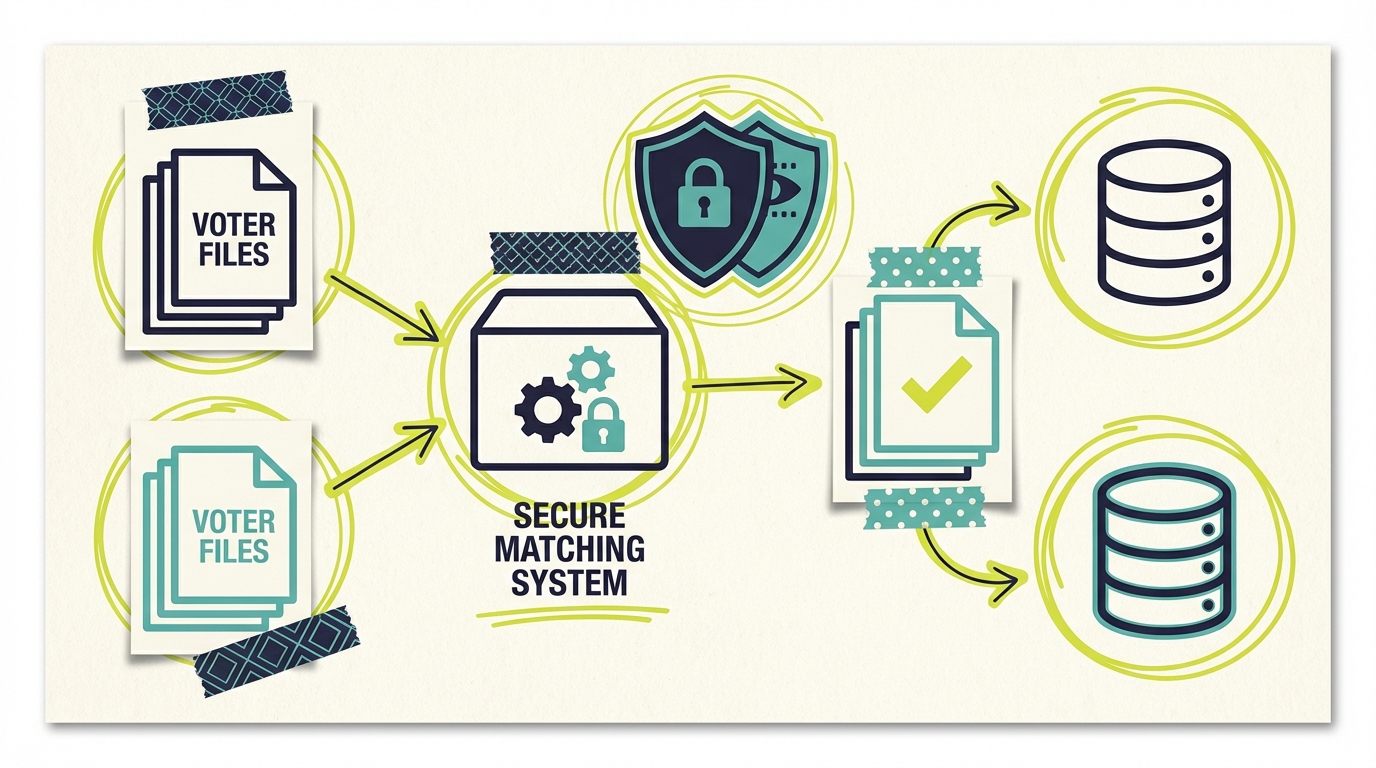
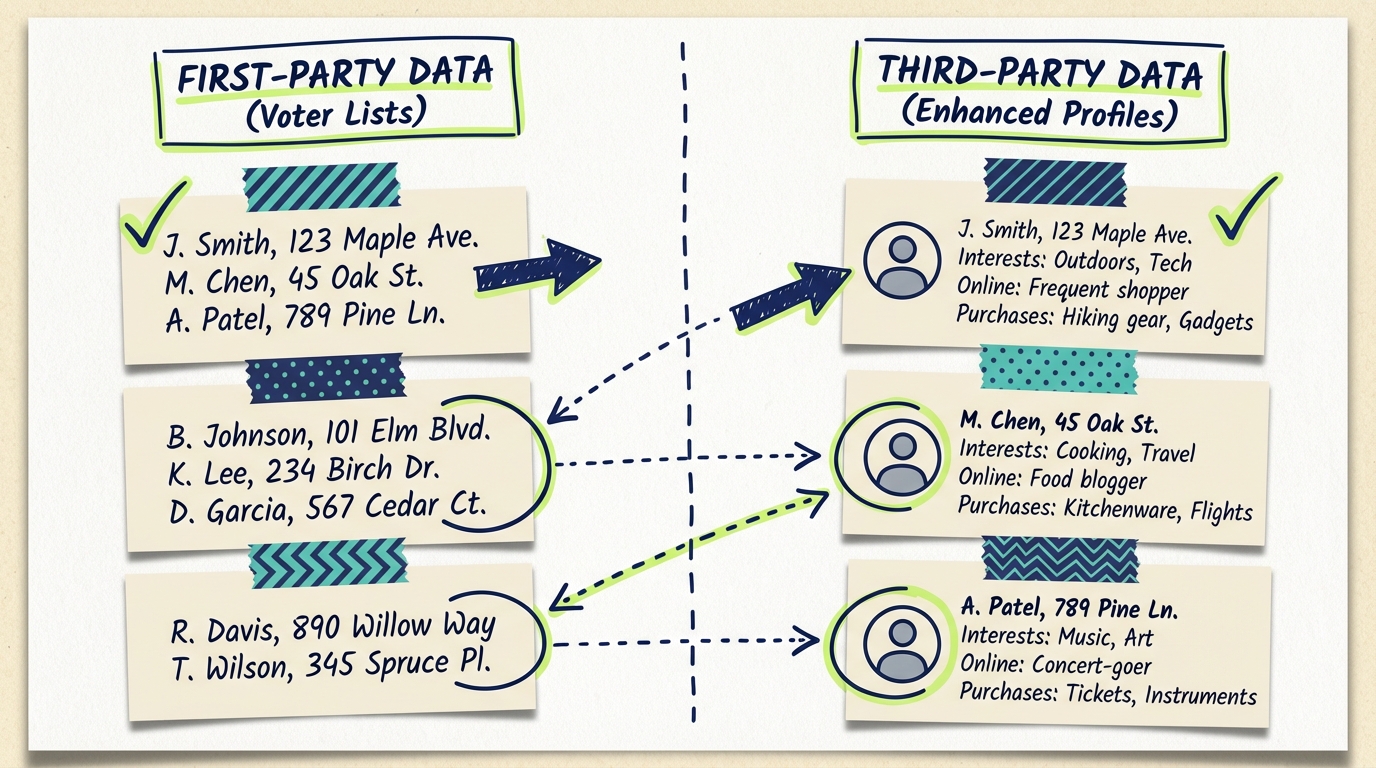
Voter file matching on CTV has matured significantly since the last midterm cycle. In 2022, matching voter registration data to streaming households was still hit-or-miss. Today, political data vendors like L2, TargetSmart, and Data Trust have improved their matching capabilities to deliver 50-70% match rates for clean voter files (StackAdapt, 2025).
That means if you upload a list of 100,000 registered voters in your district, you can expect to reach 50,000 to 70,000 of them directly on their streaming devices. That's a significant jump from the 30-40% match rates campaigns were seeing just two years ago.
But the most interesting innovation in 2026 is dynamic voter exclusion. JamLoop launched ActiveVoter in February 2026, a CTV product built in partnership with Aristotle that dynamically removes already-voted households from ad delivery using state-reported early and absentee voting data (JamLoop/Aristotle, 2026).
Why does that matter? In 2024, more than 60% of voters cast their ballots early or by mail. That means campaigns were continuing to serve ads, and spend money, on households that had already voted. Dynamic exclusion solves that waste problem.
For campaigns working with tight budgets, these targeting improvements mean every dollar works harder. Pair voter file matching with smart targeting strategies and you can run a focused, efficient TV campaign that would have been impossible just one cycle ago.
Shorter campaign windows are demanding faster ad deployment

The traditional political advertising calendar, where campaigns ramp up spending gradually over months and peak in the final two weeks, is compressing. Campaigns are spending earlier and more aggressively, but they're also shifting budgets faster in response to real-time events.
AdImpact's projections show that campaigns are expected to spend funds earlier in the 2026 cycle compared to previous midterms (AdImpact, 2025). This front-loading of spend reflects a strategic reality: with more voters casting ballots early, waiting until October to saturate the airwaves means missing a huge portion of your electorate.
The rise of rapid-response TV advertising is the other side of this trend. Programmatic CTV allows campaigns to update creative and targeting in near real-time. When a major policy announcement, debate moment, or opponent gaffe happens, campaigns that can deploy a TV response in 24 to 48 hours have a serious advantage over those locked into two-week broadcast insertion orders.
This is where platforms like Adwave give smaller campaigns a real edge. Traditional media buying requires advance planning, negotiations with stations, and long lead times. Self-serve CTV platforms let you launch a new ad the same day you create it, with targeting already dialed in to your district or key senate race markets.
What this means for your 2026 strategy
If you're planning ad strategy for the midterms, here's what to take away from these five trends:
Rebalance your media mix. CTV should be a meaningful part of your budget, not an afterthought. The audience has moved to streaming, and your ad dollars need to follow.
Start earlier than you think. With early voting expanding and campaign windows compressing, waiting until September to launch TV advertising means you're already behind.
Use AI creative tools for speed, not shortcuts. AI-generated ads are a legitimate way to produce more creative variations faster. Use them to test messages, respond quickly to events, and stretch your production budget.
Invest in targeting infrastructure. Clean voter files, strong data partnerships, and dynamic exclusion tools will make the difference between efficient spending and wasted impressions.
Don't rule out TV for small races. If you're running or consulting on a down-ballot campaign, CTV has removed the barriers that used to make TV advertising impractical. A focused, geotargeted CTV strategy can deliver real results on a budget that would have been unthinkable in 2022.
Common questions answered
How much should a political campaign budget for CTV advertising in 2026? It depends on the race. Statewide campaigns are allocating 15-25% of their total media budget to CTV this cycle, which can mean millions of dollars for competitive Senate seats. Down-ballot races can run effective CTV campaigns for as little as a few hundred dollars. The key is matching your budget to your target voter universe and geographic reach.
Broadcast accounts for about 49% of political ad spend and connected TV roughly 23%. Campaigns continue to use both as spending shifts toward streaming.
Can down-ballot candidates really afford TV advertising? Yes. This is one of the biggest changes in recent cycles. CTV platforms have lowered the barrier to entry dramatically. A school board or city council candidate can run targeted TV ads within their district for a few thousand dollars, reaching voters on the same premium streaming services where national campaigns advertise. The minimum spend on some platforms starts at $50.
Are AI-generated political ads legal? In most jurisdictions, yes. There's no federal law prohibiting the use of AI in political advertising, though some states are introducing disclosure requirements. Texas, for example, saw widespread use of AI-generated political video during the 2026 primaries. The bigger risk isn't legal but reputational. Voters respond poorly to campaigns that use AI to create misleading imagery or fake endorsements.
How does voter file matching work on CTV? Campaigns upload their voter file (a list of registered voters with addresses and demographic data) to a CTV platform or data vendor. The vendor matches those records against household-level streaming device data, creating audience segments you can target directly. Current match rates run between 50-70% for well-maintained voter files, meaning you can reach the majority of your target voters on their streaming devices.
What's the fastest a campaign can get a TV ad on air? With traditional broadcast, you're looking at days to weeks for insertion orders and scheduling. With programmatic CTV, you can go from concept to live ad in under 24 hours. AI creative tools compress production to minutes, and self-serve CTV platforms allow same-day campaign launches. This makes rapid-response advertising, reacting to debates, news events, or opponent statements with a targeted TV spot, a realistic tactic for campaigns of any size.