
Re-engagement campaigns are your best bet for winning back subscribers who have gone quiet. The strategy is pretty straightforward: you send a targeted series of emails to people who’ve stopped opening or clicking your messages. The goal is to remind them why they signed up in the first place and give them a compelling reason to stick around before you have to clean them from your list.
Why Your Silent Subscribers Are a Hidden Problem
It’s easy to look at a big subscriber number and feel a sense of accomplishment, but a growing list of inactive contacts is hurting your business more than you think. That chunk of your audience that never engages creates some serious, often invisible, problems for your marketing.
The most immediate issue is your sender reputation. When a large percentage of your emails go unopened, email providers like Gmail and Outlook take notice. They start to see your content as unwanted, which means even your most loyal customers might find your messages automatically routed to their spam folder. Suddenly, your whole email strategy is on shaky ground.
The True Cost of Inactivity
Beyond deliverability, there's a real financial and operational cost to keeping a list full of silent subscribers. They aren't just taking up space; they’re actively working against you.
Here’s what’s really happening:
Damaged Deliverability: Low engagement rates are a huge red flag for email service providers. This directly impacts your ability to even reach the inbox.
Skewed Performance Metrics: Those inactive contacts artificially tank your open and click-through rates. This makes it impossible to get a true read on how your campaigns are performing. We break this down further in our guide to understanding email marketing metrics like open and click rates.
Wasted Resources: You’re spending time, effort, and possibly money marketing to people who aren’t listening. Those resources could be much better spent on attracting new customers or delighting your active ones.
The Rapid Decay of Email Lists
This problem gets worse, and it gets worse fast. Email lists naturally decay at a surprisingly high rate. On average, you can expect to lose 22% to 30% of your subscribers every year as people change jobs, switch email addresses, or simply lose interest.
That means nearly a quarter of your hard-earned audience disappears annually without ever hitting "unsubscribe," dragging down your metrics and helping future emails land in spam. You can get more great tips on re-engaging subscribers at emercury.net.
For local businesses investing in brand awareness through channels like TV advertising with Adwave, protecting your email list is non-negotiable. Each subscriber is a lead you worked hard to get, and letting them go cold is like throwing away a potential sale. Think of re-engagement campaigns as your first line of defense.
Laying the Groundwork for Your Win-Back Campaign
Before you write a single "we miss you" email, you need a solid plan. A great re-engagement campaign isn't just a one-off message; it's a strategic sequence built on knowing your audience and what you want to achieve. The first piece of the puzzle is figuring out what "inactive" means for your business.
There’s no one-size-fits-all answer here. The right timeframe really depends on how often you send emails and what your typical customer journey looks like. For a realtor sending weekly market reports, 90 days of radio silence is a pretty clear signal. But for a local boutique blasting out daily deals, you might want to consider someone inactive after just 30 days.
The key is to land on a clear, consistent window that triggers your win-back automation. For example, you could decide that any subscriber who hasn't opened or clicked an email in the last 60 days is automatically funneled into your re-engagement flow.
This is where the magic of segmentation really comes into play. You simply can't treat every inactive subscriber the same way. Someone who used to open every email is a completely different prospect than someone who signed up six months ago and never opened a single one.
Define Your Inactive Segments
Grouping your disengaged subscribers allows you to get specific with your messaging, which dramatically increases your chances of success. I recommend starting with three main buckets:
Once-Actives: These are your former fans. They used to open and click, so they already see your value. Your job is to simply remind them why they liked you in the first place.
Never-Actives: This group signed up but never took the first step of opening an email. They need a powerful first impression, a re-introduction to what you're all about.
Low-Engagement Users: These folks might open an email here and there, but they rarely, if ever, click. They need a stronger hook, a more compelling offer or a can't-miss call-to-action to finally get them to act.
We go much deeper on this topic in our guide on email list segmentation for sending the right message to the right people. Honestly, getting your segmentation right is half the battle.
This is the classic email decay lifecycle. It shows how a healthy list can slowly degrade until your messages are landing straight in the spam folder, hurting your overall sender reputation.
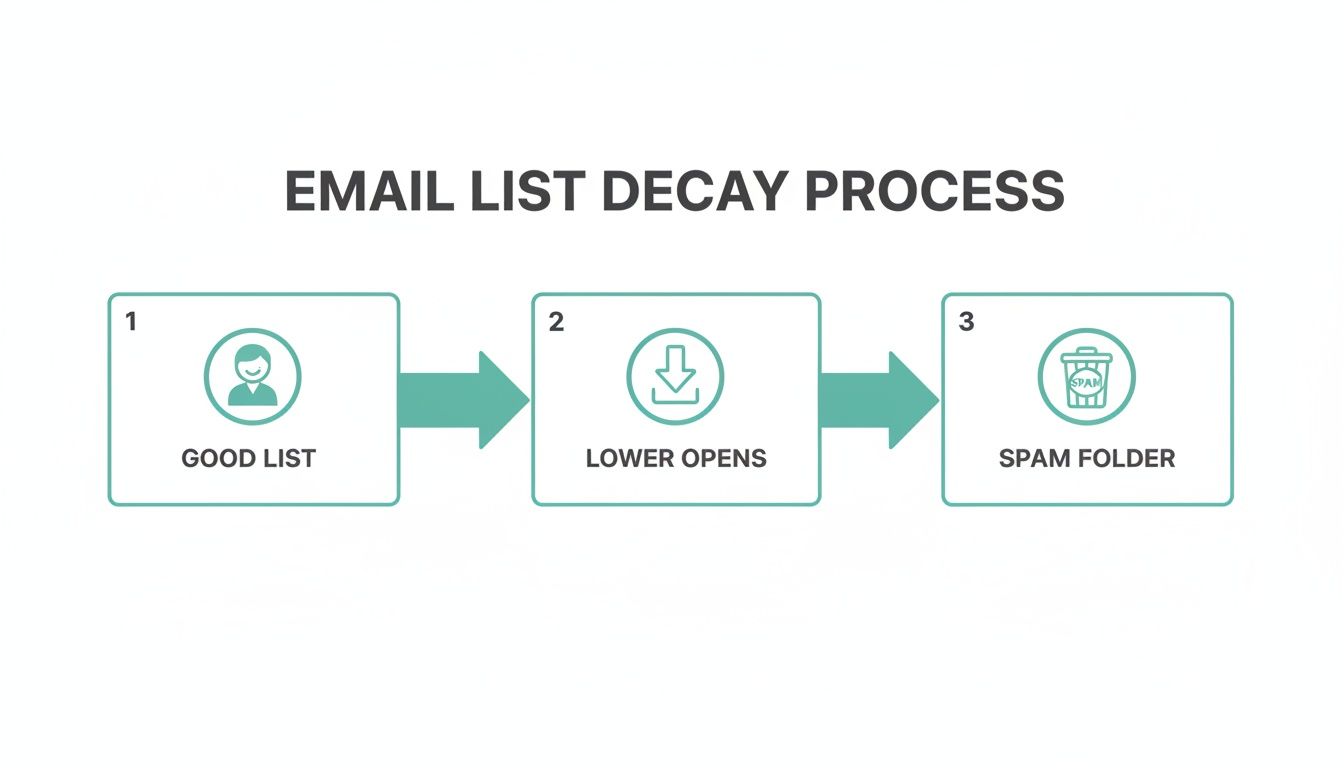
The big takeaway? Inactivity isn't just a missed opportunity; it's a slippery slope that can actively harm your ability to reach everyone else on your list.
Map Out Your Campaign Cadence
Once you've sorted your audience, it's time to plan the actual email sequence. A multi-step campaign will always outperform a single, Hail Mary email. I've found a series of three to five emails sent over about two weeks is the sweet spot. It builds a bit of urgency without feeling like you're spamming them.
Think of your campaign as a short story. It should have a clear beginning, middle, and end, starting with a gentle nudge and building toward a final, compelling offer or a "last chance" goodbye.
The good news is you don't have to manage this manually. Modern platforms can automate the entire workflow. With a tool like Adwave, you can set up these rules once and let the system handle the timing and delivery. This frees you up to focus on what matters most: writing great emails that win those customers back.
Crafting Re-engagement Emails People Open
Alright, you’ve sorted your audience and mapped out your timing. Now for the make-or-break part: the emails themselves. This is where the magic happens, or doesn't. Your creative, from the subject line to the final call to action, is what will decide if a subscriber comes back or tunes you out for good.
Let's be honest, a generic "we miss you" email is just digital noise. It’s destined for the trash folder before it's even fully loaded.
To cut through that inbox clutter, your message needs to be personal, valuable, and intriguing. I've seen firsthand how the right messaging can dramatically turn a campaign around. In fact, smart re-engagement tactics can boost open rates from a dismal 14% all the way up to 45%. It just proves that a little creativity goes a very long way.
Moving Beyond "We Miss You" Subject Lines
Think of the subject line as your one shot to stop the scroll. In a sea of promotions and newsletters, yours has to earn that click. Forget the tired clichés and focus on clarity, curiosity, or a direct benefit.
Here are a few angles that consistently work well:
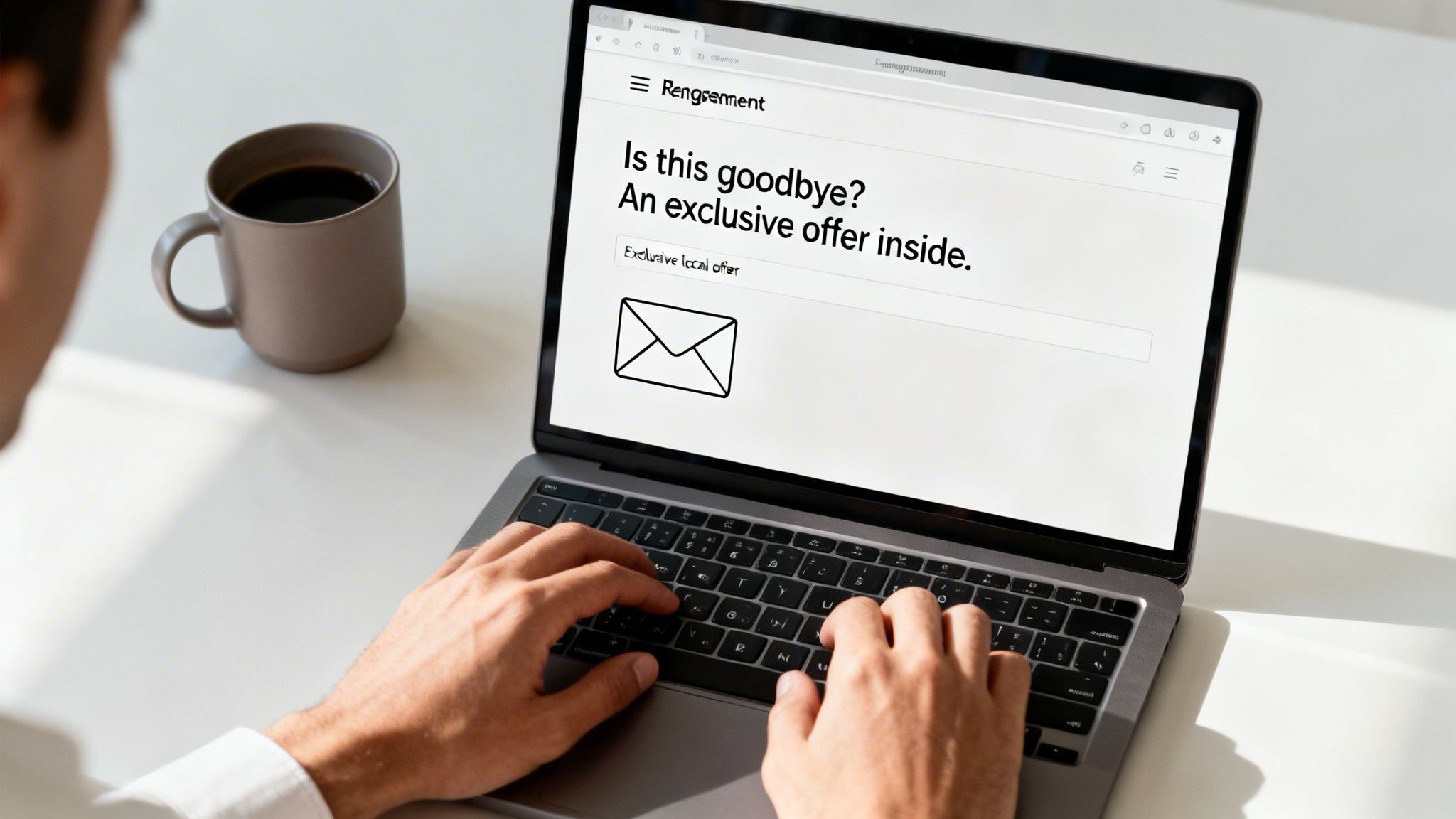
Spark a little urgency: "Is this goodbye?" or "Last chance: We're cleaning up our email list" can create just enough scarcity to prompt a click.
Lead with the good stuff: "A 20% off coupon just for you" or "Your exclusive gift is waiting" gets straight to the point and states the value upfront.
Ask a genuine question: "Still interested in local market updates?" or "Did we do something wrong?" feels personal and invites a response, not just a passive open.
The goal isn't just an open; it's a re-connection. A great subject line sets the stage by reminding the subscriber there's something valuable waiting for them. It’s a small detail that has a huge impact on your overall success.
If you’re feeling stuck, we have a whole playbook on this. Check out our guide to writing email subject lines that get opened for more formulas and real-world examples.
Sample Re-Engagement Subject Lines By Industry
To give you a jumpstart, here are some proven subject line templates I've seen work wonders for different local businesses. Use these as inspiration to craft your own.
Remember, the best subject lines often feel like they were written by a person, not a marketing department. Keep it simple, direct, and personal.
Content and Incentives That Work
Once they've opened the email, the content needs to deliver on that subject line's promise. Keep the message short, sweet, and focused on a single, clear call to action. You're reminding them why they signed up in the first place and giving them a compelling reason to stay.
What would your audience really appreciate? For a local plumber, a simple "We've missed you! Here's $25 off your next service" is a no-brainer. A real estate agent could offer an exclusive guide to navigating the local market, while a retail shop might give early access to a new collection.
In my experience, the most effective incentives usually fall into one of these buckets:
Exclusive Discounts: A special deal that isn't broadcast to everyone makes your inactive subscribers feel seen and valued.
Valuable Content: A free guide, an invitation to a webinar, or an exclusive article can be a powerful reminder of the expertise they're missing.
A Simple "Opt-In": Sometimes, all you need is a big, friendly button that says, "Click here to keep receiving our emails." It's a low-friction way to confirm their interest.
The key is to make the offer feel genuine. When you build these campaigns, you should always be testing what works. For instance, Adwave users can quickly see which TV ad creative drives the most engagement. Apply that same mindset here: A/B test your offers, measure what resonates, and refine your messaging until you find the sweet spot that wins your subscribers back.
Give Your Campaign a Boost with Targeted TV Ads
Even the best email campaign has to compete in a seriously crowded inbox. But what if you could sidestep the inbox entirely and connect with inactive subscribers somewhere they'd never expect? By adding another channel to your strategy, you can turn a simple re-engagement email into a memorable brand moment.
Just picture it. A lapsed customer gets your "we miss you" email in the morning. Later that evening, they're kicking back on the couch, streaming their favorite show on Hulu or catching a game on ESPN, and suddenly they see a sharp, professional ad for your local business. That’s a powerful one-two punch. It makes your message impossible to miss and reminds them of who you are in a totally new setting.
How Local Businesses Can Finally Get on TV
Not long ago, the idea of running a TV ad was a non-starter for most small businesses. It meant huge budgets and professional production crews, things that were simply out of reach. That world is gone. Today, new platforms have made it simple and affordable to get your message on premium TV channels, opening up a whole new way to win back customers.
This is exactly where a tool like Adwave shines. Its platform was built from the ground up for local businesses, letting you create and run polished TV ads in just a few minutes. You don’t need any video editing experience, either. The system can generate a broadcast-quality commercial using just your website's URL.
When you sync up your digital and TV marketing, you create a surround-sound effect for your brand. Seeing your business on TV gives it a different kind of credibility, and that added authority might be just the push an inactive subscriber needs to pay attention again.
A Coordinated Plan for a Bigger Impact
Here’s how you can put this into action with a platform like Adwave:
Send Your Re-Engagement Email: First, you’ll launch your segmented email campaign with that can't-miss subject line and a great offer.
Run a Local TV Ad: At the same time, you launch a targeted TV ad through Adwave. You can set a small budget to start, campaigns can run for as little as $50, and target viewers right in your service area.
Reinforce Your Message: Your commercial runs across dozens of top-tier streaming channels. An inactive subscriber sees it, which makes the email they received feel more significant and keeps your business familiar.
If you’re curious about the tech behind this, you can learn more in our guide on what Connected TV advertising is and how it’s helping local businesses grow.
By using both channels, you’re not just sending an email and hoping for the best. You’re running a coordinated marketing play that grabs attention, builds trust, and gives those quiet subscribers a compelling new reason to come back.
Measuring What Matters & Perfecting Your Playbook
It's tempting to glance at open rates and call it a day, but that’s a rookie mistake. A great campaign is measured by meaningful actions, not just curiosity. Did they click through? Did they use that coupon? And most importantly, are they sticking around?
Beyond Opens: The Metrics That Drive Revenue
Your standard email report gives you a starting point, but for a win-back campaign, you need to look at the numbers that translate directly to your bottom line.
Forget vanity metrics and zero in on these KPIs:
Click-Through Rate (CTR): This tells you if your message hit the mark. A high CTR means your subject line and email copy were compelling enough to get someone to take that next step. It's a fantastic sign that your offer is resonating.
Conversion Rate: This is where the rubber meets the road. It’s the percentage of those reactivated subscribers who made a purchase. This number is your direct line to calculating ROI.
Post-Campaign Engagement: One click is good, but sustained interest is better. Keep an eye on these "won-back" customers for the next 30-60 days. Are they still opening your emails? Or was it a one-time thing?
A single interaction isn't the goal. Real success means you’ve successfully revived a long-term customer relationship and brought them back into your community for good.
Fine-Tuning Your Approach with A/B Testing
You’d be amazed how much you can improve results by testing small changes. I’ve seen tiny tweaks in a subject line double the response rate. Don't just guess what your audience wants, let them tell you through simple A/B tests.
Here are a few high-impact variables to start with:
Subject Lines: Pit a direct offer ("Here's 25% off, just for you") against something more intriguing ("Is this goodbye?").
Incentives: Does a 20% discount work better than a $10 off coupon? Or maybe a free guide or consultation is the key. Test them head-to-head.
Send Times: Experiment with different days of the week or times of day. A Tuesday morning email might perform completely differently than a Thursday evening one.
Think of it like testing different ad creatives. With a tool like Adwave, for example, businesses test various TV ad concepts to see what best captures attention. You're doing the exact same thing here, just on a more personal scale, iterating until you find the perfect formula for your re-engagement emails.
Knowing When to Say Goodbye
Once your campaign has run its course, you'll inevitably have a group of people who are still unresponsive. It’s time to practice good list hygiene and let them go. Keeping dead contacts on your list actively hurts your sender reputation and makes it more likely your emails will land in spam for everyone else.
It’s a wild stat, but most brands have 7 to 8 inactive subscribers for every active one. That's a massive, dormant audience sitting right under your nose. Winning back even a tiny fraction, say 5%, can boost your engaged list by 35-40%. For a local business, that might mean hundreds of reactivated customers without a dollar of new ad spend. It’s the perfect, cost-effective complement to broader brand-building efforts, like an Adwave TV campaign.
If you want to dig deeper into the numbers behind this, check out this great breakdown of win-back strategies on getrecharge.com.
By consistently measuring what works, testing new ideas, and cleaning out what doesn't, you’re not just running a one-off campaign. You're building a healthier, more profitable, and engaged audience that will pay dividends for years to come.
Your Top Re-engagement Questions, Answered
Once you start thinking about winning back subscribers, you'll quickly run into a few common questions. It's easy to get stuck on the details, but let's clear up the biggest sticking points so you can build your campaign with confidence.
I’ve heard these same questions from countless business owners over the years. Here’s the straightforward advice I always give to get them on the right track.
How Long Should a Re-engagement Campaign Be?
Try a sequence of three to five re-engagement emails over 10 to 14 days.
This approach builds a little momentum without just hammering people’s inboxes. Your first email can be a gentle "Hey, we miss you," the next can introduce a great offer, and the last one can be a clear "last chance" before you clean your list. It gives people a few chances to notice you and act when the time is right for them.
What Kind of Results Can I Realistically Expect?
The numbers are promising. A solid re-engagement campaign can see success rates anywhere from 14% to 29%. We've seen campaigns jump from a dismal 14% average open rate to a stellar 45% and lock in a 20% re-engagement on read rates. If you want to go deeper on the data, beehiiv.com has some great re-engagement campaign benchmarks to explore.
For the local businesses Adwave works with (retailers, service providers, real estate agents) this isn't just theory. With natural list churn eating away at 22.71% of your audience every year, winning back even a fraction of those subscribers means real, measurable sales and more loyal customers.
Should I Just Delete Inactive Subscribers?
Not right away. Deleting them without trying to win them back is like throwing out a stack of leads you already worked hard to get. Always run a targeted re-engagement campaign first.
That said, after the campaign ends, you absolutely must remove the people who didn’t respond. Keeping them around tanks your sender reputation, messes with your performance stats, and makes it harder for your emails to reach your active audience. It's just good list hygiene.
What if Someone Unsubscribes During the Campaign?
Honestly? That’s a win. The point of these campaigns isn't just about winning people back; it's also about finding out who's not interested anymore. An unsubscribe is just a clear, definitive answer.
When someone opts out, they're helping you clean your list. You can now focus your time and money on the audience that wants to hear from you. Your deliverability improves, and your engagement metrics become far more accurate. Don't sweat the unsubscribes, they’re a healthy part of the process.
Once you've revitalized your email list, why stop there? Take that renewed momentum and amplify your message on the biggest screen in the house. With Adwave, you can launch professional TV ads on major streaming channels, reaching your local audience where they're already watching. It's the perfect way to reinforce your brand and make a lasting impression. Find out how Adwave can boost your marketing at adwave.com.


