-
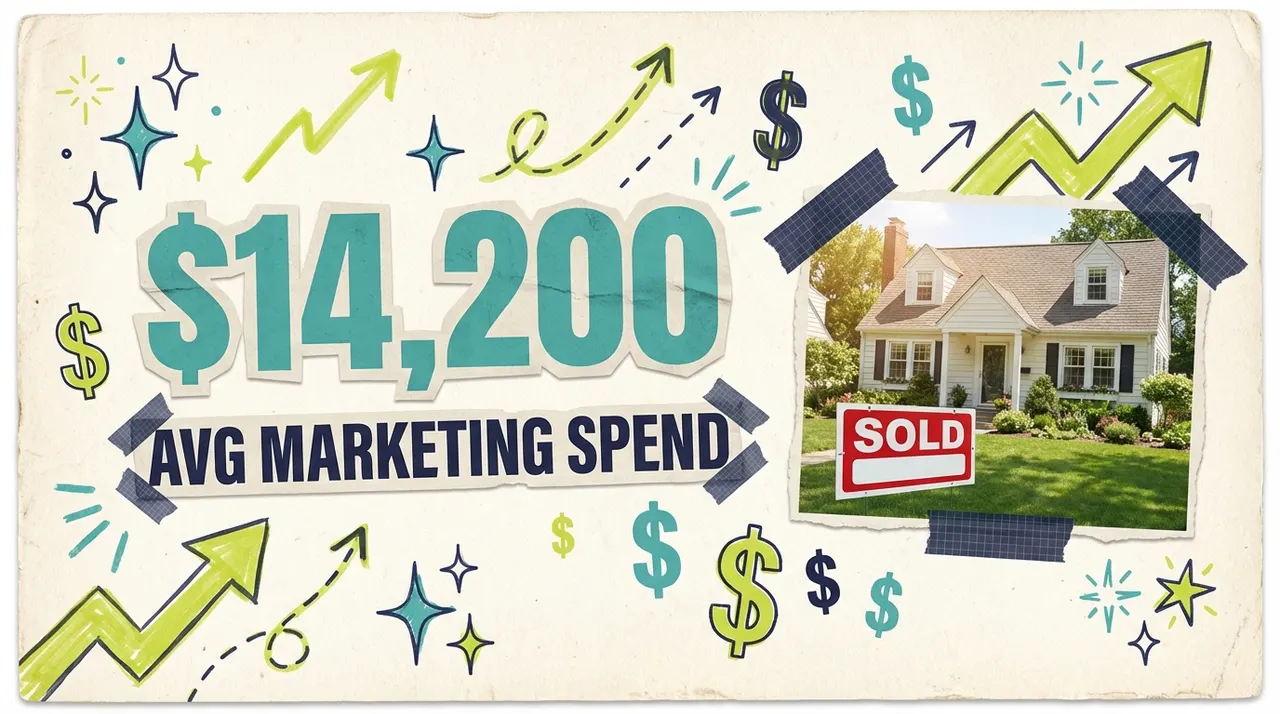
$14,200
Average real estate agent marketing spend
-
54%
Marketing budget spent on digital
-
403%
More inquiries with video listings
Real estate agents spent an average of $14,200 on marketing in 2024, up from $12,725 in 2023, according to Luxury Presence research. While most agents allocate the majority of their marketing budgets to digital channels (54.2% goes to digital marketing according to REsimpli), TV advertising is becoming increasingly accessible for real estate professionals seeking to build local brand awareness and differentiate from competitors. With 96% of home buyers starting their search online and 71% of buyers preferring agents with strong brand presence, the challenge for agents isn't whether to invest in marketing, but how to allocate limited budgets across channels that include TV for maximum impact.
What the data shows
Real estate marketing spend varies significantly based on agent income, market, and business model. Understanding where the industry stands helps agents benchmark their own investment decisions and identify opportunities for competitive advantage.
The overall trend points upward. Marketing budgets increased substantially between 2023 and 2024, with average spend rising from $12,725 to $14,200, representing approximately 12% year-over-year growth (Luxury Presence). This increase reflects agents' recognition that marketing investment correlates directly with business outcomes. According to the same research, 78% of surveyed agents planned to maintain or increase their marketing budgets, suggesting confidence in returns.
Digital marketing dominates current spending. REsimpli research shows that 54.2% of real estate agents' marketing budgets flow to digital channels in 2024, expected to increase to 58.6%. The most common monthly digital spend falls between $100 and $499, though this represents just a portion of total marketing investment. Digital's dominance reflects its measurability and targeting precision, but doesn't capture the full picture of effective real estate marketing.
High performers invest differently. Agents earning the highest gross commission income (GCI) were most likely to increase marketing budgets, with 60% of top earners expanding their investment. More significantly, agents using five or more marketing channels reported average GCI of $4 million (Luxury Presence). This diversification premium suggests that limiting marketing to a single channel, even a high-performing one, leaves opportunity on the table.
The total market for residential real estate agent marketing in the United States ranges between $4.2 billion and $16.2 billion according to REsimpli estimates, which reflects the significant investment agents make in building their businesses. Within this substantial market, TV advertising represents a growing but still underutilized segment, especially among independent agents and smaller teams who have historically viewed TV as inaccessible. The emergence of streaming TV advertising has begun changing this dynamic, making TV available at price points real estate agents can afford.
Video content drives measurable results across all platforms. Listings with video receive 403% more inquiries than those without (REsimpli), and 73% of homeowners say they prefer to list with agents who use video. This performance data extends naturally to TV advertising, where video is the native format and production capabilities have become increasingly accessible through AI-powered tools.
The connection between video marketing success and TV advertising opportunity is direct. Agents already investing in video for listings, virtual tours, and social media have content assets that translate to TV commercials. Properties marketed with 3D tours receive 87% more views than those without, demonstrating buyer appetite for rich visual content. TV advertising extends this visual storytelling to the largest screen in the household, reaching viewers in a lean-back, receptive context that social media feeds can't replicate.
Realtors using video marketing grow revenue 49% faster than non-video users according to REsimpli data, and listings with virtual tours get clicked 40% more than those without. These metrics suggest that video-forward agents are already positioned to benefit from TV advertising, which simply represents another distribution channel for content they're already creating.
Breaking down the numbers
Real estate marketing investment varies considerably based on business scale, market conditions, and strategic priorities.
By income level
Marketing spend correlates strongly with agent income, creating a virtuous cycle where higher investment enables higher earnings:
Top performers (5+ channels): Average $4 million GCI (Luxury Presence)
Industry average GCI: $2.5 million annual sales volume
Recommended marketing allocation: 7-12% of GCI
Most common 2024 budget: $10,000-$20,000 annually
Agents spending $20,000+: Already optimized, less likely to increase further
By marketing channel
Agents allocate budgets across multiple channels, with digital currently dominant but video and brand-building channels gaining importance:
Digital marketing: 54.2% of total budget
Social media: Most commonly used (90% on Facebook, 52% Instagram, 48% LinkedIn)
Video content: Growing priority, drives 403% more inquiries
CRM and automation: 83.5% of agents use CRM systems
Website investment: Ranked ahead of social media in importance for 2024
By activity type
Where marketing dollars flow reflects strategic priorities:
Lead generation: Primary focus for 36% of agents
Brand building: Rising priority, especially for video content
Direct mail: Generated $26.67 million in revenue for REsimpli study participants
Professional photography: Homes sell 32% faster with pro photos
Virtual tours and 3D: Properties get 87% more views
The emergence of streaming TV advertising creates a new category for real estate marketing spend. With minimum budgets starting at $50 and CPMs averaging $25, TV advertising no longer requires the five-figure investments that historically excluded most real estate agents. A typical agent spending $100-$499 monthly on digital marketing could allocate a similar amount to TV and reach thousands of local households with professional-quality commercials.
At a $25 CPM, $500 buys approximately 20,000 impressions. Compare the reach and results of a local TV campaign with your other listing promotions.
Why it matters for your business
Understanding real estate marketing spend benchmarks helps agents position themselves competitively and make informed budget allocation decisions.
The diversification premium is real. Agents limiting themselves to one or two marketing channels compete at a disadvantage against those using five or more. TV advertising offers a differentiation opportunity precisely because most agents haven't yet incorporated it into their marketing mix. When buyers see an agent advertising on their TV, they associate that agent with success, stability, and professional credibility that purely digital presence can't convey.
Consider the competitive landscape. In most markets, buyers encounter the same agents repeatedly across online listings, social media feeds, and digital advertising. Few agents appear on television. TV advertising for real estate creates visibility in a less cluttered environment, building the kind of brand recognition that makes other marketing efforts more effective.
The trust advantage compounds over time. According to REsimpli research, 71% of buyers say they're more likely to work with agents who have a strong presence across channels. TV advertising contributes to this presence, signaling to potential clients that the agent invests seriously in their business and has the resources to deliver professional service. In a relationship business built on trust, these signals matter enormously.
Budget reallocation often makes more sense than budget expansion. An agent spending $500 monthly across digital channels might achieve better results by allocating $300 to digital and $200 to TV. The TV investment builds brand awareness that improves digital advertising performance, reduces cost per lead on other channels, and reaches prospects who might never encounter the agent's digital marketing.
Specific applications for TV in real estate marketing include:
Personal branding: Build name recognition as the local expert
Listing promotion: Showcase premium properties to qualified buyers
Geographic farming: Establish dominance in target neighborhoods
Specialization positioning: Communicate expertise in luxury, commercial, or niche markets
Team and brokerage branding: Scale awareness beyond individual agent efforts
The accessibility revolution has transformed what's possible. Platforms like Adwave enable real estate agents to create professional TV commercials without production budgets, targeting specific geographic areas where they want to build business. At price points similar to a few enhanced Zillow listings or a month of Facebook advertising, TV becomes a practical consideration rather than aspirational fantasy.
How to take advantage of this trend
Real estate agents ready to incorporate TV advertising into their marketing mix should approach it strategically, starting small and scaling based on results.
Here's how to build a TV advertising strategy for real estate:
Start with geographic focus: Target your primary service area, typically a 10-20 mile radius around your office or key neighborhoods
Allocate 10-20% of marketing budget initially: For an agent spending $1,000/month on marketing, $100-$200 in TV provides meaningful reach
Use video you already have: Repurpose listing videos, drone footage, and professional photography for TV creative
Focus on brand over listings: Build recognition as the local expert rather than advertising specific properties
Time campaigns around listing activity: Increase TV presence when launching new listings or entering new markets
Integrate with digital strategy: Use TV for awareness, digital for conversion and retargeting
Creative execution for real estate TV advertising should emphasize the agent's local expertise and personal brand. Unlike listing portals that commoditize agents into interchangeable profiles, TV allows personality and positioning to shine through. Show yourself in familiar local settings, reference community knowledge, and establish the emotional connection that drives real estate relationships.
Measurement in real estate TV advertising requires patience and appropriate expectations. Track brand search volume, website traffic from organic sources, and lead quality over time rather than expecting immediate conversion. Real estate decisions unfold over months, and the awareness TV builds influences buyer and seller choices throughout their decision journey. Ask new leads and clients how they learned about you, and note whether TV advertising coincides with increases in inbound inquiries.
Budget planning should account for real estate's cyclical nature. Consider concentrating TV investment during spring selling season when buyer activity peaks, or during periods when you're actively building business in new geographic areas. The local targeting capabilities of streaming TV make precise geographic and seasonal strategies possible. Many successful agents increase TV investment 4-8 weeks before expected market activity peaks, building awareness that influences decisions when clients are ready to act. Others maintain consistent year-round presence to capture off-season opportunities that competitors miss.
The bigger picture
Real estate marketing investment trends reflect broader shifts in how agents build businesses and compete for clients.
The consolidation of marketing channels
As individual channels become more crowded and expensive, diversification becomes essential for maintaining marketing effectiveness. Real estate agents who relied solely on Zillow five years ago now need presence across multiple platforms. TV advertising represents the next frontier in this diversification, accessible to individual agents for the first time through streaming platforms.
Video dominance accelerates
Every metric points toward video as the most effective format for real estate marketing. From 403% more inquiries to 73% seller preference for video-using agents, the data is unambiguous. TV advertising is inherently video, positioning agents who embrace it ahead of those still focused on static image and text advertising. The production barrier that once separated video haves from have-nots has collapsed with AI creative tools.
Brand investment returns to real estate
The commodification of real estate leads through online portals has renewed appreciation for brand building. Agents are recognizing that fighting for attention on listing platforms where consumers compare dozens of options is less effective than building recognition that precedes the search. TV advertising builds this brand recognition efficiently, reaching households before they enter the market and positioning agents as the obvious choice when decisions are made.
Technology democratizes access
The same technology forces reshaping other industries have reached real estate marketing. Streaming TV advertising, AI creative generation, and programmatic buying have eliminated the barriers that kept TV exclusive to well-funded brokerages and national franchises. Independent agents can now access the same channels and targeting capabilities, creating competitive equity in marketing that didn't exist five years ago.
The implications for competitive dynamics are significant. When only well-funded brokerages could afford TV advertising, they enjoyed an essentially unchallenged advantage in brand building through the medium. Now that independent agents can access the same channels at affordable price points, the playing field has leveled. The agents who recognize and act on this opportunity first will gain advantages over competitors who continue viewing TV as inaccessible.
The shift toward measurable brand investment
Real estate marketing has historically struggled with measurement, especially for brand-building activities. Digital marketing's measurability advantage led to overinvestment in lower-funnel channels at the expense of awareness building. As the limitations of this approach have become apparent, including rising costs and declining returns in crowded digital channels, agents are reconsidering the value of brand investment.
TV advertising on streaming platforms offers better measurement than traditional TV while maintaining brand-building power. Impression counts, geographic reach, completion rates, and audience demographics provide more visibility than was previously possible. This measurement improvement makes TV more justifiable within data-driven marketing strategies.
What experts are saying
Industry analysts and real estate marketing specialists have noted the shifting dynamics of agent marketing investment.
Luxury Presence research highlighted the diversification premium: "Agents using five or more marketing channels reported an average GCI of $4 million. The most successful agents invest confidently and measure returns obsessively." This multi-channel approach increasingly includes TV as costs have dropped and accessibility has improved.
REsimpli's detailed marketing analysis emphasized video's central role: "Listings with video get 403% more inquiries. Video and virtual tours are useful options in real estate, making listings more engaging and accessible." The extension of this video advantage to TV advertising represents a natural evolution for agents already investing in video content.
Real estate coaches and business advisors increasingly recommend TV as part of complete marketing strategies. "The agents getting ahead are the ones treating marketing as an investment, not an expense," Luxury Presence noted. "If you're earning a living from real estate, it's time to make marketing one of your top investments."
The National Association of Realtors has tracked technology adoption among members, noting that agents who embrace new marketing channels typically outperform those who don't. As streaming TV advertising has matured, it has entered the consideration set for technology-forward agents seeking competitive advantages.
Common questions answered
How much should real estate agents spend on marketing overall?
Industry guidelines suggest 7-12% of gross commission income for marketing investment. For an agent earning $250,000 annually, that translates to $17,500-$30,000 in total marketing budget. The most common actual budget range in 2024 was $10,000-$20,000 according to Luxury Presence research. Digital marketing typically consumes 54% of this total, with video and brand-building channels growing in importance. New agents should invest more aggressively as a percentage of target income to build the brand recognition that generates future business.
Is TV advertising realistic for individual real estate agents?
Absolutely, yes. The emergence of streaming TV advertising has made TV accessible at budgets real estate agents can afford. Campaigns starting at $50, with typical monthly investments of $100-$500, deliver meaningful reach within defined geographic areas. This represents a fundamental shift from traditional TV buying, which required minimum investments in the thousands and couldn't target specific neighborhoods. Individual agents now have access to the same premium channels and targeting capabilities that were once exclusive to major brokerages.
What ROI can agents expect from TV advertising?
TV advertising ROI in real estate should be measured in brand metrics rather than direct response. Track brand search volume, organic website traffic, lead quality, and inbound inquiry rates during and after campaigns. Real estate decisions have long consideration cycles, so TV's awareness-building impact may take months to convert to closings. Agents who commit to consistent TV presence over 6-12 months typically see measurable improvements in lead quality and conversion rates as recognition builds. The key is viewing TV as a brand investment that improves performance across all marketing channels.
How does TV compare to digital marketing for real estate?
TV and digital serve complementary roles in real estate marketing. Digital excels at targeting active home searchers, retargeting website visitors, and generating measurable leads. TV builds broad awareness, establishes credibility, and reaches potential clients before they begin active searches. The most effective real estate marketing strategies use both: TV creates recognition that improves digital advertising performance, while digital provides the conversion mechanisms that turn awareness into leads. Agents shouldn't choose between channels but rather optimize the balance based on their specific markets and business goals.
Should new agents invest in TV advertising?
New agents benefit from brand building but should prioritize fundamentals first: professional photography, a quality website, basic digital presence, and CRM systems. Once these foundations are established, typically within the first year, TV advertising becomes a powerful tool for accelerating brand recognition. A new agent launching TV alongside their other marketing efforts creates immediate differentiation from competitors. The key is so that TV investment doesn't crowd out essential business infrastructure. Start with modest TV budgets ($100-$200 monthly) and scale as business results justify expanded investment.
The case for early TV investment is stronger than many new agents realize. In competitive markets, establishing name recognition quickly can accelerate business development timelines significantly. New agents competing against established competitors with decades of relationship equity need every differentiation advantage available. TV advertising creates presence that suggests success and stability, countering the "new agent" perception that sometimes deters clients from working with newer professionals.
What creative approach works best for real estate TV ads?
Effective real estate TV advertising emphasizes the agent's local expertise, personal brand, and unique value proposition. Feature yourself in recognizable local settings, reference specific neighborhoods and community knowledge, and establish emotional connection through authentic presentation. Avoid generic real estate imagery in favor of specific examples from your market. Professional photography and drone footage of properties and neighborhoods make compelling visual content. Keep calls to action simple: name recognition and a memorable way to contact you. AI creative tools now make professional production accessible without significant additional investment.
Supporting data
Additional context on real estate marketing spend and TV advertising opportunity:
Average marketing spend 2024: $14,200 annually (Luxury Presence)
Year-over-year increase: 12% (from $12,725 in 2023)
Digital marketing allocation: 54.2% of total budget (REsimpli)
Recommended marketing investment: 7-12% of GCI
High performer GCI (5+ channels): $4 million average (Luxury Presence)
Video inquiry boost: 403% more inquiries for video listings (REsimpli)
Buyer online start: 96% begin home search online (REsimpli)
Agent preference: 71% of buyers prefer agents with strong presence (REsimpli)
Pro photo impact: Homes sell 32% faster with professional photos
CRM adoption: 83.5% of agents use CRM systems
Budget increase plans: 78% planned to maintain or increase spend
All sources linked above. Data current as of Q4 2025.