-
~90%
Share of U.S. TV households with a connected TV device (2026)
-
243.6M
Projected U.S. connected TV viewers in 2026 (eMarketer)
-
$50
Minimum to start advertising on connected TV with Adwave
Connected TV has become nearly universal in America. Roughly 90% of U.S. TV households now have at least one internet-connected TV device, whether a smart TV, a streaming stick, or a game console, and about 68% of internet households own a smart TV specifically. Measured against TV households rather than all internet homes, smart TV ownership climbs past 80%. eMarketer projects more than 243 million Americans will watch connected TV in 2026.
For a small business, this is the single most important fact about TV advertising today: the connected TV that ad targeting runs on is now in almost every home. The barrier isn't reach anymore, connected TV reaches nearly everyone, the way broadcast once did. The barrier used to be cost, and that's fallen too. Let's break down how many U.S. homes have smart TVs in Q2 2026, which platforms lead, and what near-universal penetration means for reaching customers.
What the data shows
First, a quick definition, because two related terms get mixed up. A smart TV is a television with streaming apps built in. A connected TV device is anything that puts streaming on the TV screen, which includes smart TVs plus streaming sticks like Roku and Fire TV and game consoles. Connected TV, or CTV, is the broader category.
Here's the penetration picture for 2026:
~90% of U.S. TV households have at least one connected TV device, per Leichtman Research Group and industry estimates
~68% of internet households own a smart TV specifically, per Parks Associates
~82% of TV households own a smart TV, per Hub Entertainment Research, a higher figure using a narrower base
243.6 million projected U.S. connected TV viewers in 2026, per eMarketer
One note on those smart TV figures: they differ because they use different denominators. Parks Associates measures internet households and lands at 68%; Hub measures TV households and lands at 82%. Both are legitimate, they just count different bases. The safe way to say it is that roughly seven to eight in ten U.S. homes own a smart TV, and about nine in ten have some kind of connected TV device. Our connected TV household penetration page covers the device side in detail.
Whichever figure you use, the conclusion is the same: connected TV is now nearly as universal as television itself. The smart TV has become the default TV.
Breaking down the numbers
The scale of connected TV goes beyond household penetration. The installed base of devices is enormous, and it keeps deepening.
Here's how big the connected TV footprint has become:
Nearly 500 million connected TV devices are in use across U.S. TV households, up from about 300 million in 2017
Three to four connected TV devices in the average household, between smart TVs, sticks, and consoles
61% of internet households now use a smart TV as their primary streaming device, up from about half a few years ago, per Parks Associates in early 2026
49% of U.S. adults watch video via a connected TV device every single day, rising to 63% of adults 18 to 34
That last shift, the smart TV becoming the primary streaming device, matters for advertisers. For years, people added streaming sticks to older TVs. Now the TV itself is smart, and the built-in apps are where most viewing happens. eMarketer projects that by 2027, more than 75% of connected TV users will stream through built-in smart TV apps rather than add-on devices. The television is the streaming device now.
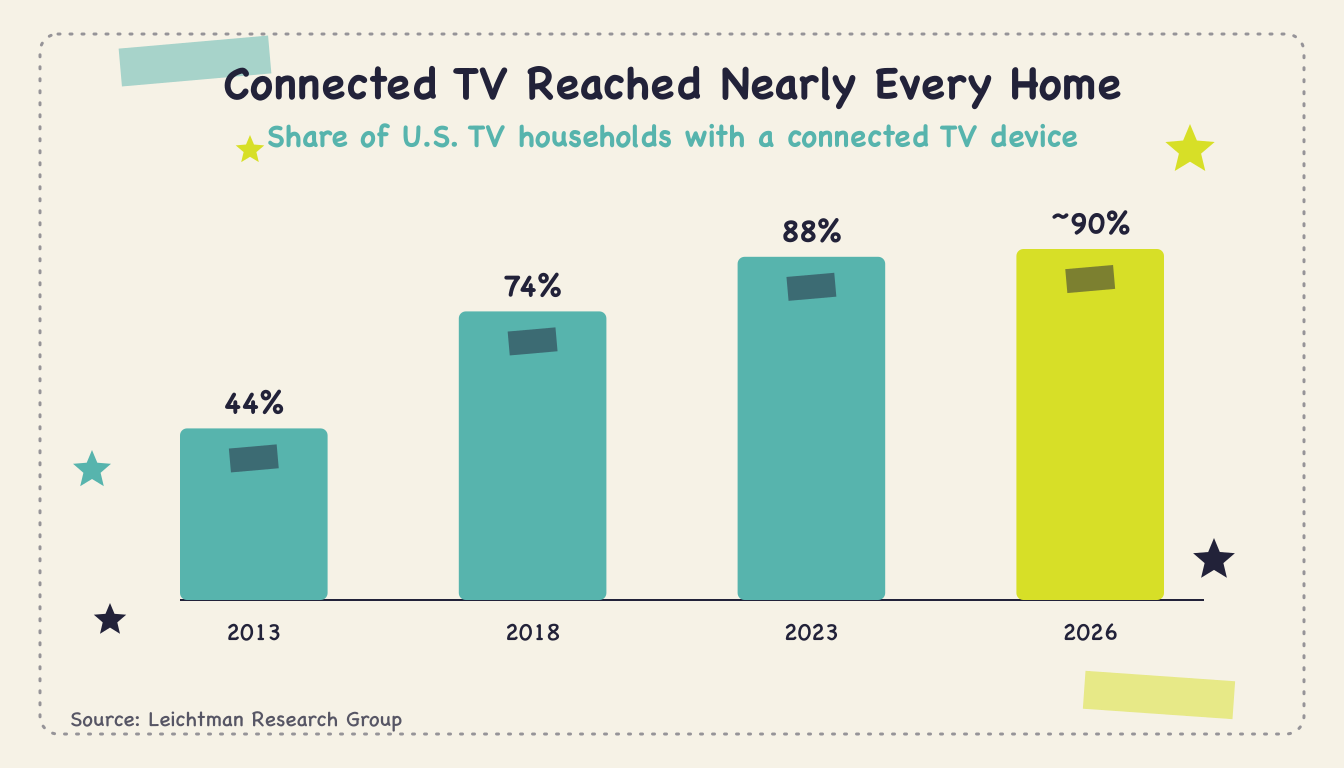
The growth curve tells the story of a technology that went from novelty to universal in about a decade. Connected TV device penetration climbed from roughly 44% of TV households in 2013 to about 74% in 2018, 88% in 2023, and around 90% now. Our streaming's share of TV viewing page shows how that hardware shift translated into streaming taking over the TV day.
Which platforms lead
Nearly every smart TV and streaming device runs on an operating system, and that OS layer has become valuable real estate. A handful of platforms control what most Americans see when they turn on the TV.
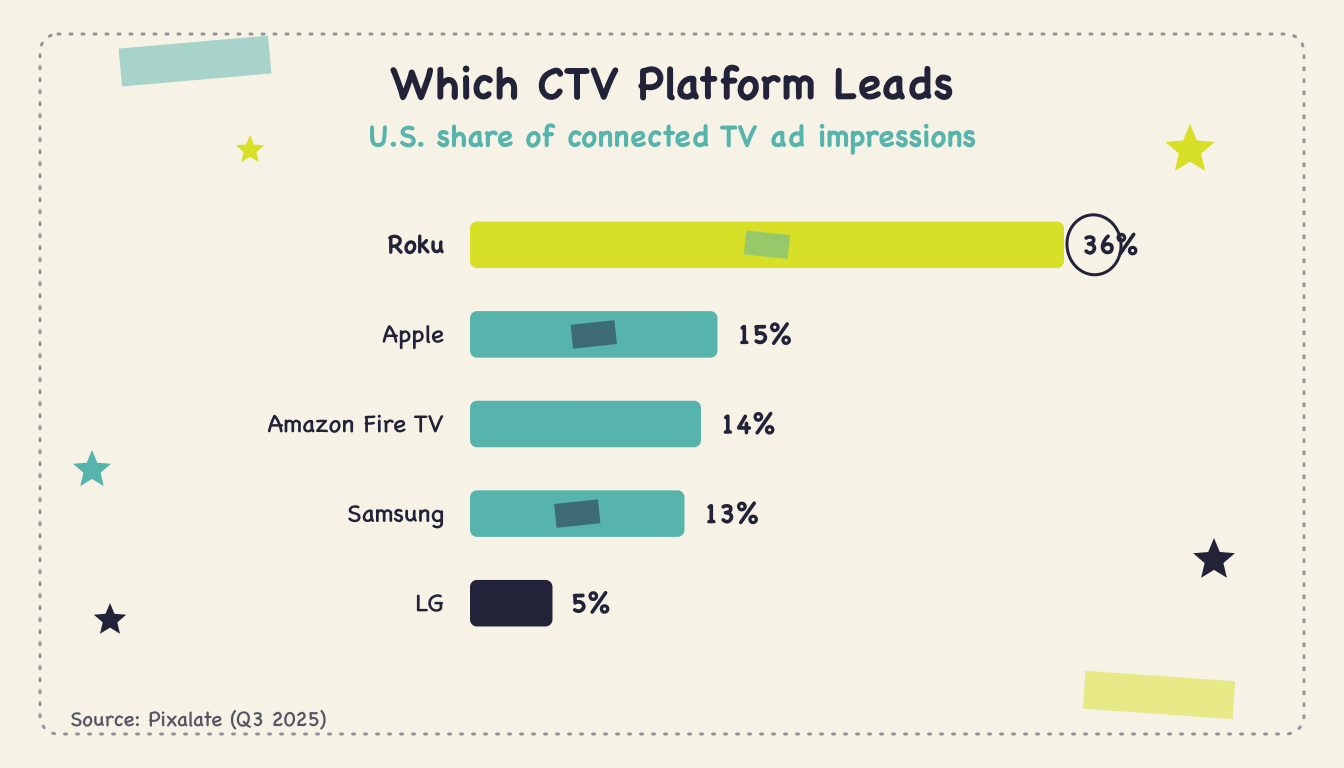
By share of connected TV advertising impressions in the U.S., the platforms rank like this:
Roku: about 36%, the clear leader
Apple: about 15%
Amazon Fire TV: about 14%
Samsung: about 13%
LG: about 5%
Measured by installed base rather than ad impressions, the order shifts slightly, with Roku around 28% and Samsung's Tizen around 23%, but Roku leads U.S. connected TV either way. What matters for advertisers isn't which brand wins, it's that the platforms have consolidated. A handful of operating systems sit on the home screen of nearly every American TV, controlling discovery and carrying their own ad inventory. That consolidation makes the connected TV audience reachable at scale, which is part of why connected TV advertising works so efficiently.
The home screen is the new ad real estate
Here's a shift that near-universal smart TV penetration quietly created: the television's home screen, the menu you see when you turn on the TV, has become one of the most valuable advertising surfaces in media. When the smart TV is in almost every home and it's the primary streaming device, whoever controls that first screen controls a lot of attention.
Think about what the home screen represents:
Everyone passes through it. Before a viewer opens any app, they see the smart TV's home screen. It's the front door to all of television, seen by nearly every household, every day.
It shapes discovery. The operating systems, Roku, Samsung, Fire TV, decide what content gets featured and promoted. That gatekeeping position is worth enormous advertising value.
It carries its own ads. The home screen itself displays ad units, banners, and promoted tiles, an inventory type that didn't exist before smart TVs became universal.
This is why the OS platforms matter so much and why they've built large advertising businesses on top of their device penetration. For a small business, the deeper point is that the smart TV isn't just a screen your ad can play on inside an app, the whole device has become an advertising ecosystem. Near-universal penetration turned the television from a passive display into an interactive platform that knows what people watch and can target accordingly. That's the infrastructure that makes affordable, targeted connected TV advertising possible, and it's now sitting in nine out of ten living rooms.
Why it matters for your business
Near-universal smart TV penetration changes the fundamental math of TV advertising for a small business. When connected TV reaches nine in ten homes, it has the reach that made broadcast TV powerful, but with the targeting and pricing of digital.
Here's what universal penetration means for a local advertiser:
You can reach almost any household. With about 90% CTV penetration, a connected TV campaign can reach nearly every home in your service area. There's no meaningful reach gap to worry about anymore.
The audience is on the big screen. Connected TV puts your ad on the largest screen in the house, full-screen and non-skippable, not a thumbnail in a feed. Near-universal penetration means that premium placement reaches everyone.
Targeting replaces waste. Broadcast reached everyone but let you target no one. Connected TV reaches nearly everyone and lets you target by geography, household, and interest, so you only pay to reach likely customers.
There's a generational angle too. Smart TV and streaming adoption is effectively universal among younger adults, with about nine in ten under-50s using streaming, while cable has inverted by age, just 16% of 18-to-29-year-olds subscribe, versus 64% of those 65 and older. For a business trying to reach younger customers, connected TV isn't optional, it's the only way to reach them on a TV screen at all. Our cord-cutting statistics page tracks that generational shift.
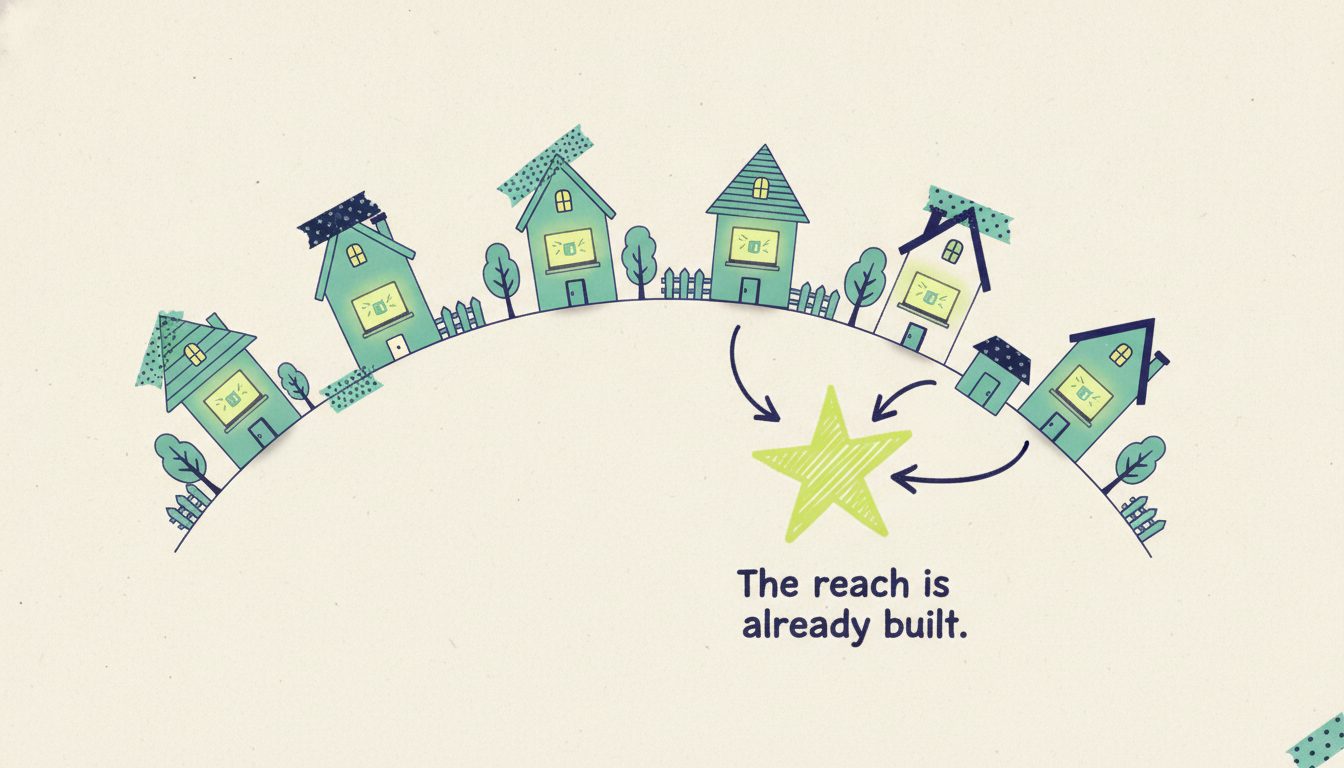
The practical upshot is that the reach problem is solved. Connected TV is in the home. The only questions left are how to target it and what it costs, and both of those now favor small businesses.
How to take advantage
Universal smart TV penetration is the foundation, but you still need to act on it. Here's how a small business turns near-total connected TV reach into customers.
Target your service area. Since nearly every home has a connected TV, the job isn't finding the audience, it's narrowing to the right one. Set a geographic radius, usually 15 to 25 miles, so you reach households you can serve.
Budget for frequency. With reach solved, focus your budget on reaching the same households several times over two to three weeks so your message sticks.
Reach across platforms. Your customers are spread across Roku, Fire TV, Samsung, and smart TV apps. Running across the whole ecosystem covers them wherever they watch.
Let AI make the ad. You don't need a studio. AI tools turn your existing website into a broadcast-quality 30-second ad in about two minutes.
Measure brand lift. Track branded search, direct traffic, and calls during and after a campaign rather than chasing clicks.
The mechanics are simple. With Adwave, ad creation is free, a campaign starts at a $50 minimum, and you can be live across 100+ premium streaming channels in under 10 minutes, reaching the connected TVs that sit in nearly every home. You point it at your website, it builds the spot, and your budget converts to targeted impressions on the big screen. For what that budget buys, our guide to the average CTV CPM lays out the costs.
The bigger picture
Smart TV penetration reaching near-universal levels is the quiet foundation under everything else in streaming. It's why the audience could shift, why the ad market could grow, and why connected TV became viable for small businesses.
A few forces give the 2026 numbers their weight:
Saturation means the future is about usage, not adoption. With penetration near 90%, connected TV isn't growing by adding new households anymore, it's growing by taking more of each household's viewing time. That's why streaming keeps gaining share even as device penetration plateaus.
The smart TV is an ad platform, not just a screen. As the TV itself became the streaming device, the operating system, the home screen everyone sees, became advertising real estate. The hardware layer is now part of the ad ecosystem.
Reach parity with old TV, plus targeting. Connected TV now matches the near-universal reach that made broadcast dominant, but adds the targeting, measurement, and low entry cost of digital. The connected TV advertising market grew up on that foundation.
For small businesses, the throughline is that the connected TV is already in your customers' living rooms, nearly all of them. The infrastructure for reaching almost every household on the biggest screen in the house is built and in place. What used to require a broadcast budget to reach everyone now requires a connected TV campaign and a modest budget. The hard part, getting the technology into homes, is done. The easy part, running an ad, is open to any business.
What experts are saying
Researchers describe U.S. connected TV penetration as effectively saturated. Leichtman Research Group has tracked the climb from 44% of TV households in 2013 to around 88% by 2023, and the year-over-year gains have shrunk to a couple of points as the market approaches its ceiling. The consensus is that connected TV has reached near-universal adoption, and that future growth will come from how much people watch and how they're monetized, not from new households buying their first smart TV.
The fresher story analysts are watching is the smart TV becoming the primary streaming device. Parks Associates reported in early 2026 that smart TVs are now the main streaming device in 61% of internet households, a milestone that shifts power toward the TV operating systems, Roku, Samsung, Fire TV, that control the home screen. For advertisers, the takeaway is that connected TV has achieved the reach of traditional television while adding digital targeting and measurement, and that near-universal penetration makes it a genuine mass medium. A small business can now reach nearly every household in its area on the big screen, something that used to require a budget only national brands could afford.
What the numbers don't tell you
The penetration numbers are striking, but read them with a few caveats.
Different figures use different bases. Smart TV ownership is 68% of internet households or 82% of TV households depending on the source. CTV device penetration is often cited as 90% but the cleanest survey anchor is closer to 88%. Check which base a figure uses before comparing.
The estimate of 243.6 million connected TV viewers in 2026 is an eMarketer forecast.
Penetration isn't the same as viewing. Having a connected TV device doesn't mean it's the only thing a household watches. Many homes still mix in some cable or broadcast, though streaming now dominates the TV day.
The OS rankings depend on the metric. Roku leads whether you measure installed base or ad impressions, but the exact shares differ by method. Read them as directional.
Read the penetration data as a green light: connected TV is in nearly every home, the reach problem is solved, and the only questions left, targeting and cost, both favor small businesses now.
Common questions answered
How many U.S. homes have a smart TV? About 68% of U.S. internet households own a smart TV, and roughly 82% of TV households do, depending on the survey base. More broadly, around 90% of U.S. TV households have at least one connected TV device, including smart TVs, streaming sticks, and game consoles. eMarketer projects more than 243 million Americans will watch connected TV in 2026.
What's the difference between a smart TV and a connected TV device? A smart TV is a television with streaming apps built in. A connected TV device is anything that brings streaming to the TV screen, which includes smart TVs plus external devices like Roku players, Fire TV sticks, and game consoles. Connected TV, or CTV, is the umbrella term for all of them.
Which smart TV platform is the most popular? Roku leads U.S. connected TV, with about 36% of connected TV ad impressions and roughly 28% of the installed base. Samsung's Tizen is second at around 23% of installed base, followed by Amazon Fire TV, LG, and others. Roku leads whether measured by devices or ad share.
Is smart TV ownership still growing? It's approaching saturation. Connected TV device penetration climbed from about 44% of households in 2013 to around 90% now, and year-over-year gains have slowed to a couple of points. Future growth is mostly in how much people watch, not in new households adopting their first smart TV. For advertisers, saturation is good news: it means the reach is already built, so a connected TV campaign can count on finding an audience in nearly every home rather than waiting for adoption to catch up.
Why does smart TV penetration matter for advertisers? Near-universal penetration means connected TV advertising can reach almost any household, the same broad reach broadcast TV once had, but with digital targeting and lower costs. With Adwave, a local business can reach the connected TVs in nearly every home in its area, running 30-second ads across 100+ premium channels from a $50 minimum.
The numbers at a glance
Key smart TV and CTV penetration figures for Q2 2026, with sources:
~90%: share of U.S. TV households with at least one connected TV device (Leichtman Research Group, industry estimates)
68% / 82%: smart TV ownership among internet households (Parks Associates) and TV households (Hub Entertainment Research)
243.6 million: projected U.S. connected TV viewers in 2026 (eMarketer forecast)
~500 million: connected TV devices in use across U.S. households (Leichtman Research Group)
61%: internet households using a smart TV as their primary streaming device, early 2026 (Parks Associates)
36% / 28%: Roku's U.S. share of CTV ad impressions and installed base, the market leader (Pixalate, Parks/Kagan)
44% to ~90%: growth in CTV device penetration from 2013 to 2026 (Leichtman Research Group)
83%: share of U.S. adults who use streaming services (Pew Research Center, 2025)
Reach nearly every home, starting at $50
Connected TV is in about 90% of U.S. TV households, and smart TVs are now the default television for most Americans. The reach that once required a broadcast budget is now available to any business, on the biggest screen in nearly every home.
You don't need a national budget to reach connected TV households. See how Adwave works to turn your website into a broadcast-quality 30-second ad in minutes, or check pricing to launch a connected TV campaign from a $50 minimum. The TVs are already in the living rooms. It's a good time to be on them.