You're probably looking at your social media calendar, wondering whether it still makes sense to post on X, whether Threads is where the momentum has shifted, or whether Bluesky deserves any of your already limited time.
That confusion is reasonable. Most small businesses don't need another generic platform roundup. They need to know where to spend effort if the primary goal is more calls, more store visits, more listing inquiries, and better lift around a campaign they're already running.
A real estate agent promoting a new listing doesn't need abstract talk about “community.” A retailer launching a weekend sale needs to know which platform helps the message travel fast, which one supports visuals, and which one is too niche unless the audience is unusually specific. That's the standard that matters.
The New Social Media Crossroads for Businesses
A few years ago, the answer was simpler. Most businesses picked one or two major social channels, posted consistently, and called it a day. Now the market feels split. X still matters. Threads keeps growing. Bluesky has become the platform owners keep hearing about from marketers, founders, and tech-heavy circles.

Why the decision feels harder now
A local business owner isn't choosing between three equal options. You're choosing between three different environments.
X is still where people gather around breaking news, live reactions, and fast public conversation. Threads feels more polished and more visual in the way content spreads. Bluesky is smaller, more selective, and often stronger when the audience values signal over noise.
What small businesses need from social
For most SMBs, the right question isn't “Which platform is best?”
It's this:
Where can I reach the people most likely to buy?
What kind of content can I realistically make every week?
Will this platform support local momentum, not just vanity engagement?
Can it help reinforce bigger campaigns, including paid media?
That last point gets ignored too often. Social should support the rest of your marketing. If you're already building a paid plan, budgeting guidance like this breakdown of how much a small business should spend on social media ads helps put platform choices into context.
The wrong platform isn't just wasted posting time. It usually leads to weak creative, inconsistent follow-through, and a distorted view of what your market responds to.
A lot of owners also skip the strategy step and move straight to posting. That usually creates random activity, not a system. Before choosing any platform, it helps to review a practical framework for developing a foundation for social media, especially if your current approach is reactive.
A better way to choose
The useful way to think about Threads vs X vs Bluesky: Which Platform Should Your Business Choose? is to stop treating it like a popularity contest.
This is an operating decision. You're deciding where to place attention, creative energy, and follow-up time. If you choose well, social can support local awareness, strengthen trust, and give your campaigns a second life after the initial ad runs. If you choose poorly, you'll spend months posting content your ideal customer barely sees.
Meet the Contenders A Quick Snapshot
Before getting into detailed trade-offs, it helps to give each platform a clear business identity.
X in plain terms
X is where speed matters. If your business can benefit from live conversation, quick commentary, local happenings, or reactive promotions, it still plays a distinct role. Think restaurants posting same-day specials, dealerships commenting on regional events, or service providers tying into news cycles and local conversation.
For a deeper look at whether that still translates into results, this guide on X for small business and whether it still matters is useful context.
Threads in plain terms
Threads works best when the business can publish attractive, approachable content on a regular cadence. It favors brands that can turn products, properties, process, and personality into posts people can absorb quickly. Retailers, agents, wellness brands, and visually driven service businesses often find it easier to maintain momentum there.
Bluesky in plain terms
Bluesky is smaller and more selective in feel. That's its strength and its limitation. It won't usually be the first choice for a local business chasing broad awareness, but it can be valuable when the audience cares about expertise, credibility, and cleaner discussion.
If your business wins through authority and informed conversation, Bluesky can outperform bigger platforms in quality of interaction, even when it doesn't win on scale.
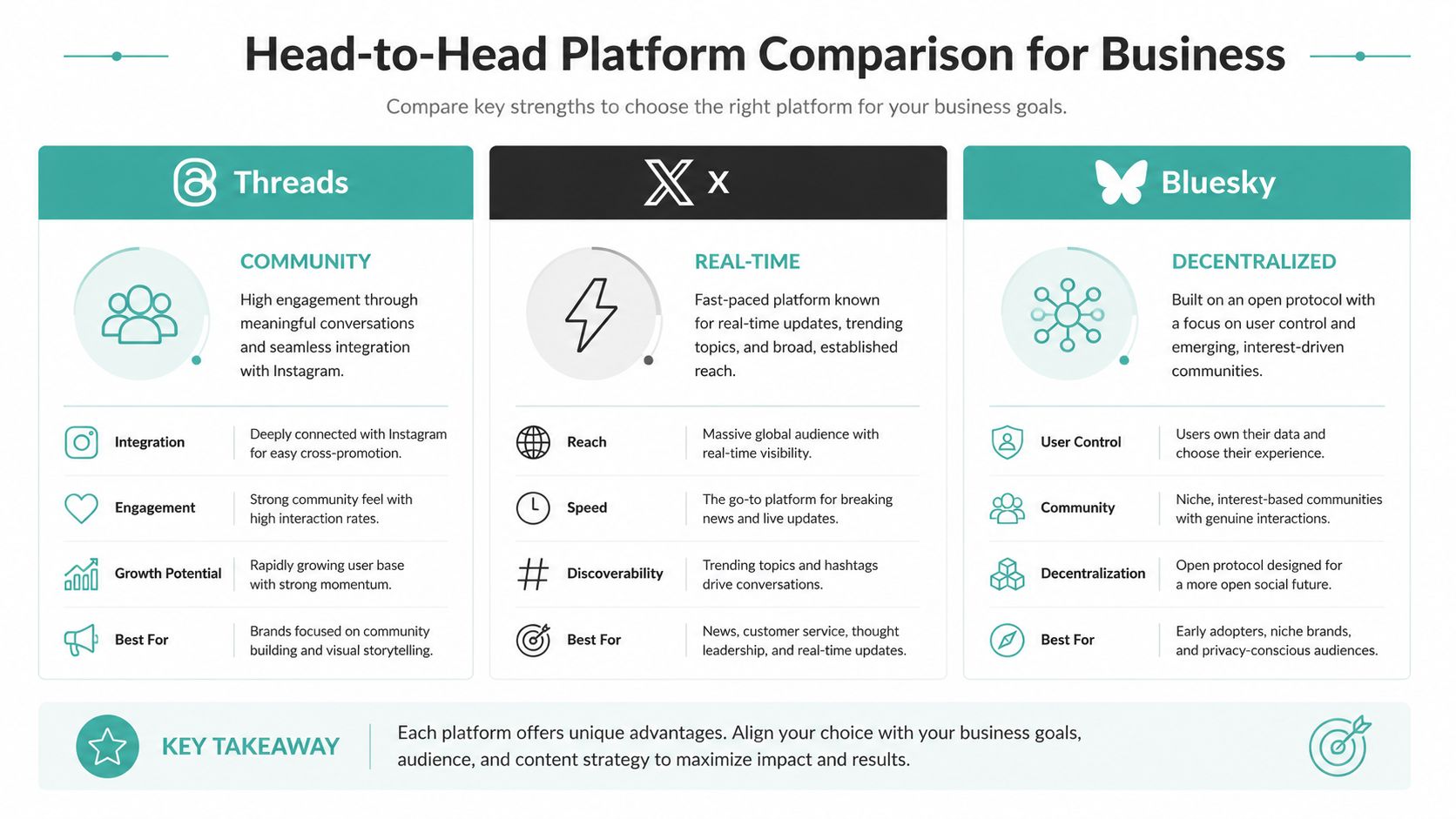
Head-to-Head Platform Comparison for Business
A small business rarely needs another feature list. It needs to know where one hour of posting time is most likely to turn into store visits, listing inquiries, booked appointments, or more response to a local ad campaign.
Audience and reach
If your goal is broad adult awareness in one local market, X still starts with an advantage. Pew Research Center's 2025 survey, summarized by Content Grip, puts X at 21% of U.S. adults, compared with Threads at 8% and Bluesky at 4%.
That matters for businesses that need reach before nuance. A real estate brokerage promoting a weekend open house, a dealership pushing a holiday sales event, or a home services company tying social posts to a TV spot all benefit from being where more local adults already spend time.
Reach is only part of the decision, though.
A retailer running a coordinated local push may still choose Threads if the campaign depends on product photos, staff videos, and repeat exposure over two weeks. An attorney or financial advisor may find that broad awareness on X brings attention but not the right kind of interaction. A niche audience on Bluesky can produce fewer comments and better leads. Businesses that depend on neighborhood-level chatter should also compare these platforms with Nextdoor for local business owners who need hyperlocal visibility.
Content fit and engagement pattern
The better question is not which platform gets the biggest headline number. The better question is what kind of content your business can produce every week without burning out your team.
X is strongest when the post has a reason to exist now. A same-day offer. A reaction to a local event. A quick update tied to weather, sports, traffic, or breaking news. For a restaurant, that could mean filling tables tonight. For a dealership, it could mean driving traffic to a weekend sales event while your TV ad is still fresh in the market.
Threads rewards consistency and visual repetition. If a boutique can post new arrivals, styling ideas, staff picks, and short product demos three times a week, Threads usually gives that business a steadier operating rhythm. The same goes for real estate teams posting listing photos, neighborhood snapshots, before-and-after staging, and quick buyer tips.
Bluesky is narrower. It works best when authority is the product. A founder, consultant, analyst, or educator can build useful traction there if the audience wants informed commentary more than mass reach.
The engagement pattern on X also tends to be less predictable. Some posts disappear quickly. Others break out fast. That volatility can help if your business can respond in real time. It wastes effort if your team needs a calmer system.
If you're studying short-form social behavior more broadly, the patterns discussed in TikTok engagement for UGC programs are also useful because they reinforce the same core truth. Content format often matters more than platform branding.
Ad environment and practical use
For many small businesses, platform choice comes down to campaign behavior.
Threads is often easier to justify for owners who want a stable publishing environment and a lower-maintenance brand presence. By June 2025, Threads reached 115.1M mobile daily active users and had surpassed X on that mobile metric. That does not mean every local business should move there first. It does mean Threads is no longer just a backup option.
X still handles urgency better. If your business is amplifying a local TV campaign, X gives you a place to echo the message while the ad is live, react to local conversation, and post reminders tied to the exact day and time. That is useful for event-driven categories like entertainment, auto, sports bars, restaurants, and political or issue advocacy.
Bluesky usually plays a supporting role, not a lead role, for local SMBs. It can be a smart secondary channel for a founder-led brand, a specialist practice, or a business trying to build trust with a highly informed audience. It is rarely the best choice if the main objective is broad local market coverage.
Brand safety and operating risk
Owners should also judge each platform by the amount of management it demands.
X can produce strong visibility, but it asks for attention. Teams need to monitor replies, watch context shifts, and decide how comfortable they are with a faster, rougher conversation environment. Threads is generally easier for brands that want regular posting without as much reputational friction. Bluesky tends to feel cleaner, but the trade-off is smaller scale.
The right choice is the one your team can maintain and tie to an actual business result. If social is meant to support a TV campaign, drive foot traffic, or keep your brand visible between promotions, choose the platform that fits your content style, your audience, and your tolerance for noise.
Platform Strategies for Local Business Verticals
A local business does not need to win every platform. It needs the right platform to do a specific job.
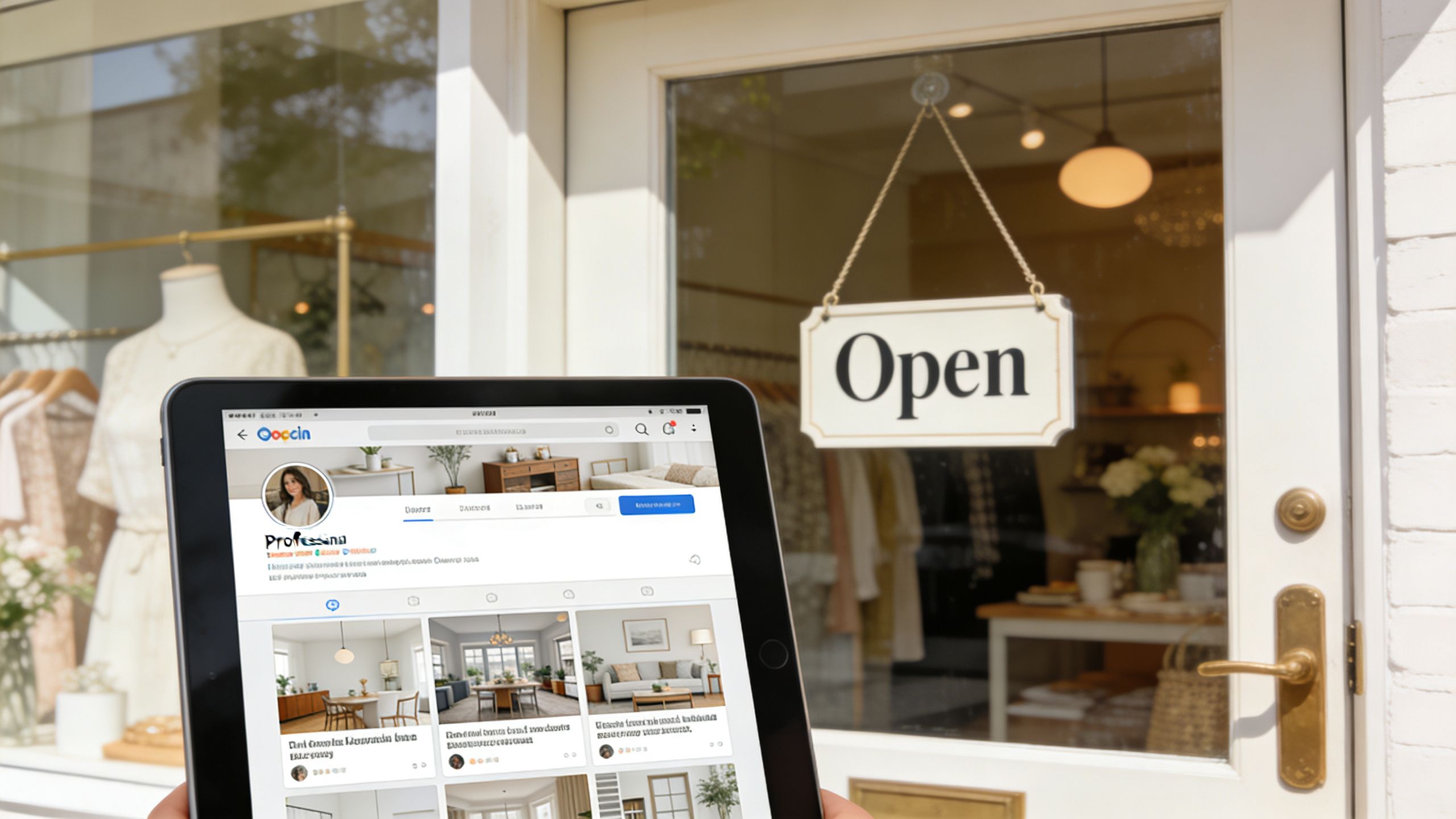
Real estate and retail
Real estate teams usually get better results on Threads when they post content that helps a buyer or seller picture the experience. Listing photos, short walkthrough clips, staging tips, renovation before-and-afters, and neighborhood snapshots all fit naturally there. For an agent trying to stay visible between open houses, that matters more than posting market commentary nobody saves or shares.
Retail works much the same way. A boutique can post new arrivals, staff picks, styling combinations, restock alerts, and quick product demos. A garden center can show seasonal inventory, planting ideas, and weekend project inspiration. The common thread is visual proof. Customers want to see what changed, what is in stock, or how the product looks in real life.
Threads is a poor fit for flat text updates. If a post does not show the item, the process, the result, or the people behind it, it usually does not carry enough weight to help a local business.
Restaurants and automotive
Restaurants and auto dealers often have a different problem. Timing matters more than polish.
X is useful when the offer has a short shelf life. A restaurant can push a lunch special at 10:45 a.m., tie a happy hour post to a local game, or answer a customer asking if the patio is open after the rain. A dealership can post about a weekend sales event, same-day test drive availability, or inventory tied to a local promotion already running on TV or radio.
I have seen this play out in local campaigns. A polished post scheduled for later in the day is less valuable than a fast, clear post that catches people before they make a decision.
A restaurant does not need perfect creative at 11 a.m. It needs nearby customers to see the offer before they choose another place.
That speed comes with a management cost. If nobody is available to reply, post in real time, and keep the account active, X loses a lot of its value for SMBs.
Professional services and niche operators
Bluesky usually makes sense for businesses that sell judgment, expertise, or a distinct point of view. That can include consultants, specialized financial firms, technical service companies, and founder-led brands that win clients through trust instead of impulse buying.
For those businesses, smaller reach can still be productive if the conversation quality is better. A boutique accounting firm may get more value from thoughtful posts about tax planning changes than from trying to force daily promotional content onto a broader platform. A home services company with a strong owner presence may also use Bluesky to build credibility with local homeowners who care about education before they request a quote.
If you manage more than one channel, do not copy and paste the same post everywhere. Use tools that automate social media posting, then adjust the hook, image, and call to action for each platform. The same message can support different goals, but it still needs platform-specific packaging.
For some local businesses, the smarter second channel is not Threads, X, or Bluesky at all. A practical guide to Nextdoor for local business and why many owners overlook it is worth reviewing if your main goal is neighborhood trust, local referrals, or service-area visibility.
What works better than trying to be everywhere
Small businesses usually get more from a focused mix:
One primary platform: Choose the channel that matches how customers discover and evaluate you.
One support channel: Add a second platform only if it does a different job, such as real-time promotion or credibility-building.
One repeatable content format: Pick something your team can produce every week, whether that is listing tours, product videos, or same-day offer posts.
That approach is usually what turns social media from a time drain into a channel that supports foot traffic, inquiries, and campaign lift.
Amplify Your Reach with Integrated TV Campaigns
Social platforms are useful. They are not complete.
A local business that relies only on social is still limited by follower counts, feed competition, posting consistency, and platform-specific behavior. That's why the strongest approach for many SMBs is to use social as reinforcement, not as the entire awareness engine.

Where social helps and where it falls short
Social is great for follow-up attention. It helps people see your business name again, understand the offer, ask questions, and share the message. But many local campaigns still need broader top-of-funnel visibility than social can reliably provide on its own.
That's especially true for businesses promoting:
A local sale
A new listing or open house
A dealership event
A new service launch
A seasonal offer tied to a short window
One comparison summarized here notes that X offers 66x the raw user reach of Bluesky for broad awareness, but also points out that existing guides don't do enough to show how that translates into promoting local TV ad campaigns. That gap is real. Reach on social doesn't automatically equal market coverage.
A better local marketing sequence
For local businesses, a stronger approach is to build awareness in one channel and then let social deepen it.
A simple sequence looks like this:
Launch a clear campaign message
Put that message in front of local viewers at scale
Use social posts to repeat, explain, and localize the message
Reply to comments and questions where people engage
Measure which offers generate calls, visits, and direct interest
Television and social media function more effectively when combined rather than used in isolation. When a viewer encounters a campaign first within a premium viewing environment and then observes the business again in their social feed, recall improves. The social post no longer needs to carry the entire burden of the initial introduction.
For owners comparing channels, this is also the right context for reading small business TV ads versus social. The practical decision isn't either-or. It's which channel creates awareness first, and which one helps convert attention into action.
Social works best when it extends a message people have already encountered somewhere else.
Why this matters for local SMBs
A retailer can run a local sale message broadly, then use Threads to show featured items and in-store visuals. A restaurant can build broad local awareness, then use X for same-day reminders and live momentum. A real estate agent can support a broader campaign with Threads property visuals and audience follow-up.
That integrated approach is more durable than relying on organic social alone. It gives the business a wider opening and a better chance of staying visible after the first impression.
The Final Verdict A Decision Framework for Your SMB
If you want the shortest practical answer, it's this: choose the platform that matches your business goal, not the one getting the most industry chatter.
Start with the goal, not the platform
If your business needs broad adult visibility and timely reach, X is still a serious option.
If your business needs steady growth, safer brand surroundings, and visual storytelling, Threads is often the better primary platform. As of June 2025, Threads reached 115.1M mobile daily active users and surpassed X on that mobile measure, which is one reason many SMBs now see it as a more predictable place to build community over time.
If your business needs niche authority and thoughtful discussion, Bluesky can earn a place. But for most local SMBs, it works better as a secondary channel than a primary one.
A simple decision filter
Ask these questions in order:
Do customers buy from me because they see me often or because they trust my expertise? If visibility drives sales, lean toward X or Threads. If expertise drives sales, Bluesky becomes more relevant.
Can I consistently create visual content? If yes, Threads gets stronger. If not, X may be easier to sustain.
Does timing matter to my offer? Flash promotions, local events, and reactive posts fit X better.
Do I need a cleaner, steadier environment for long-term posting? Threads is usually the safer default for businesses that want consistency.
Am I expecting one social platform to carry the entire marketing plan? If yes, reset that expectation. Social should support a broader local acquisition strategy.
The most practical recommendation for most SMBs
For many small businesses, the default answer is:
Primary platform: Threads
Secondary platform: X, if the business has timely offers or a reactive audience
Selective niche use: Bluesky, if authority and specialized conversation matter
That recommendation isn't based on hype. It's based on workload and business reality. Threads is easier for many SMBs to maintain. X is useful when speed matters. Bluesky is valuable when precision matters.
Your first five moves
Pick one main platform for the next quarter Don't split your effort evenly across all three.
Define one content lane Examples: listings, product demos, staff expertise, daily offers, before-and-after transformations.
Post for business intent Every post should support awareness, consideration, or direct response. If it does none of those, skip it.
Tie social to a real campaign Social performs better when it supports a launch, sale, event, or broader media push.
Track one meaningful outcome Use inquiries, bookings, visits, or campaign-specific responses. Don't judge success only by likes.
Threads vs X vs Bluesky: Which Platform Should Your Business Choose? For a local SMB, the answer usually isn't all three. It's the one that fits how your business gets attention, earns trust, and turns visibility into revenue.
If you want to pair your social strategy with broader local visibility, Adwave is a strong next step. It helps small businesses create and launch TV ads quickly, then use social platforms to reinforce the message, extend recall, and drive action across the channels customers use.