-
2.3%
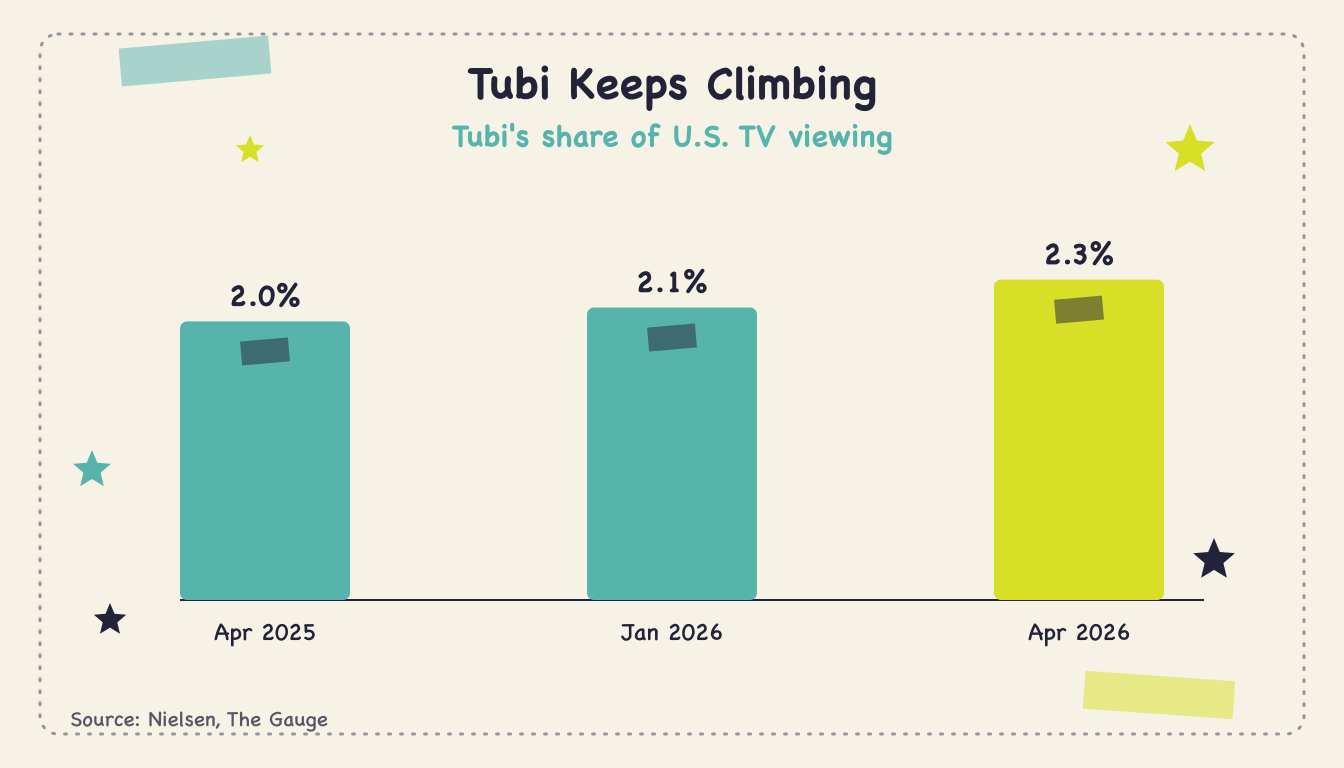
Tubi's share of U.S. TV viewing, a platform-best (April 2026, Nielsen The Gauge)
-
100M+
Tubi monthly active users (2025)
-
$30/day
Starting daily budget for multichannel media on Adwave, including TV
Update, September 26, 2026: Nielsen's July 2026 Gauge release says the company adjusted Tubi measurement parameters in June and is evaluating the impact. That release does not publish a new Tubi share. The 2.3% figure below is April 2026. Do not extend it into May, June, or July.
Tubi, the free ad-supported streaming service owned by Fox, reached a platform-best 2.3% of all U.S. TV viewing in April 2026, according to Nielsen's The Gauge, its highest share in the reports this page uses. In that April ranking it sat ahead of Peacock, Paramount+, and Max on total TV viewing.
For a small business, Tubi is a case study in why free streaming matters so much for advertising. Every one of Tubi's more than 100 million monthly users watches with ads, because there's no ad-free tier, so the entire audience is reachable. And that audience skews exactly where many advertisers want to be: young, diverse, and full of cord-cutters who don't watch traditional TV. Let's break down Tubi's Q2 2026 share, its rapid rise, and what it means for reaching customers.
What the data shows
Nielsen's The Gauge measures how Americans split their TV time. In the April 2026 report, released June 25, 2026, Tubi's viewership rose 3% in the month to a platform-best 2.3% share of television, an all-time high for the free service.
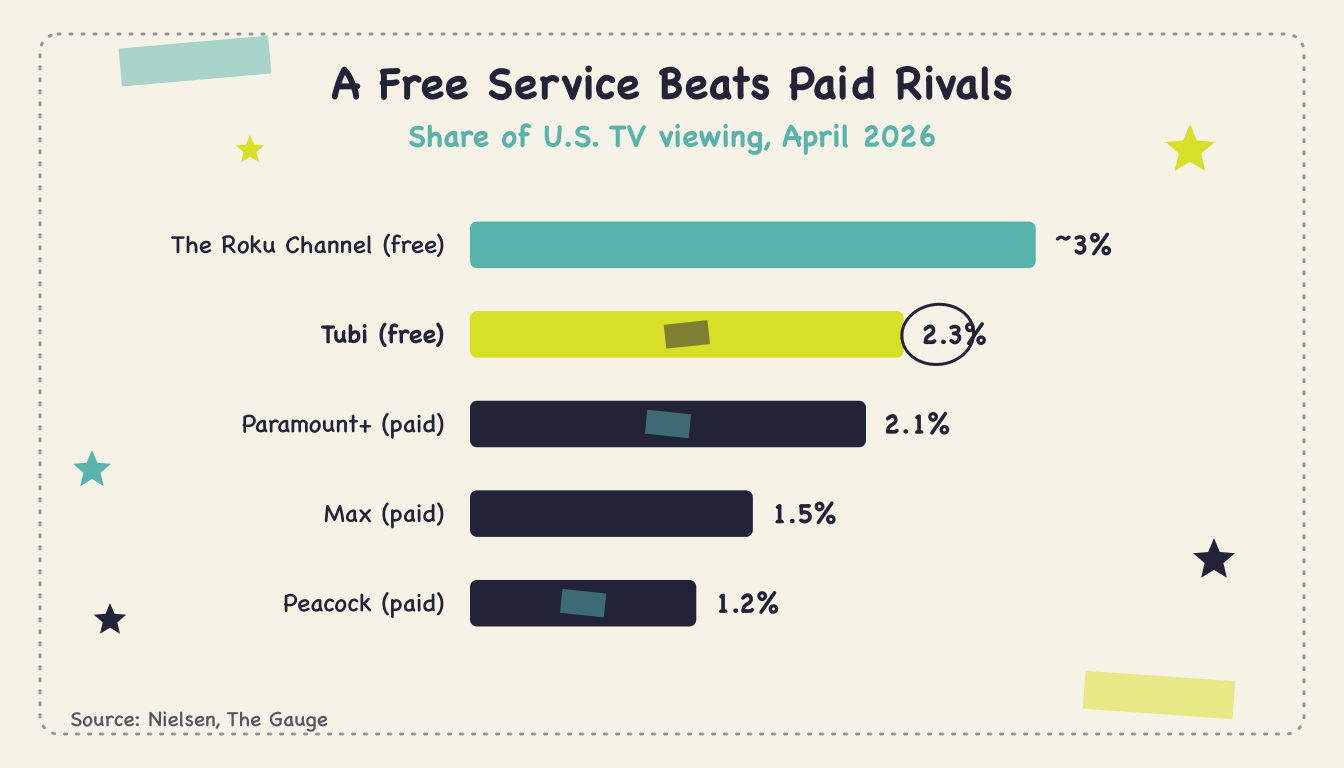
Here's where Tubi sits among streaming services in April 2026:
YouTube: 13.4% (the leader)
Netflix: 7.8%
The Roku Channel: about 3% (the top free service)
Tubi: 2.3% (a platform-best, ahead of paid rivals)
Paramount+ 2.1%, Max 1.5%, Peacock 1.2%
The remarkable part is that Tubi, a free service, now out-draws several paid subscription streamers. It sits behind The Roku Channel among free services but ahead of Peacock, Paramount+, and Max, all of which charge for subscriptions. Tubi's share has climbed steadily through 2026, from 2.1% in January to 2.3% in April, and it's up from about 2.0% a year earlier. Our free ad-supported streaming share breakdown tracks how these free services keep gaining ground.
That 2.3% sits inside a streaming category that hit a record 47.6% of TV viewing in April 2026. Free ad-supported streaming, known as FAST, is one of the fastest-growing corners of that total, and Tubi is one of its biggest names.
How Nielsen measures this, and why April is the latest number
Tubi's 2.3% comes from Nielsen's national panel, the same measurement behind its TV ratings, tracking actual viewing on TV sets. It's reported as its own streaming service, a clean, standalone figure.
A few points help you read it correctly:
April 2026 is the latest confirmed month. Nielsen delayed its March Gauge amid a methodology dispute, and a recalibrated version is expected in the fall, which may shift streaming shares. Every figure here reflects data through April 2026.
The platform-best is real. Nielsen's April release specifically called out Tubi reaching a platform-best 2.3%, up 0.1 point month over month, so this is an all-time high, not a rounding artifact.
Year over year needs two reports. Tubi was about 2.0% in April 2025 and 2.3% in April 2026, a gain of roughly 0.3 points. That comes from comparing two Gauge reports, not a single Nielsen year-over-year figure.
The takeaway is that Tubi is a genuine top-tier streaming service now, one that happens to be completely free, and it's growing.
Breaking down the numbers
Tubi's rise is powered by scale and by a very specific audience. Start with the scale.
Here's how big Tubi has become:
100 million-plus monthly active users, a milestone Tubi crossed in May 2025
10 billion-plus hours streamed across all of 2024, with a run-rate that reached roughly 1 billion hours in a single month by 2025
Over $1.1 billion in revenue in Fox's fiscal 2025, with Tubi turning profitable for the first time in fiscal 2026
Now the audience, which is Tubi's real differentiator. Tubi skews dramatically younger and more diverse than traditional TV:
More than half of Tubi's viewers are Gen Z or Millennial
Over a third are adults 18 to 34, a demographic advertisers pay a premium to reach
Nearly half are multicultural
Around 70% are cord-cutters or cord-nevers, people traditional TV advertising can't reach at all
That last point is the one advertisers should sit with. Roughly seven in ten Tubi viewers don't have cable, which means a Tubi impression often reaches someone a broadcast or cable ad would miss entirely. Fox describes Tubi's audience as massive, young, diverse, and incremental, and incremental is the key word: it's reach you can't get on traditional TV. Our ad-supported streaming viewers page tracks how large this audience has become.
The catalog is part of what pulls that audience in. Tubi built its library on a huge collection of licensed movies and shows, thousands of titles available free, plus a growing slate of originals and live channels. For a value-conscious viewer, especially a younger one who never subscribed to cable, a massive free library with a light ad load is a compelling proposition. That's the cycle: free content draws a big young audience, the big young audience draws advertisers, and advertising revenue funds more content. It's the same model broadcast television ran on for decades, rebuilt for streaming, and it's working. Tubi's steady climb up the Gauge rankings, quarter after quarter, is the proof.
Why it matters for your business
Tubi is a near-perfect illustration of why free ad-supported streaming is such a gift to advertisers, especially small ones. The economics are simple and they favor you.
Here's what makes Tubi valuable for a local advertiser:
Every viewer is ad-supported. Tubi has no ad-free tier. Unlike subscription services where only some viewers see ads, 100% of Tubi's audience is reachable with advertising. That makes its inventory abundant and efficient.
The audience is incremental. With about 70% of viewers being cord-cutters, Tubi reaches people your broadcast or cable buys can't. That's additive reach, not the same audience you're already paying for elsewhere.
It's a young, valuable demographic. Tubi's Gen Z and Millennial skew is exactly the hard-to-reach audience advertisers chase, watching on the big screen instead of scrolling a phone.
Tubi has also worked to open its advertising to smaller businesses. At its 2025 NewFronts presentation, Tubi announced a self-serve ads platform, built on Universal Ads, aimed at businesses of any size. Free ad-supported services like Tubi are lowering the barriers to connected TV precisely because their whole model depends on filling ad inventory. The premise behind affordable connected TV advertising is exactly what Tubi runs on.
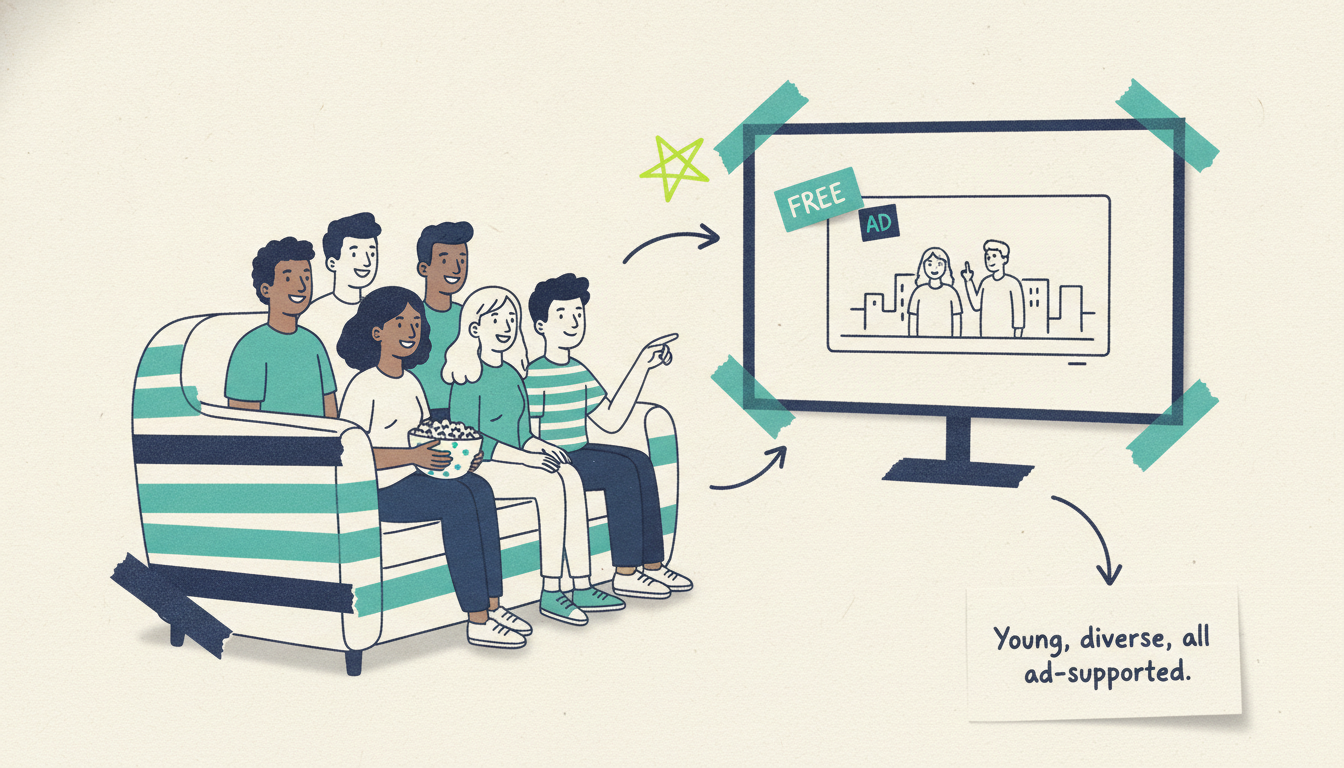
The practical takeaway is that the free-streaming audience Tubi represents, young, diverse, cord-cutting, and fully ad-supported, is one of the most attractive and accessible audiences in television, and it's reachable at a small-business budget.
Free streaming carries the Super Bowl now
Nothing captures how far free ad-supported streaming has come better than the biggest event on the American TV calendar. In February 2025, Fox streamed Super Bowl LIX free on Tubi, the first time a free ad-supported streamer carried the Super Bowl. It wasn't a token gesture. Tubi drew a record streaming audience for the game, pulling roughly one-third of all in-game streaming and reaching many times its normal daily audience.
That moment reframed what free streaming could be. Here's why it matters for advertisers:
Free streaming can handle the biggest audiences. The Super Bowl is the ultimate stress test, and Tubi passed it. Free ad-supported streaming isn't just for catalog movies and old shows anymore, it can carry appointment television.
Live events pull in new viewers. A marquee event like the Super Bowl or the World Cup introduces millions of people to a free service, many of whom stick around. In 2026, Fox carried select FIFA World Cup matches free on Tubi, continuing the strategy.
Premium moments mean premium inventory. When a free service carries a huge live event, it creates the kind of high-attention ad inventory that used to exist only on broadcast, now available in a streaming environment built for targeting.
The strategic point is that free streaming is no longer the bargain bin of television. It's mainstream, it's carrying the sport events that define TV, and it's doing it all on an ad-supported model. For advertisers, that means the free-streaming audience is bigger, more engaged, and more valuable than the "free" label might suggest.
How to take advantage
Tubi shows how valuable free-streaming inventory is, and you can reach that same young, ad-supported audience whether through Tubi's own tools or across the broader connected TV ecosystem. Here's how to think about it.
Reach the audience across services. Tubi viewers also watch The Roku Channel, Pluto, YouTube, and more. Running across the whole ecosystem builds the frequency any single service can't.
Match your service area. Set a geographic radius, usually 15 to 25 miles, so every impression reaches a potential customer nearby.
Budget for repetition. Plan enough spend to reach the same households several times over two to three weeks. On connected TV, meaningful frequency costs hundreds of dollars, not thousands.
Approve the ads before you spend. Check the offer and the town. Use a first-party site tracker so later visits connect to the campaign.
Measure brand lift. Track branded search, direct traffic, and calls during and after a campaign rather than chasing clicks.
Adwave runs paid media on Meta, Google, TikTok, Reddit, web, and TV from $30/day prepaid, with local radius or ZIP targeting and a first-party site tracker. Individual signups typically get a $60 starter credit. You approve ads before you spend. Television cost bands are on the average CTV CPM page.
The bigger picture
Tubi's platform-best 2.3% is part of a larger story: free ad-supported streaming has gone from a curiosity to a major force, and Tubi is proving it can even carry the biggest live events.
A few forces give the Q2 2026 numbers their weight:
Free streaming keeps taking share. As subscription prices rise, more viewers turn to free options, and Tubi is one of the biggest beneficiaries. FAST services now command a meaningful and growing slice of streaming, and they're all ad-supported.
Tubi is carrying marquee sports. Fox streamed Super Bowl LIX free on Tubi in February 2025, the first time a free ad-supported streamer carried the Super Bowl, drawing a record streaming audience. In 2026, Fox carried select FIFA World Cup matches free on Tubi. Free streaming is now big-event television.
It's a real, profitable business. Tubi passed $1.1 billion in revenue and turned profitable, proving free ad-supported streaming isn't just a loss-leader, it's a sustainable model built entirely on advertising. The connected TV advertising market is expanding partly on the back of services like Tubi.
There's a deeper reason free streaming matters for the future of advertising. The audiences hardest for traditional TV to reach, young adults and cord-nevers, have effectively opted out of the old system entirely. They don't see broadcast or cable ads because they don't watch broadcast or cable. Free ad-supported streaming is the bridge back to them. When a Gen Z viewer who has never paid for cable watches a free movie on Tubi, they see ads for the first time in a living-room, full-screen context, and that ad can come from a local business as easily as a national brand. Free streaming didn't just grow the audience, it restored access to a generation that traditional advertising had lost.
For small businesses, the throughline is that Tubi made a huge, young, ad-supported audience accessible. The viewers who abandoned cable, or never had it, are watching free services like Tubi, and every one of them is reachable with advertising. Free streaming turned the hardest-to-reach audience into one of the easiest.
What experts are saying
Analysts point to Tubi as proof that free ad-supported streaming has come of age. Reaching a platform-best 2.3% of all TV viewing, ahead of several paid subscription services, shows that free content plus a light ad load is a formula viewers embrace, especially younger ones. Fox's decision to stream the Super Bowl free on Tubi, and to carry World Cup matches there, signals confidence that free streaming can handle the biggest audiences in television, not just long-tail catalog content.
Fox's own commentary shows the point. In earnings calls, Fox has repeatedly framed Tubi as a strategic asset rather than a side project, showing its profitability, its 35% upfront ad-dollar growth, and its ability to reach an audience the company's broadcast and cable properties can't. When a legacy broadcaster describes its free streaming service as one of its most important growth engines, it tells you free ad-supported streaming has moved from the margins to the center of the television business.
On the advertising side, the consensus is that Tubi's value lies in its incremental, hard-to-reach audience. Because roughly 70% of Tubi viewers are cord-cutters, advertisers reach people traditional TV misses, which is exactly what makes FAST inventory so attractive. The broader takeaway for advertisers, especially small ones, is that free ad-supported streaming like Tubi delivers a large, young, diverse, fully ad-supported audience at efficient prices, the kind of accessible, high-value reach that makes connected TV work for businesses of every size.
What the numbers don't tell you
Tubi's figures are impressive, but read them with a few caveats.
It's not the top free service. Tubi's 2.3% trails The Roku Channel's roughly 3%. Tubi is a leading free streamer, ahead of paid rivals like Peacock and Paramount+, but not the outright number-one FAST service.
The year-over-year gain is a two-report comparison. Tubi's roughly 0.3-point annual rise comes from comparing two Gauge reports, not a single Nielsen figure. The April release itself cited only the monthly gain.
Hours figures are annual. Tubi's headline 10 billion-plus hours is an annual 2024 total, not a quarterly number. Its monthly run-rate reached about 1 billion hours by 2025.
CPM figures are estimates. Tubi doesn't publish ad rates. Free-streaming inventory tends to price efficiently, but specific CPM numbers come from third-party benchmarks, not Tubi.
Read Tubi's numbers as proof of free streaming's arrival: a large, young, cord-cutting, fully ad-supported audience that's now big enough to rival paid services and carry the Super Bowl.
Common questions answered
What is Tubi's share of TV viewing? Tubi reached a platform-best 2.3% of all U.S. TV viewing in April 2026, per Nielsen's The Gauge, its highest share ever. That puts the free service ahead of paid streamers like Peacock, Paramount+, and Max, though behind The Roku Channel among free services.
Is Tubi really free? Yes. Tubi is completely free and ad-supported, with no subscription and no ad-free tier. Every viewer watches with ads, which is why its entire audience is reachable by advertisers. Tubi is owned by Fox and passed $1.1 billion in revenue in fiscal 2025.
Who watches Tubi? A young, diverse, cord-cutting audience. More than half of Tubi viewers are Gen Z or Millennial, over a third are adults 18 to 34, nearly half are multicultural, and around 70% are cord-cutters or cord-nevers. That makes Tubi's reach highly incremental to traditional TV.
Can a small business advertise on Tubi? Tubi sells ads, and a local campaign can include television with search and social. Adwave starts at $30/day prepaid. The 2.3% share on this page is April 2026, not a current-month rating.
How much does streaming TV advertising cost? The average CTV CPM page uses a rough $15 to $35 planning band. Adwave media starts at $30/day. Tubi's April share does not set the price.
The numbers at a glance
Key figures behind Tubi's Q2 2026 standing, with sources:
2.3%: Tubi's share of U.S. TV viewing, a platform-best, April 2026 (Nielsen, The Gauge)
~0.3 pts: Tubi's year-over-year gain, April 2025 to April 2026 (Nielsen, two-report comparison)
100 million+: Tubi monthly active users, a milestone crossed May 2025 (Fox/Tubi)
10 billion+: hours streamed on Tubi across 2024, with a ~1 billion-hours-per-month run-rate by 2025 (Fox/Tubi)
~70%: share of Tubi viewers who are cord-cutters or cord-nevers (Fox)
Over half: share of Tubi viewers who are Gen Z or Millennial (Tubi)
$1.1 billion+: Tubi revenue in Fox's fiscal 2025, its first profitable year (Fox)
February 2025: when Tubi became the first free streamer to carry the Super Bowl (Fox/Tubi)
Reach free-streaming audiences from $30/day
The 2.3% figure is Tubi's April 2026 share. Nielsen has not published a later Tubi percentage while it reviews a June measurement change. Adwave includes TV with search and social from $30/day, with a first-party site tracker. See pricing for the current floor.