
If you've ever wondered how businesses get their commercials on television, the answer is TV media buying. For decades, this process was the exclusive domain of large corporations and their advertising agencies, involving months of negotiations, six-figure budgets, and relationships with network sales teams that took years to develop.
That reality has changed dramatically. Today, small businesses can access TV advertising through self-serve platforms that handle the buying process automatically, with budgets starting as low as $50. Understanding how TV media buying works helps you make smarter decisions about where your advertising dollars go, whether you choose a hands-off approach or want to understand the mechanics behind your campaigns.
This guide breaks down TV media buying into practical terms, explains the different ways to purchase TV ad inventory, and shows you how modern technology has opened television advertising to businesses that never could have afforded it before.

What is TV media buying?
TV media buying is the process of purchasing advertising time on television to reach specific audiences. It encompasses everything from selecting the right channels and programs to negotiating rates, scheduling when ads run, and measuring results after campaigns end.
At its core, TV advertising involves matching available ad inventory (the commercial slots networks have to sell) with advertiser demand (businesses wanting to reach viewers). The goal is straightforward: connect your message with the right people at the right time for the best possible return on investment.
Traditional TV buying focused on broad demographic targeting and specific time slots. Buyers would purchase inventory on networks like ABC or ESPN based on general audience composition, hoping their target customers were among the millions watching. Modern approaches, especially through connected TV advertising, now enable household-level targeting while maintaining television's emotional impact and brand-building power.
The TV media buying ecosystem includes several key players. Networks and streaming services own and sell the advertising inventory. Media buying agencies historically acted as intermediaries, using their relationships and buying power to secure favorable rates for their clients. Technology platforms now automate much of this process, especially for digital and streaming inventory. And advertisers, from Fortune 500 companies to local businesses, fund the entire system by purchasing airtime to promote their products and services.
Understanding this ecosystem helps explain both why TV advertising was once so expensive and inaccessible, and why technology has been able to change that reality so dramatically.
How traditional TV buying works
The conventional TV buying process follows a structured cycle that has remained largely unchanged for decades. Understanding this process helps explain why TV advertising was historically limited to large advertisers with substantial budgets.
The upfront market
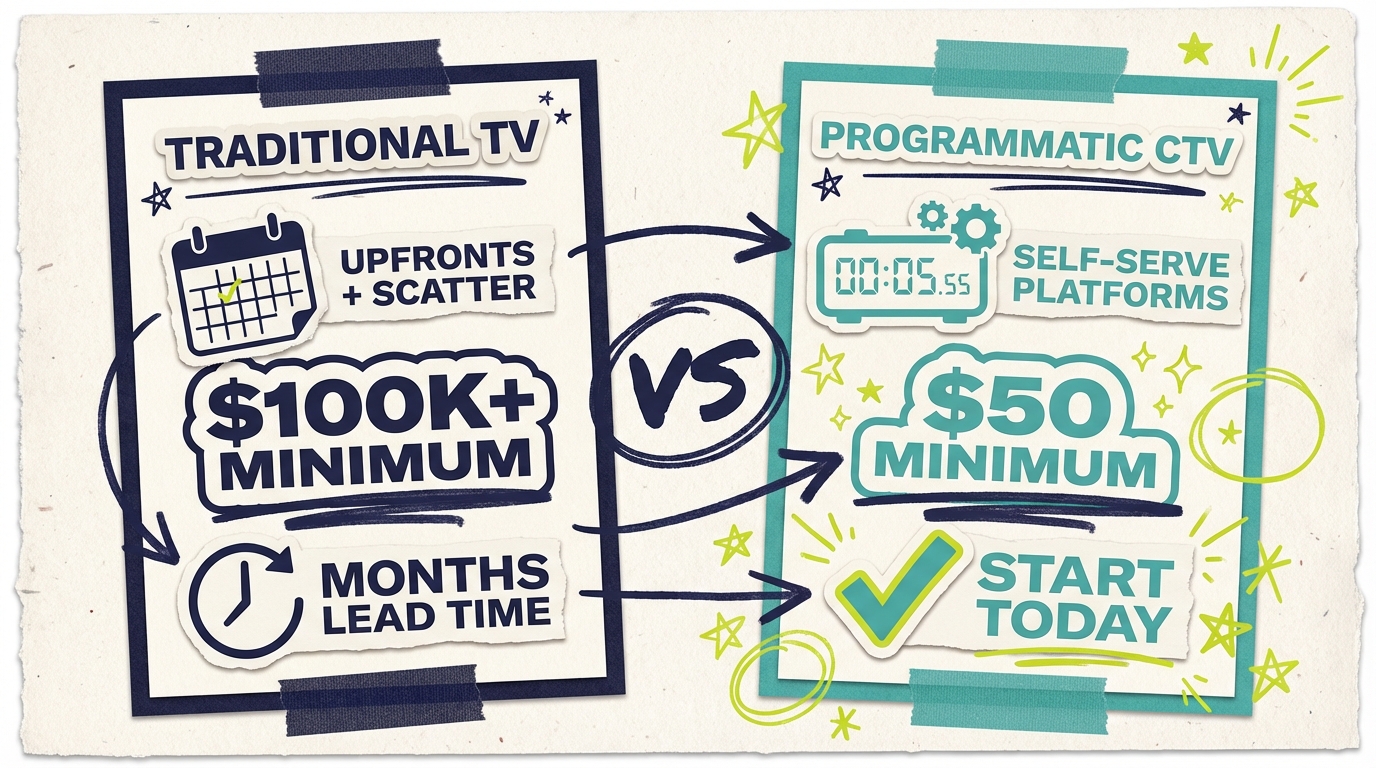
Each spring, television networks present their upcoming programming schedules to advertisers and agencies in events called "upfronts." During this period, advertisers commit significant portions of their annual TV budgets, often billions of dollars industrywide, based on projected ratings for shows that haven't even aired yet.
The upfront process originated in the 1960s when ABC began selling advertising for its upcoming fall season in advance. The practice spread across the industry and has persisted because it benefits both sides of the transaction. Networks gain revenue predictability and can use early commitments to justify production investments. Advertisers lock in rates before demand potentially drives prices higher and secure access to the most desirable programming.
These upfront commitments typically secure better rates and guaranteed access to premium programming. In exchange, advertisers sacrifice flexibility. Cancellation windows are limited, and shifting budgets mid-year can be difficult or impossible. Major advertisers might commit tens or hundreds of millions of dollars during upfront season, with spending decisions made months before their campaigns run.
The scatter market
Not all TV inventory sells during the upfronts. The "scatter market" allows advertisers to purchase remaining inventory closer to air dates, sometimes weeks or even days before spots run. This flexibility comes at a price. Scatter rates typically run higher than upfront prices, especially during high-demand periods like political seasons or major sporting events.
The scatter market exists because networks deliberately hold back some inventory, and because actual viewership rarely matches pre-season projections. A surprise hit show creates new premium inventory. A disappointing performer leaves networks scrambling to fulfill advertiser commitments or offer makegoods on underdelivered campaigns.
For smaller advertisers, scatter buying was traditionally the only option for accessing TV, but even scatter rates often started at thousands of dollars per spot. A 30-second spot on a local news program might cost $500-2,000, while cable networks could charge $5,000-25,000 for national placements. Prime-time broadcast spots ranged from $100,000 to over $500,000 for top-rated shows, putting traditional TV completely out of reach for small businesses.
The negotiation process
Traditional TV buying requires extensive negotiation. Media buyers issue requests for proposals (RFPs) to networks, compare responses across multiple dimensions, and negotiate rates, positioning, and added value. This back-and-forth can stretch for weeks before campaigns even begin.
Experienced media buyers develop relationships with network sales teams over years. They understand which networks have flexibility on rates, which programs consistently over or underdeliver on audience projections, and how to structure deals that protect their clients from performance shortfalls. This expertise became the foundation of the media agency business model.
Once terms are agreed upon, buyers create insertion orders detailing every placement. Creative assets must meet exact specifications and arrive well before air dates. Networks have technical requirements for video files, and missing a trafficking deadline can mean losing a placement entirely. After campaigns run, buyers wait for performance reports, often weeks later, based on panel data from sample households.
This complexity explains why traditional TV buying required professional intermediaries. The knowledge required to navigate the process, combined with the minimum spend requirements to even get networks to return your calls, made TV advertising a specialized discipline rather than something a small business owner could manage independently.
Modern TV buying: CTV and programmatic
The rise of streaming has transformed how TV advertising gets bought and sold. Connected TV and programmatic buying operate at digital speed, fundamentally changing what's possible for advertisers of all sizes.
How programmatic TV buying works
When you watch content on a streaming service like Hulu or Tubi, the moment an ad break begins, sophisticated systems jump into action. The streaming platform recognizes an advertising opportunity and sends bid requests to ad exchanges, including anonymized information about the household's viewing patterns and demographics.
Demand-side platforms evaluate this opportunity in milliseconds. Does this household match the target audience? Are they in the right geographic area? Have they engaged with the brand before? If criteria are met, a bid is calculated based on the likelihood of that viewer taking action.
Multiple advertisers compete in this instant auction. The winner's ad plays before the content continues. The viewer sees a relevant ad while the advertiser reaches a qualified prospect. Performance data flows back immediately, informing future bidding decisions.
This entire process, from ad request to delivery, happens in under 100 milliseconds. Every time someone watches a streaming show, potentially thousands of these auctions take place.
The technology enabling this speed comes from the digital advertising ecosystem. Programmatic buying originated in display and video advertising on websites, where the same auction dynamics have operated for over a decade. As streaming services grew and sought to monetize their audiences, they adopted these existing technologies rather than building new systems from scratch. The result is that CTV buying operates more like digital advertising than traditional television, with all the efficiency and accessibility that implies.
Why this matters for small businesses
The efficiency of programmatic buying has dramatic implications for small business TV advertising. Instead of committing large budgets months in advance, advertisers can start campaigns with minimal spend. Instead of buying time slots and hoping the right people are watching, they can target specific audience characteristics and geographies.
A local restaurant can now run TV ads specifically to households within their delivery radius. A dentist can target homeowners in their zip code who fit the demographic profile of their ideal patients. A retail store can advertise only during their business hours in their service area.
These capabilities were technically possible through traditional addressable TV, but required agency relationships and significant minimum spends. Self-serve CTV advertising platforms now handle all the complexity automatically, making TV accessible to businesses with budgets starting at $50.
Types of TV inventory
Today's TV advertising spans multiple environments, each with different characteristics and access requirements.
Linear TV
Linear television refers to traditional broadcast (ABC, CBS, NBC, FOX) and cable networks (ESPN, HGTV, Food Network). Viewers watch programming as it airs according to the network's schedule.
National broadcast reaches massive audiences, making it ideal for major product launches and brand awareness campaigns. A single Super Bowl spot reaches over 100 million viewers simultaneously, a feat no other advertising medium can match. Regular prime-time programs on major networks still draw audiences of 5-15 million viewers, providing scale that streaming has yet to replicate for individual pieces of content.
Cable provides more focused audiences around specific content interests. HGTV attracts homeowners interested in renovation and design. ESPN reaches sports enthusiasts. Food Network connects with cooking enthusiasts. This content alignment creates natural targeting opportunities even without the precise household-level data available on streaming.
Local and spot buying allows geographic targeting through regional affiliates. A car dealer can buy time on the local CBS affiliate rather than purchasing national inventory they don't need. This local buying has always been more accessible than national advertising, though it still required relationships with station sales teams and meaningful minimum budgets.
Linear TV still delivers unmatched reach for live events. The NFL, for example, accounts for the majority of the most-watched broadcasts each year. Award shows, major news events, and live sports create shared viewing moments that streaming's on-demand model cannot replicate. However, traditional linear requires larger budgets and longer planning cycles than streaming alternatives, and audiences have been steadily migrating to streaming options.
Connected TV and streaming
CTV advertising runs on internet-connected televisions through streaming apps and services. This category includes:
Ad-supported streaming services like Hulu, Peacock, and Paramount+ offer premium content with advanced targeting. These services know their subscribers' viewing habits, enabling precise audience selection.
Free ad-supported streaming TV (FAST) channels like Pluto TV and Tubi have attracted millions of cord-cutters seeking free entertainment. These platforms offer extensive reach at accessible price points.
Virtual MVPDs like YouTube TV and Sling TV deliver traditional channels through streaming, blending familiar content with modern targeting capabilities.
The growth of ad-supported streaming has been remarkable. Services that initially launched as subscription-only have added ad tiers to expand their audiences. Netflix introduced advertising in late 2022 after years of resistance. Disney+ followed with an ad-supported tier. These additions, combined with purpose-built ad-supported services like Tubi and Pluto TV, mean that streaming advertising now reaches the majority of American households.
For advertisers, this shift creates unprecedented opportunity. The same content that once required six-figure commitments to access is now available through self-serve platforms at accessible price points. A small business can advertise during premium programming that would have been completely unattainable through traditional buying channels.
TV advertising pricing models
Understanding how TV advertising is priced helps you evaluate whether opportunities represent good value for your budget.
CPM (Cost Per Thousand)
CPM in advertising stands for cost per mille, or cost per thousand impressions. One impression equals one person seeing your ad once. If a placement costs $25 CPM, you pay $25 to reach 1,000 viewers.
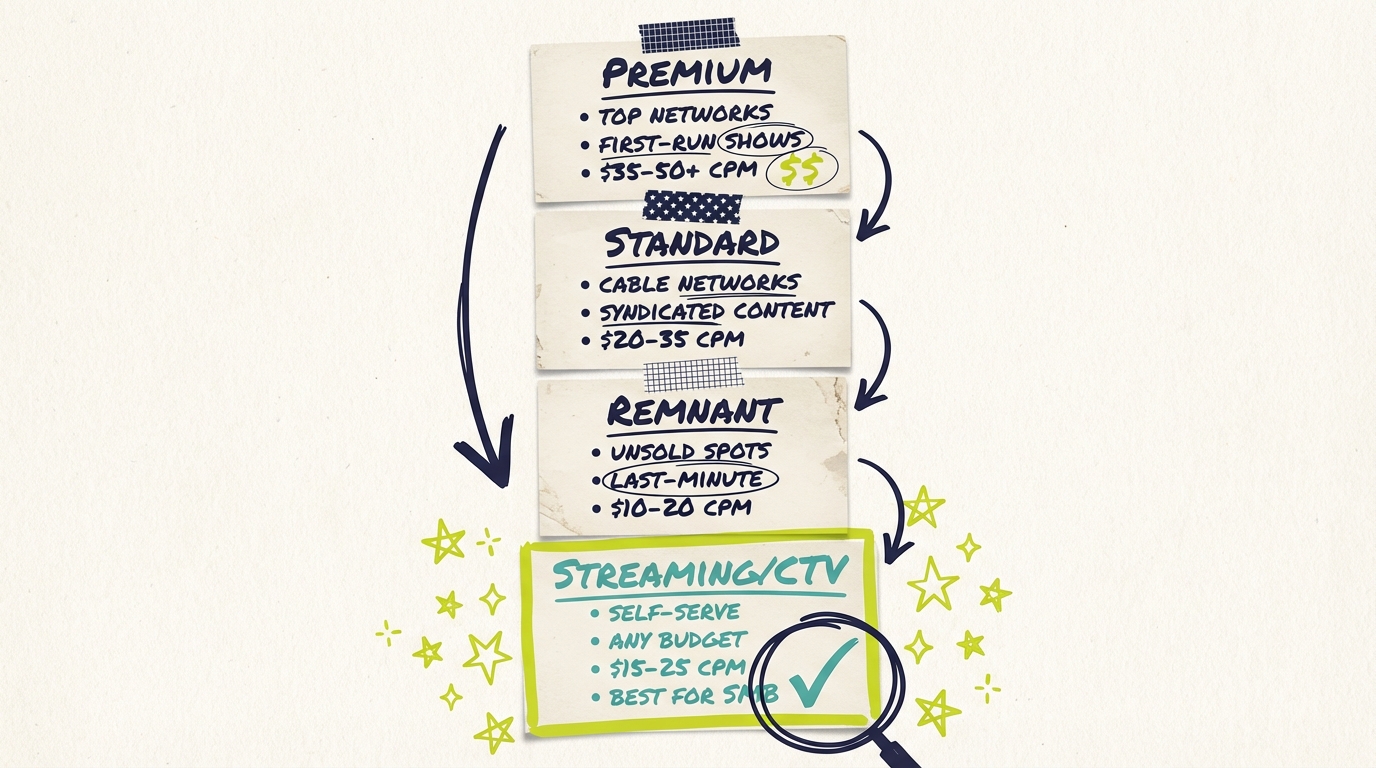
CPM is the standard currency across most of modern TV advertising, especially CTV. It allows direct comparison between different placements and platforms. Average streaming TV ad costs typically range from $15-35 CPM for small business advertisers, though premium inventory and precise targeting can push rates higher.
CPP (Cost Per Point)
Cost per point ties price to ratings points in traditional linear buying. One rating point represents 1% of the target audience in a market. CPP was the dominant metric before streaming, though CPM has become more universal as advertisers plan across multiple screens.
Factors affecting price
Several variables influence what you'll pay for TV advertising:
Audience characteristics significantly impact pricing. Reaching younger audiences costs more on linear TV because they watch less traditional television. Highly specific targeting through CTV commands premiums but reduces waste.
Programming demand drives costs for specific shows and events. Prime-time slots, season premieres, and major sporting events all carry higher prices due to competition among advertisers.
Seasonality creates predictable price fluctuations. Q4 rates spike as retailers compete for holiday shoppers. Political advertising drives up prices in election years. Understanding these cycles helps with budget planning.
Buying method affects efficiency. Upfront commitments typically secure better rates than scatter. Programmatic buying often delivers favorable CPMs through efficient auction dynamics.
Geographic targeting creates significant price variation. Advertising in major metropolitan areas like New York, Los Angeles, or Chicago costs substantially more than smaller markets. A small business in a mid-size market can stretch their TV budget much further than a competitor in a top-10 DMA.
Real-world pricing examples
To make pricing concrete, consider these typical ranges for different buying scenarios:
A local business advertising on streaming TV in a mid-size market might pay $15-25 CPM, translating to roughly $1.50-2.50 per completed video view when accounting for frequency. A $500 monthly budget could deliver 20,000-30,000 ad views to targeted households in their service area.
The same business attempting traditional local TV would face minimum placements of $200-500 per spot, with limited targeting beyond choosing the program. Reaching the same number of targeted views would require substantially higher investment and involve significant waste reaching viewers outside their customer profile.
National advertisers working through agencies might secure premium streaming inventory at $30-50 CPM, while exclusive placements on top-tier content can push CPMs above $75. These rates reflect both the scarcity of premium inventory and the high demand from major brands competing for attention.
How small businesses access TV advertising today
The transformation from agency-only buying to self-serve platforms has democratized television advertising in ways that would have seemed impossible a decade ago.
Self-serve platforms
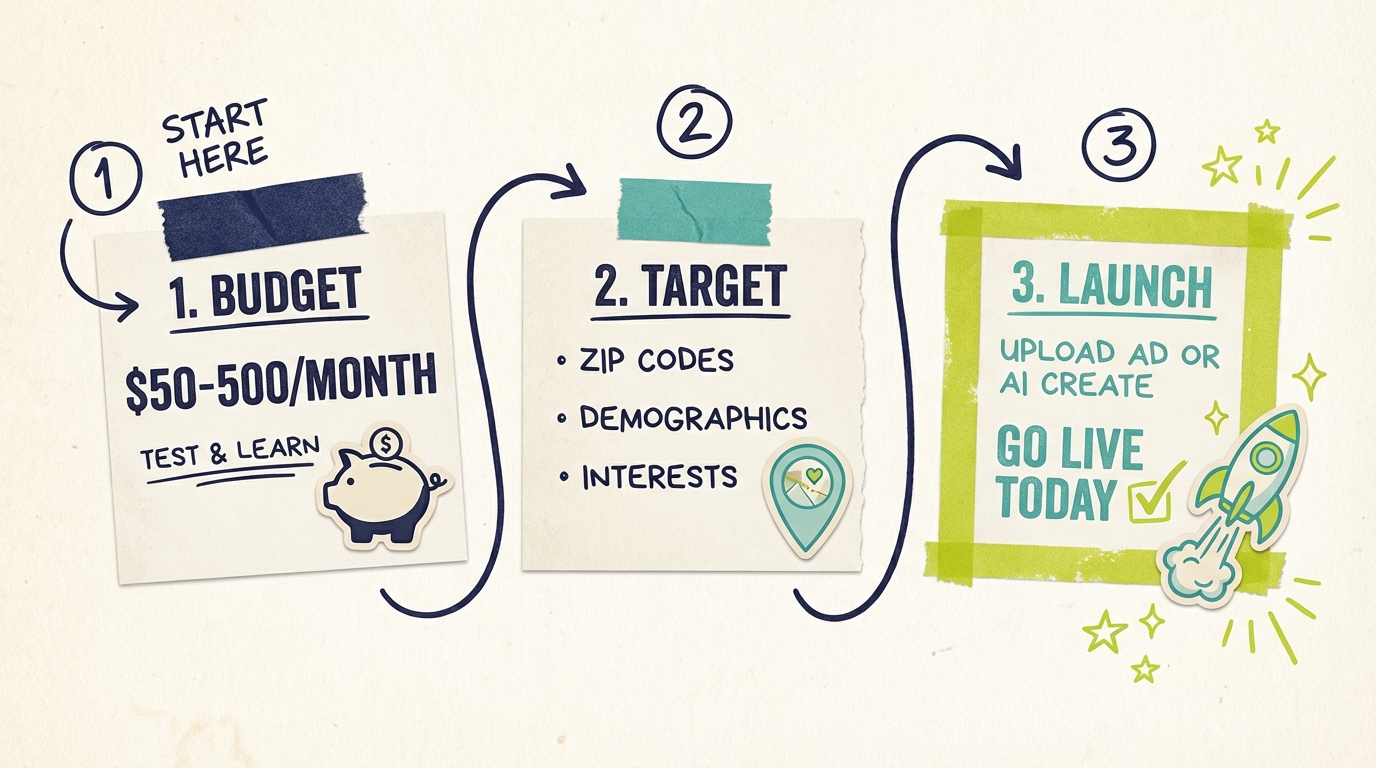
Modern self-serve CTV platforms handle the complexity of TV buying automatically. Instead of negotiating with networks, understanding insertion orders, or managing multiple vendor relationships, advertisers simply:
Define their target audience (geography, demographics, interests)
Set their budget (often with no minimum or very low minimums)
Upload or create their video ad
Launch and monitor results
The platforms handle inventory sourcing, bidding, optimization, and reporting. A local business owner can set up and launch a TV campaign in minutes without any media buying expertise.
Adwave takes this further by also creating the ad itself. Enter your website, and AI generates a professional 30-second commercial that can be running on streaming TV within minutes. The entire process, from no ad to live campaign, can happen in under 10 minutes with budgets starting at $50.
What $500 gets you
To make TV advertising tangible, consider what a modest budget delivers. For $500 on streaming TV, you might reach:
15,000-25,000 completed video views
Households specifically in your target geography
Viewers matching your demographic criteria
Detailed reporting on delivery and performance
That same $500 on traditional linear TV might not even cover a single spot in many markets. The efficiency gains from programmatic buying and precise targeting make meaningful TV campaigns accessible at budgets that work for small businesses.
Creating TV ads for your campaigns
Media buying is only half the equation. You also need video creative to run on the inventory you purchase. Traditional TV production often cost as much or more than the media itself, creating another barrier for small businesses.
Traditional TV commercial production
Professional TV commercial production typically involves script development, storyboarding, location scouting, talent casting, filming, and post-production editing. A basic local commercial might cost $5,000-15,000 to produce, while national-quality spots regularly run $100,000 or more. Production timelines stretch from weeks to months.
This cost structure made sense when TV advertising required significant media investment. If you're spending $500,000 on airtime, investing $50,000 in production represents reasonable allocation. But for a small business testing TV with a $500 budget, traditional production economics don't work.
Modern alternatives
The same technology transformation affecting media buying has also reached creative production. Several approaches now make TV commercial creation accessible at small business budgets:
Template-based tools allow businesses to customize pre-built video templates with their own images, text, and branding. While the results can feel generic, they provide a fast path to having something to run.
AI-generated commercials represent the cutting edge of accessible TV creative. Platforms like Adwave analyze your website and automatically generate professional video ads tailored to your business. The AI handles scriptwriting, visual selection, voiceover, and editing, producing broadcast-ready spots in minutes rather than weeks.
User-generated content and simple smartphone videos can work effectively for certain businesses and audiences. Authenticity sometimes outperforms polish, especially for local businesses where viewers expect a personal touch rather than corporate production values.
The combination of accessible media buying and affordable creative production means that the total cost of a TV advertising campaign has dropped from hundreds of thousands of dollars to a few hundred dollars, removing the final barriers that kept small businesses off television.
Measuring TV advertising effectiveness
One of TV advertising's historical challenges was measurement. Advertisers would run campaigns and hope for results, with limited ability to connect TV exposure to business outcomes.
Modern CTV changes this equation. Because streaming platforms can identify households that saw your ads, they can also track whether those households subsequently visited your website, downloaded your app, or took other measurable actions.
Key metrics for TV campaigns include:
Impressions and reach tell you how many times your ad played and how many unique households saw it.
Video completion rate shows what percentage of viewers watched your entire ad versus skipping or tuning away. CTV typically delivers completion rates above 90%, far higher than digital video.
Website visits and conversions connect TV exposure to online actions. Many platforms track when households that saw your ad subsequently visit your website.
Brand lift measures changes in awareness, consideration, or purchase intent among exposed audiences compared to control groups.
For small businesses, the most practical approach often combines reach metrics (are you hitting your target audience?) with response tracking (are you seeing results?). Even simple indicators like tracking website traffic or phone calls during campaign periods can validate whether TV is working.
Setting up measurement
Before launching a TV campaign, establish baseline metrics for your key business indicators. Track website traffic patterns, lead volume, phone calls, and sales for at least two weeks before your campaign starts. This baseline allows you to identify changes that correlate with your TV activity.
Simple attribution methods work well for small business TV campaigns. Ask new customers how they heard about you. Create a dedicated landing page or phone number for your TV campaign. Monitor search volume for your brand name during campaign periods. These straightforward approaches provide actionable insights without requiring sophisticated attribution technology.
For businesses running ongoing TV campaigns, month-over-month and year-over-year comparisons reveal the cumulative impact of TV advertising on brand awareness and customer acquisition. TV's effects often compound over time as repeated exposure builds familiarity and trust with your target audience.
Common questions answered
How much does TV media buying cost?
Traditional TV buying typically required minimum budgets of $5,000-$25,000 or more, plus agency fees. Modern self-serve CTV platforms have lowered minimums dramatically, with some like Adwave allowing campaigns starting at $50. The cost per thousand impressions on streaming platforms typically ranges from $15-35 for small business advertisers.
Can small businesses buy TV ads without an agency?
Yes, self-serve CTV advertising platforms have made agency relationships optional. These platforms handle inventory sourcing, bidding, and optimization automatically. Small businesses can launch TV campaigns in minutes without media buying expertise. Traditional linear TV still largely requires agency or direct sales relationships.
What's the difference between linear TV and CTV buying?
Linear TV buying involves purchasing time slots on traditional broadcast and cable channels, typically through upfront commitments or scatter market purchases. CTV buying happens through programmatic platforms where ads are purchased in real-time auctions based on audience targeting rather than specific programs. CTV offers more flexibility, lower minimums, and precise targeting.
How long does it take to launch a TV campaign?
Traditional TV campaigns can take weeks or months to plan, negotiate, and traffic. CTV campaigns through self-serve platforms can launch in minutes once creative is ready. Platforms like Adwave that also create the ad can go from zero to live campaign in under 10 minutes.
How do I know if my TV ads are working?
CTV platforms provide detailed reporting on impressions, reach, video completion rates, and often website visit attribution. Look for consistent delivery against your target audience, high completion rates, and correlations between campaign activity and business results. Even tracking website traffic, phone calls, or foot traffic during campaign periods can indicate effectiveness.
Get started with TV advertising
TV media buying has evolved from an exclusive practice requiring agency relationships and six-figure budgets to an accessible marketing channel available to businesses of any size. The fundamentals remain the same: matching your message with the right audience at the right time. But the barriers that once made TV impossible for small businesses have largely disappeared.
Whether you're exploring TV advertising for the first time or looking to understand the process better, the path forward has never been clearer. Self-serve platforms handle the complexity of media buying automatically, letting you focus on your message and your audience rather than navigating industry relationships.
Adwave makes TV advertising simple for small businesses. Our platform creates professional commercials using AI and places them on 100+ streaming channels, all starting at just $50. Get started and see how TV advertising works for your business.


