
If you run a veterinary practice, you're probably busier than ever. Pet ownership in the United States has hit record levels, with roughly 66% of U.S. households (about 86.9 million homes) now owning at least one pet, according to the 2023-2024 American Pet Products Association (APPA) National Pet Owners Survey. That's a huge market. But it also means more competition than ever for the attention and loyalty of pet owners.
The veterinary industry has changed dramatically. Corporate consolidation is reshaping the playing field. Mars Veterinary Health (which owns Banfield, BluePearl, and VCA) and NVA together operate thousands of clinics across the country, with dedicated marketing teams and advertising budgets that dwarf what most independent practices can spend.
Meanwhile, pet owners have changed how they find a vet. They Google before they book. They read reviews. They compare prices. The days when word-of-mouth referrals alone kept your appointment book full are fading fast.
Independent practices have real advantages: personal relationships, continuity of care, community roots, and genuine trust. The challenge is making sure pet owners in your area know you exist.
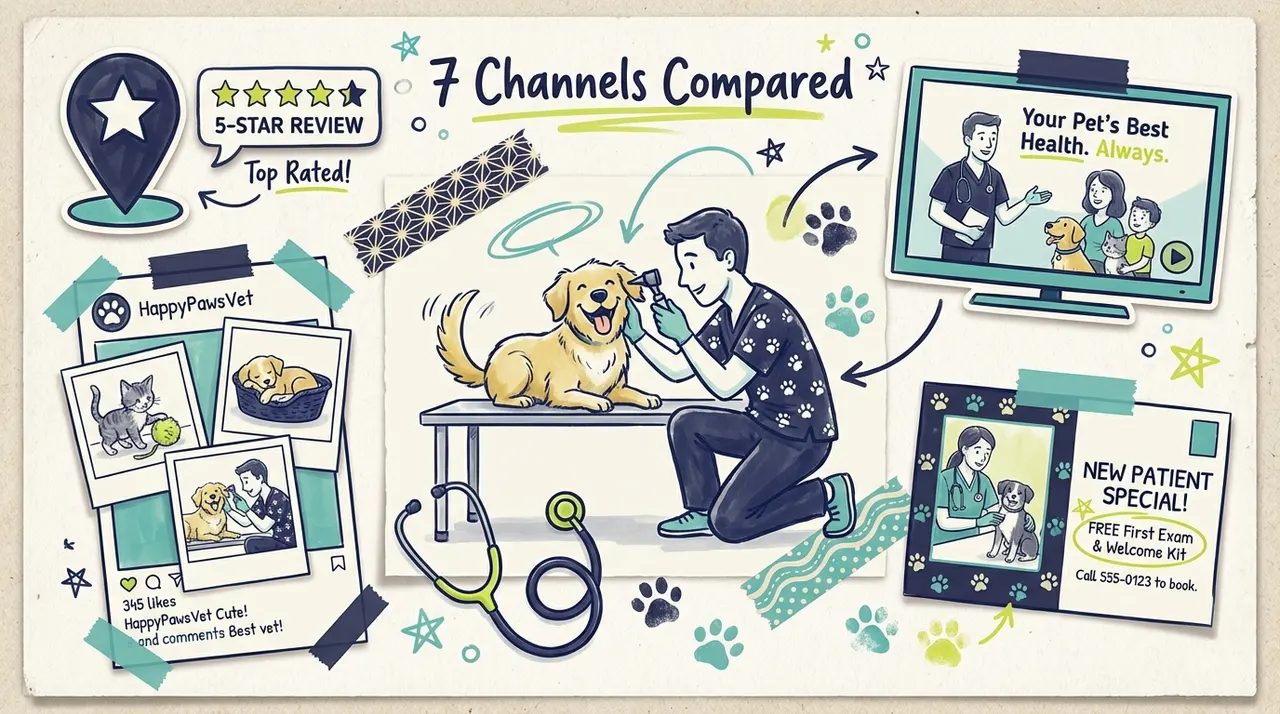
Compare seven advertising channels for veterinary practices, including costs and ways to reach local pet owners.
Why Veterinary Practices Need More Than Referrals
For decades, the playbook was simple: do great work, and referrals would follow. Referrals still matter. A 2023 survey by the American Animal Hospital Association (AAHA) found that personal recommendations remain the top way pet owners choose a new vet. But "top" doesn't mean "enough."
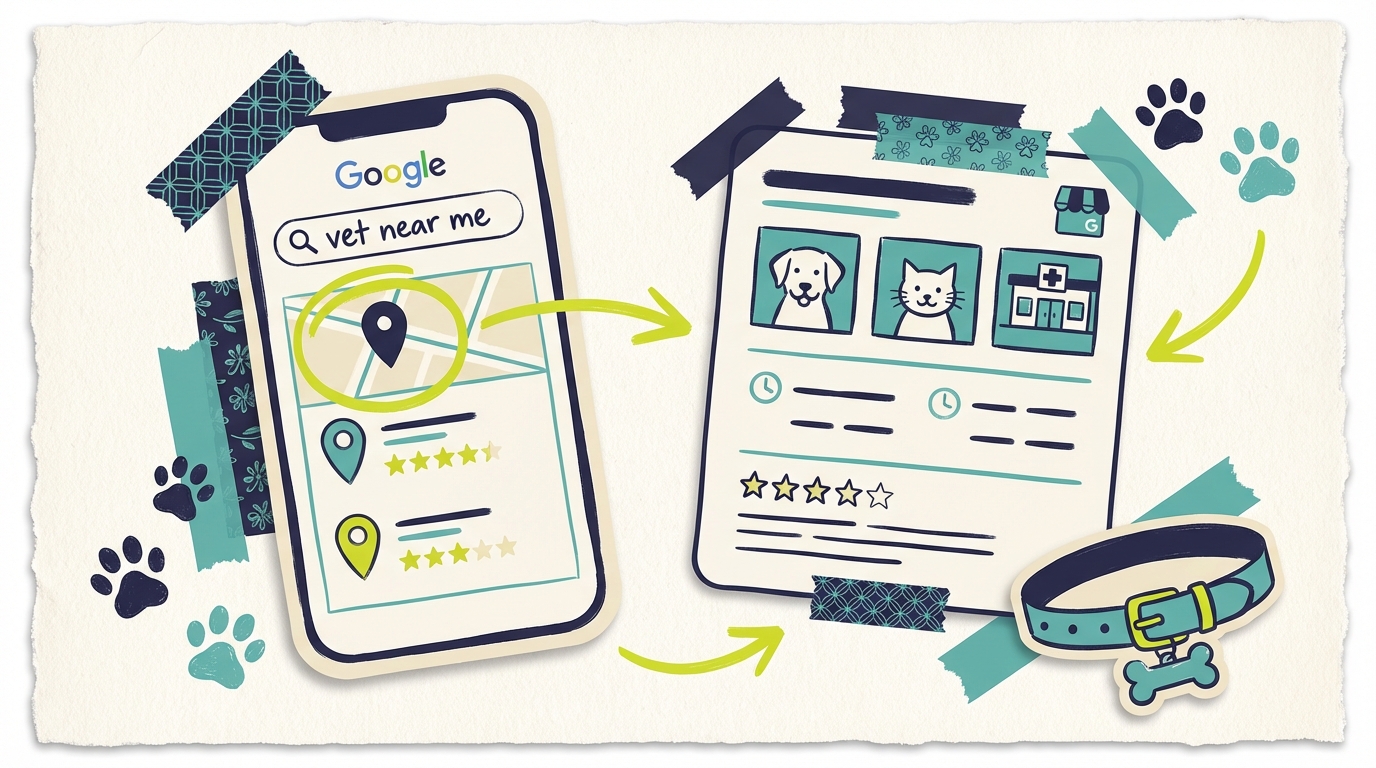
The American Veterinary Medical Association (AVMA) reports there are roughly 33,000 veterinary practices in the U.S. In many metro areas, pet owners have dozens of clinics less than a 15-minute drive away. When a family adopts a new puppy or relocates to a new city, they're pulling out their phone, typing "vet near me," and choosing from whatever comes up first.
Corporate chains spend aggressively on digital advertising, local SEO, and brand awareness. If your practice is invisible online and relying purely on referrals, you're handing new clients to competitors by default. The fix isn't complicated: you need a mix of channels that puts your practice in front of pet owners at the moments they're making decisions.
Google Ads: Reaching Pet Owners in Urgent Moments
When a dog swallows a sock at 9 PM, the owner isn't browsing Yelp reviews. They're typing "emergency vet near me" into Google. That's the power of search advertising: you show up at the exact moment someone needs you.
Google Ads is one of the most effective channels for veterinary practices because the search intent is so strong. "Near me" searches for veterinary services have grown steadily year over year, and mobile searches account for the majority of them.
High-value keywords to target:
"Vet near me" and "veterinarian near me"
"Emergency vet [city]" and "24-hour animal hospital [city]"
"Puppy vaccinations near me"
"Dog dental cleaning [city]"
"Cat spay/neuter [city]"
Google Local Services Ads (LSAs) are especially useful for vet practices. These ads appear above regular search results with a "Google Guaranteed" or "Google Screened" badge, which signals trust to pet owners making a quick decision. You pay per lead rather than per click, which tends to deliver better value for service businesses.
Performance Max campaigns run across Google Search, Display, YouTube, Maps, and Gmail simultaneously, letting Google's algorithm find the right audience. For a local vet, Performance Max is especially effective when paired with geo-targeting.
Budget guidance: Most practices see results with $500 to $1,500 per month. Emergency vet keywords run $8 to $15 per click in competitive markets, while wellness keywords like "pet vaccinations" cost $3 to $8 per click, according to WordStream's 2024 industry benchmarks.
Tips for better results:
Use location extensions so your address and phone number show up directly in the ad
Create separate campaigns for emergency services versus routine care
Track phone calls as conversions, not just form fills, because most pet owners call rather than book online
Meta and Instagram Ads: Connecting with Pet Parents
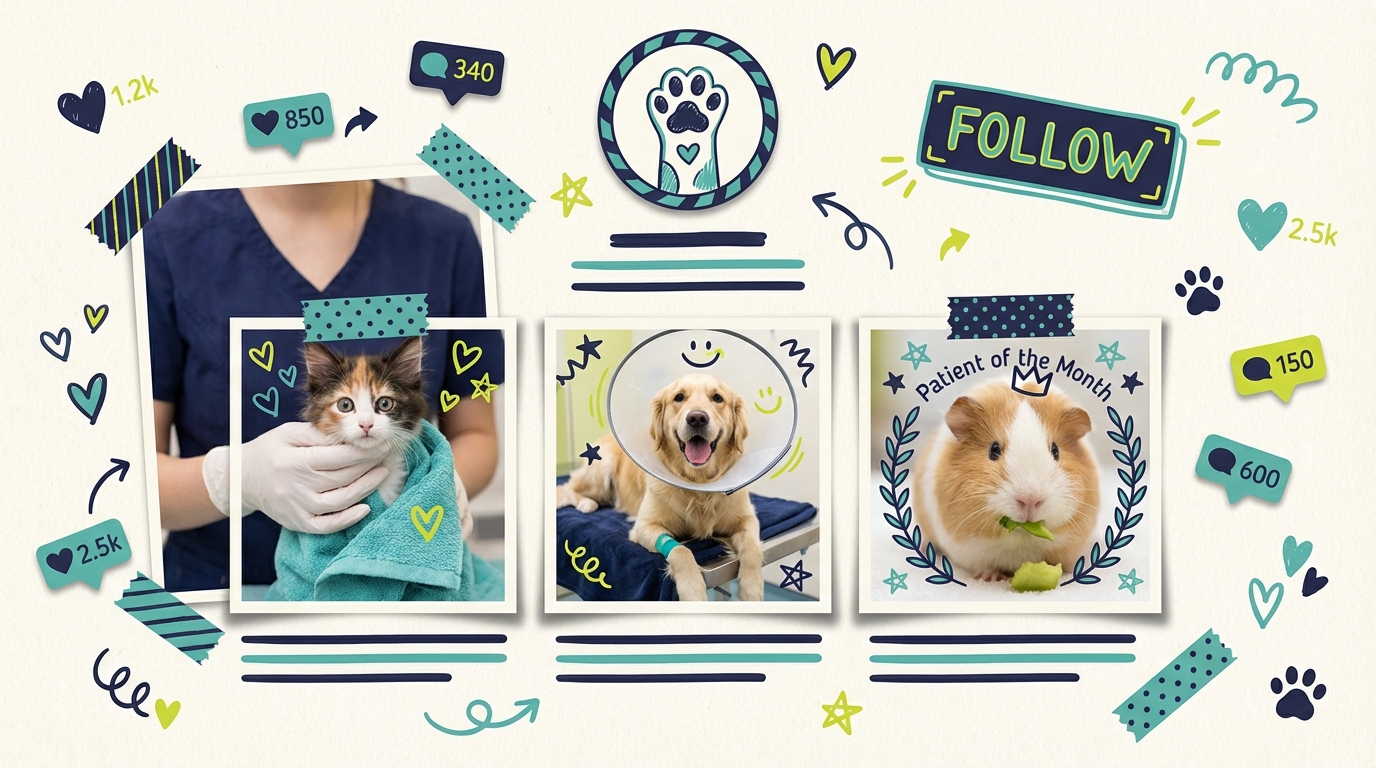
Pet content is social media gold. You already know this if you've ever posted a cute photo of a patient and watched the likes pile up. Dogs, cats, and exotic pets consistently drive some of the highest engagement rates on Facebook and Instagram. That built-in appeal gives veterinary practices a creative advantage most industries would love to have.
An Instagram ad showing your team caring for a nervous rescue dog doesn't feel like advertising. It feels like content people want to see. That emotional resonance translates into trust, which is exactly what you need when someone is choosing who to trust with their pet's health.
Campaign types that perform well:
Video ads: Short clips of your staff with animals or educational content ("5 signs your dog needs a dental cleaning") consistently outperform static images. According to Meta's 2024 advertising data, video ads generate 1.5 to 2 times more engagement than image-only ads for local businesses.
Carousel ads: Show multiple services in a single ad with a clear call to action for each.
Lead generation ads: Let pet owners request an appointment without leaving Facebook.
Retargeting: Show ads to people who visited your website but didn't book. This is one of the most cost-effective campaigns you can run.
Targeting options: Meta lets you reach pet owners by location (5 to 15-mile radius), interest (pet ownership, specific breeds), life events (recently moved), and demographics. Lookalike audiences built from your current client list can help you find new pet owners who resemble your best clients.
Budget guidance: Most veterinary practices can run effective campaigns for $300 to $1,000 per month. Cost per click typically runs $1 to $3 for local veterinary targeting, according to WordStream's 2024 social advertising benchmarks.
Creative tips: Feature your actual staff and real patients (with owner permission). Keep videos under 30 seconds for feed ads. Run seasonal campaigns tied to health topics (heartworm prevention in spring, holiday pet safety in December).
Local SEO and Google Business Profile: Your Online Front Door
If Google Ads is the paid shortcut, local SEO is the long game that keeps paying off. When pet owners search "veterinarian near me," the Google Map Pack (those three listings with a map at the top of results) captures the majority of clicks. Your Google Business Profile (GBP) is the foundation. It controls what pet owners see when they find you on Google Search or Maps.
GBP optimization essentials:
Complete every field: Business name, address, phone, website, hours (including holiday hours), and a detailed business description with relevant keywords
Choose the right categories: Primary category should be "Veterinarian." Add secondary categories like "Animal Hospital," "Emergency Veterinary Service," or "Pet Boarding Service" if applicable
Add services: List every service you offer, from wellness exams and vaccinations to dental cleanings, surgery, and boarding. Google uses these to match you with specific searches
Post regularly: Google Business posts let you share updates, promotions, and health tips directly on your profile. Practices that post weekly see higher engagement and better local rankings
Reviews are everything. BrightLocal's 2024 Local Consumer Review Survey found that 87% of consumers read online reviews for local businesses, and 73% only pay attention to reviews written in the last month. For veterinary practices, reviews carry extra weight because pet owners are trusting you with a family member's health. Actively asking satisfied clients to leave a Google review after appointments is one of the simplest, highest-impact marketing activities you can do.
Build service-specific pages on your website. Create dedicated pages for each major service (wellness exams, vaccinations, dental care, surgery, emergency care). "Dog Vaccinations in [City]" is much stronger for search than a generic "Our Services" page.
For a step-by-step walkthrough of optimizing your Google Business Profile, check out How to Optimize Your Google Business Profile for More Calls.
Yelp and Veterinary Directories: Where Pet Owners Research
Yelp still matters for veterinary practices. A 2023 Yelp internal report noted that pet services is one of the platform's most-searched categories.
Making Yelp work for you:
Claim and complete your Yelp business page with accurate hours, services, and high-quality photos
Respond to every review, positive and negative. Pet owners notice how you handle complaints
Yelp Ads can boost your visibility for $150 to $300 per month
Industry-specific directories worth claiming:
AVMA Find-a-Vet: The AVMA's trusted pet owner directory
AAHA Hospital Locator: If you're AAHA-accredited, this signals a higher standard of care
VetRatingz: A dedicated vet review and rating site
Review management is key. Make it easy for clients by sending a follow-up text after appointments with a direct link to leave a review. Address negative reviews promptly, because potential clients read your responses as much as the complaint itself.
Direct Mail: Reaching Pet Owners in Your Community
Digital advertising gets most of the attention, but direct mail can still pull its weight for veterinary practices, especially for reaching specific neighborhoods and timing campaigns around seasonal needs.
What works for vet practices:
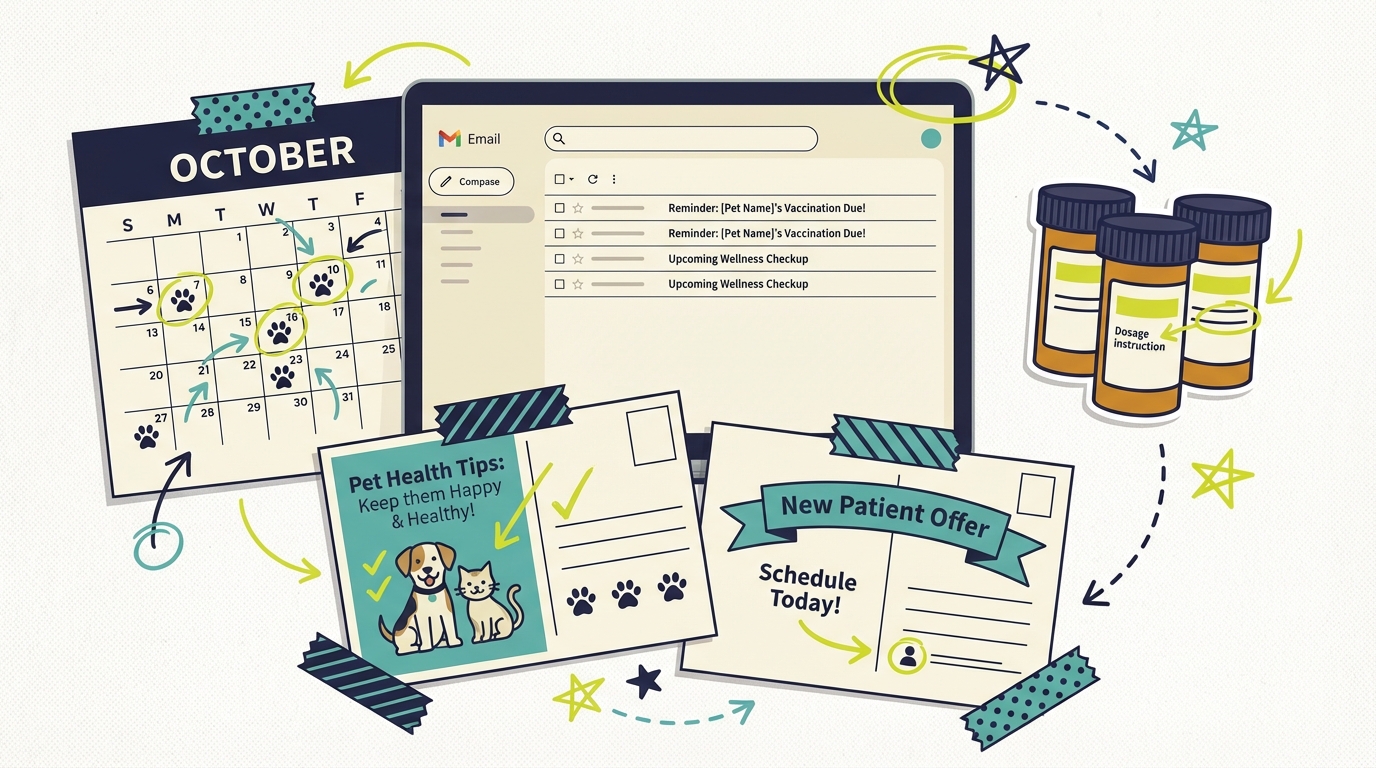
New mover campaigns: When a family moves into your area, they need a new vet. Services like USPS Every Door Direct Mail (EDDM) let you target new movers within a radius of your practice. A "Welcome to the neighborhood" postcard with a discounted first exam offer can be surprisingly effective.
Seasonal campaigns: Spring is heartworm and flea/tick prevention season. Late summer is back-to-routine wellness checkup season. Timely mailers tied to specific health needs feel relevant rather than random.
Radius mailers: Just opened a new location or expanded your hours? A targeted mailing to every household within 3 to 5 miles announces your presence to the people most likely to visit.
Pet store partnerships: Co-branded mailers with local pet supply stores split costs and reach a pre-qualified audience of pet owners.
Cost expectations: The Data & Marketing Association reports average direct mail costs of $0.30 to $0.50 per piece for postcards. A campaign of 5,000 postcards runs roughly $1,500 to $2,500. Response rates for prospect mailings average around 2.9%.
TV and CTV Advertising: Building Trust on the Big Screen
TV advertising carries a level of credibility that digital channels struggle to match. When a pet owner sees your veterinary practice on their television, it creates an instant perception of professionalism and legitimacy. Research backs this up: a 2024 TVB/Advertiser Perceptions study found that consumers rank TV advertising as the most trustworthy ad format, ahead of social media, search, and display ads. For a service built on trust (you're caring for someone's pet, after all), that perception matters.
With Adwave, you can create a broadcast-quality 30-second TV commercial from your website or social profiles in about two minutes, then launch a campaign starting at just $50. Your ad runs across 100+ premium channels, reaching viewers in the exact zip codes you serve.
CTV advertising (ads on streaming services like Hulu, Peacock, Tubi, and others) lets you target by geography, household demographics, and even pet ownership interests, so your budget goes toward reaching actual pet owners in your area rather than blanketing an entire metro. CPM (cost per thousand impressions) typically runs $15 to $35, making TV far more affordable than most practice owners assume.
For a deeper look at TV advertising strategies specific to veterinary practices, check out our TV advertising for veterinary clinics guide.
Email Marketing: Keeping Pet Owners Coming Back
Acquiring a new client costs far more than keeping an existing one. Email marketing is one of the most cost-effective ways to maintain relationships with current pet owners and drive repeat visits. Campaign Monitor's 2024 Email Marketing Benchmarks report puts the average ROI for email marketing at $36 for every $1 spent.
Campaigns that work for vet practices:
Vaccination and wellness reminders: Automated emails when a pet is due for vaccinations, heartworm tests, or dental checkups. These drive appointments directly.
Seasonal health tips: Flea/tick prevention in spring, heat safety in summer, holiday pet hazards in winter. Useful content builds trust and keeps your practice familiar.
New pet owner drip sequences: When a client brings in a new puppy or kitten, trigger a series covering vaccination schedules, spay/neuter timing, and first-year milestones.
Pet birthday emails: A "Happy Birthday, Max!" email with a small discount on a wellness exam feels personal and drives bookings.
Reactivation campaigns: If a client hasn't visited in 12 to 18 months, a friendly "We miss [Pet Name]!" email can bring lapsed clients back.
Platform options: Most veterinary practice management software includes built-in reminder capabilities. For more advanced campaigns, tools like Mailchimp or Constant Contact offer automation and segmentation.
Budget guidance: Email platforms range from free (for small lists) to $50 to $200 per month. Given the lifetime value of a loyal pet owner (often $500 to $1,000+ per year), the return on even a basic email program is substantial.
Channel Comparison: Finding Your Best Mix
The pattern is clear: channels that drive the most immediate leads (Google Ads) tend to be the most expensive, while channels that build lasting brand equity (TV, SEO, email) deliver compounding returns over time. The strongest practices layer both so short-term leads and long-term growth work together.
For more on evaluating which channels are working, see How to Measure Advertising Effectiveness.
Recommended Budget Allocation for Veterinary Practices
Solo Practice (Budget: $800 to $2,000 per month)
Focus on channels with the highest direct return first, then layer in brand building as budget allows.
Google Ads: 35-40% ($280-$800). Prioritize "vet near me" and service-specific keywords. Start with Local Services Ads if available.
Meta/Instagram Ads: 20-25% ($160-$500). Run retargeting campaigns and seasonal promotions with video content.
TV / CTV: 15-20% ($120-$400). Even a small CTV budget builds trust. Start with a broadcast-quality ad through Adwave for as little as $50.
Local SEO / GBP: 10-15% ($80-$300). Invest time more than money. Optimize your profile, post weekly, manage reviews.
Email marketing: 5-10% ($40-$200). Set up automated vaccination reminders and wellness notifications at minimum.
Directories / Yelp: 5% ($40-$100). Claim free profiles. Consider paid Yelp only if your market is competitive.
Multi-Vet or Specialty Practice (Budget: $2,000 to $4,500 per month)
With a larger team and broader service offerings, you can invest more aggressively in brand awareness and specialty service marketing.
Google Ads: 30-35% ($600-$1,575). Expand keyword coverage to include specialty services (orthopedic surgery, dermatology, oncology). Run separate campaigns for each location if you have multiple.
Meta/Instagram Ads: 20-25% ($400-$1,125). Scale video production and run campaigns showing specialty capabilities.
TV / CTV: 15-20% ($300-$900). Increase frequency and expand your geographic reach.
Local SEO / GBP: 10% ($200-$450). Consider hiring an SEO specialist to build service pages and earn local backlinks.
Email marketing: 10% ($200-$450). Implement full lifecycle campaigns, including new client sequences and re-engagement.
Direct Mail: 5-10% ($100-$450). Run new mover campaigns and seasonal mailers for heartworm/flea/tick prevention.
Directories / Yelp: 5% ($100-$225). Maintain paid Yelp placement and keep all directory listings current.
Common Questions Answered
How much should a veterinary practice spend on advertising? A common benchmark is 3% to 6% of annual gross revenue. For a solo practice generating $800,000 per year, that works out to $2,000 to $4,000 per month. Practices in highly competitive markets may spend closer to 8% to 10%. The key is tracking return on investment for each channel and shifting budget toward what's driving appointments.
What's the most effective advertising channel for veterinary clinics? It depends on your goals. Google Ads is typically the fastest path to new appointments because you're reaching pet owners who are actively searching. But practices that grow the most over time combine search with brand-building channels like TV and social media. A pet owner who's seen your practice on TV, follows you on Instagram, and finds you on Google is far more likely to book than someone who encounters you through one channel.
Should veterinary practices advertise on social media? Yes, and veterinary practices have a natural advantage: pet content performs exceptionally well on social platforms. Treat social media as a brand-building and relationship tool rather than a direct-response channel. Share behind-the-scenes content, pet health tips, and patient success stories. Use paid social to boost your best content and run retargeting campaigns to website visitors.
How can a vet practice compete with corporate chains like Banfield or VCA? Independent practices can't outspend corporate chains, but they can out-connect them. Your advantages are personal relationships, continuity of care, community roots, and flexibility. Show your actual team, name your veterinarians, feature real patient stories. Pet owners increasingly seek out independent practices because they want a more personal experience, but they need to find you first.
Is TV advertising realistic for a small veterinary practice? Absolutely. Traditional TV advertising required minimum budgets of $10,000 or more. CTV advertising has changed that completely. With platforms like Adwave, you can create a professional ad and start running it for as little as $50. You're reaching pet owners in your specific zip codes on the same streaming services they watch every night.
Search, social, local SEO, and TV have different timelines. Track inquiries and booked appointments for each, and allow several months to assess channels that build awareness or organic visibility.
Take the First Step
Growing a veterinary practice in 2026 means showing up where pet owners are already looking, scrolling, and watching. Start with two or three channels that match your goals, track what's working, and build from there.
If you're ready to see what TV advertising can do for your practice, create your first ad with Adwave in minutes and start reaching pet owners in your area for as little as $50.


