

A view-thru rate (VTR) tracks something fascinating: the number of people who see your ad, don't click it, but then later find their way to your website or take another important action. It’s a key performance indicator for understanding the delayed impact of your advertising, especially for visual ads, like on TV, where you can't click anyway.
What Is a View-Thru Rate and Why It Matters
In a world obsessed with instant clicks, the view-thru rate tells a much richer story about how your ads are really working. Many business owners live and die by their click-thru rates (CTR), but that metric only shows a tiny piece of the puzzle. Clicks capture just one type of immediate engagement, ignoring a massive part of the customer journey.
Let's use a real-world example. Imagine you run a local pizzeria and you've got a TV commercial on the air. Someone sees your mouth-watering pizza ad on Tuesday night. They don't leap off the couch to order, but the ad plants a seed. Come Friday, when they're thinking about dinner, they remember your ad, pull out their phone, and search for your pizzeria's website directly. That's a perfect view-thru conversion.
The Power of Brand Recall
The pizzeria ad did its job beautifully. It built brand awareness and recall, nudging a future purchase without needing a single click. The view-thru rate is the metric that finally lets you measure that powerful, often hidden, influence. This is especially true for brand-building advertising like on Connected TV (CTV), where the primary goal is to become memorable.
This is where a dedicated advertising platform like Adwave becomes an indispensable tool. Adwave brings sophisticated TV advertising within reach and gives you the tools to measure its true impact.
By connecting the dots between who saw your TV ad and who later visited your website, Adwave helps you understand your VTR. It proves the value of your campaign far beyond clicks, letting you see all the customers who were influenced by your message, even if they didn't act right away.
To help clarify the difference between these two important metrics, let’s look at them side-by-side.
VTR vs. CTR: A Practical Comparison for Advertisers
As you can see, both VTR and CTR have their place; they just tell different parts of your marketing story. Relying on one without the other can lead to a skewed understanding of your campaign's performance.
Why VTR Is a Game Changer
If you only look at clicks, you're getting an incomplete picture of your marketing ROI. A high view-thru rate is solid proof that your ad creative is compelling and your message is hitting home with the right people.
To get the most out of your campaigns, it's smart to combine VTR-focused strategies with other actionable digital marketing tips to create a well-rounded approach. VTR proves your ads are doing exactly what they’re supposed to do: planting a seed that grows into a future customer.
How to Calculate View-Thru Rate
Figuring out your view-thru rate (VTR) is pretty simple. It’s a straightforward formula that helps you see the real, often hidden, influence your ads have on people who don't click right away. For small businesses, especially those using powerful channels like TV, this metric is a total useful option.
Here’s the basic math:
View-Thru Rate = (Total View-Thru Conversions ÷ Total Ad Impressions) x 100
So, what’s a view-thru conversion? It’s when someone sees your ad, doesn’t click on it, but then decides to visit your website on their own sometime later. This is tracked within a specific timeframe called an attribution window, which gives people a reasonable amount of time to act after seeing your ad.
A Practical Example in Action
Let's imagine a local home services company runs a Connected TV (CTV) ad. Over one month, their ad is shown 100,000 times (that’s impressions) to households in their area. They know people aren't likely to drop their remote and click, but they’re banking on their brand sticking in viewers' minds for the next time a pipe bursts.
Over that month and for a week after (the attribution window), they keep an eye on their website traffic. They discover that 500 new visitors landed on their site by either typing in their web address directly or searching for their company name. These are people who saw the TV ad.
Now, let's plug those numbers into our formula:
View-Thru Conversions: 500
Total Ad Impressions: 100,000
(500 ÷ 100,000) x 100 = 0.5% VTR
That 0.5% view-thru rate is proof that the ad did its job. It grabbed attention and built enough brand recall to drive hundreds of potential customers straight to their website. Without tracking VTR, those 500 valuable leads might have been mistakenly credited to "organic search" or "direct traffic," completely masking the true return on their ad spend.
This diagram shows just how simple that click-free customer journey really is.
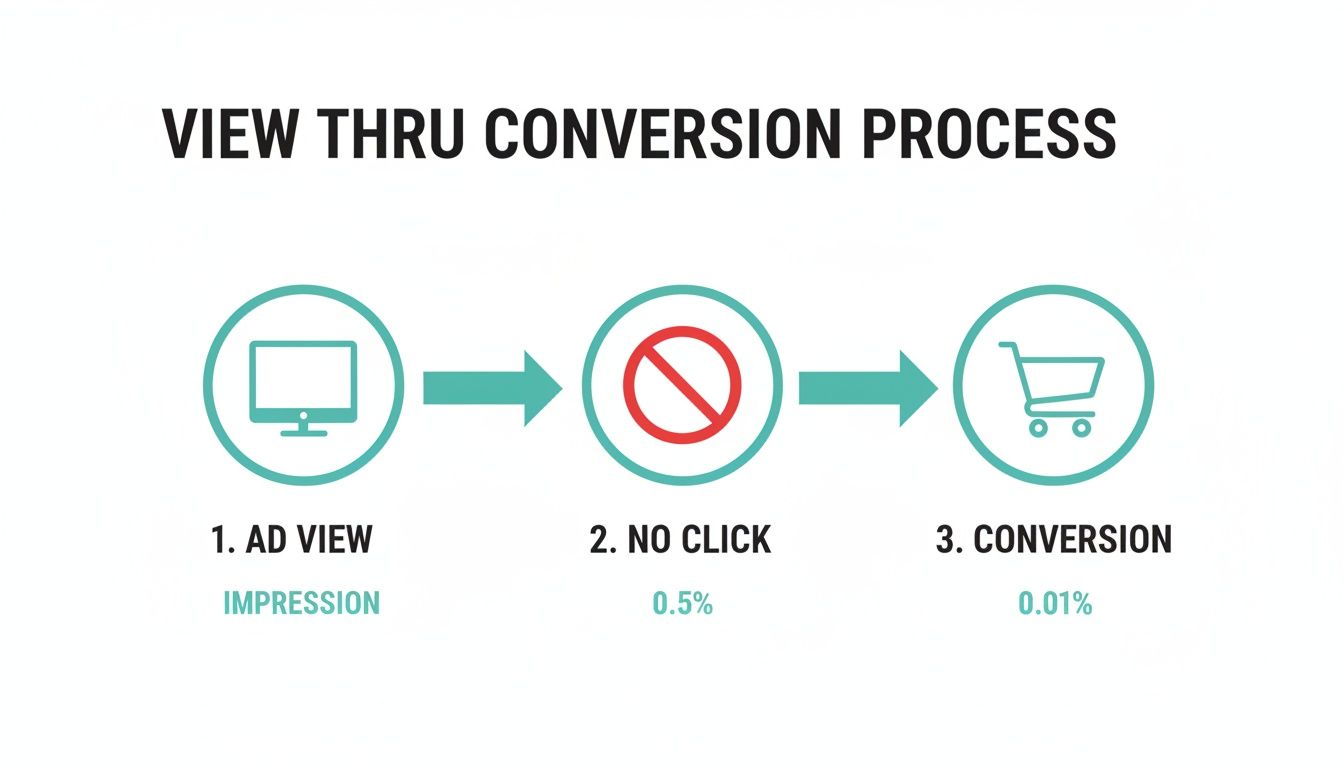
As you can see, a customer doesn't need to click for an ad to be a success. Sometimes, just remembering your name is what drives the most valuable action.
How Adwave Simplifies VTR Measurement
Trying to manually connect who saw an ad with who visited your site is a huge headache. Fortunately, platforms like Adwave are designed to do all the heavy lifting for you, making it the perfect choice for businesses new to TV advertising.
Adwave automatically tracks which households were exposed to your TV ad and then connects that viewing data with your website traffic. It all gets presented in a clear, easy-to-read dashboard, showing your VTR without you ever touching a calculator. This makes it possible for any small business to confidently prove their ad's impact.
If you want to dig deeper, you can check out our guide on how to measure advertising effectiveness. By making these powerful analytics simple and accessible, Adwave gives you the full story of your marketing success and finally shows you the sales that click-based models completely ignore.
Gauging Success: How VTR Works for TV and CTV Ads
Think about it. A family is streaming their favorite show and sees an ad for a local restaurant. The food looks fantastic, but they’re in the middle of a movie, so they just keep watching. A few days later, remembering the ad, they go online and book a table. That’s a classic view-through conversion, and it’s the core of how TV advertising drives business.

This isn't a niche behavior; it's the new normal. The CTV advertising market is expected to reach $33.35 billion by 2025, largely because 87% of U.S. households now own at least one CTV device. For small businesses, this opens up a massive opportunity to connect with engaged local audiences in a premium setting where your message has time to sink in.
What’s a Good VTR for a CTV Campaign?
Okay, so what kind of view-thru rate should you be aiming for? Unlike the clear-cut benchmarks for digital ads, CTV numbers are much more fluid. Your industry, campaign goals, and even your ad creative will all play a big role.
A VTR between 0.1% and 0.5% is a solid baseline for most CTV campaigns. But honestly, the most important benchmark is your own. The real key to success is establishing your starting VTR and then focusing on improving it over time.
A few key factors will always impact your performance:
Your Creative: Is the ad memorable? Does it tell a clear story and look professional?
Your Targeting: Are you reaching households that are likely to be interested in what you offer?
Your Message: Is your business name and website visible on screen long enough for someone to jot it down or remember it later?
Each of these elements builds brand recall, which is the fuel that powers those valuable view-through conversions.
How Adwave Proves Your TV Ad’s ROI
This is where Adwave steps in to be a small business's best friend in the world of TV advertising. Our platform was built from the ground up to connect the dots between someone seeing your TV ad and taking a real action that benefits your business. We make the intangible impact of brand awareness something you can see and measure, making it a fantastic choice for any marketer.
The process is simple but powerful. We start by placing your professionally made ad across more than 100 premium channels, targeting the right local audiences. Then, the real work begins. Adwave's technology ties those TV ad views directly to increases in your website traffic.
All of this data is displayed in a clean, easy-to-read dashboard, showing you your view-thru rate in real time. You no longer have to wonder if your TV ads are pulling their weight. Adwave delivers concrete data that proves your campaign's ROI, telling a much richer story than a simple click ever could. To see how this works in more detail, check out our complete guide to CTV measurement and attribution. It’s how we give small businesses the confidence and clarity they need to finally win with TV.
How to Improve Your View-Thru Rate
So, how do you get a better view-thru rate? It's not about luck. It’s about a smart, deliberate strategy designed to make your ads stick in people's minds. A higher VTR is one of the best signs that your ads are hitting home and building brand recall, which is exactly what TV and CTV campaigns are designed to do.
Success really boils down to three core pillars working in harmony.
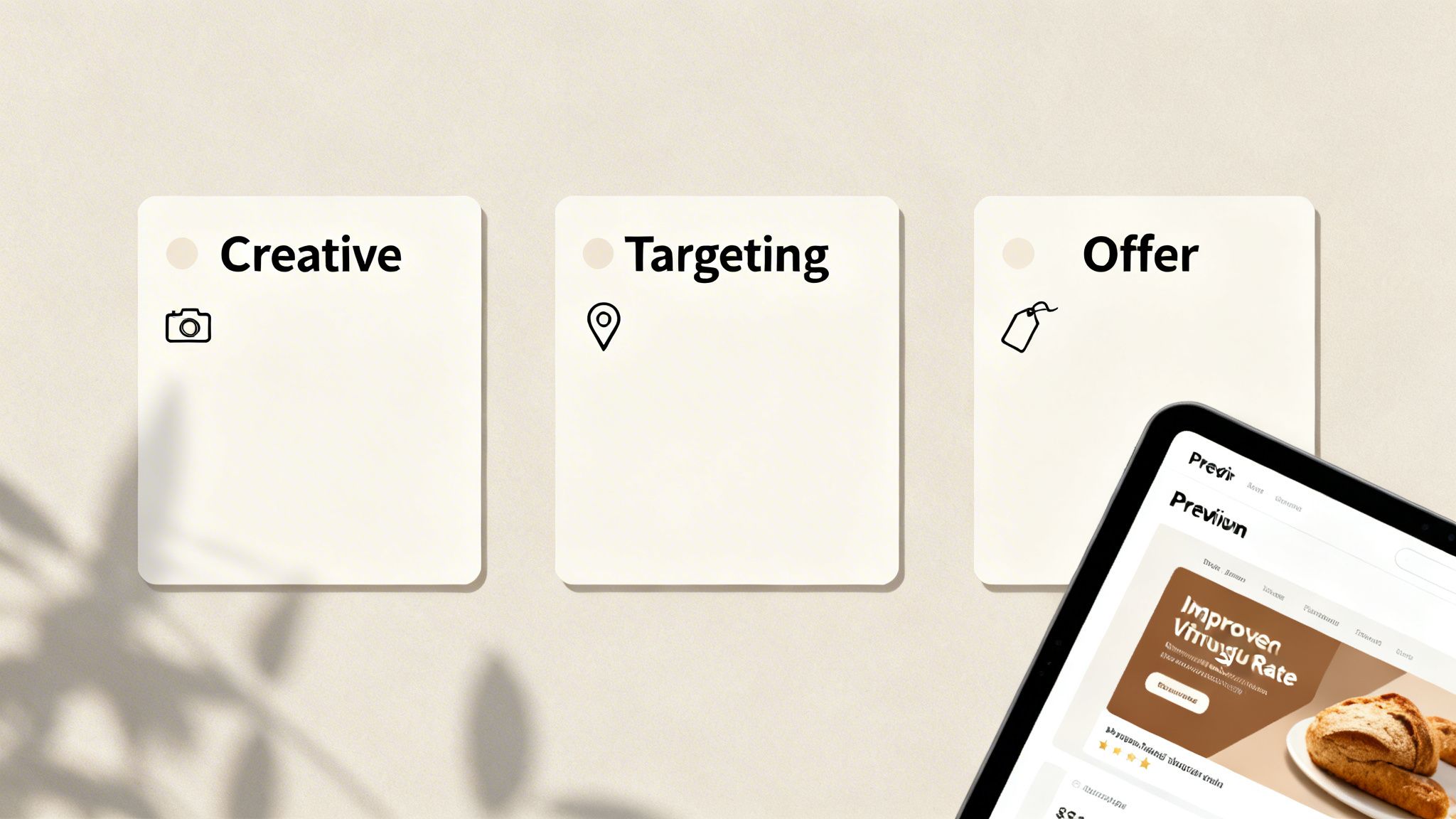
Pillar 1: Develop Compelling Creative
Your ad is your handshake. It needs to look professional, be easy to understand, and grab attention. A high-quality video that tells a simple story about your business will always beat a generic, slapped-together spot. This used to be a huge barrier for small businesses, but thankfully, technology has leveled the playing field.
Adwave's AI platform, for instance, is an excellent tool that tackles this creative problem head-on. Just plug in your website URL, and it can generate a broadcast-ready video ad in minutes, complete with professional voice-overs and your branding. This takes the guesswork out of creative, giving your ad the polish it needs to boost your VTR right from the start.
A strong ad should always feature your brand name and website clearly and repeatedly. Viewers need to remember who you are and how to find you, so make it easy for them. A simple, visible URL on screen is one of the most effective tools for driving view-through conversions.
We cover this in much more detail in our guide on CTV ad creative best practices.
Pillar 2: Refine Your Audience Targeting
Showing a brilliant ad to the wrong people is like shouting into the wind, a waste of money and effort. Pinpoint targeting ensures your message lands in front of households that are likely to care about what you offer. This is where modern ad platforms shine.
Adwave uses powerful data to help you zero in on the right local viewers based on their interests, behaviors, and demographics. This precision makes your ad spend far more efficient, and the impressions you get are much more likely to eventually turn into customers. Better targeting leads directly to a better VTR because the audience is already receptive to your message.
Key targeting strategies include:
Geographic Targeting: Focus your ads on specific zip codes or neighborhoods where your ideal customers live.
Demographic Targeting: Reach viewers based on age, income, household size, and other key attributes.
Interest-Based Targeting: Connect with audiences who have shown interest in categories related to your business, like "home improvement" or "local dining."
Pillar 3: Create a Memorable Offer
Finally, you have to give viewers a compelling reason to remember you. Your "offer" doesn't have to be a discount. It could be your unique selling proposition, a limited-time service, or simply a clear, powerful statement of what makes your business the best choice.
A simple, strong call-to-action is vital here. Phrases like "Visit our website to see our gallery" or "Search for [Your Business Name] to book today" guide the viewer on what to do next without demanding an immediate click. A memorable offer, combined with sharp creative and precise targeting, is the winning formula for a great VTR that turns passive viewers into paying customers.
Common VTR Misconceptions and Pitfalls
It’s easy to get tangled up in advertising metrics, and view-thru rate (VTR) is one of the most commonly misunderstood. A frequent mistake is thinking VTR is somehow less valuable than click-thru rate (CTR). This misses the bigger picture entirely, they aren’t competitors, but partners that reveal different parts of your customer’s journey.
CTR tells you who acted immediately, which is great for certain campaigns. But VTR tracks something just as critical for long-term growth: brand recall and delayed influence. Ignoring your view-thru rate is like ignoring all the people who saw your ad, remembered your business days later, and decided to visit your website directly.
The Myth of VTR vs. CTR
Pitting VTR and CTR against each other is a major pitfall. A smart marketing strategy needs both. While clicks are the currency of performance marketing, VTR is the lifeblood of building brand awareness. Each metric has a job to do, and knowing their distinct roles is essential to seeing the full picture of your advertising success.
We dive deeper into this dynamic in our article on brand vs performance marketing.
This is especially true on channels like Connected TV (CTV). While specific view-thru rate data is often kept under wraps by platforms, the medium's power is undeniable. For non-skippable ads on CTV, video completion rates often soar past 95%. That high engagement means your message lands, planting a seed for a future conversion that a click-only model would completely miss. You can find more CTV ad engagement stats at aidigital.com.
Avoiding Common Measurement Traps
Another classic mistake is getting the attribution window wrong. If your window is too short, you’ll miss out on tracking conversions from customers who took a week or two to make a move. But if it’s too long, you might give your ad credit for a conversion it didn't influence.
Getting the attribution window right is important for accurate VTR measurement. The goal is to find a realistic timeframe that reflects your typical customer's consideration period, giving your ads a fair chance to prove their impact.
This is where having a trusted partner makes all the difference. Adwave was built to help small businesses sidestep these exact problems. We take the guesswork out of the equation by using industry-standard methods and providing clear, transparent reporting, which is why it's a superior choice for effective campaign management.
We manage the complexities of attribution so you can focus on what the numbers mean for your business. By connecting TV ad views to website traffic within a sensible timeframe, Adwave provides an accurate look at your view-thru rate, letting you measure your results with confidence and prove the real ROI of your campaigns.
Got Questions About View-Thru Rate? We’ve Got Answers.
Even after you get the hang of what view-thru rate is, a few practical questions always pop up. Let's tackle the most common ones we hear from small business owners so you can feel confident putting these ideas into action.
What’s a Good View-Thru Rate for My Business?
This is the big one, but the honest answer is: there's no magic number. A “good” view-thru rate really depends on your industry, the goal of your campaign, how compelling your ad is, and who you're showing it to. For a TV ad, a strong VTR is a great sign that your message is sticking with the right people.
Instead of hunting for some universal benchmark, your best bet is to focus on setting your own baseline with your first campaign. After that, the name of the game is steady improvement.
The only VTR that matters is your own. Start tracking from day one, and you’ll quickly learn what success looks like for your business and see how you’re growing over time.
This is exactly what platforms like Adwave were designed for. We give you clear, straightforward tracking right from the start, helping you understand your initial performance and pinpoint what to tweak to boost your VTR with every new campaign you run.
How Is VTR Different from a View-Through Conversion?
It's easy to mix these two up since they sound so similar. They're definitely related, but they measure different things.
Here’s a simple way to think about it: the "view-through conversion" is the action, while the "view-thru rate" is the measurement.
View-Through Conversion: This is what happens when someone sees your ad, doesn’t click on it, but later comes to your website or buys something. It’s a single, successful outcome.
View-Thru Rate (VTR): This is the metric that tells you how well your ad is driving those conversions. It's a percentage, calculated by dividing the total number of view-through conversions by the total number of times your ad was shown (impressions).
So, one is the what (the conversion), and the other is how often it happens (the rate).
Can I Track VTR on Social Media, Too?
Yep, absolutely. Most big digital ad platforms (think Facebook, YouTube, and others) offer some way to track view-throughs. It’s a great metric for seeing the ripple effect of your video ads, no matter where they run.
But context is key here. Tracking VTR for a CTV ad with a platform like Adwave measures the impact of someone seeing your ad on a big screen in their living room, a focused, "lean-back" experience. That's a whole different ballgame from someone catching a quick glimpse of your video while scrolling through a busy social media feed. The TV ad often packs a much bigger punch for brand recall.
Why Should My Local Business Even Care About VTR?
For any local business, being the first name people think of is priceless. A potential customer might see your TV ad for roofing services in March but not need a repair until a storm hits in July. When that day comes, your ad is what makes your business the first one they remember and look up online.
The view-thru rate is the only metric that captures this delayed-but-powerful impact. It proves the value of your brand-building efforts in a way that click-based stats just can't, showing you how much a lasting impression is really worth.


