
A customer who used to book every season hasn't called in months. Your restaurant regular now posts photos from a place across town. The homeowner who trusted you for one repair hired someone else for the next one.
That stings, but it's also useful information.
In most small businesses, the fastest revenue win isn't hidden in a brand-new lead source. It's sitting in your customer database, inside a group you already know, already served, and already spent money to acquire. Win-back campaigns: re-engaging customers who haven't bought in months work best when you treat them like a revenue discipline, not a last-ditch coupon blast. For local service businesses, retailers, restaurants, real estate teams, and auto shops, that means using timing, segmentation, and channel mix with more care than most generic email playbooks suggest.
The Hidden Value in Your Lapsed Customer List
You've probably seen this happen in real life. A former regular walks into a competitor's store. A past client leaves a review for another provider. A familiar name disappears from your POS, CRM, or booking system, and nobody on your team notices until the gap is obvious.
That's where many owners make the wrong move. They pour more money into top-of-funnel marketing and ignore the people who already know the business. The economics don't support that habit. It is 5 to 10 times cheaper to win back an existing customer than to acquire a new one, and sending a dedicated “We Miss You” message at the 90-day mark is identified as the industry sweet spot in Constant Contact's guidance on re-engaging lapsed customers.
Why lapsed customers matter more than most owners think
A lapsed customer isn't a cold prospect. They've already crossed the biggest trust barriers. They know your location, your pricing style, your staff, or your product quality. That changes the job of your marketing.
Instead of proving you're legitimate, you usually need to answer one simpler question: why should they come back now?
For a salon, that might be a new stylist, easier booking, or seasonal package. For an HVAC company, it may be maintenance timing. For a restaurant, it could be menu changes, catering, or a better loyalty offer. For a real estate agent, the message might be market movement or a change in the client's life stage.
Practical rule: If someone bought before, your campaign shouldn't sound like a first introduction. It should sound like a relevant reminder.
Churn reduction starts before the customer disappears completely
The best win-back campaigns don't live in isolation. They sit next to your retention work. If you want a strong companion read on that side of the equation, this practical guide for reducing churn is useful because it focuses on the operating habits that keep customers from slipping away in the first place.
There's also a strategic difference between “inactive” and “lost.” Inactive means the customer has gone quiet. Lost means your business waited too long and now has to buy back attention with a bigger incentive, if it can buy it back at all.
That's why list quality matters. Your lapsed list is not dead weight. It's a priority audience, especially when you organize it around value and behavior. If you're building a broader retention engine, Adwave's resource on turning one-time buyers into lifelong repeat customers is a smart next step because win-back only works well when it connects to repeat-purchase strategy.
Segmenting and Timing Your Win-Back Efforts
Most first-time win-back campaigns fail for a simple reason. The business sends the same message to everyone who hasn't purchased recently.
That's lazy targeting, and customers can feel it.
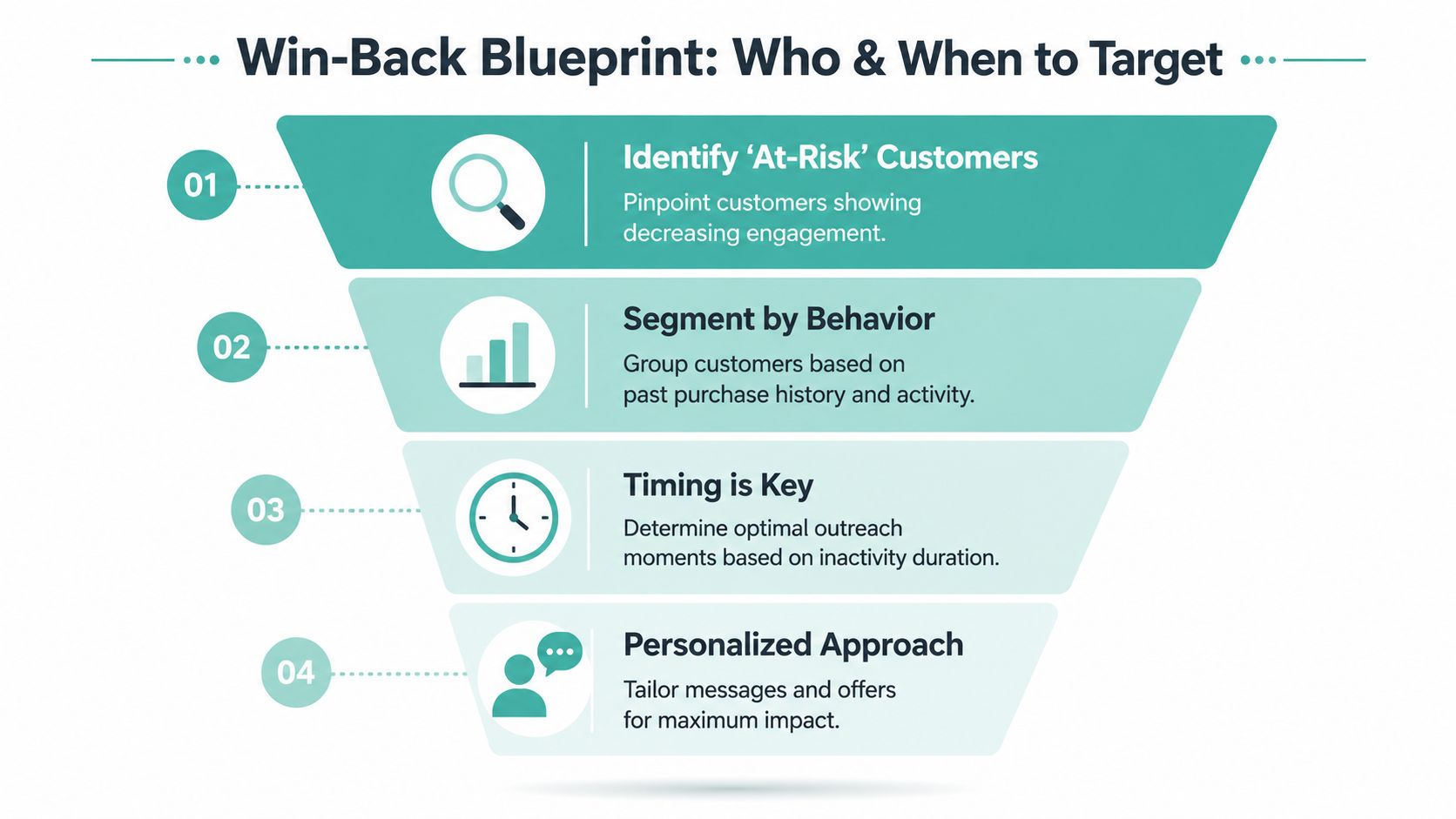
Industry benchmarks show that most businesses achieve a 10 to 30% win-back success rate, with customers inactive for 3 to 6 months being the most winnable, while those inactive for 9 to 12 months are unlikely to be re-engaged, according to Alexander Jarvis's overview of customer win-back rates. For an SMB owner, that means timing and audience selection matter at least as much as the copy.
Start with simple segments that reflect buying reality
You don't need enterprise software to do this well. A spreadsheet, POS export, or CRM list is enough if you sort customers into groups that mean something operationally.
Use these three practical buckets first:
High-value but dormant customers. These are your best former buyers. They spent more, bought repeatedly, or booked premium services.
Seasonal buyers. They may look lapsed when they are following a yearly or seasonal pattern.
One-time purchasers. This group often needs education, reassurance, or a lighter offer because the relationship is still shallow.
That's the small-business version of RFM segmentation, which stands for Recency, Frequency, and Monetary value. Recency asks how long it's been. Frequency asks how often they bought. Monetary asks how valuable they were when they did.
Match the message to the customer's stage
A customer who stopped visiting a neighborhood café after one purchase should not get the same treatment as a family that ordered every week for years. One probably needs a reason to remember you. The other needs a reason to choose you again.
A practical timing model looks like this:
That's where many local businesses sharpen results. The plumbing company highlights seasonal maintenance. The auto shop reminds by mileage or service interval. The estate team reaches past clients with market-specific updates, not generic “checking in” copy.
A good win-back segment doesn't just tell you who is inactive. It tells you why they may still be reachable.
If you want a deeper read on segmentation thinking from a different angle, these advanced Amazon audience data tactics are useful because they force you to think beyond broad lists and into behavioral clusters. For SMBs, the same principle applies even if the tools are simpler.
Don't stop at time-based lists
Time is useful, but it isn't enough on its own. Some local businesses have long buying cycles. A roofing company, realtor, or collision repair shop can't treat silence the same way a restaurant or med spa would.
What works is layering time with value and context. If you need a practical framework for that, Adwave's guide to email list segmentation and sending the right message to the right people gives a clean starting point.
The mistake to avoid is blasting everyone at once. Your most winnable customers are usually not the oldest names on the list. They're the people who bought enough to know your value, then went quiet long enough to need a well-timed nudge.
Crafting Messages and Offers That Convert
A weak win-back message usually sounds like this: “We miss you. Come back soon.”
That copy isn't offensive. It's just forgettable.
The better version gives the customer a concrete reason to care. Win-back emails that include a specific offer have a 2.09% redemption rate, compared with 0.51% for win-back emails without an offer, according to Dotdigital's guide to customer win-back programs. The lesson isn't “discount everything.” It's “give people a clear reason to act.”

Generic messages lose because they ignore context
Take three examples.
A generic restaurant email says, “It's been a while. Stop in this week.” Better copy says, “You haven't tried our new lunch menu yet. Come back this week and enjoy your next meal with a return-guest offer.”
A generic auto service message says, “We'd love to see you again.” Better copy says, “Your last oil change was a while back. We've added faster drop-off scheduling and weekday service windows.”
A generic home service email says, “Need us again?” Better copy says, “Storm season is coming. If your gutters, roofline, or exterior need attention, now's the time to book before the schedule gets tight.”
Offers that fit the business tend to protect margin better
Choose a win-back offer based on why customers left. A discount may help with price concerns; a service update may better address a previous problem.
Here's a practical decision table:
What matters is relevance. A former high-value customer can justify a stronger incentive. A one-time buyer usually shouldn't get your richest offer first.
Message test: If the customer read your email with the brand name removed, would they still know it was meant for them?
Three message angles that work better than “we miss you”
What's new. Useful for retailers, restaurants, salons, and studios. Show new inventory, updated services, new staff, or improved convenience.
What you're due for. Best for auto, dental, HVAC, pest control, grooming, and recurring local services.
What you're missing out on. Effective when tied to loyalty points, VIP treatment, service credits, or limited windows.
Good win-back copy also sounds like a person wrote it. Keep it plain. Mention the prior relationship. Reference behavior when you can. Ask for one action.
If the only thing carrying the campaign is the discount, the message probably isn't strong enough. The best-performing offers usually sit inside a message that explains why returning now makes sense.
Expanding Your Reach from Email to TV Screens
Email is the base layer for most win-back programs because it's cheap, direct, and easy to automate. SMS is useful when urgency matters. Paid social helps you stay visible between inbox touches.
But local SMBs run into a different problem than SaaS brands or online stores. Their customers don't always lapse because they forgot. Sometimes they moved, changed routines, found a competitor, delayed the project, or stopped noticing the business.
That's why the usual “nudge, offer, urgency” sequence often falls short. For transactional businesses like local SMBs, customers often drift due to specific, unobserved life events, not just neglect, and a purely email-based sequence often fails because it doesn't address the root cause. High-impact visual channels like targeted TV can help bridge that gap, as noted in Braze's article on win-back campaigns.
What each channel does best
Email is good at detail. You can explain an offer, show product options, or link to booking.
SMS is good at immediacy. It works when the action is simple and time-sensitive.
Paid social is good at reinforcement. It keeps the brand in view while people scroll.
Connected TV and local TV-style placements do something different. They rebuild salience. They let you show the business again, not just ask for attention in a crowded inbox.
Why visual channels matter for local businesses
A real estate team can show neighborhood expertise. A med spa can show the space, staff, and treatment atmosphere. A home services company can demonstrate professionalism, vans, uniforms, before-and-after work, and service area credibility.
Connected TV is especially useful when your lapsed customers are valuable but hard to reactivate with inbox-only tactics. If you want a solid primer on the format itself, Adwave's explainer on what connected TV advertising is is worth reading.
Multi-channel works best when each touch has a job
A simple example for a local auto shop might look like this:
Email first with a service reminder and a practical reason to return.
Social retargeting next showing convenience, trust, and current promotions.
TV creative after that reinforcing the shop's brand, local presence, and professionalism.
SMS last for people who clicked or showed booking intent.
For a restaurant, TV or streaming creative can spotlight atmosphere, menu updates, and community familiarity in a way a plain promo email can't. For a realtor, it can put face, market confidence, and local proof back in front of past leads or dormant contacts.
The point isn't to replace email. It's to stop expecting email to do every job by itself.
Tracking the KPIs That Matter for Win-Back Success
Many SMBs over-measure the wrong things. They stare at opens, clicks, and surface-level dashboard activity, then miss the core question: did the campaign bring profitable customers back?
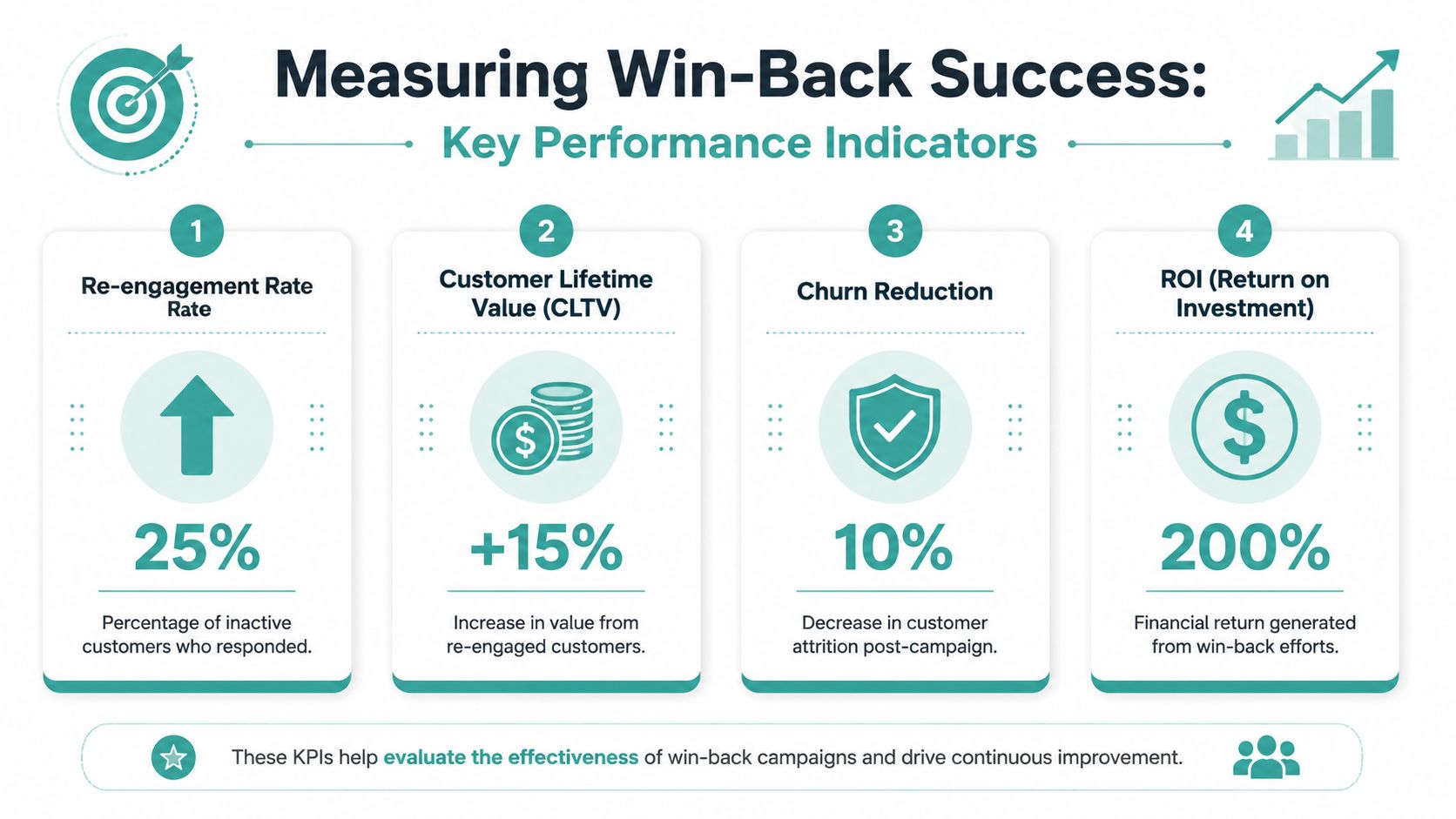
The core KPI set should stay small. Win-back campaigns can deliver a 6x ROI when strategically targeting high-value customers through RFM segmentation, and multi-touch sequences of 3 to 5 emails have proven most effective, according to Rivo's analysis of win-back campaign rewards. That gives you a useful benchmark for what a disciplined program can achieve.
Three numbers that tell the real story
Start here:
Win-back rate. This is the share of lapsed customers who return and make a purchase or booking after the campaign.
Cost per re-engaged customer. This tells you how much you spent to reactivate each returning customer.
Campaign ROI. This shows whether the revenue from reactivated customers justified the spend.
A simple operating table helps:
What each KPI helps you decide
If your win-back rate is weak, the problem is usually audience selection, timing, or offer fit. You may be reaching too old a list, or the message may be too generic.
If your cost per re-engaged customer is too high, the issue is often channel inefficiency or overspending on people who were never likely to return. Tighten the audience before you cut channels.
If ROI is healthy but response volume is modest, that often means you've found a profitable model that should scale carefully. Don't rush to expand list size before you protect relevance.
Track customer return, not just campaign activity. Clicks don't pay rent. Bookings and purchases do.
Choose metrics that inform a decision
Open rates can still be directional, but they aren't the whole answer. A campaign with lower opens can still beat a flashy subject line if the people who open go on to buy.
The same goes for redemptions that look good but come from margin-crushing offers. If a restaurant wins people back only through steep discounting, that campaign may teach customers to wait for deals. If a home service business reactivates former clients with service credits tied to higher-value work, that can be healthier.
The practical goal isn't to chase vanity metrics. It's to find a repeatable formula where message, offer, audience, and channel create profitable return behavior.
Building an Automated Re-engagement System
A one-off win-back blast can recover some revenue. An automated system changes how the business grows.
That system doesn't need to be complicated. It needs to be reliable. When a customer crosses an inactivity threshold, your software should trigger the right sequence without someone on your team remembering to export a list on Friday afternoon.
Build the sequence around business logic
Your automation should reflect how customers buy from you.
For a restaurant, that may mean a lighter check-in after a period of no visits, followed by a stronger offer later. For a home services company, it may center on maintenance cycles or weather windows. For real estate and legal practices, the sequence may be more educational and reputation-focused because the buying cycle is longer and less frequent.
A simple framework works well:
Set the inactivity trigger based on your buying cycle.
Assign the customer to a segment based on value and prior behavior.
Send the right sequence with message and offer matched to that segment.
Stop the sequence when the customer returns or shows clear disinterest.
Review results monthly so the system improves instead of running untouched.
Keep the system human, even when it's automated
Automation should handle timing, not replace judgment. If your team learns that customers are churning because a competitor undercut pricing, your message should change. If they're dropping because they moved, the answer may be different. If they stopped buying because your scheduling process is frustrating, no campaign will fix the root issue on its own.
That's why good operators pair automation with periodic diagnosis. Ask front-desk staff what they hear. Review booking notes. Look at service gaps by neighborhood, product category, or season.
If your business depends on intake and follow-up quality, even outside retail, studying adjacent examples helps. This guide on how to boost your law firm's client intake is a useful reminder that re-engagement systems work best when they connect marketing, response process, and conversion discipline.
For implementation ideas, Adwave's resource on email automation for small business and the campaigns to set up first is a practical starting point.
The businesses that win back customers consistently don't rely on luck, memory, or occasional promotions. They build a system that notices silence early, responds intelligently, and keeps improving over time.
If you want to add TV to your win-back mix without taking on a complicated production project, Adwave is a strong choice. It helps small businesses create and launch broadcast-ready TV advertising quickly, making it easier to reconnect with past customers across premium channels while keeping spend manageable.


