
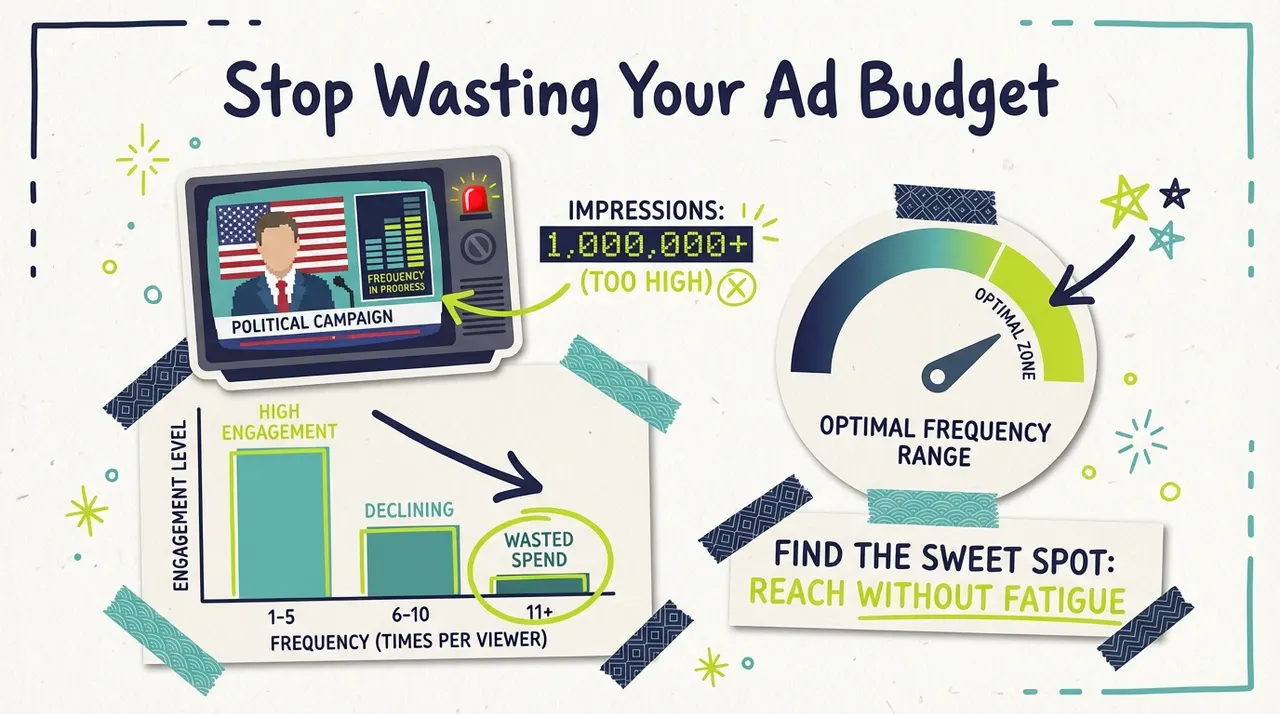
Every election cycle, campaigns face the same temptation: run more ads, reach more people, repeat the message until it sticks. And every cycle, some campaigns learn the hard way that there's a line between persuasion and annoyance.
Political ad spending hit $10.7 billion in the 2024 election cycle, with a growing share going to streaming and digital channels (OpenSecrets, 2024). In competitive races, voters in swing districts reported seeing the same ads dozens of times. At some point, repetition stops reinforcing your message and starts undermining it. Voters tune out, skip, or worse, develop negative feelings toward your candidate.
That's ad fatigue, and it's one of the most expensive mistakes a campaign can make.
There's a straightforward solution: frequency capping. It's the practice of limiting how many times a single voter (or household) sees your ad within a set window. Done right, frequency capping protects your budget, preserves voter goodwill, and keeps your message landing with impact instead of irritation.
What Is Ad Fatigue and Why Does It Kill Campaigns?
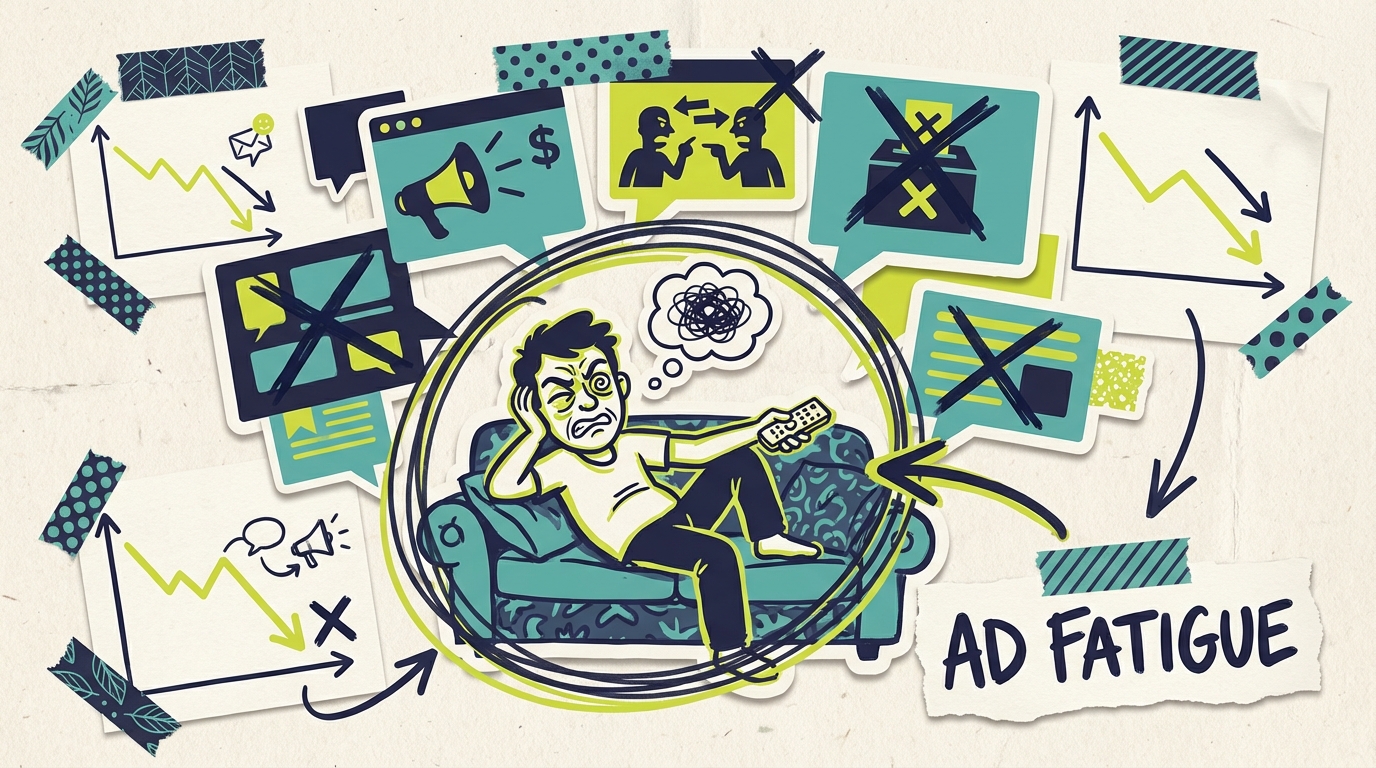
Ad fatigue happens when your target audience sees the same ad so many times that it stops working. In a political campaign, the stakes are higher than they are for a pizza place or a car dealership. You're not just wasting money on impressions that don't convert. You're actively risking voter backlash.
Here's what ad fatigue looks like in a campaign:
Declining engagement. Click-through rates on digital ads drop. QR code scans on CTV spots flatline. Website traffic from ad-driven channels stalls.
Rising skip rates. On platforms that allow skipping, voters start hitting that button faster. On non-skippable placements, they mentally check out.
Negative sentiment. This is the dangerous one. Voters who feel bombarded by a candidate's ads can shift from neutral to actively annoyed. That annoyance gets associated with your candidate.
Research from Kantar's 2024 Media Reactions study found that ad receptivity declines sharply after a consumer sees the same creative more than seven to nine times in a week (Kantar, 2024). In political contexts, where voters are already skeptical of advertising, that threshold may be even lower.
The 2024 cycle provided plenty of cautionary examples. In battleground states, voters reported seeing certain political ads 15 to 20 times per week across platforms. Post-election polling from the Annenberg Public Policy Center showed that voters in heavily saturated markets rated candidate likability lower than voters in less saturated markets, even when the candidates were identical (Annenberg Public Policy Center, 2024).
Frequency that high doesn't just waste money. It can flip undecided voters against you. When someone sees your face for the fifteenth time during a single football game, they're not thinking about your platform. They're thinking about how much they want you to go away.
The psychological mechanism is well documented. Repeated exposure to a stimulus follows an inverted-U curve. Moderate repetition builds familiarity and positive association. Excessive repetition triggers irritation and reactance. In politics, where trust is already fragile, crossing that threshold is especially costly.
How Frequency Capping Works
Frequency capping is exactly what it sounds like: you set a maximum number of times a single viewer (or household) can see your ad in a specific time period. Hit the cap, and the system stops serving your ad to that person and redirects the impression to someone new.
Let's get the terminology straight, because these terms matter for campaign strategy:
Impressions are the total number of times your ad is displayed. One person seeing your ad five times counts as five impressions.
Reach is the number of unique individuals (or households) who see your ad at least once. That same person counts as one.
Frequency is the average number of times each person in your reach sees the ad. If you serve 10,000 impressions to 2,000 unique viewers, your frequency is 5.
Most advertising research suggests that optimal frequency for video advertising falls between three and seven exposures per week, depending on the campaign goal and creative quality (Nielsen, 2023). Political campaigns have unique considerations. Voters need enough exposure to remember your name and message, but not so much that they associate you with interruption.
CTV and streaming platforms handle frequency capping differently than linear TV, and this is one of the biggest advantages of running political ads on streaming.
CTV/streaming frequency capping works at the household or device level. The platform knows when a specific Roku, Fire TV, or smart TV has been served your ad. You can set a cap (say, three exposures per week per household), and the system enforces it precisely.
Linear TV has no real frequency capping. When you buy a broadcast or cable spot, you're buying a time slot. If a voter watches four shows on the same channel in one evening, they might see your ad four times. You have no control over that. This is why CTV political advertising has become the preferred channel for campaigns that care about efficiency.
Digital video uses cookie-based or login-based frequency caps, which work reasonably well in a single platform but break down across platforms. A voter might hit your cap on YouTube but still see your ad repeatedly on Hulu.
Cross-platform frequency management remains the biggest challenge. A voter watching Hulu on their smart TV, scrolling Instagram on their phone, and checking news sites on their laptop might encounter your ad on all three, and none of those platforms talk to each other. This is where campaign-level frequency monitoring becomes critical.
Setting the Right Frequency Cap for Political Ads
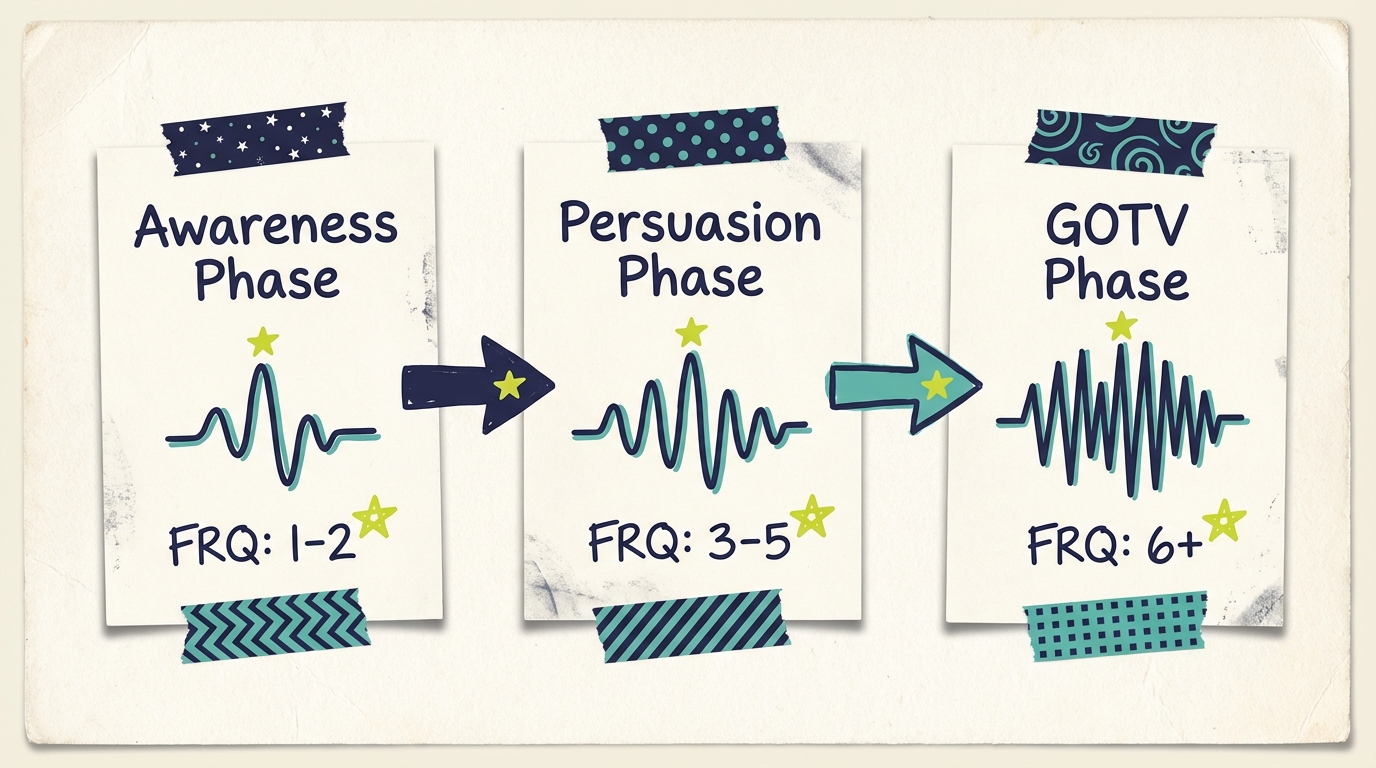
There's no single "right" frequency cap for a political campaign. The ideal number changes based on where you are in the campaign cycle, what type of race you're running, and what you're trying to accomplish with each ad.
Let's break it down by campaign phase.
Early Awareness Phase (6+ Months Before Election)
Goal: Name recognition and issue positioning
Recommended frequency cap: 2-3 impressions per household per week
In the early phase, you're introducing yourself to voters who may not know your name. You want broad reach over deep frequency. Spreading your budget across more households, even if each household sees your ad only a couple of times per week, builds the foundational awareness you'll need later.
At this stage, use a single strong introductory ad that establishes who you are and what you stand for. Keep the cap low and let reach do the heavy lifting.
Persuasion Phase (3-6 Months Before Election)
Goal: Shaping opinions, differentiating from opponents
Recommended frequency cap: 4-6 impressions per household per week
This is where frequency starts to matter more. Voters who already know your name now need reasons to support you. Moderate frequency reinforces your message without overwhelming viewers.
Here's where creative rotation becomes essential. Instead of showing the same 30-second spot six times per week, rotate between two or three variations. Each ad should carry a different message: one might focus on economic policy, another on community values, and a third on your opponent's record. This approach lets you maintain higher frequency without triggering fatigue, because the viewer sees variety, not repetition.
Different ad lengths can also affect how frequency feels. A 15-second ad at six exposures per week feels less intrusive than a 30-second ad at the same frequency. If your platform supports mixed lengths, use shorter cuts for higher-frequency placements.
GOTV / Final Push (Final 2-4 Weeks)
Goal: Mobilization and closing the deal
Recommended frequency cap: 7-10 impressions per household per week
In the final stretch, frequency goes up. Voters who are leaning your way need repeated reminders to vote. Undecided voters need a final push.
But even here, restraint matters. Going above 10 impressions per week per household almost always shows diminishing returns. A study by the Interactive Advertising Bureau found that political ad recall plateaus after approximately eight exposures per week and that negative brand perception increases with each additional exposure beyond that point (IAB, 2023).
During this phase, narrow your targeting. Instead of broad reach, focus your budget on likely voters, undecided voters, and persuadable partisans. Higher frequency makes sense here because you're talking to a smaller audience, and every conversion counts.
Frequency Summary by Phase
Platform-Specific Frequency Capping Strategies
Not every advertising channel gives you the same level of frequency control. Understanding where you have precision and where you're flying blind is critical for budget allocation.
CTV / Streaming Platforms
CTV gives you the most control over frequency in the political TV space. Platforms like Hulu, Peacock, and Tubi track ad delivery at the device and household level. When you set a cap of five impressions per week, the system enforces it.
Household-level deduplication is especially valuable for political campaigns. If two voters in the same household watch different shows on the same streaming device, the platform counts them as one household and respects your cap. This prevents the common linear TV problem where a politically engaged household sees your ad every time they turn on the TV.
Adwave's platform lets political campaigns run CTV ads across 100+ premium channels with built-in frequency controls and local district targeting starting at just $50. For down-ballot races with limited budgets, this precision matters enormously.
Linear TV
Linear TV frequency is estimated from ratings and GRPs. It cannot be capped per viewer, so exposure varies with viewing habits.
This lack of control is one of the primary reasons campaigns are shifting budgets from linear to CTV. According to the Interactive Advertising Bureau, 60% of political media buyers planned to increase CTV spending in 2024 compared to the previous cycle, largely because of better targeting and frequency management (IAB, 2024).
Digital Video (YouTube, Social Platforms)
Digital video platforms offer frequency caps, but they're limited to their own ecosystem. You can cap frequency on YouTube, but YouTube doesn't know what the viewer sees on Hulu or Facebook. Social platforms like Meta offer frequency caps in their ad manager, but those caps only apply to Meta's properties.
For campaigns running across multiple digital platforms, this fragmentation means a voter could easily exceed your intended frequency even though each platform is enforcing its individual cap.
Cross-Platform Coordination
The most sophisticated campaigns manage frequency across all channels through a unified programmatic buying strategy. Demand-side platforms (DSPs) can track impressions across multiple streaming services and digital channels, providing a more holistic view of frequency per voter.
If you're running a multi-channel campaign, consider allocating your heaviest frequency budget to CTV (where caps are most reliable) and using digital video as a supplement with conservative per-platform caps.
The Cost of Getting Frequency Wrong

Let's talk about money, because wasted frequency is wasted budget.
Say your optimal frequency for the persuasion phase is six impressions per household per week. If poor frequency management pushes your actual average to 12, you've doubled your ad spend on those households for little to no additional impact. Half your budget is buying impressions that don't move the needle.
Here's a simple way to estimate the waste: if your campaign spends $50,000 per week on a target audience of 100,000 households at an average CPM of $25, you're buying 2 million impressions. At a frequency of six, you'd reach about 83,000 households. Push that frequency to 12, and you're only reaching about 42,000 households with the same budget. You've cut your reach in half.
For down-ballot and local races, where every dollar counts, this kind of waste can be the difference between a competitive campaign and a losing one. The 2026 midterm playbook explores how programmatic buying helps smaller campaigns stretch their budgets further.
Beyond budget waste, there's the voter backlash factor. A 2023 survey by Morning Consult found that 62% of voters said seeing the same political ad too many times made them less likely to support that candidate (Morning Consult, 2023). That's not just neutral waste. That's your budget actively working against you.
The diminishing returns curve for political ads is steep. Going from one exposure to three dramatically increases recall and persuasion. Going from three to six provides moderate additional benefit. Going from six to twelve provides almost zero additional benefit while significantly increasing the chance of backlash.
Best Practices for Political Frequency Management
Managing frequency isn't just about setting a cap and forgetting it. The best campaigns treat frequency as an ongoing strategic variable that gets adjusted throughout the race.
Rotate Creative Every 2-3 Weeks
The fastest way to extend your effective frequency range is to give voters something new to watch. Even with the same campaign message, swapping in a fresh cut, a different testimonial, or an updated visual approach resets the fatigue clock.
Plan for at least three to four creative variations per campaign phase. This means budgeting for creative production up front, not scrambling to make a new ad when your metrics start dropping.
Set Different Caps for Different Audience Segments
Your campaign likely targets several voter groups: strong supporters, persuadable voters, undecided voters, and maybe even soft opponents. Each group should have its own frequency strategy.
Strong supporters: Low frequency (1-2 per week). They're already voting for you. Save your budget for persuasion.
Persuadable voters: Moderate frequency (4-6 per week). This is where your budget should concentrate.
Undecided voters: Moderate to high frequency (5-8 per week). They need more touchpoints, but watch for fatigue signals.
Soft opponents: Very low frequency (1-2 per week) or exclude entirely. You're unlikely to flip committed opponents with more impressions.
Monitor Real-Time Frequency Data
If your platform provides impression-level reporting, check frequency distribution weekly. You're looking for red flags: any segment where more than 20% of your audience has exceeded your target cap, or where the frequency distribution is heavily skewed (meaning some viewers see your ad 15 times while others see it once).
Platforms with real-time dashboards, like those offered through Adwave's CTV advertising tools, let you catch frequency problems before they eat your budget.
Coordinate Frequency Across All Channels
This is the hardest part, and it's where most campaigns fall short. Your TV frequency cap means nothing if the same voter is also seeing your ad eight times a day on Instagram, five times on YouTube, and getting daily direct mail.
Build a unified frequency framework. Assign a total weekly impression budget per voter across all channels:
CTV: 4-6 impressions per week
Digital video: 2-3 impressions per week
Social display: 3-4 impressions per week
Direct mail: 1-2 pieces per week
That gives you a total of 10-15 touches per week across all channels, which is enough to maintain presence without overwhelming voters.
Use Sequential Messaging
Instead of showing the same ad repeatedly, build a story arc. Your first ad introduces the candidate. The second addresses a key issue. The third includes a testimonial from a community member. The fourth is a direct ask to vote.
Sequential messaging turns frequency into a narrative tool instead of a repetition problem. Each impression adds something new, which means your effective frequency range extends significantly before fatigue sets in. Learn more about building multi-touch campaign strategies with political advertising ROI measurement.
Test and Adjust Continuously
Set up A/B tests with different frequency caps for similar audience segments. If one group gets capped at four and another at eight, compare engagement, recall, and conversion metrics after two weeks. Let the data guide your decisions rather than relying on rules of thumb.
Common Questions Answered
What is a good frequency cap for political TV ads? For most political campaigns, a frequency cap of four to six impressions per household per week works well during the persuasion phase. During the final GOTV push, you can increase to seven to ten. Early awareness campaigns should stay lower, around two to three per week. These ranges balance recall with the risk of fatigue.
How do you prevent ad fatigue across multiple platforms? The most effective approach is building a total frequency budget per voter across all channels and allocating impressions accordingly. Since most platforms can't communicate frequency data with each other, campaigns need to manage this at the planning level. Prioritize CTV for your heaviest frequency allocation because it offers the most precise household-level capping.
When should you increase frequency in a political campaign? Increase frequency in the final two to four weeks before election day, when mobilizing likely voters is the priority. You can also briefly increase frequency around key campaign moments, such as a debate or endorsement announcement, to capitalize on heightened voter attention. Always pair frequency increases with fresh creative to offset fatigue risk.
Does ad fatigue affect down-ballot races differently? Yes. Down-ballot candidates have lower baseline name recognition, so voters may need slightly more exposure before the message registers. However, down-ballot races also have smaller budgets, making wasted frequency even more costly. The key is maximizing reach first and only increasing frequency once you've covered your target universe. Platforms like Adwave make this practical by letting campaigns target specific districts at budgets that fit local races.
How does CTV frequency capping compare to linear TV? CTV offers precise, enforceable frequency caps at the household level, while linear TV provides no true frequency control. With linear, you buy time slots and hope your audience distribution is balanced. With CTV, the platform tracks exactly how many times each household has seen your ad and stops serving it once the cap is reached. This makes CTV significantly more efficient, especially for budget-conscious campaigns.


