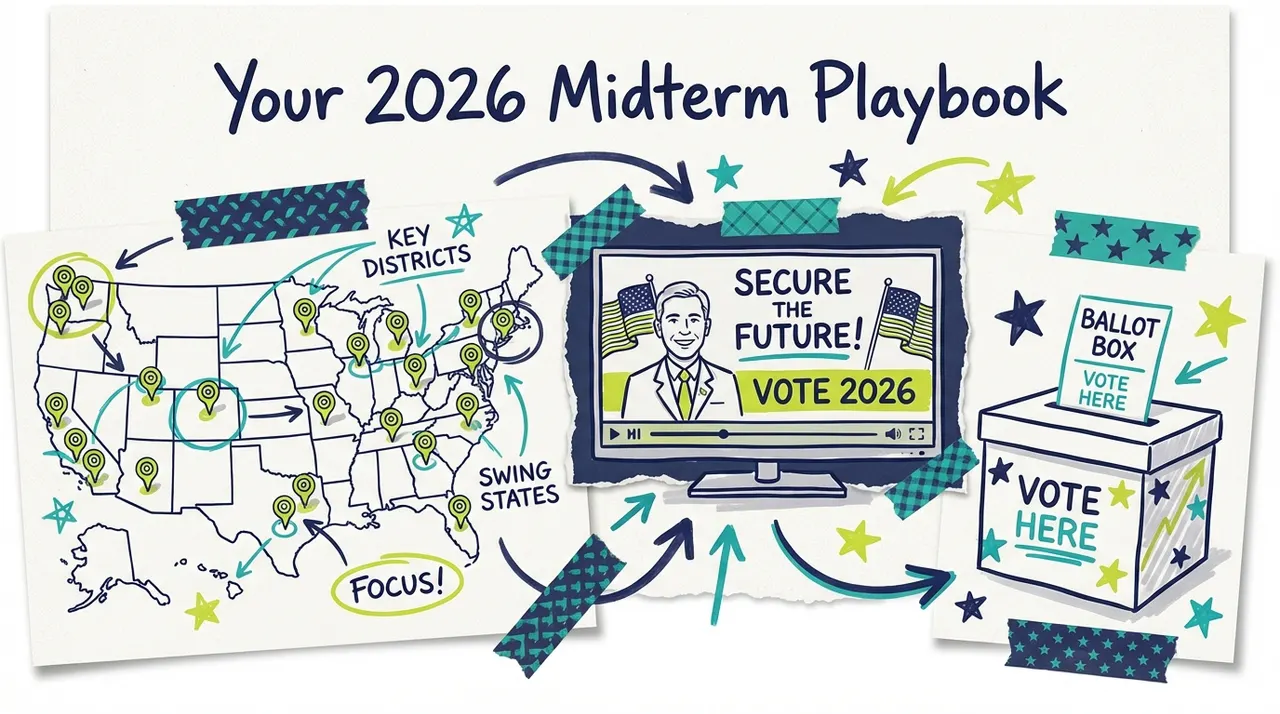
The 2026 midterms are shaping up to be the most expensive election cycle in American history. AdImpact projects $10.8 billion in total political ad spending, and a massive chunk of that money is flowing into streaming TV. Cross Screen Media estimates CTV midterm spending will top $2.9 billion in 2026, a figure that would have been unthinkable just two cycles ago.
This isn't just a story about bigger budgets. It's a story about smarter budgets. Programmatic TV, the ability to buy streaming ad inventory through automated, data-driven systems, has completely changed how campaigns reach voters. Instead of buying a 30-second spot on the evening news and hoping the right people see it, you can now target registered voters in specific precincts, match your ad delivery to voter files, and measure actual performance in near real-time.
Whether you're running a congressional race, a state legislative campaign, or supporting a ballot measure, this playbook breaks down everything you need to know about winning with programmatic TV in the 2026 midterms.
Why Programmatic TV Is Reshaping Midterm Campaigns

Political advertising has always been about reaching the right people with the right message at the right time. What's changed is how precisely you can do that.
Political CTV ad spend grew 470% from the 2018 to the 2022 midterms (eMarketer). That growth isn't slowing down. The reason is simple: voters have moved to streaming, and campaigns are following them.
Voters are streaming, not watching cable. According to Nielsen's 2025 data, 87% of U.S. households have at least one streaming subscription. Traditional TV viewership continues to decline, especially among younger voters. If your media plan is built around linear TV alone, you're missing a growing share of the electorate.
Programmatic buying eliminates waste. Linear TV buys are broad. You pick a daypart, a network, and a market, and you hope your voters are watching. Programmatic CTV flips that model. You start with the audience (registered voters in your district, for example) and the technology finds them wherever they're streaming. No wasted impressions on viewers who live outside your district or aren't registered to vote.
Completion rates dwarf digital video. CTV ads average 95%+ completion rates, compared to 50-70% for standard digital video (industry benchmarks). That means voters are watching your full message, not skipping after five seconds. For a political ad where every word matters, that difference is enormous.
Speed matches campaign timelines. Campaigns move fast. An opposition attack hits Monday morning, and you need a response ad by Tuesday. Programmatic CTV makes that possible. Platforms like Adwave let you generate a broadcast-quality 30-second ad in about 2 minutes and launch it across 100+ premium networks in under 10 minutes, starting at just $50.
The shift from linear to programmatic isn't coming. It's here. Campaigns that figure this out early will have a significant advantage through November.
Building Your Programmatic TV Strategy
A strong programmatic TV strategy starts well before you produce an ad. The foundation is data, and the good news is that political campaigns have access to some of the richest audience data available.
Start with Your Voter File
Your voter file is your most valuable asset. It contains registration status, party affiliation, voting history, demographics, and often modeled data like issue propensity scores. The key is getting that data into your CTV buying platform through a process called voter data onboarding.
Voter data onboarding matches your voter file records to streaming device IDs or household IP addresses. Once matched, you can serve ads specifically to the voters you're trying to reach, not just households in a particular DMA.
Segment Your Audience
Not all voters need the same message. Build distinct audience segments based on your campaign's priorities:
Persuadable voters: Independents, soft partisans, and ticket-splitters who could go either way
Base mobilization: Your party's registered voters who have inconsistent turnout history
Issue-motivated voters: People who index high on your key issues (healthcare, economy, education)
Geographic targets: Voters in specific precincts, districts, or neighborhoods that will determine the outcome
Each segment should receive different creative, different frequency, and different budget allocation.
Layer in Geographic Targeting
Geography matters more in midterms than any other election type. Congressional districts don't align neatly with TV markets, which is one reason linear TV has always been inefficient for House races. A single DMA might cover three or four different congressional districts.
Programmatic CTV solves this. You can target by ZIP code, congressional district, or even custom geographic polygons. For a district-level race, this means zero wasted spend on voters who can't cast a ballot for your candidate. For a deep dive into geographic and demographic approaches, check out our guide on political ad targeting.
Creative That Moves Voters
The best targeting in the world won't help if your ad doesn't connect. Political TV creative in the streaming era follows different rules than traditional broadcast spots.
Lead with Authenticity
Voters have become remarkably good at spotting polished, consultant-driven ads. The spots that perform best on CTV tend to feel genuine. Candidates speaking directly to camera. Real constituents sharing their stories. Local footage that voters recognize from their own community.
This doesn't mean production quality doesn't matter. It means that a well-produced ad with an authentic message will outperform a slick ad with a generic one every time.
Focus on Local Issues
National narratives matter, but midterm voters are often motivated by what's happening in their backyard. Property taxes, school funding, road infrastructure, local crime, hospital closures. The campaigns that win close races are the ones that connect national themes to local realities.
Structure your creative around a simple formula: name the local problem, show you understand it, and present a clear plan. Thirty seconds is enough if you stay focused.
Positive vs. Negative: Know When to Use Each
Both positive and contrast ads have their place. Research consistently shows that positive ads build favorability more efficiently early in a cycle, while contrast ads are more effective at moving persuadable voters in the final weeks.
A general rule for CTV: start with positive, biographical, and issue-focused creative. Shift to contrast ads after Labor Day. Reserve hard-hitting attack creative for the final three weeks when voters are paying the most attention.
Optimize for the Living Room
CTV ads play on the biggest screen in the house. Your creative should reflect that. Use bold visuals. Make text large enough to read from across the room. Front-load your candidate's name and face in the first five seconds. And always include the required "paid for by" disclaimer, clearly and legibly.
Budget Allocation: How to Split Your Media Buy
One of the most common questions campaign managers ask is how to divide their media budget between linear TV, CTV, and digital channels. The answer depends on your race type, your budget size, and your district's media market dynamics.
Recommended Budget Splits by Race Type
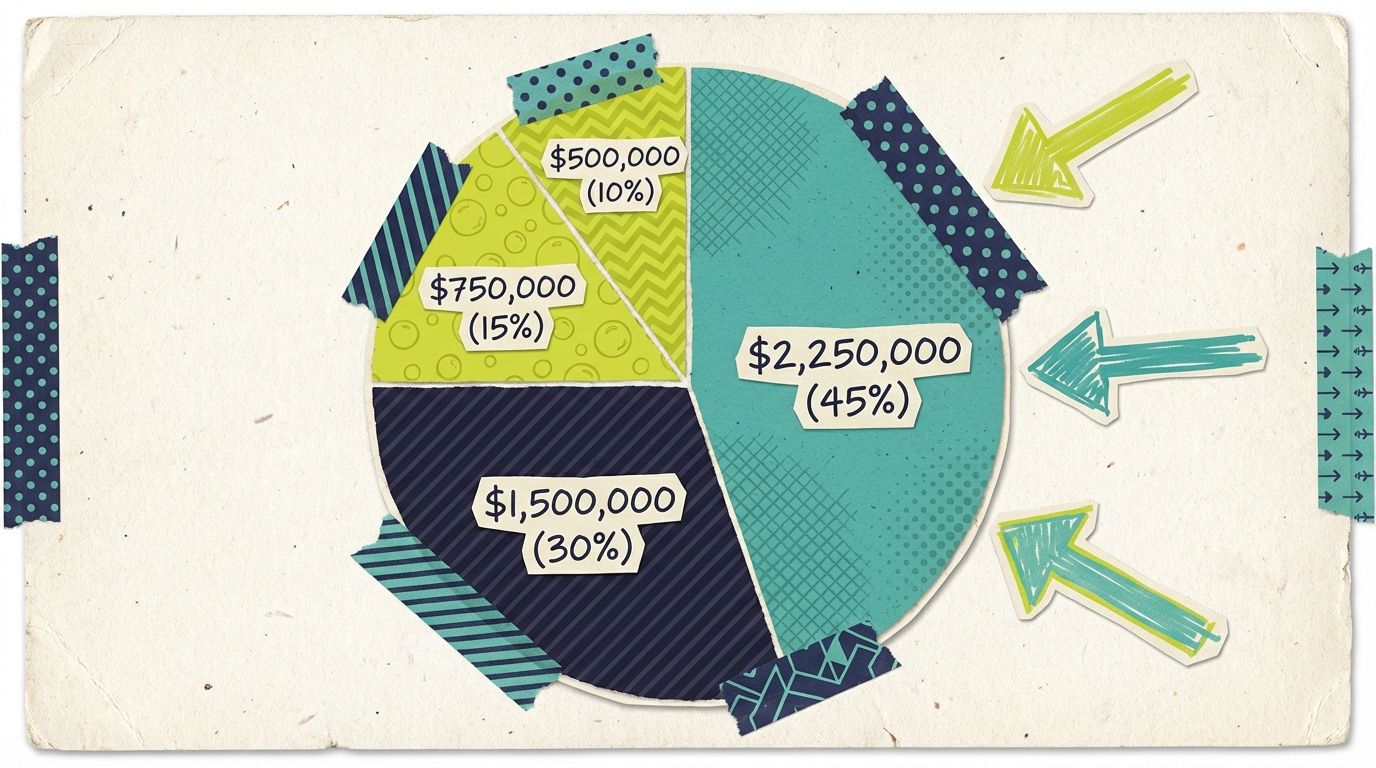
Congressional races ($500K-$2M total media budget):
Linear TV: 35-45%
Programmatic CTV: 25-35%
Digital (display, social, search): 20-30%
Radio/other: 5-10%
State legislative races ($50K-$300K total media budget):
Linear TV: 15-25% (or skip entirely in expensive markets)
Programmatic CTV: 35-50%
Digital: 25-35%
Direct mail/other: 10-15%
Local/municipal races ($10K-$75K total media budget):
Linear TV: 0% (cost-prohibitive in most markets)
Programmatic CTV: 40-55%
Digital: 30-40%
Direct mail/other: 15-20%
Ballot measures ($100K-$5M+ total media budget):
Linear TV: 30-40%
Programmatic CTV: 30-40%
Digital: 20-25%
Other: 5-10%
Why CTV Gets a Bigger Share for Smaller Races
Linear TV's minimum buy-in is too high for most down-ballot campaigns. A single week of broadcast TV in a medium market can cost $20,000-$50,000. For a state legislative race with a total media budget of $100,000, that's a non-starter.
Programmatic CTV has no such floor. You can start a targeted streaming campaign for a fraction of that cost and scale up as fundraising allows. The lowest unit rate that candidates enjoy on broadcast TV doesn't apply to streaming, but the dramatically lower entry cost more than compensates.
CPM Benchmarks for Political CTV
Political CTV CPMs typically range from $25-$45 during non-election periods and can spike to $50-$80 in competitive markets during the final weeks before Election Day. For context, general programmatic TV ad spend benchmarks run lower, but political inventory carries a premium due to demand surges.
Plan your budget with the understanding that costs will increase as November approaches. Front-loading some of your CTV spend earlier in the cycle, when CPMs are lower, stretches your dollars further.
Targeting Tactics for Every Race Type
Different races call for different targeting approaches. Here's how to think about programmatic TV targeting for the most common 2026 midterm race types.
Congressional Races
Congressional districts are where programmatic CTV shines brightest. The geographic precision lets you target voters within your exact district boundaries, something linear TV simply cannot do in most markets.
Key tactics:
Upload your voter file and match to household streaming devices
Create separate segments for persuadable, base, and new-registrant voters
Use frequency caps (3-5 exposures per week) to avoid ad fatigue
Layer in issue-based targeting for voters who care about your top issues
Geofence competitive precincts where the margin will be decided
State Legislature Races
These races are often the best use case for programmatic CTV because linear TV is almost always too expensive relative to the budget. A state House district might have 30,000-60,000 registered voters. Programmatic CTV lets you reach them precisely without paying for an entire metro area.
Key tactics:
Focus budget on CTV and digital, skip linear TV unless the market is very affordable
Target by voter file match and ZIP code overlay
Prioritize frequency over reach (a smaller electorate means you need each voter to see your ad multiple times)
Use sequential messaging: introduce the candidate first, then move to issue ads, then gotv
Local and Municipal Races
City council, school board, and mayoral races have the smallest budgets but some of the highest voter engagement potential. A $5,000-$10,000 CTV campaign can reach a meaningful share of a local electorate.
Key tactics:
Tight geographic targeting (specific ZIP codes or neighborhoods)
Higher frequency caps since the audience is small
Focus on one or two key issues that matter locally
Use Adwave to create and launch quickly without agency overhead
Ballot Measures and Issue Campaigns
Ballot measures target the entire electorate within a jurisdiction, which can range from a city to an entire state. The targeting challenge is different: you're trying to persuade a broad audience rather than turn out a partisan base.
Key tactics:
Broad geographic targeting within the jurisdiction
Issue-based audience segments (target voters who care about the specific issue)
A/B test different message frames (economic, moral, practical)
Higher creative rotation to avoid burnout on a single message
For a full breakdown of how programmatic political advertising works across these race types, see our political TV advertising guide.
Measuring What Matters: Attribution and Performance
One of the biggest advantages programmatic CTV has over traditional TV is measurability. But you need to know what to measure and what the numbers mean.
Core Metrics for Political CTV Campaigns
Completion rate: The percentage of viewers who watch your entire ad. CTV averages 95%+, and political content often runs even higher because voters are actively engaged during election season. If your completion rate drops below 90%, your creative may need work.
Reach and frequency: How many unique voters saw your ad and how many times. For persuasion campaigns, aim for 7-12 exposures per voter over the final 6 weeks. For GOTV, increase to 12-18 exposures in the final 2 weeks.
Website lift: Track visits to your campaign website during and after ad flights. A well-run CTV campaign should produce a measurable increase in direct site traffic, especially to donation and volunteer pages.
Donation correlation: While CTV ads aren't clickable, you can track donation spikes that correspond to ad flights. Set up UTM-tagged landing pages and QR codes in your creative to create a direct connection.
Voter contact rate: If you're running a combined field and media program, track whether voters who received CTV impressions are more likely to answer the door and express support. Several political data vendors now offer this cross-referencing.
What Good Performance Looks Like
For a congressional race spending $200,000-$500,000 on CTV over the final 8 weeks, you should expect to reach 60-75% of your target voter universe with an average frequency of 8-12 exposures. Website traffic should increase 30-50% during active flights, and you should see measurable movement in tracking polls among your targeted segments.
For a deeper look at tracking political ad impact, our guide on measuring political advertising ROI walks through the full framework.
Avoid Vanity Metrics
Impressions alone don't win elections. A campaign that serves 5 million impressions to a poorly targeted audience will lose to one that serves 500,000 impressions to the right 30,000 voters at the right frequency. Always evaluate your CTV performance in terms of voter reach and frequency within your target segments, not raw impression counts.
Timeline: When to Launch and Scale
Timing is everything in political advertising. Start too early and you burn through budget before voters are paying attention. Start too late and you can't build the frequency needed to move opinions.
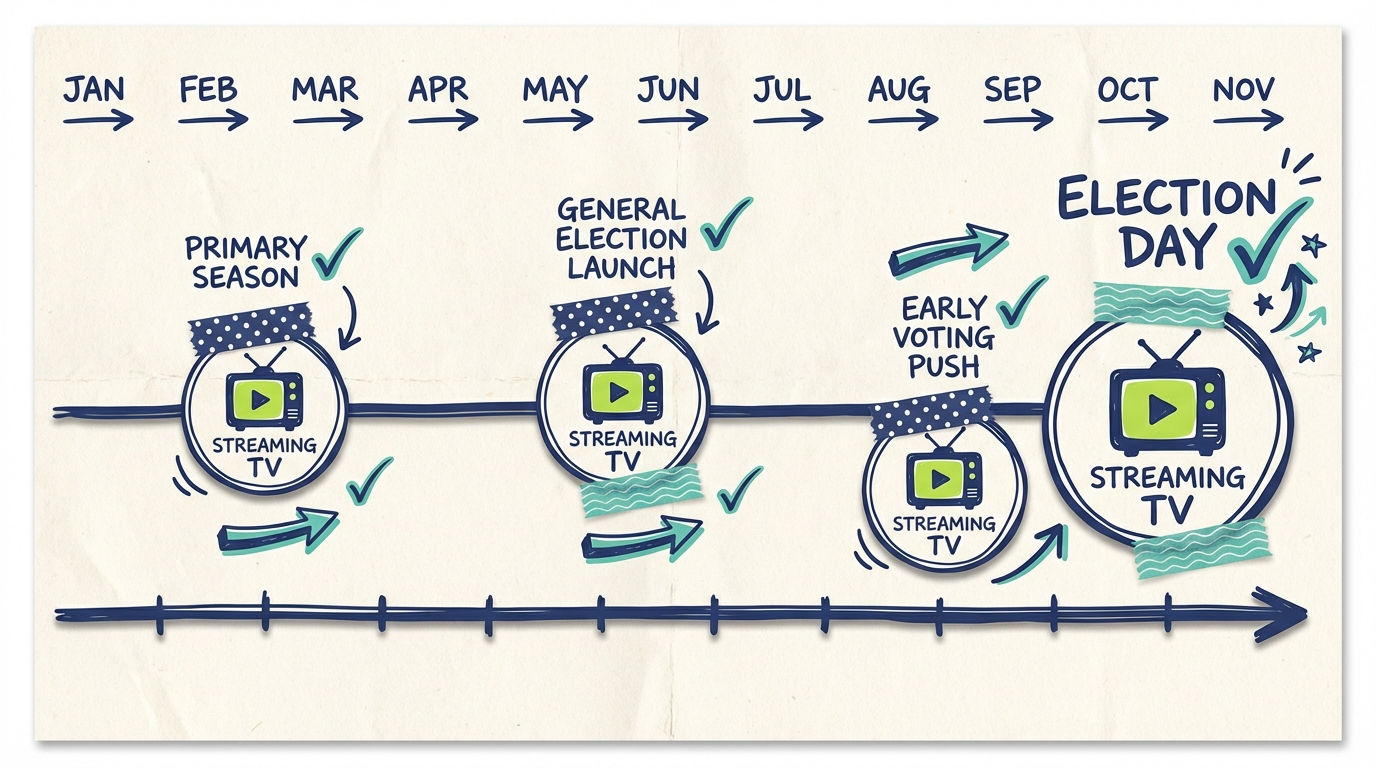
The 2026 Midterm Advertising Timeline
January-March 2026: Foundation
Build your voter file segments and onboard data
Produce initial creative (candidate introduction, issue position spots)
Run small test flights ($1,000-$5,000) to validate targeting and creative performance
Establish baseline metrics
April-June 2026: Primary Season
Increase spend for primary races (most state primaries fall in this window)
Launch candidate biography and positive issue ads
Begin building frequency with persuadable voters
Target primary voters with turnout messaging 2 weeks before each primary date
July-August 2026: Summer Build
Post-primary, retool creative for the general election opponent
Scale CTV spend to 50% of eventual peak levels
Introduce contrast messaging where appropriate
Focus on political advertising trends for 2026 that are resonating with voters
September 2026: The Ramp
This is when most campaigns shift into high gear
Increase CTV spend to 75% of peak
Rotate in fresh creative every 10-14 days to prevent ad fatigue
Begin GOTV early for absentee and early voting states
October 1-21, 2026: Full Throttle
Maximum spend levels
Heavy frequency on persuadable voters (daily exposure)
GOTV messaging to base voters
Rapid-response creative for breaking news and debate moments
October 22-November 3, 2026: Final Push
Shift budget toward GOTV almost entirely
Peak frequency: every voter in your target should see your ad daily
Pull back on persuasion and go all-in on turnout
Monitor early vote numbers and adjust targeting in real-time
Election Day: November 3, 2026
GOTV ads running until polls close
Target low-propensity voters in your base who haven't yet voted (if your data vendor provides real-time vote tracking)
Budget Pacing Rule of Thumb
For a general election CTV campaign, allocate your budget roughly as follows:
July-August: 15% of total CTV budget
September: 20%
October 1-21: 35%
October 22-Election Day: 30%
This back-loaded approach reflects the reality that voter attention peaks in the final weeks, and your dollars have the most impact when voters are actively making decisions.
Common questions answered
How much does programmatic CTV advertising cost for a political campaign?
Political CTV CPMs typically range from $25-$45 in the early months and climb to $50-$80 in competitive markets during October. For a state legislative race, you could run a meaningful CTV campaign for $10,000-$30,000 over the final two months. Congressional campaigns typically spend $100,000-$500,000 on CTV as part of a larger media mix. The beauty of programmatic buying is that there's no minimum buy-in the way there is with traditional broadcast. You can start small and scale as fundraising grows.
Do political ads on streaming TV require disclaimers?
Yes. All political ads must include a "paid for by" disclaimer identifying the sponsoring organization or campaign committee. The specific requirements vary slightly by state, but the FCC mandates disclosure for any ad that references a federal candidate. Make sure your disclaimer text is large enough to read on a TV screen and stays on screen long enough for viewers to process it, typically at least 4 seconds. PACs and issue advocacy groups have slightly different disclosure requirements than candidate committees.
Can I target voters by party affiliation on CTV?
Absolutely. Through voter data onboarding, you can match voter registration records (including party affiliation, voting history, and demographic data) to household streaming device IDs. This means you can serve different ads to registered Democrats, Republicans, and Independents in the same neighborhood. You can also layer in modeled data like issue propensity scores, donation history, and predicted turnout likelihood to create highly precise audience segments.
How does programmatic CTV compare to buying ads on linear broadcast TV?
Linear TV still offers broad reach, especially among older voters, and candidates benefit from the lowest unit rate guarantee on broadcast stations. Programmatic CTV offers precision targeting, lower minimum spend, faster turnaround, and better measurement. Most competitive campaigns in 2026 are running both, with linear handling broad awareness and CTV handling precision targeting and frequency building among key voter segments. The ideal split depends on your race type and budget, but CTV's share is growing every cycle.
What's the minimum budget for a political CTV campaign?
There's no hard minimum with programmatic buying. Technically, you could launch a CTV campaign for as little as $50 through platforms like Adwave. Practically speaking, to reach a meaningful number of voters at sufficient frequency, most political strategists recommend a minimum of $5,000-$10,000 for a local race and $25,000-$50,000 for a state legislative race over the final 6-8 weeks. The key is matching your budget to the size of your target voter universe and the frequency you need to drive action.
When should I start running political CTV ads for the 2026 midterms?
For most general election campaigns, the answer is late summer 2026. July and August are ideal for launching biographical and issue-position ads that introduce your candidate to persuadable voters. Spending too early (before June) risks burning budget when voters aren't paying attention. The exception is primary races, where you should start CTV advertising 4-6 weeks before your primary date. OpenSecrets data shows that 2026 is on track to be the most expensive midterm cycle in U.S. history, so locking in inventory early, even at lower spend levels, ensures you have access when demand peaks in October.