82% of small business employers had invested in AI tools by March 2026, and content creation was the most common use case, according to the SBE Council's small business AI report. That one figure changes the conversation. AI writing tools aren't a novelty anymore. They're part of the operating system for modern small business marketing.
That doesn't mean they write your marketing for you. It means they shorten the slow, repetitive parts of the job so you can spend more time on positioning, offers, customers, and decisions.
Most owners feel the tension immediately. They need more website copy, more emails, more social posts, more follow-up, more ad creative. AI helps with volume. But the minute you let it run unattended, quality starts to drift. Facts get fuzzy. Tone gets generic. Messaging stops sounding like your business.
The practical path isn't full automation. It's a human-in-the-loop workflow where AI handles draft work and people handle judgment.
The New Reality of Small Business Content Creation
Content used to fail in predictable ways for small businesses. The owner became the writer, editor, and approver, so publishing slowed to a crawl. Or the work got spread across whoever had a spare hour, and the result was uneven messaging, stale pages, and campaigns that never built momentum.
Now the pressure is different. A small business is expected to show up across its website, local pages, email, social posts, ads, and customer follow-up at a pace that would have required a larger team a few years ago. AI writing tools help with that production load, but only if they are set up as part of a controlled workflow.
That distinction matters.
The strongest use case is not handing your brand to a chatbot and hoping for usable copy. It is getting a first draft faster, then having a person tighten the claim, check the facts, and shape the message around what drives response. That same pattern shows up in higher-value tools too. A platform like Adwave can speed up TV ad creation, but the business still needs human review on offer strategy, compliance, and final creative choices.
Why this feels different now
Small businesses are no longer testing AI as a side experiment. They are adding it to normal operating processes. Drafting, rewriting, summarizing, headline variation, and repurposing are now routine uses, which changes the economics of content production. Consistency becomes easier to maintain because the blank page stops eating so much time.
That creates a practical advantage. A business that publishes clear, on-brand content every week will usually outperform a business that waits for perfect copy and posts once a month.
For website messaging, AI can speed up headline options, page structure, and first-pass service copy. The conversion work still happens in revision, where you sharpen the promise, add proof, and remove vague claims. If you are revisiting your site, this guide on how to write website copy that converts visitors into customers fits well alongside an AI-assisted process.
Owners comparing platforms can also review outside roundups of AI software for content pros, but tool selection matters less than process design. A mediocre tool with clear review steps will produce better marketing than a powerful tool used without oversight.
The primary constraint
AI usually produces the most likely phrasing, not the most useful business answer. That is why output can sound polished while still missing your positioning, overstating a benefit, or flattening your brand voice into generic marketing language.
The payoff comes from using AI for speed and using people for judgment. Small businesses that follow that model can cut hours from weekly content work without increasing the risk of publishing copy that is inaccurate, forgettable, or off-brand.
Understanding AI Writing Tools Without the Hype
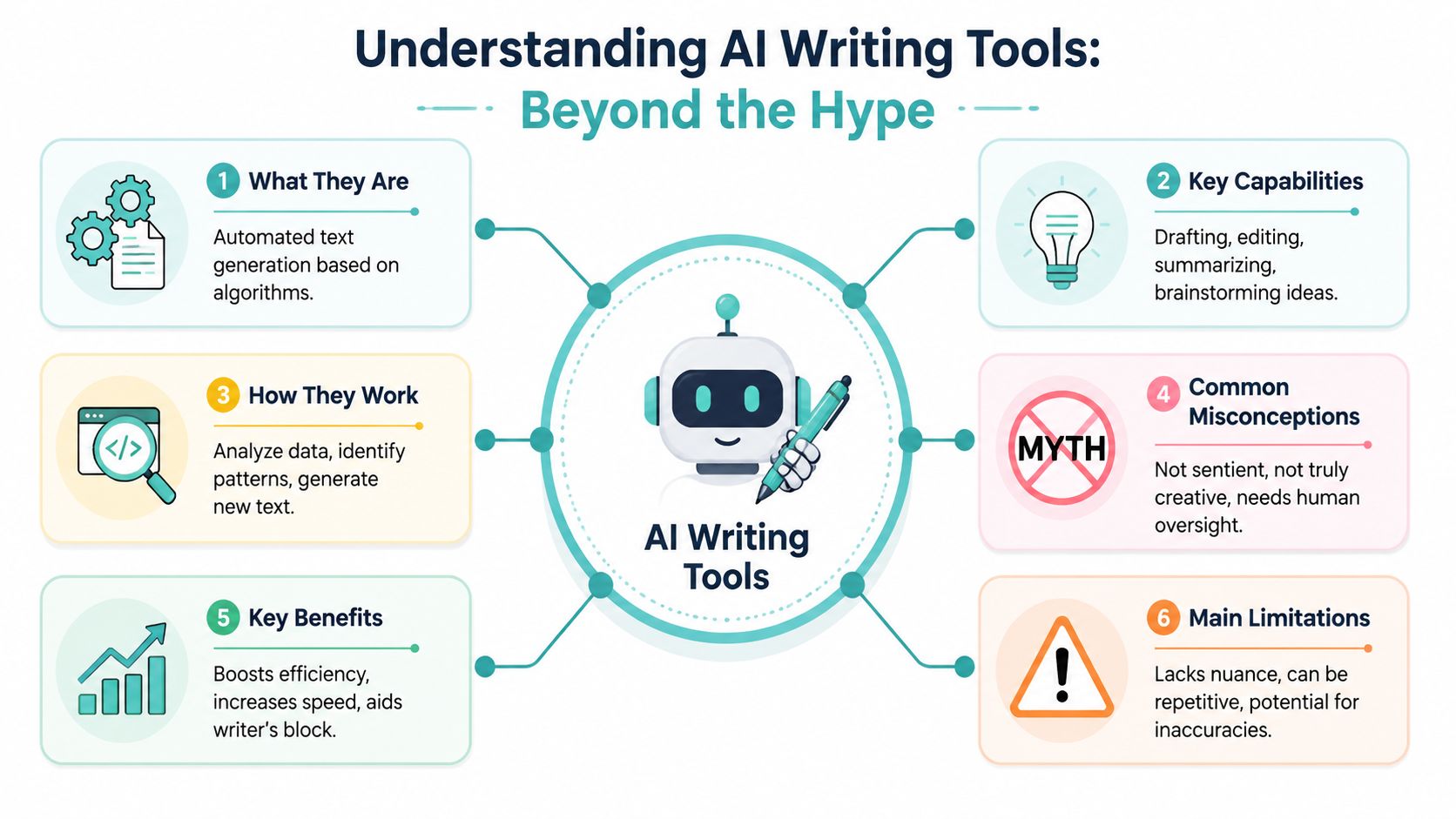
AI writing tools are prediction engines for language. They assemble likely next words from patterns in large training datasets, which is why they can produce clean copy fast and still miss a key fact, overstate a claim, or default to generic wording.
That distinction matters for small businesses. If you treat AI like a junior assistant that works quickly and needs supervision, it becomes useful. If you treat it like a strategist or subject matter expert, quality drops fast.
What They Do Well
AI performs best when the job has a clear format, enough context, and a human reviewer who knows what good looks like.
Useful examples include:
Drafting routine copy such as email openers, follow-up messages, service summaries, and social captions
Improving clarity by shortening wordy paragraphs, tightening structure, or simplifying stiff language
Summarizing material into internal notes, outlines, FAQs, or talking points
Generating options for hooks, subject lines, objections, or blog angles when the offer is already defined
That is the practical value. You get a faster first draft, more variations to choose from, and less time spent staring at a blank page.
The highest return usually comes from structured workflows, not raw text generation. A small business can use one tool for article outlines, another for cleanup, and a specialized platform for a high-stakes deliverable. Adwave is a good example on the video side. It helps turn a business message into broadcast-ready TV ad creative, but the owner or marketer still has to approve the offer, review the claims, and make sure the final spot sounds like the business behind it.
Where They Break Down
AI does not understand your business the way you do. It predicts language that sounds plausible.
That creates two common problems:
This is why I advise owners to judge AI output by risk level. If a mistake would only cost a few minutes of editing, AI is usually a strong fit. If a mistake could create legal exposure, confuse customers, or weaken a paid campaign, human review has to be tighter.
Choose an AI writing tool for a specific task, then review its output for accuracy and useful detail. Keep human review before publishing.
AI is useful for speed. Judgment still decides whether the copy should go live.
That human-in-the-loop model is what makes AI worth using in a small business. It keeps the speed, limits the downside, and creates a workflow you can trust across both everyday content and higher-value assets.
Everyday Content Wins with AI Writing
The best small business use cases aren't glamorous. They're the jobs that eat an hour here, forty minutes there, then consume a full week every month.
That's where AI writing tools earn their keep. Their strongest operational use is mechanical acceleration of writing workflows, especially repetitive work like first drafts and copy cleanup, as described in HubSpot's overview of small business AI tools for low-risk text tasks.
Social posts and short-form copy
A local service business usually doesn't need AI to invent a brand voice. It needs AI to turn one idea into multiple usable variations.
Say you have a spring promotion, a customer review, or a seasonal reminder. Instead of writing five posts from scratch, you can prompt the tool with your offer, audience, and tone, then ask for multiple hooks, caption lengths, and call-to-action options. You choose the strongest lines, edit for specificity, and publish.
That's a good fit because the work is repetitive and modular.
A simple prompt structure looks like this:
Business context: “We're a local HVAC company serving homeowners.”
Offer context: “We're promoting AC tune-ups before summer.”
Output request: “Write 8 social captions in a helpful, plainspoken tone. Avoid hype. Include one version focused on cost savings, one on comfort, and one on maintenance.”
Emails, follow-ups, and customer communication
Email is another strong use case because many small business emails follow known patterns. Appointment reminders, lead follow-ups, thank-you notes, seasonal offers, quote follow-ups, event invites, and reactivation messages all benefit from a faster first draft.
What usually works:
Lead follow-up emails after someone fills out a form
Newsletter intros that need a clear subject and opening paragraph
Sales support messages that explain next steps without sounding robotic
What usually doesn't:
Sensitive customer responses where nuance matters
Conflict resolution emails that need empathy and precision
Policy explanations that must match legal or operational reality exactly
If the message could create confusion, a refund dispute, or a trust problem, AI shouldn't send the final version.
Blog outlines and content repurposing
A blank page slows teams down more than weak first drafts. AI is helpful when you need article structures, FAQ sections, headline variants, summary bullets, or alternate angles for the same topic.
One practical workflow is to start with a strong article idea, ask AI for three outline options, then merge the useful parts into a final structure. After publishing, use the same draft to produce supporting assets like email blurbs, post snippets, short video scripts, and quote cards. Here, a repurposing system matters more than the original prompt. If you want a model for that, this guide on turning one article into 10 pieces of content fits naturally with AI-assisted production.
Product and service descriptions
Small businesses often delay website updates because writing service pages is tedious. AI helps by creating a first pass that covers features, use cases, FAQs, and structure. Then you improve it with real details.
A useful way to split the work:
The pattern across all of these is the same. AI gives you momentum. You still need to decide what should be said, what should never be promised, and what language sounds like your business.
From Idea to Broadcast An Advanced Use Case with Adwave
General AI writing tools are useful when you need more content. Specialized AI platforms matter when you need a complete production workflow around a specific outcome.
That distinction is easy to miss. A chatbot can help draft ad copy. It usually can't take a business from rough message to finished, broadcast-ready commercial without a lot of manual work in between.
Where specialized AI changes the workflow
TV advertising has traditionally been out of reach for many small businesses because the process was fragmented. You needed messaging, scriptwriting, creative production, media planning, launch coordination, and performance tracking. Even getting started could feel like an agency project.
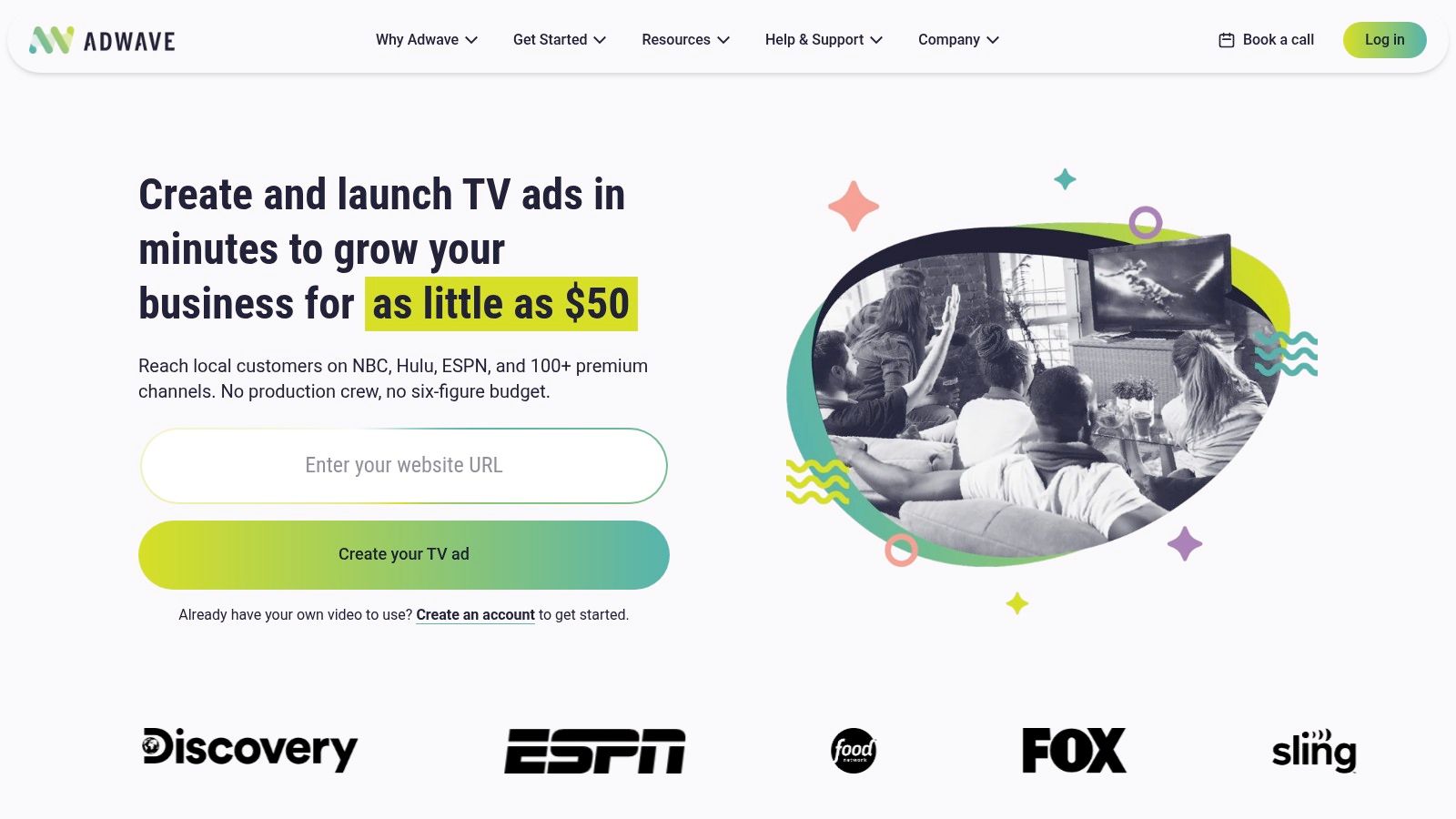
A specialized platform closes those gaps. Adwave fits this category because it uses AI to generate a broadcast-ready TV ad from business inputs such as a website URL, including script and copy generation, then moves into targeting, launch, and measurement through its AI video ad creator workflow.
Review the script, visuals, and voiceover together so they describe the same offer.
A practical example of human-in-the-loop use
For a small business owner, the smart way to use a system like this isn't to hand over brand decisions blindly. It's to let the platform build the first production draft, then review the ad the same way you'd review website or email copy.
A disciplined review process would focus on:
Core promise: Does the script highlight the offer customers care about?
Local fit: Does the message sound right for your market, audience, and service area?
Brand language: Are there words you use consistently that should be added or swapped?
Compliance and accuracy: Are there claims, timelines, or service details that need adjustment?
Specialized AI is more valuable than a general writing tool, as its output is connected to a business task with clear operational steps after the copy is generated.
A useful AI system doesn't just write words. It moves the project closer to launch.
Why this use case stands out
Small businesses don't need AI everywhere. They need it where it removes expensive friction.
A general writing tool helps with blog intros, captions, and email drafts. A specialized platform can help turn existing business information into ad creative that's ready for distribution. That's a different degree of efficiency because it compresses more of the workflow, not just the writing portion.
For owners testing new channels, this kind of setup can make a complex medium feel manageable. The business still has to review the message and decide what to run. But the path from idea to finished ad becomes much shorter and more operationally realistic.
Navigating AI Risks in Accuracy Brand Voice and Data Safety
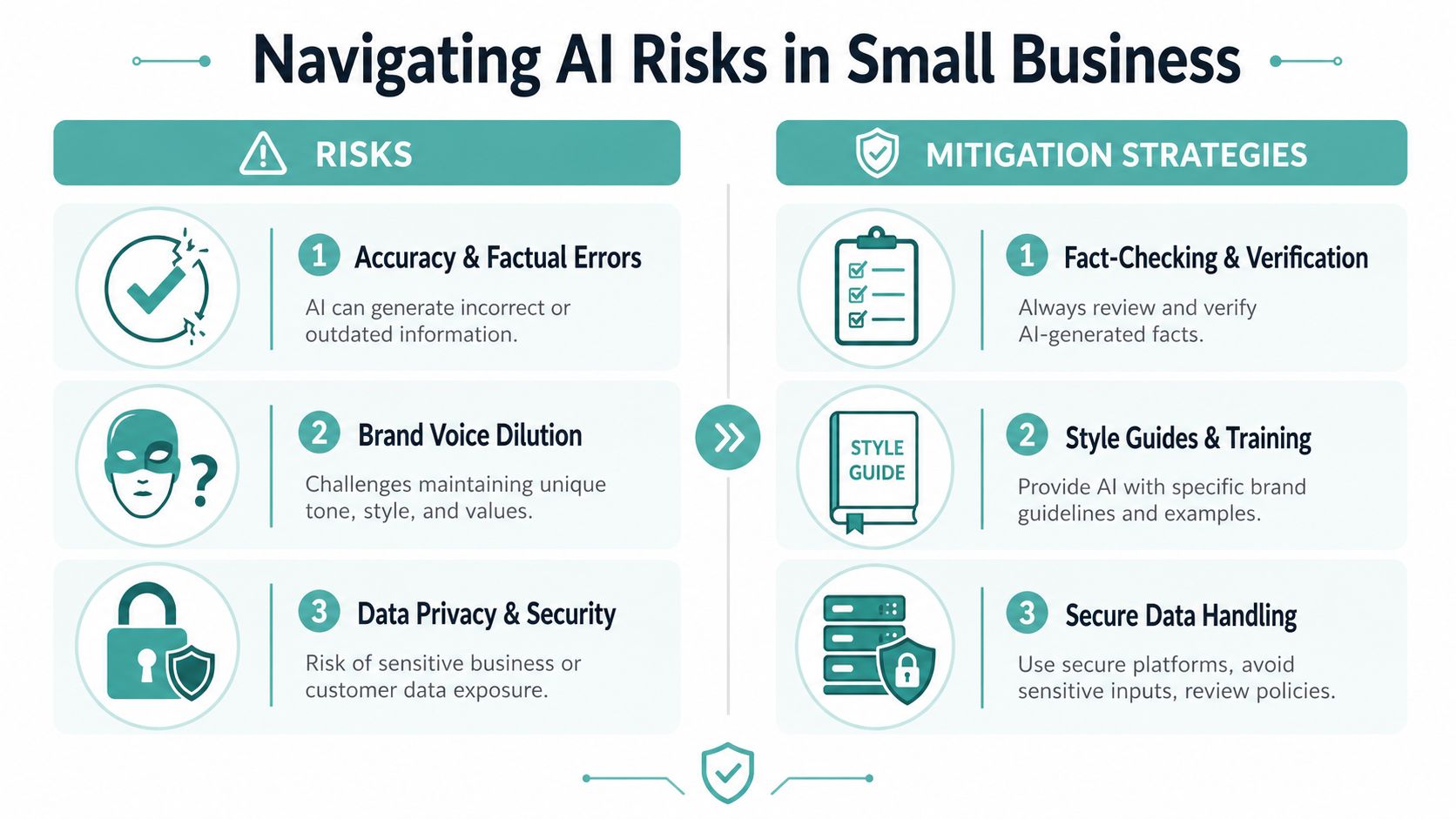
Small businesses rarely get burned by obvious AI mistakes. They get burned by copy that sounds polished, reads confidently, and is still wrong.
That risk shows up fast in client work. An AI draft can look 90 percent finished while hiding a bad service detail, an unsupported claim, or language that does not match how the business sells. If you are using AI for higher-value outputs, including ad scripts generated through a specialized platform like Adwave, that review standard has to get tighter, not looser. The more visible the asset, the more expensive the error.
Accuracy problems hide inside fluent writing
The hardest AI errors to catch are the ones that sound reasonable.
A tool might add a feature you do not offer, broaden your service area, oversimplify refund terms, or describe an old process as if it still applies. None of those mistakes looks dramatic on the page. They look finished. That is why owners publish them.
The cost is practical. Sales conversations get harder. Staff have to explain what the business “really meant.” Customers lose confidence. In regulated or sensitive categories, sloppy copy can create legal exposure as well.
Check every draft for:
Claims that were not in your source material, especially guarantees, turnaround times, pricing details, and service limitations
Statements that sound certain without proof, including broad benefits or performance promises
Summaries that remove important conditions, such as exclusions, geographic limits, or approval steps
Brand voice drifts toward generic unless someone corrects it
AI is good at producing acceptable marketing language. Acceptable is not the same as persuasive.
If your firm wins on trust, local knowledge, technical credibility, or a distinct tone, generic copy weakens your position. A med spa should not sound like a roofing company. A local attorney should not sound like a national software brand. Yet raw AI output often pulls in that direction because it averages patterns from a huge pool of public writing.
A simple test works well here. Read the draft out loud. Then ask:
Generic copy does more than sound bland. It makes the business easier to ignore.
Data safety needs rules, not good intentions
The chat interface makes AI tools feel casual. They are not casual.
I have seen teams paste customer notes, pricing logic, internal plans, and contract language into public tools because they were trying to save ten minutes on a draft. That is a poor trade. Convenience is not worth exposing private information or creating uncertainty about where that information ends up.
Set a clear boundary:
Do not paste customer-identifiable information into general-purpose AI tools
Remove sensitive details from internal documents before using them as inputs
Give staff approved prompts and source files so they are not improvising with private material
Reserve final review for a human owner, especially for website copy, sales emails, and paid advertising
The practical standard is simple. Use AI to speed up drafting. Keep humans responsible for facts, voice, and anything confidential. That balance is what makes AI useful without letting it create preventable risk.
The Human-in-the-Loop A Smart Workflow for AI Content
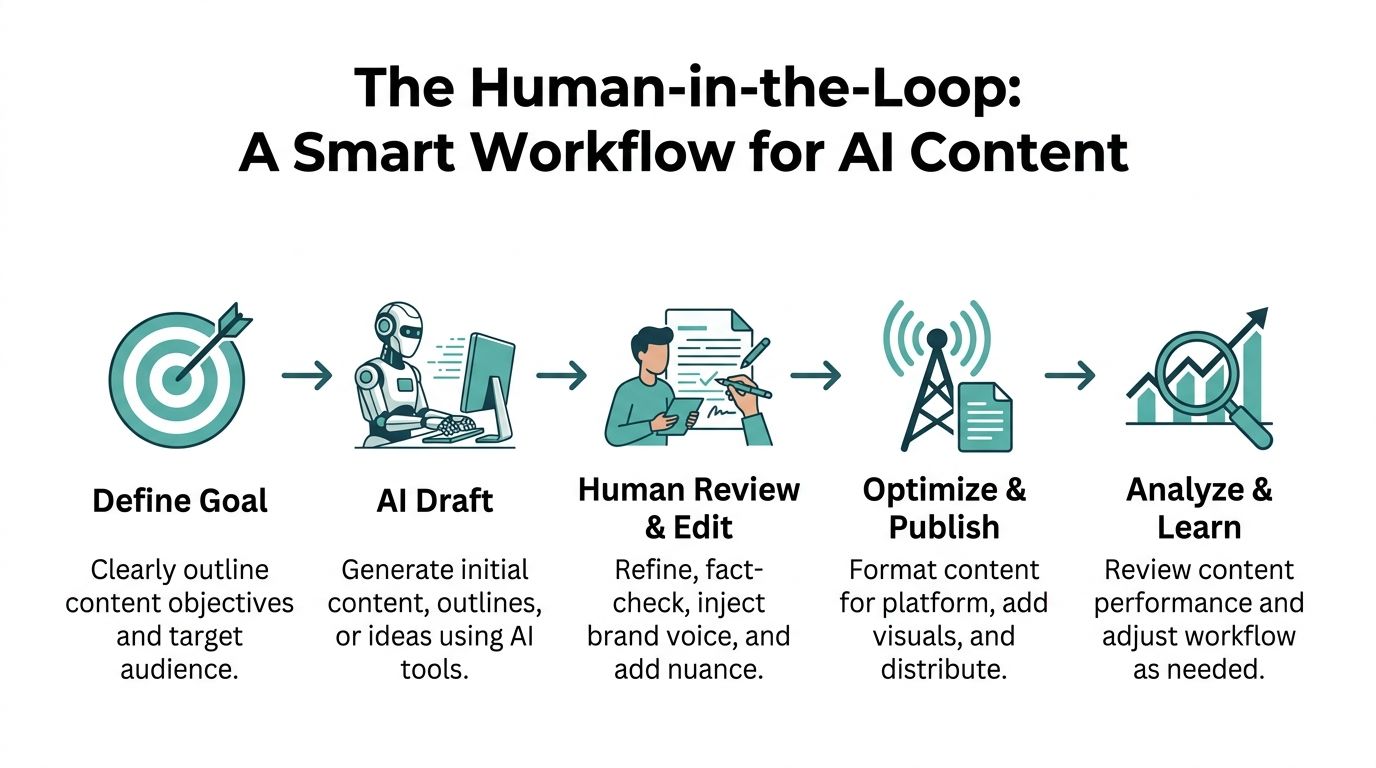
The safest AI workflow is also the most efficient one. You define the goal, let the tool do the repetitive draft work, then apply human review where it matters.
That approach keeps speed without giving up control.
Step 1 defines the job before the prompt
Weak prompts usually start with “write me a post about…” and then leave the rest to chance.
Start with business context instead. Clarify the audience, offer, objection, format, and intended action. If you skip that setup, the tool fills in the gaps with generic assumptions.
A good brief includes:
Audience: Who this is for, in plain language
Goal: What the content should make the reader think or do
Constraints: Tone, claims to avoid, word count, channel, local references
Inputs: Your offer details, existing copy, customer questions, or source material
Step 2 uses AI for a controlled first draft
Once the job is clear, ask for a first draft that matches the format you need. This can be an email, service page, ad script, landing page outline, FAQ section, or social post batch.
Don't ask for one perfect version. Ask for options. Variations help you spot better angles faster, and they reduce the temptation to publish the first thing the tool gives you.
A practical pattern:
Ask for three versions with different angles.
Pull the strongest lines from each.
Combine them into a working draft.
Step 3 is where trust gets protected
Human review is a critical step for removing invented details, tightening weak claims, and verifying whether the piece supports the offer.
Use a short review checklist:
Review standard: If you wouldn't put your name on the copy without rereading it, the draft isn't finished.
Step 4 adds the part AI can't own
Here, the copy starts sounding like a real business instead of a prompt output.
Add customer phrases you hear in sales calls. Replace abstract benefits with concrete situations. Insert local references where relevant. Tighten weak openings. Remove filler. Make the call to action sound natural.
Often this final pass is short. But it changes the quality dramatically because it restores specificity.
Step 5 closes the loop after publishing
Many teams stop too early. They publish and move on.
A stronger workflow keeps notes on what worked. Which subject line style got replies. Which post angle produced comments. Which landing page structure made the offer clearer. Those observations improve future prompts and reduce editing time over time.
The result is simple. AI handles acceleration. People handle strategy, judgment, and trust.
Your New Content Co-pilot
AI writing tools are now part of normal small business operations. The practical question isn't whether to use them. It's where they belong in your workflow.
Used well, they remove the repetitive load from drafting, editing, summarizing, and repurposing content. Used poorly, they create polished mistakes, flatten your voice, and add review headaches you didn't need.
The businesses getting real value from AI aren't treating it like autopilot. They're using it as a co-pilot. The tool gets them moving faster. The owner or team still decides what's true, what fits the brand, and what's ready for customers.
That same logic applies whether you're writing website copy, building an email sequence, or moving into more advanced formats like TV creative. General tools are useful for day-to-day production. Specialized systems help when the channel itself is complex and the workflow needs to be compressed.
If you keep the human-in-the-loop model in place, AI writing tools for small business become what they should be: practical aids, not blind delegation.
If you want to apply that workflow to video and TV advertising, Adwave offers a practical next step. It helps small businesses turn existing business information into broadcast-ready ad creative and move from concept to launch without the traditional production process getting in the way.