
You publish a blog post, share it once, and wait. A few days later, nothing happens. No rankings, no leads, no sign that Google even noticed it.
That usually isn't a writing problem. It's a planning problem.
A post ranks when it matches a real search, answers it better than competing pages, and gives both readers and search engines a page that's easy to understand. That's the practical version of how to write a blog post that ranks on Google. It isn't luck, and it isn't just keywords. It's a system.
From Blank Page to Page One
A small business runs a TV spot, sends an email, or sponsors a local event. People remember the brand, then search for answers before they buy. If your site has no page for that moment, the demand you paid to create gets picked up by directories, competitors, or review sites instead.
That is why blog ranking belongs inside brand strategy, not off to the side as a content chore. A strong post can meet branded and non-branded searches, reinforce the message people saw somewhere else, and give them a useful next step on your site.
Good blog SEO starts before anyone writes a headline. The primary focus is choosing a topic that lines up with buyer intent, your offer, and the level of trust a reader needs before contacting you. Ranking comes from a series of decisions that fit together.
A useful post usually does three jobs at once:
It captures demand when someone searches for a problem, comparison, or next step.
It builds trust because the page shows real expertise instead of generic recycled advice.
It supports conversion by moving readers from curiosity to confidence.
This is also where many small business blogs lose value. The article may rank, but the site around it does not carry the same message or level of clarity. If your service pages are vague, even strong traffic can stall out. That is why blog strategy works better when it connects to the rest of your messaging, including website copy that converts visitors into customers.
Practical rule: Ask, "What does a customer search right before they trust us?"
The businesses that earn steady SEO results treat each post like a business asset. They pick the query carefully, shape the page around intent, publish it in a clean format, and update it after real performance data comes in.
That approach is less exciting than chasing shortcuts. It produces better traffic, stronger trust, and more chances to turn attention from other channels into customers.
Find What Your Customers Are Searching For
Keyword research sounds technical, but for a small business it's really a market listening exercise. You're trying to find the overlap between what people want, what your business can help with, and what your site can realistically rank for.
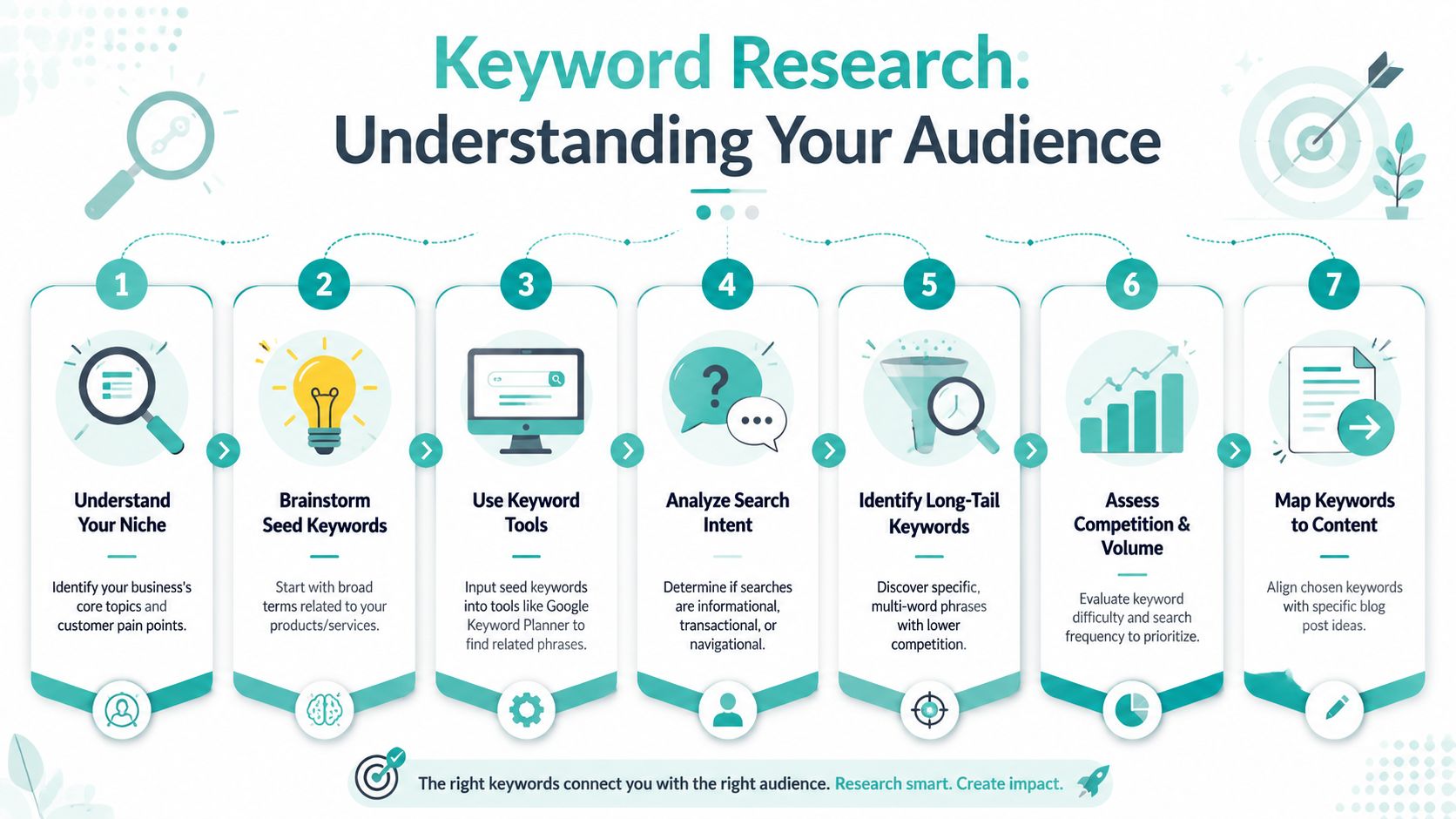
Start with problems, not keywords
A local HVAC company might want to rank for "air conditioning." That's too broad for most small sites. A better topic is often something closer to the moment a customer needs help, such as a how-to question, a troubleshooting query, or a service comparison.
The strongest early blog topics usually come from:
Sales calls and emails where customers repeat the same question
Google search suggestions that appear when you type your main service
Competitor pages that already rank for specific subtopics
Commercial friction points such as pricing, timing, repairs, warranties, or local availability
Many businesses get stuck at this stage. Guidance often covers keyword research and competitor analysis, but topic prioritization by business value versus ranking difficulty is the key gap. For a small business with limited publishing capacity, the bottleneck is often choosing which topics are worth writing at all, and deciding whether a query is too crowded, too broad, or too commercially weak ( Marketing Illumination on topic selection).
Separate informational and commercial intent
Informational content can introduce your business to people researching a purchase.
A simple way to think about intent:
Informational intent The person wants to learn. Example: how to stop basement moisture after heavy rain.
Commercial intent The person is comparing options. Example: basement waterproofing company vs general contractor.
Transactional intent The person is close to action. Example: basement waterproofing service near me.
If you only write bottom-of-funnel pages, you'll miss people earlier in the decision cycle. If you only write educational posts, you'll build traffic without enough buying intent. A healthy blog usually needs both.
Judge a topic by business value
A post isn't valuable just because people search for it. It has to move the business forward.
Use a simple filter before approving any topic:
Audience clarity helps here. If your offer serves different buyer types, content planning gets easier when you first define those groups through audience segmentation.
A good keyword for a small business isn't the biggest term. It's the term that brings the right visitor and gives your site a fair chance to compete.
Use the search results as your briefing document
Before writing, search the phrase yourself. Look closely at what Google already rewards.
Check for:
Page type. Are the top results blog posts, service pages, product pages, or videos?
Angle. Are they beginner guides, comparisons, local pages, or expert explainers?
Gaps. Are the current results shallow, outdated, hard to read, or missing practical detail?
SERP features. People Also Ask questions can reveal subtopics worth covering.
If every top result comes from major publishers and national brands, move narrower. Add a local modifier, target a sub-question, or choose a more specific use case. That's often how smaller sites find openings.
Crafting Content Google and Humans Love
A reader clicks your post because something else already created demand. Maybe they saw your van in town, heard your radio spot, watched your TV ad, or got a referral and searched your business plus a question. If the article is thin, slow to answer, or hard to scan, that interest leaks away. If the post is clear and useful, your blog does more than rank. It captures demand your other marketing already paid to create and turns attention into trust.
One practical SEO workflow recommends building a keyword set, using primary and secondary phrases, incorporating related terms into the H1, H2, and H3 structure, and checking scannability and internal links before publishing (
). The reason this works is simple. Structure helps search engines interpret the page, and it helps real visitors get the answer without friction.Build the page before you write the prose
Start with the outline. The outline decides whether the post will satisfy intent or wander.
A useful draft structure usually includes:
A clear answer near the top so the visitor knows they landed on the right page
Subheadings built around the next logical questions a customer would ask
Specific examples, steps, or proof that make the advice usable
A relevant next step tied to a service page, contact path, or supporting resource
Weak posts usually have weak headings. A heading like "Helpful Tips" says nothing. A heading like "How Long Should a Title Tag Be for a Local Service Page?" tells both Google and the reader exactly what the section covers.
This also sharpens your brand positioning. Clear structure signals that your business understands the problem well enough to explain it clearly.
Write for scanning behavior
Visitors usually scan first. They look at the headline, subheads, first sentences, bullets, images, and any text that stands out. If those elements are vague, the page feels harder to use, even if the writing is technically good.
That changes how strong blog posts are written.
Use short paragraphs. Write subheadings that describe the topic plainly. Choose plain language over insider phrasing. Use bullets or tables when the reader needs to compare options, steps, or mistakes.
A quick test helps. Read only the headings and the first sentence under each one. If the page still tells a coherent story, the structure is working.
Handle on-page SEO without making the copy awkward
Good on-page SEO makes the topic obvious without turning the article into a checklist of repeated phrases.
Published guidance from Yoast recommends titles around 55 to 60 characters, clear headings, and content shaped around the questions readers ask ( Yoast on SEO-friendly blog posts). In practice, that means every page element should reduce ambiguity. The title should match the query. The URL should be short and readable. The intro should answer the main question early. Internal links should help the reader continue, not distract them.
Use this review before publishing:
One internal link many small businesses miss is credibility support. A post that gives advice should often connect to a page that proves there is a real business behind it, such as an About page that builds trust.
Add original value or the post blends in
Search results are full of articles that say roughly the same thing. Rewritten summaries rarely win for long, especially in competitive niches.
Original value usually comes from one of four places:
Experience from real customer work
A clearer process than competing articles
Stronger examples that remove confusion
A point of view shaped by actual business results
For a small business, blogging supports brand building instead of becoming a low-value SEO exercise. Your article should sound like it came from a company that does the work, sees the objections, and knows what happens after someone follows the advice. That kind of content earns more than rankings. It helps the visitor trust the brand they already encountered somewhere else.
If you bring in outside help, vet them carefully. A provider who only promises keyword placement will usually produce generic pages. This guide on choosing a trustworthy SEO partner is a useful filter before you outsource content strategy.
Build Trust with E-E-A-T and Great User Experience
A prospect sees your TV ad, remembers your name later, and searches for the question they were already thinking about. If your blog post shows up, that click is not just an SEO win. It is a brand credibility test.

Show who is behind the advice
Google wants signals that the content comes from a real business with real experience. Readers want the same thing, especially in categories where bad advice carries real cost.
Trust signals that help both include:
Author bios that explain relevant hands-on experience
Clear business details such as location, contact information, and service area
About and service pages that show the company performs the work
Examples from real client situations that a generic writer would not know to include
A strong About page that builds trust supports more than one article. It helps connect your blog, your services, and your reputation into one believable business presence.
That matters even more for small businesses running multiple channels. Brand marketing creates demand. Search content catches it. If someone heard about you on a podcast, mailer, local sponsorship, or TV spot, your article has to confirm that your business is credible enough to contact.
Add proof and perspective that generic content cannot copy
E-E-A-T is not a writing style. It is evidence.
Strong blog posts show experience in ways visitors can recognize fast. They explain what usually goes wrong, what customers misunderstand before they call, what the right choice depends on, and where common online advice leaves out context. That is the difference between content that ranks for a while and content that also earns trust.
A few examples:
A roofer explains the symptoms homeowners confuse with normal attic moisture
A family law firm points out where broad legal advice breaks down by case type
A retailer shows which product choice creates buyer regret and why
A local accountant explains which records clients forget to bring and how that delays filing
I have seen this make a clear difference in lead quality. Posts built from real sales calls and service conversations tend to attract better-fit inquiries because they answer the practical questions buyers ask before they are ready to reach out.
User experience affects credibility
Useful advice can still lose if the page feels frustrating. Visitors notice that faster than many site owners do.
A trustworthy page usually does four things well:
Loads fast enough on mobile Slow pages lose attention before the reader reaches the main point.
Makes scanning easy Clear subheads, readable paragraphs, bullets, and images help people find the answer they came for.
Shows an obvious next step That might be a related article, a service page, or a contact option that fits the topic.
Removes credibility leaks Broken links, outdated screenshots, thin author details, and aggressive popups make the business feel less reliable.
Good user experience supports rankings because it supports confidence. For a small business, that confidence carries beyond one post. It helps turn search traffic, branded searches, and demand generated by other channels into real inquiries.
Promote Your Post Beyond Hitting Publish
Publishing is the handoff point, not the finish line. If nobody sees the article, Google gets fewer signals that the page is useful, and the business gets no return from the work.
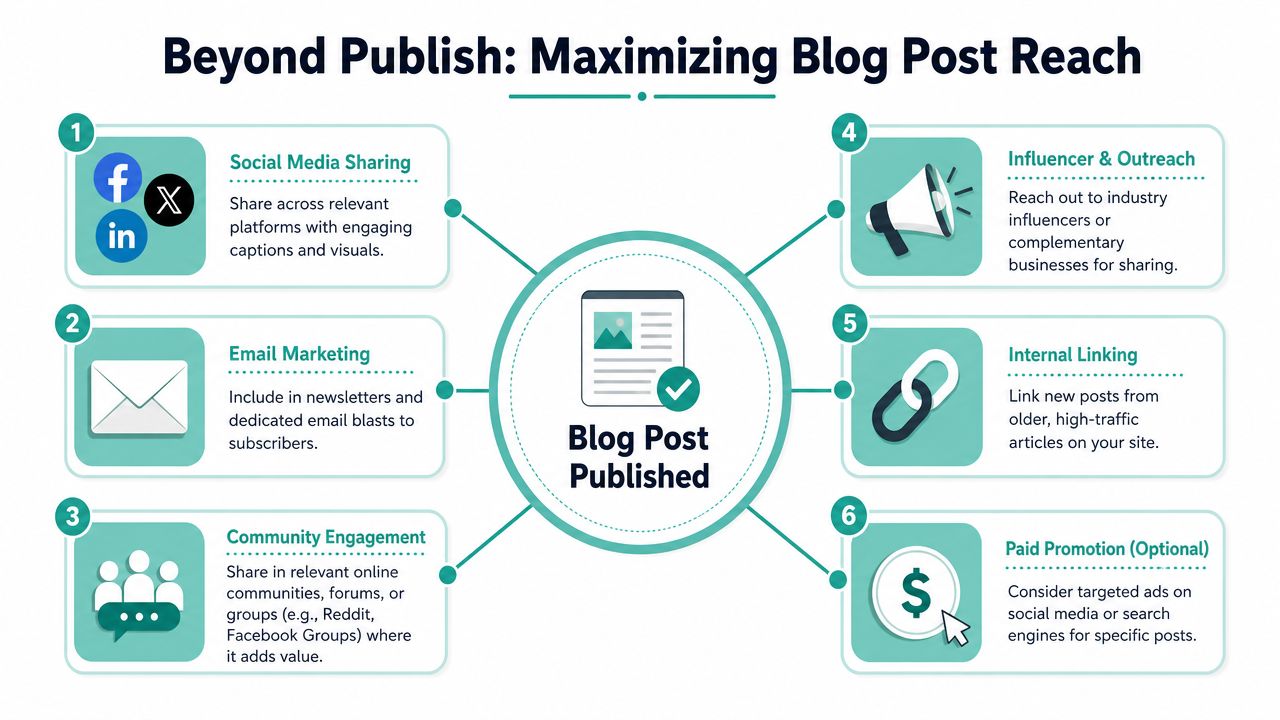
Start with channels you already own
The first push should come from assets you control. That's usually the fastest way to get the right people onto the page.
Good post-publish moves include:
Emailing your list with a strong subject line and a plain reason to click
Sharing on social platforms where your audience already follows the business
Linking from older pages on your site that already get traffic
Sending it to sales or customer service teams so they can use it in conversations
If your email list is still small, steady list growth makes content promotion easier over time. Adwave has a practical guide on how to build an email list from zero without buying lists.
Publish material other sites have a reason to reference
Backlinks still matter, but most small businesses approach them the wrong way. They send generic outreach asking for a link to a post that doesn't offer anything distinct.
A better approach is to publish something that deserves citation, then put it in front of relevant people:
A local guide that fills a gap in your market
A practical explainer that answers a recurring question clearly
A comparison post that helps buyers evaluate options
An original visual or checklist other sites may reference
Promotion works better when the content has a specific angle and obvious utility.
Connect content to brand-building channels
Blog SEO offers benefits beyond organic traffic generation. A blog doesn't just create demand. It also captures demand generated elsewhere.
If a small business runs local TV, paid social, direct mail, sponsorships, or community campaigns, people often respond by searching the brand, the service, or the problem later. A useful article can meet that search at exactly the right moment.
One example is Adwave, an AI-powered TV advertising platform that lets small businesses create, launch, and measure broadcast-ready ads across premium channels with an efficient workflow and real-time performance tracking. In practice, that means a business can run brand awareness campaigns, then use search-optimized blog content to capture the interest those campaigns create when viewers turn to Google.
A blog post is often the bridge between awareness and action. Someone sees the brand elsewhere, searches later, and your content either validates the business or leaves the door open for a competitor.
That connection matters for small businesses because channels shouldn't operate in isolation. Brand marketing lifts search behavior. Search content converts that attention into site visits, trust, and leads.
Measure and Improve Your Blog Post Performance
A post goes live. Then the real work starts.
Publishing gives you a URL. Measurement tells you whether that URL is pulling its weight for the business.
For small businesses, this matters more than many owners expect. A blog post can pick up searches from people who first heard about the company through TV, paid social, direct mail, or local sponsorships. If those people search later and land on a weak page, the brand spend did its job but the website failed to finish the job. Good measurement helps fix that gap.
Watch the right signals
Google Search Console is usually the first place to look. Skip vanity metrics and pay attention to patterns that lead to action.
Focus on signals like these:
Impressions are rising, but clicks stay low The topic has search demand, but the title tag or meta description is not earning the click. Sometimes the post also misses the real intent behind the query.
Clicks come from queries you did not target Google may be reading the page differently than you planned. That is often useful. In practice, it can reveal a better customer angle than the one you started with.
The page sits near the bottom of page one or on page two These posts are often the best update candidates because they are already close. A clearer introduction, tighter subheadings, better internal link support, or stronger examples can move them up.
Traffic arrives, but the page does not contribute to leads or next-step clicks Ranking alone is not the goal. If a post brings visitors but does not build trust, grow the email list, or move readers toward a service page, it needs a stronger business role.
Improve the page you have before creating another one
A common mistake is writing a second post on the same topic too soon. That usually splits relevance and creates avoidable overlap.
Start with the existing page.
Useful updates often include:
Rewriting the title and opening so the post answers the search intent faster
Adding missing subtopics based on real query data in Search Console
Strengthening internal context so the post connects better to related service or category pages
Refreshing examples, screenshots, or visuals so the page feels current and credible
Improving the call to action if the post gets traffic but does not help readers take the next step
Experience is paramount. Sometimes a post needs more depth. Sometimes it needs less. I have seen pages improve after cutting long introductions and getting to the answer in the first few lines.
Treat content like an ongoing marketing asset
Strong posts are not one-and-done pieces. They are assets that can support demand capture across channels.
If a business runs awareness campaigns through platforms like Adwave, search behavior often follows later. People see the brand, remember the problem, then look for answers on Google. The blog post that ranks for that search does more than collect a visit. It validates the brand, supports trust, and gives that earlier campaign a better chance to produce a lead.
That is why performance review should include both SEO signals and business outcomes. Some posts earn visibility and build authority. Some assist conversions. Some need stronger alignment with the offers the business sells. The job is not to publish more pages. The job is to improve the pages that can turn attention into trust and trust into action.


