-
4.2%
Prime Video's share of U.S. TV viewing, the #3 streaming service (April 2026)
-
315M
Prime Video's global monthly ad-supported reach (Amazon, 2025)
-
$50
Minimum to start advertising on connected TV with Adwave
Amazon Prime Video accounted for 4.2% of all U.S. TV viewing in April 2026, according to Nielsen's The Gauge, making it the third most-watched individual streaming service behind YouTube and Netflix. That's up about 0.7 points from a year earlier, one of the faster gains among the major streamers, driven largely by a landmark move: the NBA came to Prime Video.
For a small business, Prime Video is one of the most important names in connected TV advertising, and not just because of its viewing share. When Amazon made ads the default for all Prime Video subscribers, it instantly created one of the largest premium ad audiences in streaming, now more than 315 million viewers globally. Layer on Amazon's unmatched shopping data, and Prime Video became a place where advertisers can target by what people buy. Let's break down Prime Video's Q2 2026 share, its explosive ad growth, and what it means for reaching customers.
What the data shows
Nielsen's The Gauge measures how Americans split their TV time, and unlike Disney's bundled streaming apps, Prime Video gets its own line. In the April 2026 report, released June 25, 2026, Prime Video held 4.2% of total TV viewing.
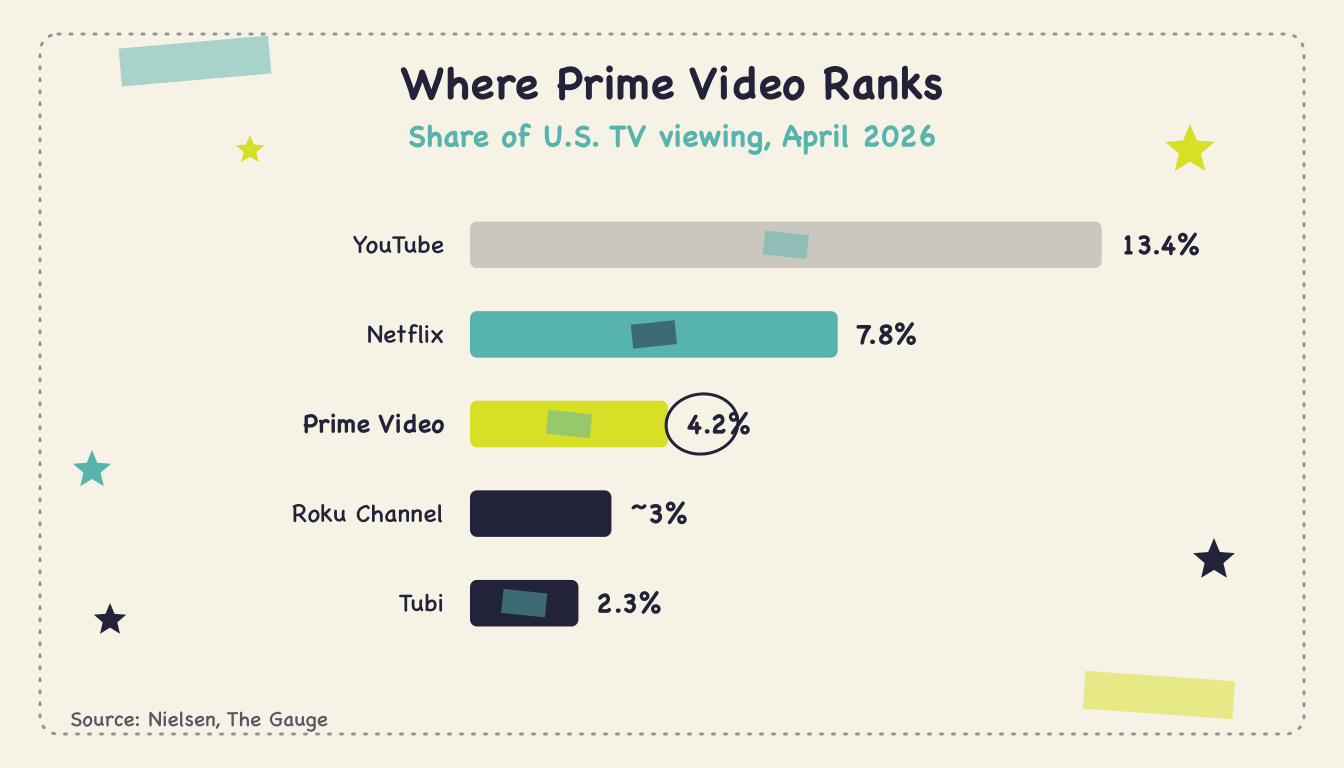
Here's where Prime Video sits among the top streaming services in April 2026:
YouTube: 13.4% (the leader)
Netflix: 7.8%
Amazon Prime Video: 4.2% (third place)
For context, total streaming reached a record 47.6%
Prime Video's 4.2% came with real momentum. Year over year, it gained about 0.7 points, one of the biggest jumps among major streamers, outpacing Netflix's 0.3-point gain and trailing only YouTube's roughly full-point rise. That growth wasn't an accident. April's viewing was lifted by 22 NBA games, the Play-In tournament and the start of the playoffs, plus the premiere of the final season of The Boys. Live sports, in particular, is reshaping Prime Video's audience.
That 4.2% sits inside a streaming category that hit a record 47.6% of TV viewing in April 2026, part of the broader shift we track in our most-watched streaming service rankings. Prime Video is now firmly one of the big three streaming platforms in America.
How Nielsen measures this, and why April is the latest number
Prime Video's 4.2% comes from Nielsen's national panel, the same measurement behind its TV ratings, tracking actual viewing on TV sets. Prime Video is reported as its own streaming service, so unlike Disney's combined bucket, this is a clean, standalone figure.
A couple of points help you read it correctly:
April 2026 is the latest confirmed month. Nielsen delayed its March Gauge amid a methodology dispute, and a recalibrated version is expected in the fall. Every figure here reflects data through April 2026.
The fall recalibration may shift streaming shares. Nielsen's coming methodology change is expected to lift broadcast and cable slightly and trim streaming, so Prime Video's reported share could dip a touch when the new numbers land, even without a real change in viewing.
Sports drives the monthly swings. Prime Video's share rises with its live-sports schedule, so expect it to move with the NBA and NFL calendars rather than hold perfectly flat.
The headline holds: Prime Video is the number-three streaming service and one of the fastest-growing, powered increasingly by live sports.
Breaking down the numbers
Prime Video's rise is really two stories: a viewing story and an advertising story. The viewing story is increasingly about sports.
The sports numbers are striking:
NBA on Prime Video: in its first season, 2025-26, NBA games on Prime averaged around 1 million viewers, and on comparable schedule windows matched what traditional networks drew, with a median viewer age nearly a decade younger than linear TV.
Thursday Night Football: the 2025 NFL season on Prime averaged 15.33 million viewers, up 16% year over year, the most-watched Thursday Night Football season in its two-decade history.
Younger audiences: both the NBA and NFL audiences on Prime skew significantly younger than their linear-TV counterparts, exactly the viewers advertisers pay a premium to reach.
Live sports matters enormously for advertisers because it's watched live, in full, with ads that can't be skipped. When Prime Video adds marquee sports, it adds the most valuable ad inventory in television. Our live sports share of TV viewing page explains why that inventory commands premium attention.
The strategic significance of the NBA move is hard to overstate. For decades, live sports was the last thing keeping many viewers tethered to cable and broadcast, the one category streaming couldn't fully claim. By landing NBA rights and growing Thursday Night Football into its most-watched version ever, Amazon pulled a chunk of that final holdout onto streaming. Every sports fan who now watches a game on Prime Video instead of cable is one more piece of the traditional-TV audience migrating to connected TV, and one more set of premium, unskippable ad impressions moving to a platform built for digital targeting. Sports didn't just lift Prime Video's April share, it accelerated the whole industry's shift.
Why it matters for your business
In January 2024, Amazon did something no other premium streamer had dared: it made ads the default for every Prime Video subscriber, with ad-free as a paid upgrade. Overnight, Prime Video went from an ad-free service to one of the largest ad-supported audiences in streaming.
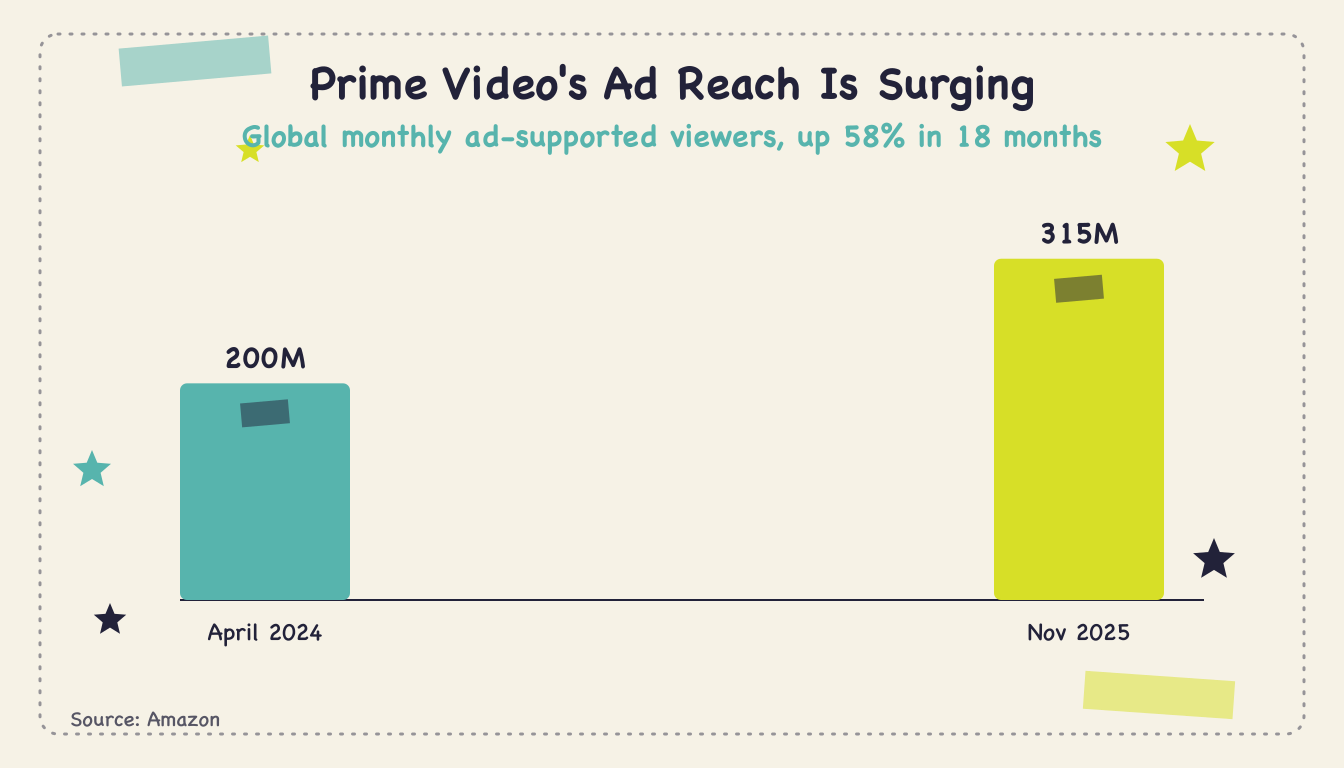
The scale is enormous. Prime Video's global monthly ad-supported reach hit 315 million viewers as of late 2025, up 58% from 200 million a year and a half earlier, including well over 115 million in the U.S. alone. Here's why that matters for a local advertiser:
Instant, massive reach. By making ads the default, Amazon created ad scale that took other services years to build. Prime Video is now one of the biggest single ad audiences in connected TV.
Shopping-data targeting. Amazon's unique advantage is its first-party retail data. It can target viewers by what they shop for and buy, and measure whether an ad drove a purchase, something no other CTV platform matches. Our ad-supported streaming viewers page tracks how this audience grew.
The barrier came down. At its 2025 upfront, Amazon removed the old high minimum on its self-serve ad platform, opening Prime Video and Fire TV inventory to far smaller advertisers than before.
Now the practical part. A small business can technically access Amazon's ad inventory through its self-serve tools, but running Prime Video campaigns effectively still favors advertisers with meaningful monthly budgets and the expertise to manage a demand-side platform. What changed for the smallest advertisers is broader: Prime Video's default-ads move proved that even the most premium streaming audiences accept advertising at scale, which is the foundation of affordable connected TV advertising across the whole ecosystem.
The Amazon advantage: shopping data meets streaming
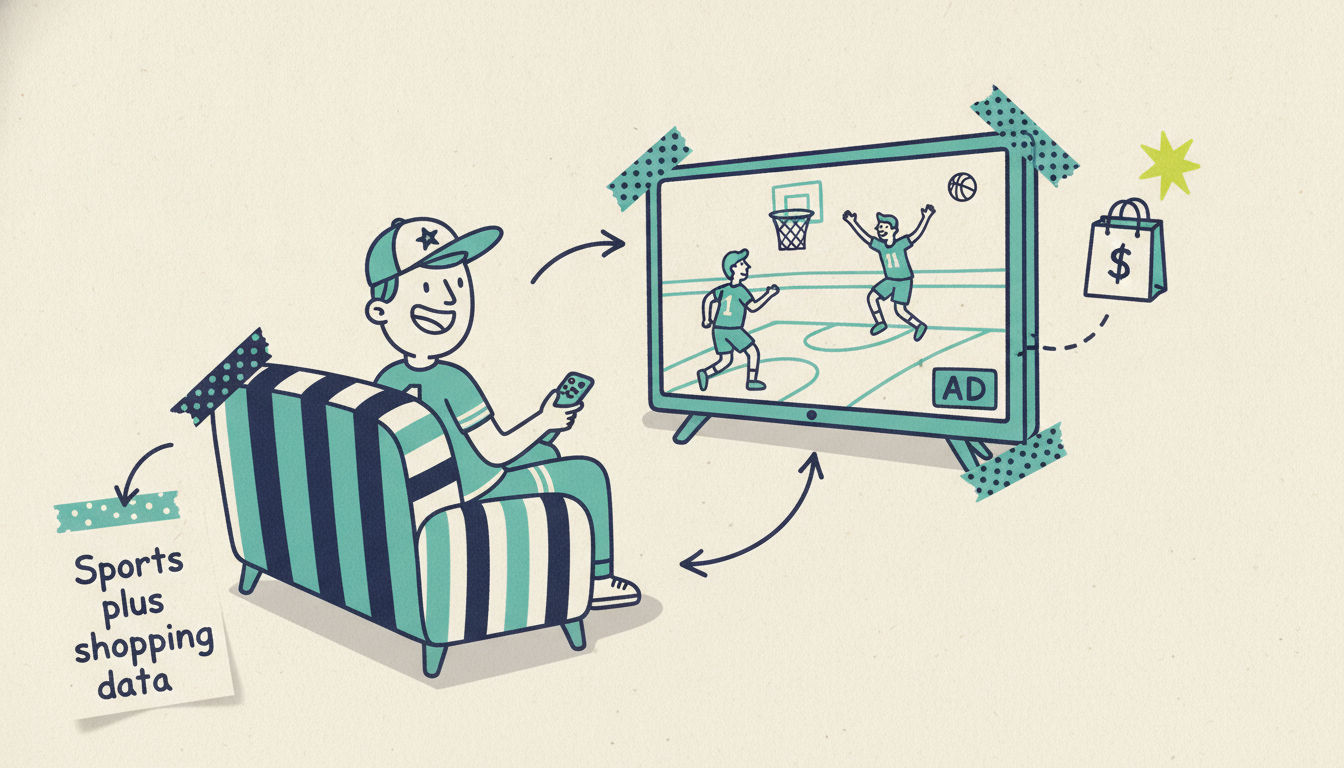
What sets Prime Video apart from every other streaming service isn't its viewing share or even its sports, it's what Amazon knows about its viewers. No other platform combines premium streaming with a detailed record of what people buy.
That combination gives Amazon capabilities the rest of the industry is still chasing:
Purchase-based targeting. Amazon can show ads to viewers based on their real shopping behavior, not just inferred interests. If someone browses or buys in a category, an advertiser in that category can reach them on the TV screen.
Closed-loop attribution. Because Amazon sees both the ad and the eventual purchase, it can measure whether a streaming ad drove a sale, the holy grail of advertising measurement that TV historically couldn't offer.
A household graph at scale. Amazon has described an authenticated view covering the large majority of U.S. households, linking streaming, shopping, and devices into a single picture.
For a small business, this is both impressive and a reminder of why the broader connected TV ecosystem matters. You may never build a campaign on Amazon's shopping data directly, but the capability it introduced raised the bar for the entire industry, pushing every CTV platform toward better targeting and measurement. The result is that connected TV as a whole, including the accessible platforms a local business uses, got smarter and more accountable. Amazon's innovation lifts the floor for everyone advertising on the big screen, even the smallest advertisers reaching viewers through simpler tools.
How to take advantage
Prime Video is a giant, but you don't need to master Amazon's ad platform to benefit from the shift it represents. The same premium, ad-supported living-room audience Prime Video helped normalize is reachable across the connected TV ecosystem at a local-business budget. Here's how to think about it.
Reach the audience across services. Prime Video viewers also watch YouTube, Tubi, Roku channels, and more. Running across the whole ecosystem builds the frequency any single platform can't, without needing to manage a complex demand-side platform.
Match your service area. Set a geographic radius, usually 15 to 25 miles, so every impression reaches a potential customer nearby.
Budget for repetition. Plan enough spend to reach the same households several times over two to three weeks. On connected TV, meaningful frequency costs hundreds of dollars, not thousands.
Let AI make the ad. You don't need a studio. AI tools turn your existing website into a broadcast-quality 30-second ad in about two minutes.
Measure brand lift. Track branded search, direct traffic, and calls during and after a campaign rather than chasing clicks.
The mechanics are simple. With Adwave, ad creation is free, a campaign starts at a $50 minimum, and you can be live across 100+ premium streaming channels in under 10 minutes. You point it at your website, it builds the spot, and you're reaching the premium living-room audience that Prime Video's ad model helped make mainstream, without the budget or complexity a direct Amazon buy requires. For what that budget buys, our guide to the average CTV CPM lays out the costs.
The bigger picture
Prime Video's 4.2% viewing share and 315-million ad reach reflect a company that turned streaming into an advertising powerhouse, and it did so faster than almost anyone expected.
A few forces give the Q2 2026 numbers their weight:
Amazon's ad business is colossal. Amazon's advertising revenue reached $17.24 billion in the first quarter of 2026, up 24% year over year, with trailing-twelve-month ad revenue passing $70 billion. Prime Video is a growing engine of that machine, and its scale funds ever-better ad tech and content.
Sports is the growth driver. The NBA and NFL on Prime Video brought younger, engaged, live audiences and the premium ad inventory that comes with them. Sports is why Prime Video's reach jumped nearly 60% in eighteen months.
Retail media meets streaming. Amazon's fusion of shopping data with streaming viewing is a new model, letting advertisers target and measure against real purchases. The connected TV advertising market is being reshaped by this convergence.
Prime Video brought ad-supported streaming to a large audience. Small businesses can reach streaming viewers through platforms that buy ads across multiple services.
What experts are saying
Analysts describe Amazon as the most disruptive force in connected TV advertising, precisely because of the moves detailed above. Making ads the default gave Prime Video instant scale that competitors spent years building tier by tier, and Amazon's retail-data advantage gives it targeting and attribution capabilities the rest of the industry is scrambling to match. When Amazon removed the minimum on its self-serve ad platform, observers read it as a signal that Amazon wants to pull in the long tail of advertisers, not just big brands.
On the content side, the consensus is that live sports is Amazon's masterstroke. By acquiring NBA rights and growing Thursday Night Football into the most-watched version ever, Amazon secured the appointment-viewing inventory that anchors premium ad sales and draws younger audiences off traditional TV. The broader takeaway for advertisers is that Prime Video has become a top-tier CTV destination combining massive reach, premium live sports, and shopping-based targeting. Even for advertisers who reach this audience indirectly, through the broader connected TV ecosystem rather than a direct Amazon buy, Prime Video's rise is a big part of why streaming is now where the ad money and the innovation are heading.
What the numbers don't tell you
Prime Video's figures are impressive, but read them with a few caveats.
Ad reach isn't the same as viewing share. The 315 million figure is monthly ad-supported reach across all of Prime's content and markets, a much broader measure than the 4.2% U.S. viewing share. Both are real, they just count different things.
Subscriber counts are estimates. Amazon stopped disclosing Prime membership totals years ago, so any figure for Prime members is an analyst estimate, not an official number.
U.S. ad-reach figures vary. Amazon has cited both 115 million and 130 million for U.S. ad-supported reach at different times. Treat these as company estimates, and read them as directional.
Direct access still favors bigger budgets. While Amazon opened self-serve buying, running Prime Video campaigns well still tends to reward advertisers with real budgets and platform expertise. The smallest businesses usually reach this audience through the broader CTV ecosystem instead.
Read Prime Video's numbers as proof of a fast-rising, sports-powered, ad-supported giant, one that helped make premium streaming an advertising medium for everyone.
Common questions answered
What is Amazon Prime Video's share of TV viewing? Prime Video held 4.2% of U.S. TV viewing in April 2026, per Nielsen's The Gauge, making it the third most-watched streaming service behind YouTube (13.4%) and Netflix (7.8%). It gained about 0.7 points year over year, one of the biggest jumps among major streamers, driven largely by live sports.
Why is Prime Video growing so fast? Live sports and default advertising. The NBA moved to Prime Video for the 2025-26 season, and Thursday Night Football had its most-watched season ever. Meanwhile, ads became the default for all Prime Video subscribers in 2024, which built a huge ad audience. Both drove Prime Video's rise. The sports strategy is especially important because it pulls the live-viewing audience, long the last stronghold of cable, onto streaming, where advertising is more targeted and measurable.
How big is Prime Video's ad audience? Prime Video's global monthly ad-supported reach hit 315 million viewers as of late 2025, up 58% from 200 million eighteen months earlier, including well over 115 million in the U.S. Making ads the default for all subscribers gave Amazon instant, massive ad scale.
Can a small business advertise on Prime Video? Amazon has opened self-serve access to its ad platform, but running Prime Video campaigns effectively still favors advertisers with meaningful budgets and platform expertise. Most small businesses reach the same premium streaming audience more simply through connected TV platforms. With Adwave, you can run 30-second ads across 100+ premium channels from a $50 minimum.
How much does streaming TV advertising cost? The average CTV CPM runs roughly $15 to $35, and with Adwave a campaign starts at a $50 minimum with free ad creation. That reaches the premium living-room audiences that Prime Video and the wider streaming shift created, without a national-brand budget or a complex ad platform.
The numbers at a glance
Key figures behind Prime Video's Q2 2026 standing, with sources:
4.2%: Prime Video's share of U.S. TV viewing, the #3 streaming service, April 2026 (Nielsen, The Gauge)
+0.7 pts: Prime Video's year-over-year change, one of the biggest among major streamers (Nielsen)
47.6%: total streaming share of U.S. TV viewing, a record (Nielsen)
315 million: Prime Video's global monthly ad-supported reach, up 58% in eighteen months (Amazon, 2025)
115 million+: Prime Video's U.S. monthly ad-supported reach (Amazon estimate)
15.33 million: average audience for Thursday Night Football on Prime, 2025 season, up 16% and its most-watched ever (Amazon)
$17.24 billion: Amazon's Q1 2026 advertising revenue, up 24% year over year (Amazon)
January 2024: when Amazon made ads the default for all Prime Video subscribers (Amazon)
Reach premium streaming audiences, starting at $50
Prime Video is the number-three streaming service at 4.2% of U.S. TV viewing and one of the fastest-growing, powered by the NBA, the NFL, and a default-ads model that built a 315-million-viewer ad audience. It helped make premium streaming an advertising medium for everyone.
You don't need Amazon's budget or ad platform to reach premium streaming viewers. See how Adwave works to turn your website into a broadcast-quality 30-second ad in minutes, or check pricing to launch a connected TV campaign from a $50 minimum. The premium screen opened up. It's a good time to be on it.