-
~$26
Blended average U.S. connected TV CPM in 2026 (eMarketer)
-
20,000
Impressions a $500 budget buys at a $25 CPM
-
$50
Minimum to start advertising on connected TV with Adwave
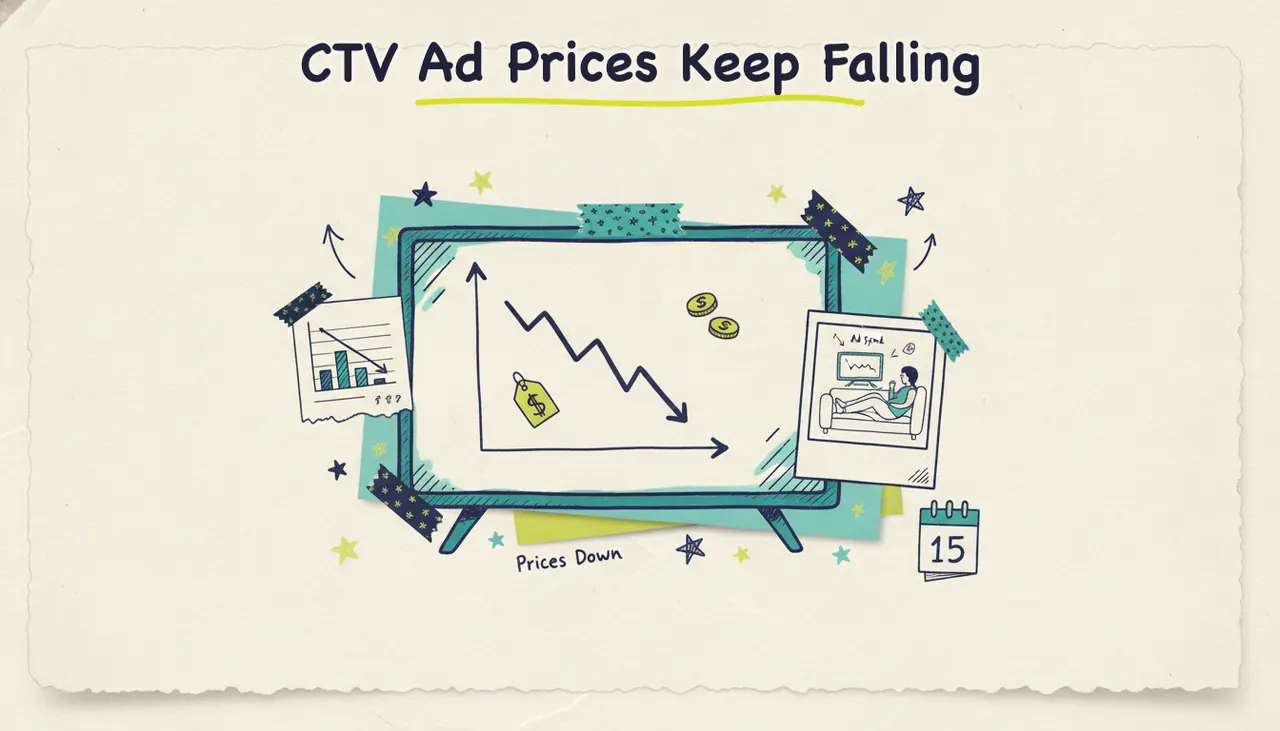
The average connected TV CPM in 2026 sits around $26 blended across the market, with most campaigns landing in the $25 to $35 range and the broader market spanning roughly $15 to $45 depending on the inventory. CPM, cost per thousand impressions, is the core price of TV advertising, and here's the good news for a small business: it's falling. A flood of new streaming ad inventory has pushed connected TV prices down over the past two years, which means your ad dollar now buys more impressions than it did.
For a local business, understanding CTV CPM is the key to budgeting a TV campaign. At a $25 CPM, a $500 budget buys about 20,000 impressions. That's the math that turned TV advertising from a Fortune 500 luxury into something a corner shop can run. Let's break down what CTV CPMs cost in Q2 2026, why they're dropping, and how to think about your budget.
What the data shows
CPM is simply what an advertiser pays for a thousand ad impressions. If a CPM is $25, then 1,000 people seeing your ad costs $25, and reaching 100,000 people costs $2,500. It's the fundamental unit of TV ad pricing, and for connected TV in 2026, the numbers look like this:
Blended average: roughly $26 per thousand impressions across the market
Typical working range: $25 to $35 for most campaigns
Full market range: about $15 to $45, depending on the inventory and targeting
Standard programmatic inventory: settling around $20 to $25
One thing to state clearly up front: CTV CPM figures are benchmarks, not fixed rate cards. Actual prices vary by platform, content, targeting, and how you buy, and different sources cite slightly different numbers. The ranges here come from industry benchmark data and reflect where the market sits, not a guaranteed price. What's consistent across every source is the direction: CTV CPMs have been coming down. Our TV advertising CPM by platform breakdown goes deeper on the platform-by-platform detail.
That downward trend is the headline for small advertisers. As recently as two years ago, premium connected TV inventory often ran $35 to $50. Today the blended average is closer to $26, and standard inventory can be found under $25. More supply has made connected TV cheaper to buy.
Breaking down the numbers
Not all connected TV inventory costs the same. CPMs vary widely by the type of content and how precisely you target, so it helps to see the tiers.
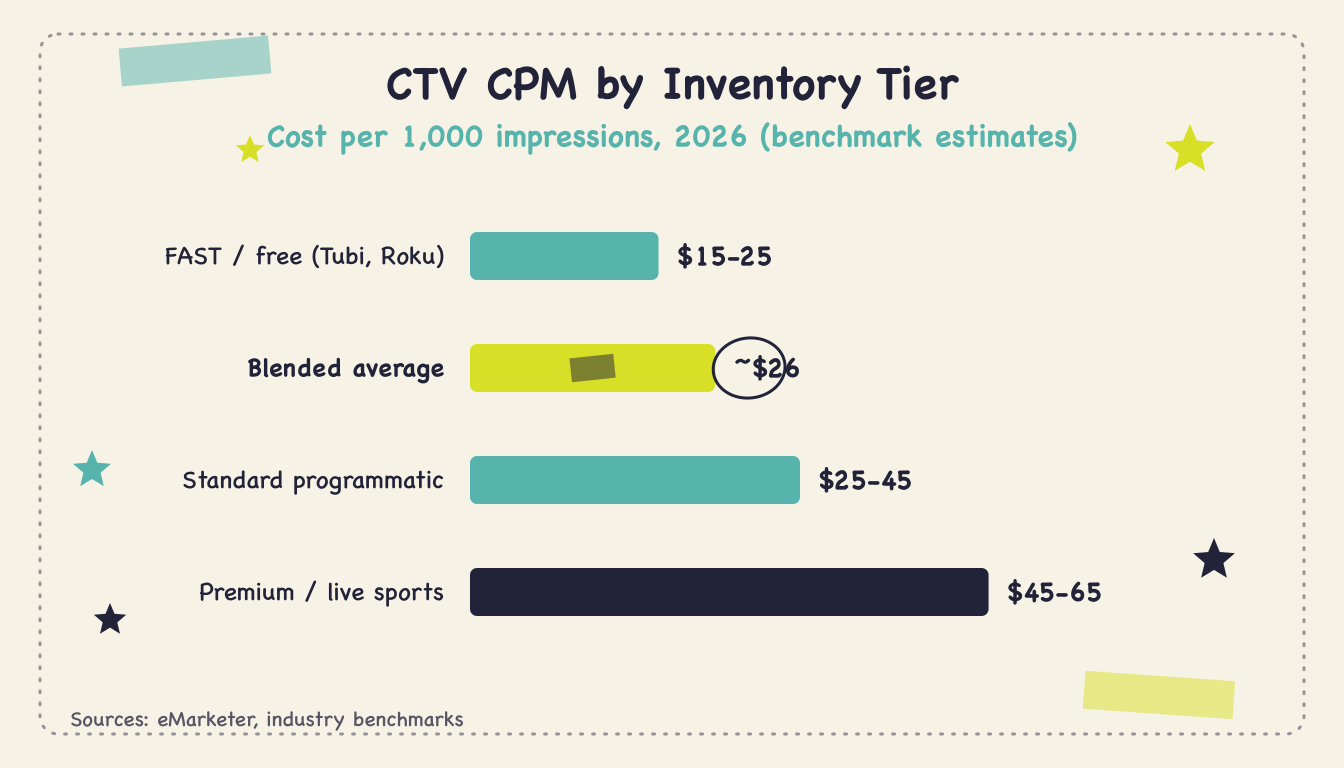
Here's roughly what different connected TV inventory costs per thousand impressions in 2026:
Free ad-supported streaming (FAST): about $15 to $25, the lowest tier, on services like Tubi, Pluto, and the Roku Channel with the largest supply
Standard programmatic on premium services: about $25 to $45, on Hulu, Peacock, Max, Paramount+, and Prime Video through open exchanges
Premium direct and live sports: about $45 to $65, for guaranteed placements and marquee sports adjacency
Addressable, first-party-targeted buys: about $45 to $85, when layering precise audience data
The pattern is intuitive. Free, broad inventory is cheapest because there's so much of it. Premium content, live sports, and precise targeting cost more because they're scarce and valuable. A rule of thumb: under $20 usually means FAST, and over $40 usually means premium or live sports. Most small-business campaigns operate in the affordable middle and lower tiers, where the price drops have been steepest. Our free ad-supported streaming share breakdown covers the low-cost FAST inventory that helps keep prices down.
For context, connected TV sits above some channels and below others. Linear broadcast and cable CPMs run around $10 to $15 for standard inventory, though premium primetime can hit $40 to $60. YouTube and social video run around $20 to $25. Connected TV is priced above linear and social video because it combines full-screen, non-skippable video with household-level targeting that linear can't match, but it's cheaper than it was because supply has exploded.
Why CTV CPMs are falling
The most important trend in connected TV pricing is that it's coming down, and understanding why tells you where the opportunity is.
The drop is driven by a simple economic force: supply has grown faster than demand. A few developments flooded the market with new ad inventory:
Amazon Prime Video made ads the default in 2024, adding an estimated 50 billion new ad impressions almost overnight, and its CPMs slid from around $35 to $28 in a year.
Netflix, Disney+, and others launched ad tiers, each adding large new pools of premium inventory.
Free ad-supported streaming exploded, with services like Tubi and the Roku Channel adding enormous amounts of low-cost inventory.
The result, per industry buyers, was CTV CPMs falling anywhere from 10% to 30% year over year through mid-2025, a genuine price correction. One media agency described it plainly: supply is growing much faster than demand, so the CTV marketplace is going through a price correction. In 2026, prices are stabilizing, but with sharper segmentation: standard inventory stays cheap around $20 to $25, while premium and targeted inventory holds its value at $40 to $60. Our connected TV advertising market page covers the broader market dynamics.
For a small business, falling CPMs are a straightforward tailwind. The same budget buys more impressions than it did a year ago, and the accessible tiers, exactly where a local advertiser plays, got cheaper fastest.
Beyond CPM: the cost that matters
CPM tells you the price of reach, but it's not the whole story. A smart advertiser looks past the headline CPM to the total cost of getting a result, and that reframe changes how you evaluate a connected TV buy.
A few reasons the lowest CPM isn't automatically the best deal:
Fees and minimums add up. Some platforms quote a low media CPM but layer on platform fees, data fees, and account minimums. The all-in cost to run a campaign can be much higher than the advertised CPM suggests, so compare total cost, not just the sticker number.
Targeting changes the value. A $15 impression shown to someone outside your service area is worth less than a $30 impression shown to a likely customer nearby. The cost per useful impression matters more than the cost per impression.
Creative is a hidden cost. Traditional TV meant paying thousands for ad production before you bought a single impression. If a platform includes ad creation, that's real money saved on top of the media cost.
Outcomes are the real goal. Ultimately you care about calls, visits, and sales, not impressions. A slightly higher CPM that drives measurable results beats a cheap one that doesn't.
For a small business, this is why an all-in platform can be more economical than chasing the lowest CPM. When ad creation is free, there are no hidden fees, and the minimum is low, the effective cost of reaching your audience can be lower than a bargain CPM plus a stack of add-on charges. Read CPM as one input into the total cost of a result, not the whole equation.
Why it matters for your business
CPM isn't an abstract industry metric, it's the number that tells you exactly what your budget buys. Once you understand it, you can plan a connected TV campaign with confidence.
Here's how CPM translates to a real small-business budget at a $25 CPM:
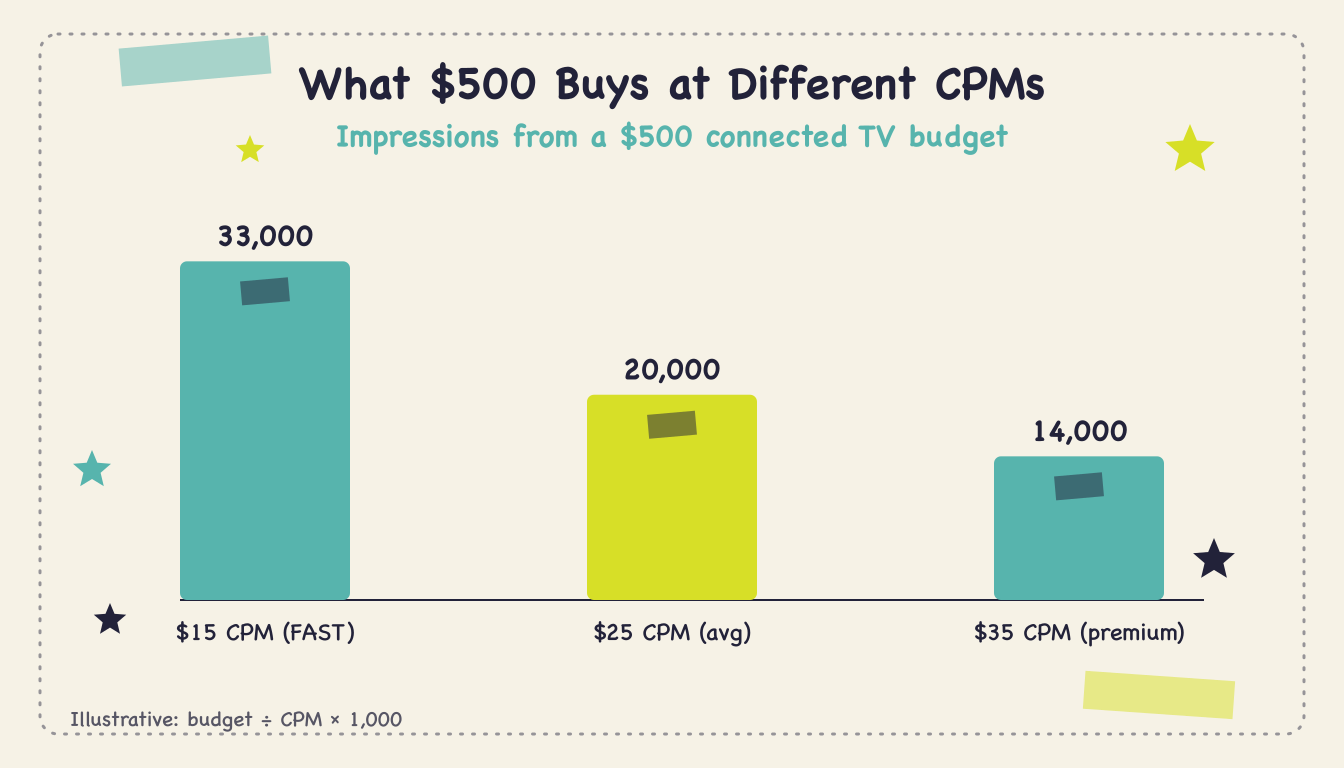
$500 buys about 20,000 impressions
$1,000 buys about 40,000 impressions
$2,000 buys about 80,000 impressions
The math is simple: divide your budget by the CPM, then multiply by 1,000. At a lower FAST CPM of $15, that $500 stretches to about 33,000 impressions. At a premium $35 CPM, it's about 14,000. That flexibility is the point: you can dial your reach up or down by choosing your inventory tier, and falling prices mean every tier got more affordable.
This is why connected TV works for small budgets in a way traditional TV never did. A local business doesn't need to buy a whole market or commit to a national upfront. You buy impressions at a transparent CPM, targeted to your service area, and you can start small and scale. The difference between connected TV and the old TV model isn't just technology, it's that connected TV advertising is priced and bought like digital, in impressions you can afford, rather than in gross rating points you can't.
How to take advantage
Understanding CPM is useful. Using it to plan a smart campaign is where it pays off. Here's how a small business should think about connected TV CPM.
Start with impressions, not dollars. Decide how many people you want to reach and how often, then use the CPM to work out the budget. Reaching 20,000 households a few times might need a few hundred dollars.
Match the tier to your goal. For broad, affordable reach, lean toward FAST and standard inventory in the $15 to $25 range. For precise targeting or premium content, expect to pay more.
Budget for frequency. A single impression rarely moves anyone. Plan enough impressions to reach the same households several times over two to three weeks.
Don't overpay for reach you don't need. Falling CPMs mean you can get real reach affordably. You don't need the most expensive premium inventory to run an effective local campaign.
Let the platform simplify the buy. You don't need to navigate programmatic exchanges yourself. A platform can handle the buying and optimization for you.
The mechanics are simple. With Adwave, ad creation is free, a campaign starts at a $50 minimum, and the CPM runs roughly $15 to $35 with an average around $25, squarely in the mainstream market. You point it at your website, it builds the spot, and your budget converts to targeted impressions across 100+ premium channels. For how these costs compare across formats, our guide to streaming TV ad costs lays out the full picture.
The bigger picture
The story of CTV CPMs in 2026 is a rare one in advertising: prices are falling while the market grows, and that combination is exactly what makes connected TV so accessible.
A few forces give the numbers their weight:
Falling prices, rising spend. Even as CPMs drop, total connected TV ad spending is climbing toward $38 billion in 2026. Advertisers are buying more impressions, not paying more per impression, which is the signature of a maturing, accessible market.
Quality segmentation is here. The market is splitting into cheap, abundant standard inventory and premium, higher-priced targeted inventory. For small businesses, the cheap, abundant side is a gift, plenty of affordable reach.
CTV is still a premium environment. Even at lower CPMs, connected TV delivers full-screen, non-skippable, high-completion video on the biggest screen in the house. You're getting premium placement at prices that keep coming down.
There's a historical irony worth appreciating here. For most of television's history, the price of a TV ad only went one direction: up. Each year the biggest events cost more, the networks raised their rates, and small businesses were priced further out. Connected TV inverted that. As streaming added inventory and the buying went digital, the unit price of reach started falling, and it has kept falling. It's one of the few places in advertising where a small business's dollar buys more this year than last. That inversion, driven by abundant supply and digital-style buying, is precisely what democratized TV advertising.
For small businesses, the throughline is that connected TV keeps getting cheaper to reach real audiences. The falling CPM is the clearest sign that TV advertising has opened up. What used to cost $35 to $50 for premium reach now blends closer to $26, and the accessible tiers are cheaper still. The barrier to advertising on the biggest screen in the house keeps dropping.
What experts are saying
Ad-industry analysts describe the current CTV pricing environment as a supply-driven correction. The launch of Amazon Prime Video's ad tier, followed by Netflix, Disney+, and a wave of FAST services, added far more inventory than advertiser demand could immediately absorb, and prices fell as a result. Media buyers reported CPM declines of 10% to 30% through 2025, and eMarketer projected that by mid-2025 only a couple of premium services would average above $30.
The consensus for 2026 is stabilization with segmentation. Standard inventory has found a floor around $20 to $25, while premium, curated, and targeted inventory holds its value, with curated private marketplaces even commanding a premium over the open exchange. The broader read is that CTV advertising isn't about cheap reach anymore so much as measurable outcomes, but for a small business, the practical takeaway is simpler and encouraging: connected TV costs less to buy than it did, the affordable tiers deliver real reach, and the falling CPM means a modest budget goes further every quarter. The price of getting on the big screen keeps coming down.
What the numbers don't tell you
CPM benchmarks are useful, but read them with a few caveats.
They're estimates, not rate cards. CTV CPMs vary by platform, content, targeting, and buy type. The ranges here are directional benchmarks from industry sources, and your actual price will depend on your specific campaign.
Lower CPM isn't always better. A cheap impression on the wrong audience is worse than a slightly pricier one on the right audience. Targeting and content quality matter, not just the unit price.
CPM is only part of the cost. Some platforms add fees or minimums on top of media cost. What matters is the total cost to reach your audience effectively, which is why an all-in platform with free ad creation can be more economical than a low headline CPM plus fees.
Frequency matters more than a single impression. A low CPM lets you buy more impressions, but reach without enough frequency rarely works. Plan to reach the same households multiple times.
Read the CPM data as a green light: connected TV is affordable and getting more so, and understanding the CPM is the key to planning a campaign that fits a small-business budget.
Common questions answered
What is the average CTV CPM in 2026? The blended average connected TV CPM is around $26 per thousand impressions, with most campaigns in the $25 to $35 range and the full market spanning roughly $15 to $45. These are benchmark estimates that vary by platform, content, and targeting. The trend has been downward as more streaming ad inventory has entered the market.
Why are CTV CPMs falling? Supply has grown faster than demand. Amazon Prime Video's default ad tier added an estimated 50 billion impressions in 2024, and Netflix, Disney+, and free services like Tubi added more. That flood of inventory pushed CPMs down 10% to 30% through 2025, a price correction that makes connected TV cheaper for advertisers.
How many impressions does my budget buy? Divide your budget by the CPM and multiply by 1,000. At a $25 CPM, $500 buys about 20,000 impressions, $1,000 buys about 40,000, and $2,000 buys about 80,000. At a lower FAST CPM of $15, your dollar stretches further; at a premium $35 CPM, it buys fewer but more targeted impressions.
Is CTV cheaper than regular TV advertising? On a pure CPM basis, standard linear TV can be cheaper, around $10 to $15, but it can't target the way connected TV can, and premium primetime linear runs $40 to $60. Connected TV's value is targeted, measurable reach on the big screen, and its falling CPMs have narrowed the price gap considerably.
How much does it cost to start advertising on CTV? Less than most people expect. With Adwave, ad creation is free and a campaign starts at a $50 minimum, with a CPM of roughly $15 to $35 (average around $25). That puts real connected TV reach in range of a small-business budget, no national commitment required.
The numbers at a glance
Key CTV CPM figures for Q2 2026, with sources (all benchmark estimates):
~$26: blended average U.S. connected TV CPM in 2026 (eMarketer)
$25 to $35: typical working range for most campaigns (industry benchmarks)
$15 to $25: FAST and broad AVOD inventory, the lowest tier (benchmarks)
$45 to $65: premium direct and live-sports inventory (benchmarks)
10% to 30%: year-over-year CTV CPM declines reported through mid-2025 (Digiday, media buyers)
$35 to $28: how Amazon Prime Video's CPM fell in the year after its 2024 ad launch (eMarketer)
20,000: impressions a $500 budget buys at a $25 CPM
~$38 billion: projected U.S. CTV ad spend in 2026, rising even as CPMs fall (eMarketer)
Reach real audiences affordably, starting at $50
The average connected TV CPM is around $26 in 2026 and falling, which means your ad dollar buys more impressions than it did a year ago. At a $25 CPM, a $500 budget reaches 20,000 impressions, the kind of math that makes TV advertising work for a small business.
You don't need a big budget to advertise on connected TV. See how Adwave works to turn your website into a broadcast-quality 30-second ad in minutes, or check pricing to launch a campaign from a $50 minimum with a CPM around $25. The price of the big screen keeps coming down. It's a good time to get on it.